
What if a single sentence in your latest consulting report cost your client thousands of dollars and led to a massive legal bill? Many entrepreneurs in the GTA feel confident because they have a standard business policy, but they often don't realize that "slipping and falling" coverage won't protect them against a claim of professional negligence. Obtaining the right professional liability insurance for small business is about more than just checking a box; it's about securing your reputation when a client claims your advice caused them financial harm.
We know that trying to distinguish between Errors and Omissions (E&O) and Commercial General Liability can feel like learning a second language. You want to focus on growing your business in Markham or Toronto, not worrying about whether a simple mistake will result in a lawsuit you can't afford. This guide provides the clarity you need to ensure your Ontario small business is fully protected from every angle.
We'll break down the critical differences between these coverage types, highlight which industries in Ontario have mandatory requirements, and show you how to compare broker options to find a solution that fits your specific needs.
Key Takeaways
- Learn the "Physical vs. Financial" divide to see why most Ontario service providers need both professional and general liability coverage.
- Identify if your industry, such as IT consulting or marketing, requires specific professional liability insurance for small business to protect against claims of negligence.
- Understand how "claims-made" policies and retroactive dates work so your business isn't left vulnerable to past mistakes.
- Discover the benefits of using a local broker to compare options from multiple Ontario-licensed insurers through one platform.
What is Professional Liability Insurance for Small Business?
Professional liability insurance is a specialized form of coverage designed for businesses that provide services or advice. In the Ontario market, you'll often hear it referred to as Errors and Omissions (E&O) insurance. While the names differ, the goal is the same: protecting your livelihood from the financial fallout of a professional mistake. It's distinct from standard business insurance because it focuses on the quality of your work rather than physical accidents.
Choosing professional liability insurance for small business is a proactive step for anyone whose work relies on their expertise. It doesn't just cover being wrong. It addresses claims of negligence, misrepresentation, or inaccurate advice that leads to a client's financial loss. If a client in the GTA sues you because they believe your work didn't meet industry standards, this policy is what steps in to help. It's about ensuring that a professional disagreement doesn't turn into a financial catastrophe for your company.
One of the most valuable aspects of this coverage is the legal defense. Lawsuits in Ontario can be incredibly expensive, even if they're groundless. If you're hit with a meritless claim, your policy typically covers the legal fees and court costs required to clear your name. This ensures that a single disgruntled client doesn't drain your company's bank account before you even get to trial. It provides peace of mind, allowing you to focus on your clients instead of worrying about potential litigation.
Why "Expertise" Needs Its Own Protection
Standard business insurance usually focuses on physical accidents. If a customer trips over a rug in your Markham office, that's a general liability issue. However, if that same customer loses money because of a flawed financial plan or a coding error you made, your physical insurance won't help. Errors and Omissions acts as the shield for a professional's specialized knowledge. Ontario has high professional standards, and clients expect a specific level of care. When that expectation isn't met, or is perceived as not being met, your expertise needs its own dedicated layer of security.
Common Risks Covered by PLI
While every policy varies by insurer and individual circumstances, most professional liability insurance for small business covers several core risks:
- Negligence: Failing to provide the standard of care expected in your specific industry.
- Misleading Advice: Giving guidance that results in a client suffering a measurable financial loss.
- Breach of Contract: Failing to deliver the professional services promised in a signed agreement.
- Errors in Delivery: Simple mistakes in a report, design, or calculation that have costly consequences.
These risks are common for everyone from IT consultants in Vaughan to marketing agencies in Toronto. Having this protection in place means you can give advice with confidence, knowing you have a safety net if things don't go exactly as planned.
Professional Liability vs. General Liability: The Comparison
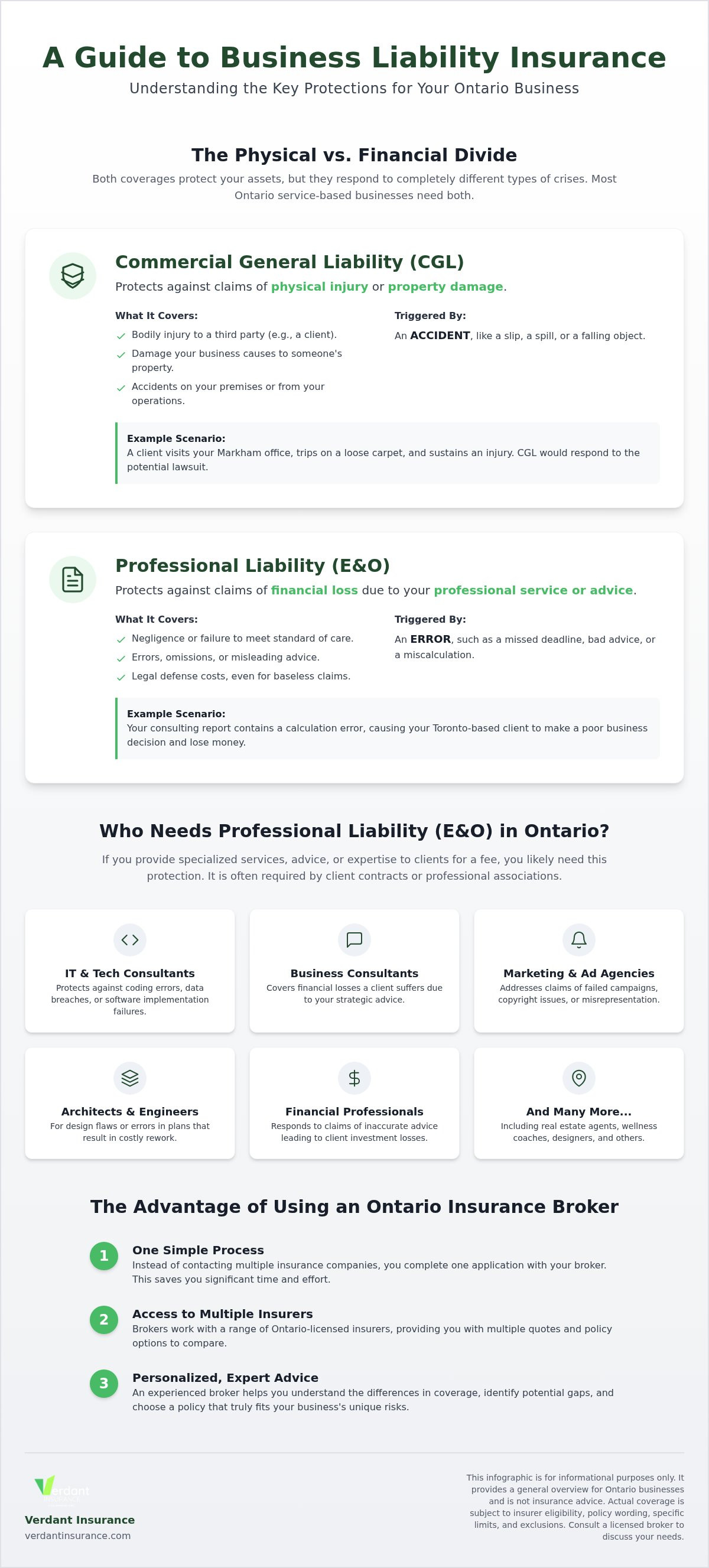
Understanding the difference between these two coverages is best viewed as the "Physical vs. Financial" divide. While they both protect your assets, they respond to completely different crises. Most businesses in the GTA require a combination of both to achieve full protection. Commercial General Liability (CGL) is frequently a mandatory requirement for commercial leases in shopping centres or office towers. On the other hand, professional liability insurance for small business is often demanded by clients through service contracts or by professional regulatory bodies in Ontario.
Commercial General Liability (CGL) Explained
CGL is the foundation of most business policies. It focuses on "slip and fall" scenarios and tangible property damage. For example, if a client visits your Markham-based office and trips on a loose piece of carpeting, CGL handles the resulting bodily injury claim. It protects you against accidents that happen on your premises or as a result of your physical operations. It doesn't matter how good your advice is if a visitor gets hurt in your workspace. This coverage ensures that a physical mishap doesn't lead to a devastating lawsuit.
The Key Differences at a Glance
To simplify the comparison, look at the triggers and outcomes of each policy. This framework helps you see where one ends and the other begins:
- Trigger: CGL is triggered by an accident, such as a spill or a falling sign. PLI is triggered by an error, such as a calculation mistake or a missed deadline.
- Outcome: CGL addresses physical harm or property damage. PLI addresses financial loss or economic damages.
- Focus: CGL focuses on your premises and physical presence. PLI focuses on your professional performance and advice.
A consultant or service provider needs business insurance for consultants Canada because CGL alone leaves their expertise exposed. When you explore Professional Liability Insurance Options, it becomes clear that these two policies work in tandem. One protects the "where" of your business, while the other protects the "what."
It's vital to remember that neither policy covers intentional misconduct, fraud, or criminal acts. These are standard exclusions across the industry. Additionally, eligibility for these coverages and the specific premiums you'll pay vary significantly by insurer and your specific business risk profile. If you're looking to balance these costs while ensuring you're covered, comparing quotes through an Ontario broker is a smart way to see your options and find the right fit for your budget.
Who Needs Professional Liability Coverage in Ontario?
In Ontario, the pool of businesses requiring this protection is expanding rapidly. Traditionally, professional liability insurance for small business was associated with regulated fields like accounting, law, and engineering. For these practitioners, carrying Errors and Omissions (E&O) isn't just a choice; it's often a licensing requirement set by provincial bodies such as CPA Ontario or Professional Engineers Ontario (PEO). However, the modern GTA economy is built on specialized services, making this coverage essential for a much wider range of entrepreneurs who provide advice or digital solutions.
Modern service providers often face risks that aren't immediately obvious. A marketing agency in Toronto might face a claim for copyright infringement or a failed campaign that didn't deliver promised results. A project manager in Vaughan could be sued if a delay in their oversight leads to a client's lost revenue. If your business provides any of the following, you likely need a professional liability policy:
- IT Consultants and Software Developers: Protecting against coding errors or system failures.
- Marketing and Advertising Agencies: Covering claims of libel, slander, or failed performance.
- Management and Project Consultants: Safeguarding against advice that leads to financial loss.
- Healthcare and Wellness Consultants: Addressing claims related to specialized professional guidance.
The Consultant’s Perspective
Specialized advice carries higher risk in the GTA's competitive market. Consider an IT consultant based in Richmond Hill who makes a minor coding error during a routine system update for a client. If that error causes the client's entire e-commerce platform to crash for 48 hours, the consultant could be held liable for the resulting loss of income and data recovery costs. Professional liability insurance is designed to cover these business interruption claims. It allows the consultant to maintain their professional reputation while the insurer handles the financial negotiations and legal defense.
E-commerce and Digital Service Providers
As more businesses move online, the line between product and service blurs. There is a rising need for business insurance for e-commerce Canada when you provide digital services, SaaS platforms, or specialized online consulting. A digital error, such as a faulty algorithm or a misconfigured data permissions setting, can lead to massive financial claims from users. It's vital to compare different insurer wordings, as some policies handle cyber-related professional errors differently than others. For a broader view of how these pieces fit into your overall risk strategy, you can refer to our Business Insurance Canada Pillar guide. Each insurer has unique eligibility requirements, so checking with a broker is the best way to ensure your specific digital niche is covered.
What to Look for When Comparing PLI Policies
Evaluating professional liability insurance for small business requires a look beyond the annual premium. Most of these policies in the Ontario market are written on a "claims-made" basis. This means the policy must be active both when the alleged mistake happened and when the claim is officially filed. If you cancel your policy or let it lapse, you could lose coverage for work you completed months ago. This is why maintaining continuous coverage is vital for long-term security for professionals in the GTA.
Your retroactive date is another critical detail. This is the specific date from which your insurer agrees to cover your professional acts. If you performed work before this date and a claim arises later, your policy won't respond. When you're comparing options, always check if a new insurer will honor your original retroactive date. It's also important to understand the "Duty to Defend" clause. In a duty to defend policy, the insurer takes control of your legal defense, hiring lawyers and managing the process. This is often preferred by small firms who don't have the resources to manage complex litigation themselves.
Deductibles and limits also play a major role in your costs. A higher deductible typically lowers your annual premium, but it means you'll pay more out of pocket if a claim occurs. Limits are the maximum amount the insurer will pay for a single claim or over the policy year. Because these factors vary by insurer and individual circumstances, it's helpful to see how different structures impact your bottom line.
Defining Your Coverage Limits
Your coverage limits should reflect the potential financial scale of a client's loss. If you're a consultant in Markham handling contracts worth $500,000, a $1 million limit might be the minimum you should consider. Many Ontario small businesses assess their largest contract value to determine their needs. However, keep in mind that professional liability insurance for small business limits are subject to insurer underwriting requirements and your specific industry risk. Higher limits provide more protection but will increase your annual premium.
Speak with a Verdant broker to compare professional liability options today
Policy Exclusions to Watch For
Actual coverage is always subject to the specific policy wording of the insurer. It's essential to watch for common exclusions that could leave you vulnerable. While every policy is different, most insurers exclude the following:
- Intentional Acts: Dishonest, fraudulent, or criminal acts aren't covered.
- Prior Knowledge: Claims resulting from errors you were aware of before the policy started.
- Bodily Injury: This is typically the domain of general liability, not professional liability.
- Cost Estimates: Guarantees or warranties regarding the cost of a project.
Reading the fine print with an Ontario broker is essential to ensure you don't have hidden gaps. Because eligibility and exclusions vary by insurer, having an expert eye on your policy documents can prevent a surprise denial. A broker can help you navigate these nuances to find a policy that balances cost with comprehensive protection.
The Advantage of Using an Ontario Insurance Broker
Choosing the right professional liability insurance for small business can feel like a heavy lift when you're managing it on your own. This is where the value of an Ontario insurance broker becomes clear. Unlike a direct insurance company that only offers its own products, Verdant works for you. We act as your advocate and guide, looking across the market to find the coverage that actually fits your operations. We don't just sell policies; we build relationships based on trust and clarity.
Our brokerage model provides several key benefits for your peace of mind:
- Choice: You can compare options from multiple Ontario-licensed insurers through a single platform.
- Local Expertise: Our team in Markham understands the specific risks faced by firms in the York Region and the GTA.
- Advocacy: We stand by your side during complicated claims, helping you navigate the process with the insurer.
- Efficiency: You save time by letting us do the heavy lifting of comparing wordings and eligibility.
Being a local Markham insurance broker means we know the landscape you work in every day. We understand the high standards of Toronto's financial core and the tech-focused needs of the surrounding regions. If a client in the GTA has a specific insurance requirement in their contract, we know how to find the policy that satisfies those terms. This local perspective ensures your protection isn't just generic; it's relevant to your community.
Customizing Your Small Business Protection
Every business is unique, and your protection should be too. We help you tailor your policy to your specific industry requirements and budget constraints. You can manage your coverage through our easy online platform, but you'll always have access to a human expert when you have questions. We also provide integrated solutions across Business Insurance, auto, and home lines. This holistic approach ensures there aren't gaps between your professional and personal protection, giving you a unified safety net.
Next Steps for Your Ontario Business
Ready to secure your expertise? Start by gathering your current contract details and any existing policy documents you might have. These details help us understand the specific limits your clients require and the retroactive dates we need to protect. Once you have your information ready, reach out to a Verdant broker for a personalized assessment. We'll help you demystify the fine print and find a solution that lets you focus on what you do best.
Protecting your business shouldn't be a source of stress. With the right coverage in place, you gain the confidence to focus on growth and innovation. Let's work together to ensure your Ontario small business is fully protected for the years ahead, allowing you to build your reputation on a solid foundation of security.
Secure Your Professional Reputation Today
Securing the right coverage means you can focus on providing top-tier service without the constant fear of a clerical error or a misunderstood piece of advice turning into a legal nightmare. You now understand that professional liability insurance for small business is the essential partner to your general liability policy, protecting your financial assets just as CGL protects your physical ones. By paying attention to retroactive dates and choosing a broker who advocates for your specific needs, you're building a more resilient company.
Our team of Ontario-based experts in Markham is ready to help consultants, e-commerce owners, and service providers across the GTA. We provide access to multiple leading Canadian insurance partners so you can see the options available for your unique situation.
You've worked hard to build your expertise. It's time to ensure it's protected so you can keep growing with confidence.
Frequently Asked Questions
Is professional liability insurance mandatory for small businesses in Ontario?
Professional liability insurance is mandatory for certain regulated professions in Ontario, such as lawyers, architects, and real estate brokers. Organizations like the Law Society of Ontario or the Ontario Association of Architects enforce these requirements. For unregulated service providers, the coverage is optional. However, many clients in the GTA require proof of insurance before signing a contract. It's a key part of professional liability insurance for small business for those providing specialized advice.
How much does professional liability insurance cost for a small business?
The cost of your policy depends on your specific industry, annual revenue, and previous claims history. Because every business faces different risks, premiums vary by insurer and individual circumstances. For example, an IT consultant might pay a different rate than a management consultant. To find an accurate price, you should compare options from multiple Ontario licensed insurers through a broker. This ensures you aren't overpaying for the protection your business needs.
What is the difference between E&O and professional liability?
Errors and Omissions (E&O) and professional liability insurance are different names for the same type of coverage. Both protect your business against claims of negligence, mistakes, or failing to deliver a promised service. In Ontario, the term E&O is very common among consultants and tech firms, while professional liability is often used by traditional professions like engineers or accountants. Regardless of the label, the core protection remains focused on your professional performance and advice.
Does professional liability insurance cover my employees?
Most professional liability policies naturally extend coverage to your employees while they are performing work on behalf of your business. This is crucial because a mistake made by a staff member can lead to a lawsuit against the company. It's important to review your specific policy wording to ensure all contractors or temporary staff are also included. Actual coverage is always subject to insurer eligibility and the specific limits defined in your policy documents.
Can I cancel my professional liability insurance if I close my business?
You can cancel your policy if you close your business, but doing so might leave you unprotected for past work. Since most professional liability insurance for small business is claims-made, the policy must be active when a claim is filed. If a client sues you next year for work you did today, a cancelled policy won't respond. You may want to consider run-off coverage, which provides protection for a set period after your business stops operating.
What happens if a claim is made for work I did years ago?
Whether a claim for old work is covered depends on your policy's retroactive date. If the work was performed after this date and you've maintained continuous coverage, the insurer should handle the claim. If you changed insurers or had a gap in coverage, you might face a denial. This is why it's vital to check your policy documents or speak with a broker to confirm how your specific retroactive date applies to previous projects in the York Region.
Do I need professional liability if I have a solid contract with my clients?
A solid contract is a great first line of defense, but it doesn't prevent a client from filing a lawsuit. Legal battles in Ontario are expensive even if you win and the contract eventually protects you. Professional liability insurance provides the funds for your legal defense and covers settlements if a court finds a gap in your contract's protection. It acts as a safety net that ensures a legal dispute doesn't exhaust your company's financial resources.
How do I get a professional liability insurance quote in Ontario?
Getting a quote is a straightforward process when you work with an Ontario broker. You'll need to provide details about your business operations, your annual revenue, and the types of contracts you typically sign. At Verdant, we use this information to compare options from several leading insurance partners. This allows you to see different price points and coverage levels in one place, making it easy to choose the right fit for your budget and industry.