

The lowest car insurance quote on your screen might actually be the most expensive policy you could buy. When two neighbours driving identical vehicles receive vastly different rates, it's easy to assume someone is getting overcharged. In reality, learning how to compare car insurance quotes in Ontario isn't about chasing the smallest premium. True comparison means matching liability limits, deductibles, and endorsements line by line so you don't discover coverage gaps after a collision.
You shouldn't have to wrestle with automated online aggregators or worry that a lower price tag quietly stripped away vital accident benefits. This guide walks you through the step-by-step process of comparing Ontario auto insurance quotes to secure dependable, tailored protection. We'll show you how to evaluate policies apples-to-apples, uncover legitimate discounts without sacrificing security, and work with a licensed local broker to ensure your coverage fits your life.
Key Takeaways
- All Ontario auto policies start with the standard OAP 1 contract, meaning true differences lie in specific limits, deductibles, and optional protections.
- Mastering how to compare car insurance quotes in Ontario requires entering identical driver details, annual mileage, and coverage options across every quote.
- A substantially lower rate often indicates missing endorsements or reduced accident benefits rather than genuine premium savings.
- Regional factors, vehicle repair trends, and FSRA-approved rating algorithms explain why quotes fluctuate significantly across the GTA and Ontario.
- Partnering with an independent Ontario insurance broker lets you compare options across multiple carriers rather than relying on a direct insurer's single product line.
Understanding the Standard Ontario Automobile Policy (OAP 1)
To understand how to compare car insurance quotes in Ontario, you first need to know that every licensed carrier starts from the exact same rulebook. All private passenger vehicles in the province are insured under the standardized Ontario Automobile Policy (OAP 1). Regulated and approved by the Financial Services Regulatory Authority of Ontario (FSRA), this framework guarantees that core policy wording and legal definitions remain identical from one insurer to another. The price gaps you see on paper stem from how different carriers assess risk, establish deductibles, and apply endorsements.
Mandatory Coverages Required by Ontario Law
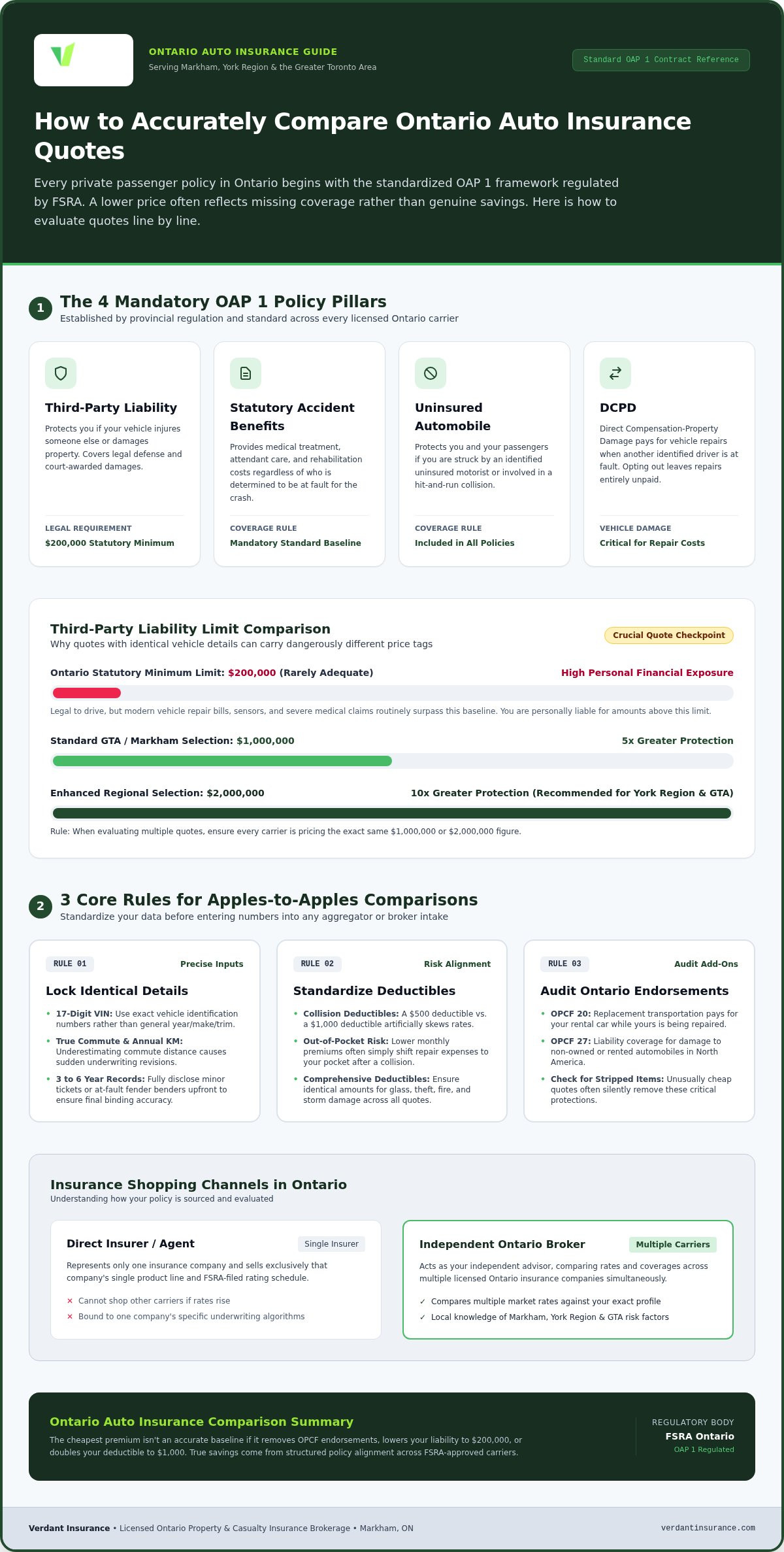
Every legitimate auto quote you review includes four baseline pillars established by provincial regulations:
- Third-Party Liability: Protects you if your vehicle injures someone else or damages property, covering legal defense and court awards.
- Statutory Accident Benefits (SABS): Pays for medical treatment, attendant care, and rehabilitation costs regardless of who caused the collision.
- Uninsured Automobile Coverage: Protects you and your passengers if you are struck by an uninsured driver or a hit-and-run motorist.
- Direct Compensation-Property Damage (DCPD): Covers damage to your own vehicle when another identified driver is at fault for the crash. Ontario drivers can technically opt out of DCPD, but dropping it means your insurer pays nothing for vehicle damage in a not-at-fault accident.
Why Minimum Legal Limits Are Rarely Adequate
Ontario law sets the absolute minimum Third-Party Liability limit at $200,000. While driving with that figure keeps you street-legal, relying on it creates severe financial exposure. Modern vehicle repair bills, advanced sensor replacements, and serious medical claims routinely exceed basic provincial baselines. If a claim surpasses your coverage limit, you become personally responsible for the difference, which can put your home and life savings at direct risk.
Most motorists across Toronto, Markham, and York Region choose liability limits of $1,000,000 or $2,000,000. When discovering how to compare car insurance quotes in Ontario effectively, always ensure each insurer is pricing the exact same liability limit. A quote that appears surprisingly cheap usually turns out to be a bare-minimum policy that cuts corners on real-world protection.
5 Steps to Compare Car Insurance Quotes Accurately
Automated online rate tools often promise instant answers in minutes. The trouble is, an algorithm is only as dependable as the numbers you feed into it. Learning how to compare car insurance quotes in Ontario requires absolute precision from the start. Small discrepancies in commute distance, driving records, or policy selections can invalidate your results. Follow these concrete steps to ensure your comparisons reflect real, binding protection.
Step 1: Gather Accurate Driver and Vehicle Details
Insurers price policies using strict risk variables. Before requesting rates, assemble your exact information:
- Driver details: Have your Ontario driver's licence number ready, along with the precise licensing dates for all household drivers.
- Vehicle data: Use your 17-digit Vehicle Identification Number (VIN) rather than just the year and trim.
- Mileage realities: Calculate your true one-way daily commute to the office and your total annual kilometres. Underestimating mileage leads to sudden rate revisions later.
- Driving history: Disclose any minor convictions or at-fault fender benders within the last three to six years upfront to avoid surprise rate jumps during final underwriting.
Step 2: Align Coverages, Limits, and Deductibles
True comparison demands identical inputs across every carrier platform. If one estimate uses a $500 collision deductible while another assumes $1,000, the lower monthly figure isn't saving you money; it is simply shifting more financial risk to your pocket after a crash. Lock in identical numbers for:
- Third-Party Liability limits ($1,000,000 or $2,000,000 across the board).
- Collision and Comprehensive deductibles.
- Statutory Accident Benefits choices, ensuring increased or optional benefit selections match on every form.
Step 3: Audit Policy Endorsements and Payment Terms
A lower premium often means key protections were omitted. Examine whether each quote includes common Ontario Policy Change Forms, such as OPCF 20 for replacement transportation or OPCF 27 for rental vehicles. Next, compare the actual annual cost against monthly installments. Direct carriers and insurance companies frequently attach administrative financing fees to monthly payment schedules, making the annual total higher than advertised.
Before making a commitment, check regulatory standards through the Financial Services Regulatory Authority of Ontario to ensure your rights are protected. If you want to review side-by-side carrier proposals without doing all the administrative legwork yourself, speaking with a dedicated broker can help you evaluate every detail. Knowing how to compare car insurance quotes in Ontario with professional oversight ensures you secure dependable protection tailored to your daily drive.
Key Factors That Influence Ontario Auto Insurance Quotes
Two drivers with spotless driving records can review identical vehicle models and still receive completely different premiums. That discrepancy happens because private carriers use proprietary, actuarial rating algorithms approved by the provincial regulator. When exploring how to compare car insurance quotes in Ontario, you must consider the specific variables underwriting teams weigh behind the scenes to price your overall risk.
Geographic Rating Territories: GTA vs Regional Ontario
Where you park your car overnight directly influences what you pay. Dense metropolitan hubs like Toronto, Markham, and Vaughan experience heavier traffic volume, higher claim frequencies, and elevated collision statistics compared to smaller communities in Eastern or Northern Ontario. Even within York Region, moving a few blocks into a new postal code can shift your territory rate. Insurers analyze localized data, including intersection accident records, regional repair costs, and neighbourhood vehicle theft frequencies along major commuter corridors.
Vehicle Make, Model, and the CLEAR System
Insurers do not guess what a vehicle costs to protect. Instead, they rely on the Canadian Loss Experience Automobile Rating (CLEAR) system. CLEAR tracks actual claims data for every make, model, and production year across Canada, scoring vehicles on several criteria:
- Collision claims: How frequently the vehicle is involved in collisions and how expensive its body panels and structural frames are to repair.
- Comprehensive risks: How often the model is targeted for auto theft or suffers environmental damage. High-theft models often face carrier surcharges unless fitted with an approved aftermarket tracking device.
- Safety and injury severity: How effectively the vehicle's passive and active safety systems protect occupants during an impact. Modern sensor arrays reduce crash severity, but sophisticated calibration requirements can increase repair shop invoices.
Driving Records and Insurance History Continuity
Your personal driving history forms the foundation of your rating profile. Maintaining a conviction-free record and avoiding at-fault claims places you in standard preferred market tiers. Moving steadily through graduated licensing, graduating from a G2 licence to a full G class, provides documented road experience that underwriters reward with lower baseline rates.
Equally critical is insurance history continuity. Unbroken policy coverage shows carriers that you manage risk responsibly over long stretches. Reviewing the provincial guide on Understanding the Standard Ontario Automobile Policy clarifies how these rating factors fit together. Understanding these background mechanics gives you the context needed for how to compare car insurance quotes in Ontario with realistic expectations.
Comparing Policy Endorsements and Optional Coverages
Top-line premium totals rarely tell the whole story. When you evaluate multiple estimates, a lower price tag often points to omitted protections rather than genuine underwriting discounts. Understanding how to compare car insurance quotes in Ontario requires looking past the summary sheet to inspect the specific Ontario Policy Change Forms (OPCF) and optional endorsements attached to each proposal.
Essential Ontario Policy Change Forms (OPCF)
Standard OAP 1 policies exclude several everyday protections that Ontario motorists often take for granted. Insurers add these back through standardized endorsements:
- OPCF 20 (Coverage for Transportation Replacement): Pays for a rental vehicle, taxi fares, or rideshare costs while your primary car undergoes covered repairs after a collision.
- OPCF 27 (Liability for Damage to Non-Owned Automobiles): Extends your physical damage coverage to rental cars driven anywhere in Canada or the United States, sparing you high daily waiver fees at the rental counter.
- OPCF 43 (Removing Depreciation Deduction): Waives vehicle depreciation on new cars during total loss settlements for a specified timeframe, ensuring you receive the original purchase value instead of depreciated market cash value.
Collision vs Comprehensive Coverage Choices
Physical damage coverage protects your vehicle's physical equity, but it remains optional on vehicles owned outright without active leases or financing liens. Collision covers impact damage against other vehicles, street furniture, or single-vehicle rollovers. Comprehensive shields against non-collision losses such as fire, catalytic converter theft, hail, vandalism, and falling tree limbs.
Comparing policies means matching these deductibles dollar-for-dollar. For older vehicles with low cash market values, paying comprehensive and collision premiums might yield diminishing returns, as claim payouts cap at the car's pre-accident market worth.
Enhanced Statutory Accident Benefits Options
Basic statutory minimums provide a safety net, but medical recovery costs can mount quickly after serious collisions. Knowing how to compare car insurance quotes in Ontario involves checking whether proposals include optional accident benefit increases. Motorists can increase medical, rehabilitation, and attendant care limits above provincial baselines. You can also raise Income Replacement Benefits beyond the standard statutory $400 weekly baseline, which is essential if your household depends on your primary paycheck. Optional caregiver and dependant care enhancements also help protect non-earning family members if an injury prevents you from managing your household.
Insurance Broker vs Direct Insurer: How to Shop in Ontario
Deciding where to purchase your policy matters just as much as the numbers on the page. Ontario motorists generally access coverage through three distinct channels: direct-writing insurance companies, captive agents, and independent insurance brokerages. Knowing how each sales model operates helps demystify how to compare car insurance quotes in Ontario and ensures you receive objective, long-term support.
Direct Writing Carriers and Captive Agents
Direct writers sell policies straight to drivers online or via national call centres. Captive agents operate similarly, representing a single insurance company under an exclusive brand name. While both provide straightforward digital interfaces, they can only offer proprietary rates from that one insurer. If their underwriting appetite shifts or their annual rates adjust upwards, they cannot move you to an alternative carrier. To check multiple direct providers, you must repeat the entire quoting process yourself across multiple websites.
The Independent Ontario Broker Advantage
Independent insurance brokers work directly for the consumer rather than a single insurer. Licensed through the Registered Insurance Brokers of Ontario (RIBO), brokers partner with multiple leading Canadian insurance companies. A broker reviews your driving profile once, then scans their broader network to find policies that suit your specific driving habits.
Beyond initial pricing, an independent brokerage provides personalized claims advocacy. If you need to navigate a complicated claim, your broker acts as a professional intermediary between you and the insurance company adjuster. They also review your coverage at renewal, verifying that your policy continues to reflect your changing needs over time.
Choosing Your Next Step with Confidence
Consider whether you prefer purely self-directed digital transactions or ongoing professional advisory support. If you own a home, condo, or rent an apartment, pairing your auto policy with property insurance under a single carrier can unlock valuable multi-line discounts. Working with a local professional helps verify that every discount applies correctly without sacrificing essential road protection.
Drivers looking for clarity across Markham, Toronto, and the greater York Region can evaluate their options through an independent advisor. When you want to see how to compare car insurance quotes in Ontario across several reputable carriers with tailored advice, reach out to the licensed team at Verdant Insurance.
Taking Control of Your Ontario Auto Insurance Coverage
Shopping for coverage shouldn't feel like a guessing game. When you master how to compare car insurance quotes in Ontario, you look beyond the bottom-line price to verify identical liability limits, matching deductibles, and vital OPCF endorsements. Standardizing your details ensures you're evaluating genuine protection rather than hidden trade-offs that leave you vulnerable after an accident.
Navigating these policy choices is much simpler with an experienced guide by your side. Verdant Insurance is a licensed Ontario property and casualty brokerage based in Markham, offering dedicated local advisory support across York Region, Toronto, and the GTA. With access to multiple trusted Canadian insurance partners, our team reviews your driving profile across carriers to build a policy that fits your budget and lifestyle.
Taking the time to review your policy details today means you can drive with complete peace of mind tomorrow.
Frequently Asked Questions
Is it better to use an insurance broker or an online aggregator in Ontario?
Using an independent broker gives you personalized guidance and advocacy that automated aggregators cannot provide. While online aggregators generate automated ballparks, they often sell your contact information to third parties. An independent Ontario broker collects your details once, shops across multiple licensed insurance carriers, tailors endorsements to your lifestyle, and acts as your direct advocate if you ever need to file an insurance claim.
How many car insurance quotes should I compare before buying?
You should generally compare quotes from at least three to five distinct insurance carriers to get an accurate market baseline. Because private insurers in Ontario utilize unique risk algorithms, premiums can vary substantially between providers for the same driver. Learning how to compare car insurance quotes in Ontario effectively means partnering with a broker who can review several carrier options simultaneously without requiring you to fill out multiple lengthy applications.
Can comparing multiple auto insurance quotes hurt my credit score in Ontario?
No, comparing auto insurance quotes won't hurt your credit score. When Ontario insurers or brokers review your credit history with your explicit consent, they perform a soft inquiry. Soft credit checks have zero impact on your credit score and aren't visible to other lenders. Moreover, provincial regulations prohibit insurers from denying coverage or increasing your premiums solely because you decline a credit check, making shopping around completely risk-free.
Why do car insurance quotes in the GTA differ from the rest of Ontario?
Higher traffic volumes, elevated collision frequencies, and increased vehicle theft rates drive higher premiums in the Greater Toronto Area compared to rural regions. Insurers set territory rates based on localized actuarial claims data approved by FSRA. A postal code in Toronto, Markham, or Brampton reflects a statistically higher likelihood of claims and repair costs than a postal code in smaller, low-density communities across Eastern or Northern Ontario.
What documents do I need to prepare to get an accurate Ontario auto quote?
You need your Ontario driver's licence, vehicle registration (or the 17-digit VIN), and your current insurance policy declarations page. Having these documents handy allows you to provide exact licensing dates, your true daily commute distance, and details about prior claims or convictions. Having precise information ready makes it much simpler to understand how to compare car insurance quotes in Ontario without facing surprise adjustments during final underwriting.
Can I switch car insurance companies mid-policy if I find a better quote?
Yes, you can cancel your existing policy and switch carriers before your term renewal date. However, cancelling mid-term often triggers a short-rate cancellation penalty fee from your current insurer. To determine if switching makes financial sense, compare the penalty cost against your projected savings across the remaining policy term. Alternatively, you can set your new policy's start date to coincide precisely with your existing policy's annual renewal date.
Does the lowest car insurance quote always provide the same coverage?
No, the cheapest quote rarely provides identical coverage to a higher-priced alternative. While all policies use the standardized OAP 1 contract, lower quotes often carry bare-minimum legal liability limits, higher physical damage deductibles, or excluded endorsements like OPCF 20 rental coverage. Before accepting the lowest quote, carefully audit the policy details line by line to ensure you aren't sacrificing essential protection just to save a few dollars a month.