

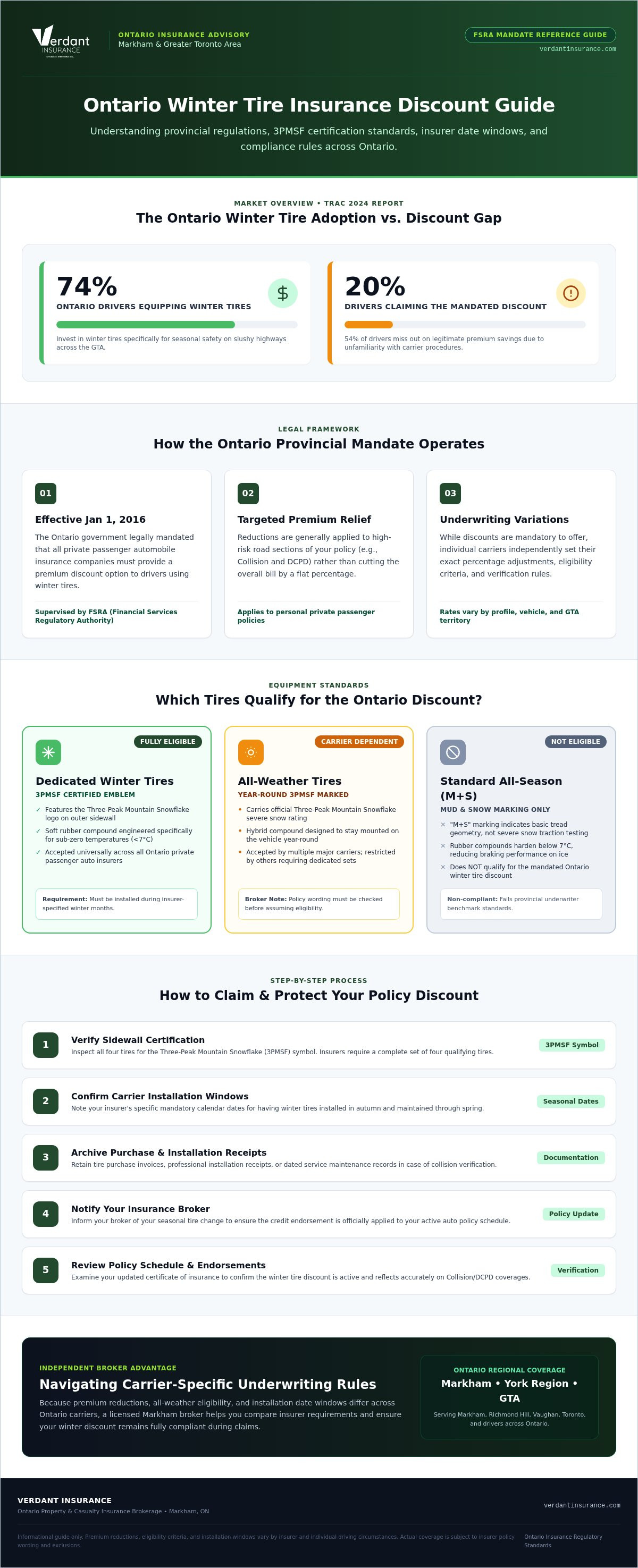
According to a 2024 report by the Tire and Rubber Association of Canada, 74% of Ontario drivers invest in winter tires for safety, yet only 20% actually claim the winter tire insurance discount Ontario carriers are legally mandated to provide. It is easy to see why. Staying safe on slushy highways across Markham and the GTA is your first priority, but sorting through carrier rules often feels like an unnecessary headache.
Between checking sidewall certification emblems and guessing exact seasonal deadlines, many drivers worry that a small oversight could complicate a winter collision claim. You deserve clear answers and peace of mind. You will learn the exact standards needed to qualify, which tires meet insurer rules, how seasonal date windows function, and how to confirm your savings with an independent broker.
Here is your straightforward guide to staying fully protected and keeping your auto policy compliant all winter.
Key Takeaways
- Understand how the winter tire insurance discount Ontario drivers receive is mandated by provincial regulations, even though individual savings amounts vary by carrier.
- Learn which tire types qualify, including how to verify the Three-Peak Mountain Snowflake symbol and check carrier rules for all-weather alternatives.
- Pinpoint common insurer date windows for seasonal installation and removal to ensure your policy remains compliant in the event of a collision.
- Follow a clear, five-step process to document your tire purchase and installation properly so your policy discount is never jeopardized.
- Discover how partnering with an independent Ontario broker helps you compare carrier-specific rules and combine your seasonal discount with other policy savings.
Understanding the Winter Tire Insurance Discount in Ontario
The Ontario winter tire insurance discount is a government-mandated reduction on auto premiums designed to reward policyholders who outfit their vehicles with certified cold-weather tires. While provincial legislation ensures that every private passenger automobile insurer offers this credit, each company sets its own underwriting rules, savings amounts, and verification procedures. Equipping your vehicle lowers your seasonal collision risk and puts money back in your pocket, making cold-weather driving across Ontario significantly safer.
The Ontario Provincial Insurance Mandate Explained
Effective January 1, 2016, the provincial government mandated that all private passenger automobile insurance companies in Ontario must provide a premium discount to drivers using winter tires. The Financial Services Regulatory Authority of Ontario (FSRA) oversees these filings to confirm that carriers maintain fair practices. The regulation applies exclusively to personal, private passenger policies, not commercial fleets. Insurers must provide a discount option, but provincial rules allow each carrier to establish its own eligibility benchmarks, required documentation, and winter tire qualifications.
How Insurers Calculate and Apply the Premium Reduction
Premium calculations vary widely across the Ontario marketplace. Rather than cutting your entire bill by a flat percentage, most carriers apply the reduction to specific portions of your coverage, such as collision or direct compensation property damage (DCPD). The exact dollar impact depends on your broader risk profile, driving record, and chosen carrier. Here is how companies generally assess the credit:
- Targeted coverage savings: Carriers typically apply the reduction to high-risk road sections of your policy, meaning coverages like comprehensive or comprehensive-only endorsements may see less adjustment.
- Carrier underwriting guidelines: FSRA reviews rate filings, but individual companies decide their specific percentage adjustments based on claims history and risk models.
- Profile dependencies: Your vehicle type, primary location in communities like Markham, Richmond Hill, or Toronto, and daily commute distance influence your base rates before the reduction is applied.
Because premium reductions and eligibility criteria vary between insurance companies, comparing distinct carrier guidelines with an independent broker helps you identify the best overall policy structure for your situation.
Tire Requirements: Which Tires Qualify for the Ontario Discount?
Not every tire designed for cold weather meets underwriting criteria. While provincial rules require carriers to offer premium relief, insurers decide the technical benchmarks rubber must meet to earn the credit. Securing your winter tire insurance discount Ontario credit requires knowing precisely which symbols, configurations, and tread ratings your policy allows before the snow starts falling.
The Three-Peak Mountain Snowflake (3PMSF) Certification
Ontario insurers look for a specific industry symbol: the Three-Peak Mountain Snowflake (3PMSF). As outlined in the official Ontario government announcement regarding seasonal savings, qualifying tires must undergo standardized testing for severe snow traction. You can spot this emblem directly on the outer sidewall, depicting a snowflake inside a mountain silhouette. Standard all-season tires marked solely with "M+S" (Mud and Snow) indicate basic tread geometry rather than certified cold-weather stopping capability, meaning they generally fail insurer guidelines.
All-Weather vs. Dedicated Winter Tires for Insurance
The distinction between all-weather tires and dedicated winter tires creates frequent confusion across the Greater Toronto Area. All-weather tires carry the certified 3PMSF emblem and stay on your vehicle year-round. Dedicated winter tires use softer rubber compounds engineered strictly for sub-zero conditions, which harden below 7°C to grip freezing pavement. Insurer rules on these models differ significantly:
- Accepted carriers: Several major insurers accept all-weather tires for premium reductions because they bear the official 3PMSF marking.
- Restricted carriers: Other underwriters strictly require dedicated winter sets that are swapped out each spring, excluding all-weather designs entirely.
- Broker verification: Because carrier underwriting guides vary, asking a licensed broker to review your policy wording prevents surprises during a claim.
Before purchasing a new set, check with an experienced broker at Verdant Insurance to ensure your planned tire choice matches your carrier's specific discount rules.
The Four-Tire Rule and Tread Depth Standards
Equipping only two tires on your drive axle will immediately invalidate your discount. Insurers mandate a complete set of four matching winter tires to ensure balanced traction and prevent dangerous spinouts on icy roads. In addition, tires must maintain adequate tread depth. While Ontario's legal minimum tread depth is 1.5 mm, insurers expect adequate seasonal grip; worn-out treads with shallow grooves may jeopardize your eligibility if inspected following a collision.
Dates and Deadlines: When Must Winter Tires Be on Your Vehicle?
Many drivers across the GTA assume they can swap tires whenever the first snowfall hits or when road conditions feel slippery. From an underwriting standpoint, timing is not just about personal preference; it is a contractual window. To maintain your winter tire insurance discount Ontario insurers enforce specific calendar dates that dictate when your seasonal tires must be installed and how long they must stay on your vehicle.
Common Mandatory Seasonal Windows Across Ontario Insurers
Every insurance company establishes its own operational schedule. While there is no single provincial calendar mandated by law, the FSRA confirmation on winter tire discounts affirms that carriers have the discretion to set reasonable seasonal eligibility terms. Most underwriters operating in Ontario enforce date ranges similar to these:
- November 1 to April 1: Frequently required by carriers seeking extensive cold-weather coverage across broader Ontario driving corridors.
- November 20 to April 15: Common among providers accounting for unpredictable late spring flurries across southern Ontario.
- December 1 to March 31: A standard baseline window used by many private passenger auto carriers in York Region and Toronto.
Motorists commuting from northern Ontario or rural regions should check their specific documents, as local underwriting guidelines may require longer installation windows to match regional climate risks.
Weather Variations vs. Contractual Insurance Deadlines
Ontario weather is notoriously unpredictable. A sudden warm spell in March might bring pleasant driving conditions, but removing your seasonal tires before your carrier's cutoff date creates serious compliance risks. If you remove your tires ahead of schedule and experience a collision during a late-season snowstorm, the insurer may investigate whether you breached the conditions of your discount.
Protecting your coverage requires balancing seasonal weather with your policy wording:
- Review your policy endorsement: Verify the exact spring removal cutoff date specified by your insurer rather than relying on general guidelines.
- Prioritize contracts over temporary thaws: Leave your tires on until the mandatory date passes, even if temperatures temporarily rise above 7°C.
- Schedule garage visits in advance: Service centres in Markham, Vaughan, and Richmond Hill book up quickly in late October. Arrange your installation early to avoid missing your carrier's autumn deadline.
How to Claim and Protect Your Discount: Step-by-Step Guide
Claiming your winter tire insurance discount Ontario credit requires a few practical administrative steps. Because insurers do not apply this endorsement automatically, you must inform your provider and demonstrate that your equipment meets their standards. Following a clear routine guarantees your savings stay active throughout the snowy season.
- Purchase certified tires: Select a complete set of four tires carrying the Three-Peak Mountain Snowflake emblem.
- Preserve official records: Keep your itemized sales invoice, professional mounting receipt, or commercial storage agreement in an accessible folder.
- Notify your brokerage: Reach out to your insurance broker before seasonal deadlines to add the endorsement to your auto policy.
- Install within policy timelines: Have the tires mounted prior to your insurer's designated autumn cutoff date.
- Maintain seasonal compliance: Keep the tires mounted on the vehicle until the spring removal window specified in your contract has passed.
Essential Proof and Documentation Insurers May Request
Insurance companies regularly conduct random underwriting audits or request verification before binding a policy renewal. To satisfy an inquiry, you must provide legible documentation detailing the tire make, model, and date of service. Acceptable forms of proof include mechanic work orders, tire shop invoices, or dealer delivery sheets for recently purchased vehicles.
If you swap your wheels at home in your own driveway, retain the original purchase receipt displaying the tire specifications. Some carriers may also ask for dated photos showing all four tires mounted on the car, clearly displaying the sidewall mountain snowflake logo and sufficient tread depth.
What Happens If You Have a Winter Collision?
During a collision investigation between December and March, adjusters inspect vehicle damage along with tire specifications. The adjuster notes the make, model, and physical condition of the tires on their report. If your auto policy lists an active winter tire endorsement but your vehicle was involved in a crash while fitted with all-season tires, the insurer will flag the inconsistency.
A mismatch between your policy declarations and your actual equipment represents a material misrepresentation under standard Ontario automobile insurance conditions. While mandatory third-party liability claims are generally paid out to protect other motorists, the carrier could retroactively remove the discount, demand back payment of premiums, increase your comprehensive or collision deductibles, or potentially deny optional physical damage coverages entirely. Staying strictly compliant protects your financial standing.
Maximizing Auto Insurance Savings Across Ontario with an Independent Broker
Earning a winter tire insurance discount Ontario drivers qualify for provides immediate value, but seasonal equipment credits represent just one piece of a comprehensive cost-management approach. Individual insurance companies calculate base rates using distinct rating algorithms, meaning the carrier offering the highest percentage reduction on tire equipment might not actually deliver your lowest overall annual premium. Layering multiple endorsements creates meaningful, lasting relief across your entire policy portfolio.
For a detailed breakdown of rating factors and policy structures across the country, review our cheap car insurance Canada guide to evaluate broader market trends.
Stacking Winter Tire Discounts with Other Policy Savings
Underwriters permit policyholders to combine seasonal tire credits with several standard rating adjustments. Pairing these options compound your potential annual savings:
- Multi-line packaging: Combining your personal auto coverage with homeowner or tenant insurance remains one of the most effective ways to lower overall household premiums.
- Clean driving records: Maintaining a claims-free and conviction-free profile guarantees you retain preferred rating tiers across major Ontario carriers.
- Telematics and usage tracking: Many insurers reward motorists who drive limited annual kilometres or demonstrate safe braking habits with connected mobile applications.
- Multi-vehicle policies: Insuring two or more personal vehicles on a single family contract unlocks additional multi-car discounts across each automobile.
Why Consult an Ontario Broker Located in Markham?
Navigating varying underwriting guidelines requires local market knowledge. Discover how partnering with an online insurance broker in Canada simplifies policy management while retaining human advice tailored specifically for Ontario drivers.
Because Verdant Insurance operates directly from Markham, our team understands the unique winter driving realities facing commuters traveling across Highway 404, Highway 407, and local GTA arteries. As an independent property and casualty brokerage, Verdant represents multiple licensed Ontario insurance carriers rather than selling a single corporate product. We examine the precise tire deadlines, eligibility forms, and credit percentages of different underwriters on your behalf. Reach out to a Verdant broker today to evaluate your existing auto insurance declarations, verify your seasonal endorsements, and structure a dependable policy suited to your driving habits.
Keep Your Vehicle Safe and Your Policy Protected This Winter
Securing the winter tire insurance discount Ontario drivers qualify for comes down to straightforward preparation. Equipping a full set of four tires displaying the Three-Peak Mountain Snowflake symbol, retaining your receipts, and adhering strictly to your carrier's seasonal dates protects both your savings and your collision coverage. When you respect these basic standards, you avoid coverage disputes and drive with genuine confidence.
As a licensed independent Ontario insurance brokerage based in Markham, Verdant Insurance provides dedicated personal service supporting York Region and GTA drivers. With direct access to multiple leading Canadian insurance carrier markets, we simplify carrier guidelines, verify your seasonal endorsements, and help structure comprehensive auto protection tailored to your routine.
Winter roads present enough challenges on their own; keeping your auto insurance clear and cost-effective shouldn't be another. Safe travels throughout the cold season ahead.
Frequently Asked Questions
Is the winter tire insurance discount mandatory for all insurance companies in Ontario?
Yes, all private passenger automobile insurers in Ontario are legally required to offer a winter tire discount. The Financial Services Regulatory Authority of Ontario (FSRA) mandates this provision across the province. However, individual carriers set their own qualification rules, discount percentages, and seasonal cutoffs. This means your eligibility terms and final savings will vary depending on your specific underwriter.
Do all-weather tires qualify for the Ontario winter tire insurance discount?
Eligibility depends entirely on your insurance carrier. All-weather tires feature the Three-Peak Mountain Snowflake emblem, which satisfies the technical criteria for several Ontario underwriters. Other insurers take a stricter stance, requiring dedicated winter sets that you remove during warmer months. Because guidelines differ across companies, you should always verify your tire model with a broker before counting on the winter tire insurance discount Ontario providers offer.
What happens if I get into an accident and my winter tires are not installed?
If you experience a collision during the winter and lack the required tires, your insurer could treat it as a policy misrepresentation. Claims adjusters routinely check tire condition at collision scenes. While third-party liability coverage generally pays out for damages to others, your carrier may remove your discount, demand retroactive premium adjustments, increase your physical damage deductible, or deny optional collision and comprehensive claims.
Can I install my winter tires myself and still receive the insurance discount?
Yes, self-installation is permitted by most insurers as long as your tires meet technical standards. You must retain the original sales receipt proving the brand, model, and purchase date of the certified tires. If audited, you might be asked to supply clear photos showing all four tires properly mounted on your vehicle, including visible close-ups of the sidewall snowflake emblem and tread depth.
What specific dates must winter tires remain on my car in Ontario?
Exact dates depend on your carrier's policy wording rather than provincial highway legislation. Most insurers mandate installation between early November and early December, requiring the tires to stay on your car until late March or mid-April. Drivers throughout Markham and the Greater Toronto Area should check their declaration pages carefully, because unseasonably warm weather does not alter your formal policy commitment.
Do I need to submit receipts every year to keep my winter tire discount?
Generally, you do not need to resubmit paperwork annually once the endorsement is active. The discount typically rolls over automatically at each policy renewal. However, underwriters conduct periodic random audits and may request fresh documentation, such as a recent maintenance slip or seasonal swap receipt, before finalizing your renewal. Keeping organized maintenance files ensures you are always prepared.
Does the winter tire discount apply to commercial or business vehicles in Ontario?
No, the provincial mandate applies exclusively to private passenger personal auto policies. While commercial automobile carriers may offer their own fleet risk-reduction incentives, they are not legally obligated to provide this specific discount. If you operate business vehicles or commercial trucks across York Region, consult an independent broker to explore dedicated commercial vehicle credits designed to manage fleet operating expenses.