

What if the risks that disrupt a small business aren’t only major emergencies, but also everyday decisions about suppliers, cash flow, technology and staffing? Risk management for small businesses in Ontario means identifying what could affect your objectives, judging how serious each risk could be, and deciding how to respond.
Managing uncertainty can feel like one more job on an already full schedule. A practical risk management approach helps Ontario small businesses focus on the exposures that matter most and prepare without treating every possibility as an emergency.
This guide explains how to identify and assess business risks, prepare for emergencies, assign responsibilities and choose responses such as reducing, accepting or transferring risk. It also shows how to keep a risk register current and factor risk into business decisions.
Key Takeaways
- Identify risks across operations, finances, suppliers, technology and the external environment, then prioritize them by likelihood and potential impact.
- Prepare for physical emergencies with clear response steps, assigned roles, staff training and an up-to-date plan.
- Record each significant risk, its owner and planned response; review the register regularly as the business changes.
- Choose whether to avoid, reduce, transfer or accept each risk, and consider how prevention measures affect insurance needs.
- Build risk considerations into business plans and decisions. Ontario’s Enterprise Risk Management Directive applies to ministries and provincial agencies, not every Ontario business.
Physical risks and emergency preparedness
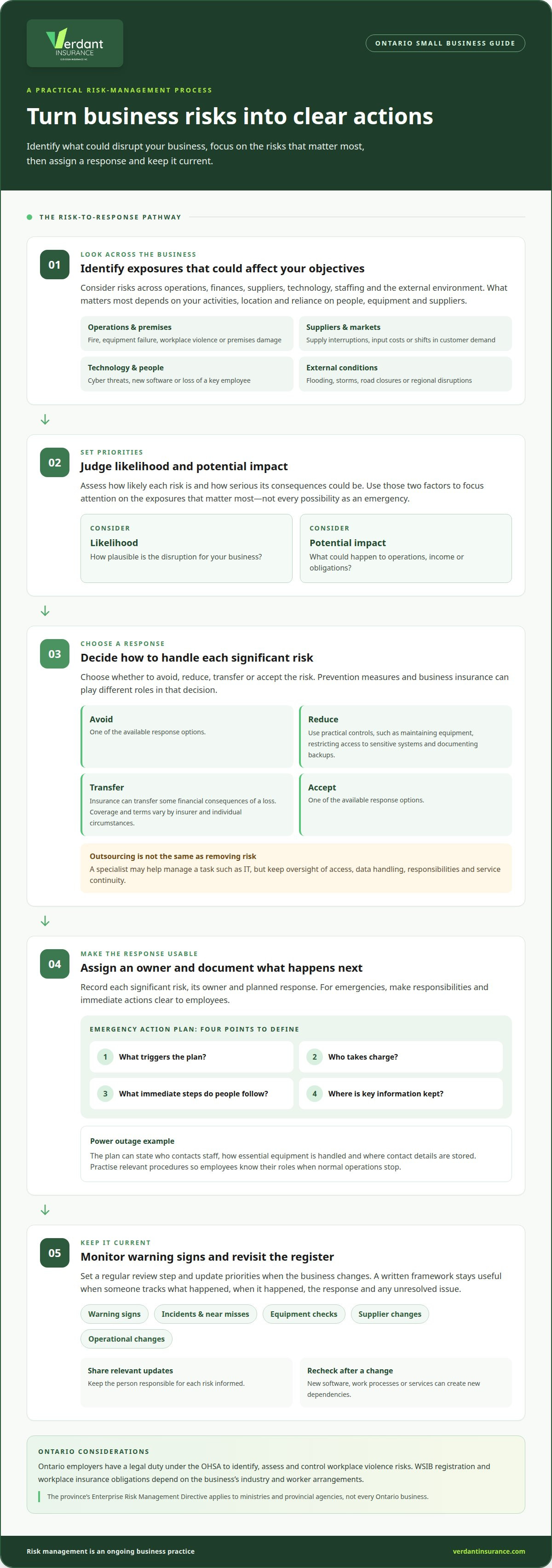
Physical risks include fire, equipment failure, workplace violence, severe weather and damage to business premises. Ontario small businesses also face changing input costs, supplier interruptions, cyber threats, credit problems and shifts in customer demand. The risks that matter most depend on your activities, location and reliance on people, equipment and suppliers.
For workplace safety, Ontario employers have a legal duty under the OHSA to identify, assess and control workplace violence risks. Emergency preparedness also involves training employees, maintaining premises, checking safety measures and inspecting equipment regularly. A fire can escalate quickly, even when the fire department is nearby. A local fire prevention or safety officer can assess workplace preparedness.
Build an emergency action plan around four points: what triggers it, who takes charge, what immediate steps people follow and where key information is kept. A power outage plan, for example, can state who contacts staff, how essential equipment is handled and where contact details are stored. Practise relevant procedures so employees know their roles when normal operations stop.
Input-cost and market risks can affect purchasing, pricing and cash flow. Track supplier availability, delivery reliability, customer demand and the cost of essential materials. If a key supplier cannot deliver, identify the operations that would be affected and the alternatives that could keep them running. Review your assumptions before major purchases or price changes.
Environmental and external risks include natural hazards and disruptions beyond a business’s direct control. Consider how flooding, storms, road closures or regional supply interruptions could affect premises, deliveries and staff access. Farms face distinct exposures: AgriRecovery is a framework that can provide targeted recovery relief after major natural disasters or extraordinary events, beyond standard business risk management programs.
Monitoring keeps a risk framework useful after it has been written. Set a regular review step to track warning signs, incidents, near misses, equipment checks and changes in suppliers or operations. Assign someone to record what happened, when it happened, the response and any unresolved issue. Share relevant updates with the person responsible for each risk.
Emerging organizational risks deserve attention too. New software, a changed work process or the loss of a key employee can create dependencies that did not exist before. When a change is proposed, identify what could fail, who would notice first and how the issue would be reported. This review keeps emergency plans and risk priorities aligned with actual operations.
Insurance and outsourcing as risk responses
Insurance can transfer some financial consequences of a loss, while outsourcing can reduce exposure by shifting selected tasks to a specialist. For WSIB, Ontario businesses must determine whether their industry and worker arrangements require registration and workplace insurance. The obligation depends on the business’s circumstances.
Selecting Insurance Coverage
Choosing insurance means matching potential business losses with appropriate policy protection. It matters because a disruption can affect property, income, operations or obligations to others, and one policy may not address every exposure.
Start by assessing your business activities, property, contracts and main sources of income. A retailer, for example, may consider how a fire could affect its premises and ability to operate, while a consultant may have different operational exposures. Coverage, eligibility and terms vary by insurer and individual circumstances, including policy wording, limits and exclusions.
An insurance broker can discuss your exposures and business details, then help you consider available options. Brokers work with multiple insurance carriers rather than a single insurer. A broker can help you review insurance options and the premiums quoted for the coverage under consideration. Treat this discussion as one input to decisions, not a replacement for considering which risks your business can prevent or absorb.
Key person insurance is life or disability insurance on someone crucial to the business. If your business depends on one person’s expertise or relationships, losing that person’s contribution could interrupt operations. Consider the dependency, the financial effect of disruption and how long adaptation might take. Life insurance is separate from property and casualty coverage.
Prevention, Insurability, and Brokerage
Risk prevention means taking practical steps to reduce the likelihood or impact of a loss. These controls can strengthen the business’s overall risk profile. Examples include maintaining equipment, restricting access to sensitive systems and documenting backup procedures. Keep records of completed maintenance and training to show how your business manages identified exposures.
Outsourcing can address risks that require specialist skills. A business might outsource IT functions to help mitigate cyber risk, while retaining oversight of access, data handling and service continuity. Define the outsourced task, responsibilities and reporting process in the agreement. Outsourcing changes how a risk is managed; it does not remove the need to monitor dependence on that service.
An insurance broker can connect your business’s risk assessment with insurance options from multiple carriers. Bring a clear description of your operations, assets, staffing and existing prevention measures to the discussion. Review these details annually or after a material change, such as adding a service or location. A current assessment helps keep risk controls and insurance decisions aligned as your organization changes.
Assigning responsibilities and documenting processes
A risk register turns uncertainty into named actions linked to business objectives. It is a practical tool for risk management for small businesses in Ontario, helping managers see who owns each risk, what response is planned and when progress needs review.
Record each risk in a consistent format. An Ontario risk register should include:
- The objective at risk and a clear risk description
- Likelihood and impact assessments, plus the overall risk
- The risk category and planned mitigation
- Accountability for the risk and its mitigation
If delayed deliveries threaten a store’s sales objective, for example, document the supplier disruption, its likelihood and impact, and the person responsible for addressing it. Distinguish risk ownership from action ownership when one person oversees the exposure and another completes the mitigation work.
Choose a response that fits the risk and your organization’s objectives. The four options are to avoid, reduce, transfer or accept the risk. Avoidance means stopping an activity that creates unacceptable exposure, such as discontinuing a service with unmanageable safety concerns. Reduction lowers likelihood or impact, for example, by adding a backup supplier. Transfer shifts some financial risk through measures such as insurance. Acceptance means acknowledging the exposure and choosing to manage its consequences without additional controls.
Managers can maintain the register, gather staff updates and carry out agreed controls. Senior leaders set priorities, decide which risks fit the business’s appetite and approve resources for larger responses. A manager might report recurring equipment failures, for instance, while a senior leader decides whether replacement or continued maintenance better supports operational objectives. Clear accountability prevents a mitigation task from becoming everyone’s responsibility and no one’s action.
Document the process behind each response, not just its label. A continuity procedure might specify who contacts customers, who approves an alternative supplier and where current contact details are stored. Record the decision, responsible person, completion status and any remaining exposure. This creates a useful record if staff responsibilities change or the disruption recurs.
Regular reviews keep risk responses relevant as operations, suppliers and objectives change. A consistent approach to risk management for small businesses in Ontario includes reviewing the register quarterly or at least annually, and updating likelihood, impact, owners and mitigation plans. A new location, service or supplier is a clear reason to review it sooner. Managers can report material changes to senior leaders, who reassess priorities and approve adjustments. This makes risk management an ongoing practice, not a document filed away after planning.
Enterprise risk management for small and medium-sized businesses
Enterprise risk management connects risks across an organization rather than treating each disruption separately. For Ontario small businesses, it can cover operational, financial and external risks.
Business Structure and Risk Needs
Business structure affects who makes decisions, shares information and oversees risks. A sole proprietorship may rely heavily on its owner, while partners need clear agreements about responsibilities. A corporation may assign oversight among managers or directors. Each organization should shape its risk process around its people, activities and decision-making structure.
Risk management also depends on business objectives and dependencies, not just structure. A sole proprietor relying on one supplier may prioritize continuity, while partners may need a shared process for approving changes. A corporation can define who reviews operational risks and reports them to leadership.
Assessing and Prioritizing Business Risks
Assess risks by considering likelihood and severity, then prioritize those most likely to disrupt operations. Compare exposures such as supplier interruptions, cyber threats and natural hazards. A risk that could stop customer service may deserve attention before a minor inconvenience. This helps direct time and resources toward the business’s most important vulnerabilities.
Ontario’s Enterprise Risk Management Directive applies to ministries and provincial agencies, not every business operating in Ontario. The Government of Ontario describes its five-step process as establishing context, identifying risks, assessing risks, planning and taking action, then monitoring and reporting. Small businesses can use this sequence as a practical framework without treating the directive as a business requirement.
The directive defines risk as the effect of uncertainty on objectives, including potential negative threats and positive opportunities. Enterprise risk management therefore considers internal and external risks, both financial and non-financial. A new service, for example, may create revenue opportunities while adding staffing or technology dependencies. Reviewing both sides supports resilience and balanced decisions.
ISO 31000 provides a risk management guidelines standard. Ontario’s Strategic Risk Management Framework for School Boards aligns with ISO 31000 and the provincial directive. For a small business, the useful connection is a structured approach: establish context, identify and assess risks, plan responses, then monitor results. This supports consistent decisions without implying that the school board framework governs private businesses.
Integrating risk into strategic planning and decision-making
Strategic planning is stronger when decisions account for uncertainty, operational impact and potential opportunity. Ontario small businesses can connect risk reviews to plans for growth, investment and continuity.
Ontario agriculture programs address some financial effects of disruption: Agricorp delivers AgriStability, which can provide payments when a producer’s current-year margin falls significantly below its reference margin. Agriculture and Agri-Food Canada delivers AgriInvest, a producer-government savings account for moderate income declines and farm-business investment; AgriRecovery can provide targeted relief after major disasters or extraordinary events.
Risk in Strategic Planning
Integrating risk into strategic planning means assessing how uncertainty could affect each business objective before making a decision. This matters because a growth opportunity can also create new operational dependencies.
Before opening a second location, for example, assess how staffing, suppliers, customer demand and cash flow could affect the plan. Compare those exposures with the expected opportunity, then choose responses that fit your objectives and risk appetite. Revisit the assumptions when costs, demand or operating conditions change.
Use a clear decision sequence: define the objective, identify risks and opportunities, assess likelihood and impact, select actions, then monitor results. The Government of Ontario describes this five-step process in its Enterprise Risk Management Directive. Although the directive applies to ministries and provincial agencies, its process offers a useful planning framework for small businesses.
Business Contingency Planning
A contingency plan sets out what your business will do if a disruption threatens a key objective. Assigning actions can help staff respond consistently instead of improvising under pressure.
Build each plan around a trigger, a person in charge, immediate response steps and the location of essential information. For a supplier interruption, the trigger might be a missed delivery that affects service. The plan can specify who contacts customers, who coordinates an alternative and where supplier and customer details are stored.
Connect the plan to strategic priorities. If online sales are essential, document how your organization will communicate with customers during a website outage and who can approve another sales process. Review the plan when services, systems or key suppliers change. A brief practice exercise can reveal unclear roles or missing information before a disruption occurs.
Use each review to update decisions, not just the plan. If a contingency depends on transferring financial risk, include business insurance options in the review, then identify that dependency and consider another response. Record the decision, responsible person and next review trigger so leaders can track whether the plan still supports business objectives.
Verdant Insurance: Business Insurance
Verdant Insurance offers Business Insurance for Ontario businesses considering how insurance may fit into their risk response. As an insurance brokerage, Verdant can discuss your operations and business details, then help you consider insurance options. Insurance can transfer some financial risk, but it doesn’t prevent an incident or replace practical risk controls.
Business Insurance may be worth discussing if a disruption could affect your premises, equipment, customer relationships or ability to continue operating. Relevant exposures depend on what your business does, the property it relies on and how it earns revenue. A retailer, consultant and trades business may face different risks, so start with your specific operations rather than assumptions based on business size or industry alone.
Before speaking with a broker, outline your activities, assets, contracts, staffing and current risk controls. Include changes such as a new location, service or major supplier. These details help frame a discussion about risks you want to transfer and those you manage through prevention, contingency planning or acceptance. A clear account of how your business operates makes the conversation more focused.
Verdant Insurance is an insurance brokerage, not an insurance company or direct insurer. Its insurance brokers work with multiple carriers and can discuss business concerns alongside available insurance options. The purpose is to connect your risk priorities with an appropriate insurance discussion, not to treat a policy as a complete risk management program. Prevention, assigned responsibilities and documented response plans remain important.
Insurance terms are not universal. Coverage, pricing and eligibility vary by insurer and individual circumstances. Actual coverage is subject to insurer eligibility, policy wording, limits and exclusions. Consider these details in relation to the loss you want to manage, and distinguish between a risk to transfer and one your business can reduce or accept. An insurance broker can discuss the options using the business information you provide.
If your business depends on specialized equipment, for example, explain its role in daily operations and what a disruption could mean. Include relevant contracts or customer commitments too. This context helps keep the conversation focused on your actual needs rather than a generic list of possible protections. As your operations change, revisit whether your insurance discussion reflects your current priorities.
Contact Verdant Insurance to discuss Business Insurance for your Ontario business.
Make your next business decision with confidence
Risk management for small businesses in Ontario is an ongoing practice, not a plan to create once and set aside. As your business changes, use new services, suppliers or goals as prompts to reconsider what could affect your progress. Choose a priority risk and decide who will review it, what action makes sense and when to revisit the decision.
Insurance may be part of your response when you want to discuss transferring financial risk. Consider how it fits alongside your prevention and planning measures rather than treating it as a substitute.
If you’d like to discuss your business’s insurance needs, contact Verdant Insurance.
A thoughtful next step can keep your plans grounded as your business grows. Let your approach to risk develop alongside your organization.
Frequently Asked Questions
What Is Risk?
Risk is uncertainty that could affect a business objective, positively or negatively. A bakery considering online ordering, for example, may see an opportunity to reach more customers as well as risks such as delivery delays or system outages. Considering both outcomes helps owners weigh the decision, identify possible disruptions and determine what information they need before proceeding.
What business insurance is required by law in Ontario, and what does it cost?
Legal insurance requirements depend on a business’s activities and circumstances, so no single rule or price applies to every Ontario business. A business using vehicles, employing workers or signing a contract may need to consider different obligations. Insurance costs also vary by insurer and individual circumstances, including operations, property, vehicles and selected coverage. Review applicable requirements and discuss relevant options with an insurance broker.
What steps should an Ontario small business take to create a business continuity and disaster recovery plan?
Start by identifying essential services, records, systems and suppliers. Document what disruption would activate the plan, who leads the response and how the business will communicate with employees and customers. A retailer, for example, could plan how to process orders if its payment system fails. Set out how to restore data, resume operations and record decisions. Test the plan with a realistic scenario, then address any gaps.


