

Ontario law doesn’t require homeowners to carry home insurance, but mortgage lenders often require proof of active coverage before finalizing a loan. That’s the key distinction behind the home insurance requirements for a mortgage in Ontario: the requirement usually comes from the lender, not the law. Home insurance protects the property, while mortgage loan insurance protects the lender if a borrower defaults.
These policies are easy to confuse when arranging a mortgage and planning closing costs. This guide explains when a lender may require home insurance, how it differs from mortgage loan insurance, and when each premium is paid. You’ll also learn what home insurance is designed to protect and why your lender’s conditions matter when arranging coverage for an Ontario home.
Key Takeaways
- Ontario law doesn’t require home insurance, but mortgage lenders often ask for proof of active coverage before finalizing a loan.
- For a home priced at C$500,000 or less, the minimum down payment is 5%, according to the Canada Mortgage and Housing Corporation.
- Mortgage loan insurance is required when a home buyer’s down payment is less than 20%, according to the Canada Mortgage and Housing Corporation. It protects the lender, not the home itself.
- A mortgage loan insurance premium may be paid upfront or added to the mortgage; in Ontario, provincial sales tax on that premium is due upfront.
- Home insurance dwelling coverage is based on the cost to rebuild, which can differ from the home’s purchase price.
Mortgage lender insurance requirements
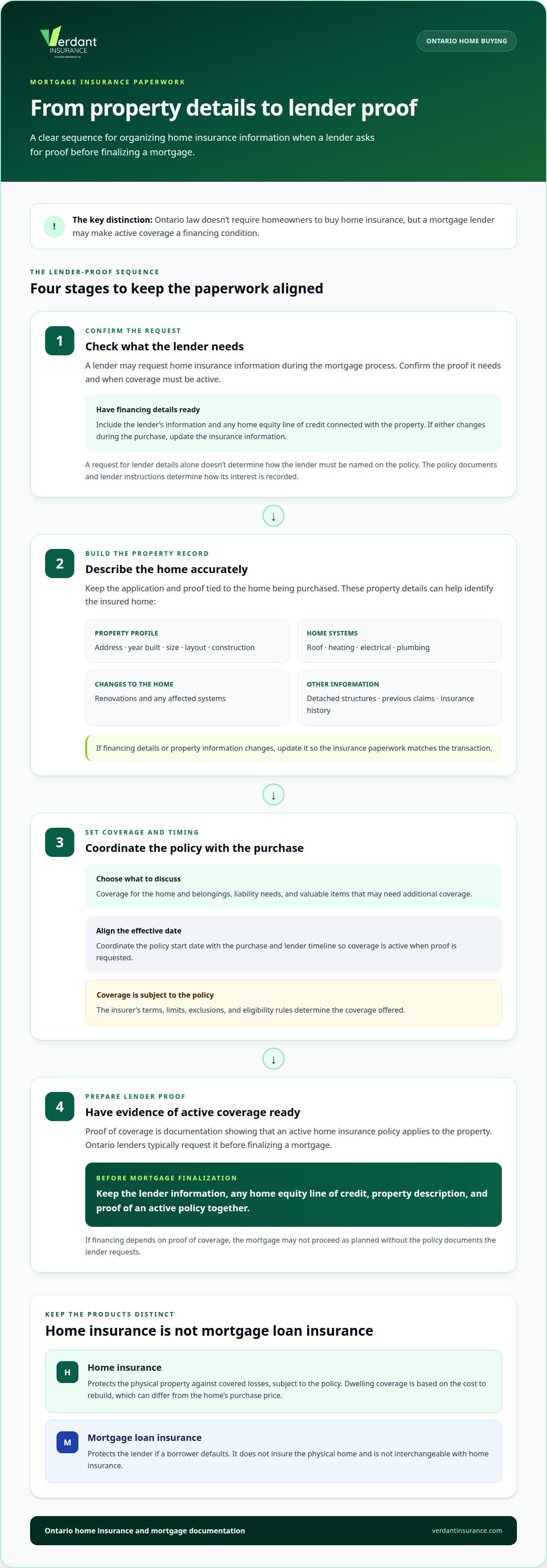
For a financed purchase, organize your insurance information around the lender’s requested proof, the property details, and the coverage start date. Keeping these records together helps align the insurance paperwork with the home purchase.
Home Insurance and Lender Requirements
A lender may request home insurance information during the mortgage process. The home insurance requirements for a mortgage in Ontario may include details about the lender and any home equity line of credit connected with the property.
Provide accurate financing information with your application. If the lender or home equity line of credit details change during the purchase, update them so the insurance paperwork matches the transaction.
Proof of Coverage Before Closing
Proof of coverage is documentation showing that an active home insurance policy applies to the property. Ontario lenders typically request it before finalizing a mortgage, so the home insurance requirements for a mortgage in Ontario include having evidence of coverage ready at that stage.
The application and proof of coverage should match the home you’re buying. Useful details include its address, year built, size, layout, construction, roof, heating, electrical and plumbing systems, renovations, and detached structures. Accurate information helps identify the property being insured.
Policy Start Date and Lender Naming
The policy needs to be active when the lender requests proof before finalizing the mortgage. Coordinate the effective date with the purchase and the lender’s timeline so the documents show coverage in force when required.
A lender may ask for its details during the insurance application. That request alone doesn’t determine how the lender must be named on the policy. The policy documents and the lender’s instructions determine how its interest is recorded.
Insurance applications may ask about previous claims and your insurance history. Answer accurately so the insurer can assess the home and applicant. If the property has been renovated, describe the work and any affected systems rather than relying only on its original details.
You may be asked about the coverage you want for the home and belongings, your liability needs, and valuable items that may need additional coverage. These choices shape the requested policy, but the insurer’s terms, limits, exclusions, and eligibility rules determine the coverage offered.
Keep the purchase and insurance details together, including lender information, any home equity line of credit, the property description, and proof of an active policy. This makes it easier to provide consistent documentation when the lender requests it during mortgage finalization.
Ontario legal requirements for home insurance
Ontario law doesn’t require homeowners to buy home insurance, and no Canadian province or territory legally mandates it. A lender’s financing condition is different: the lender may require insurance to protect its investment in the property. For someone buying with a mortgage, coverage can therefore be practically necessary to close, even though it isn’t a legal requirement.
Legal obligations and loan conditions come from different places. Ontario law doesn’t make home insurance compulsory simply because someone owns a home. A lender can set conditions for its mortgage, including requiring active insurance before financing is finalized. In that case, the obligation comes from the lending agreement, not a province-wide insurance law.
This is why a buyer may hear that insurance is “required” even though there’s no legal mandate. If mortgage approval depends on proof of coverage, include that condition in your purchase planning. Without the policy documents the lender requests, the mortgage may not proceed as planned. The key question is whether your financing terms require coverage.
Mortgage default insurance is a separate product. It protects the lender if the borrower defaults, rather than covering damage to the home. A requirement to obtain mortgage default insurance doesn’t make home insurance a legal obligation or insure the physical property. The products cover different risks and aren’t interchangeable.
For example, a buyer could meet the mortgage’s down payment conditions and still need to meet a lender’s requirement to insure the home. Conversely, a lender’s request for home insurance doesn’t mean Ontario law requires every homeowner to buy it. One is a financing condition; the other would be a legal rule.
For homeowners without a mortgage, there’s no province-wide law requiring home insurance. That doesn’t determine whether coverage makes sense for a particular household. A home is a substantial asset, and the policy wording determines which losses may be covered. Consider both the protection offered and your household’s ability to manage damage or loss.
When reviewing a mortgage offer, distinguish the lender’s home insurance conditions from any discussion of mortgage default insurance. Find out what proof the lender needs, when coverage must begin, and how the payment fits into the purchase. This clarifies the practical requirement without confusing a loan condition with Ontario law.
Optional insurance versus mortgage loan insurance
“Mortgage insurance” can describe different products, so identify the policy before agreeing to a payment. Mortgage loan insurance is tied to the down payment and protects the lender. Optional mortgage protection insurance is a separate product intended to help borrowers manage mortgage payments after certain events. Home insurance protects the physical property and, depending on the policy, belongings against covered losses.
According to the Canada Mortgage and Housing Corporation, mortgage loan insurance is required in Canada when a home buyer’s down payment is less than 20%. It protects the lender if a borrower defaults and the lender’s recovery from the property does not cover the outstanding debt. It does not insure the home against fire, theft, or other property damage. That is why it cannot replace home insurance.
Optional mortgage protection insurance works differently. A lender can’t require you to buy optional mortgage insurance to obtain mortgage approval, and you must expressly consent to purchase it. Read the product description and payment terms before accepting. Check what event triggers a benefit, who receives it, and whether it helps the borrower or pays the lender.
For example, mortgage life insurance generally pays a death benefit to the lender, not the borrower’s family. Its benefit decreases as the mortgage balance falls. By contrast, term or permanent life insurance keeps its stated death benefit while the policy remains in effect. These products serve different purposes, so the phrase “mortgage insurance” alone doesn’t explain what a policy provides.
Other optional products may address disability, critical illness, or job loss. Some mortgage protection policies may pay the lender’s mortgage payments when a borrower can’t work because of severe illness or injury. Policy terms determine eligible events, exclusions, and benefit amounts. Pre-existing medical conditions are usually not covered by mortgage disability and critical illness insurance, so read the policy wording carefully before enrolling.
Keep the three forms of protection separate when reviewing mortgage paperwork:
- Mortgage loan insurance: protects the lender against certain losses after borrower default.
- Optional mortgage protection insurance: may help with mortgage payments after specific life or health events.
- Home insurance: covers the home and potentially belongings for losses covered by its policy.
These distinctions affect coverage and payment planning. Mortgage loan insurance premiums are commonly added to the mortgage, while optional insurance may have separate payment terms. Home insurance premiums are also separate from mortgage loan insurance. Before deciding what a charge represents, check each document’s product name, insured party, benefit recipient, and payment arrangement.
Paying the premium upfront or adding it to the mortgage
For mortgage loan insurance, borrowers can generally pay the premium at purchase or add it to the mortgage. These options affect the amount due at closing and the balance on which mortgage interest accrues. This premium is separate from the home insurance payment, which covers the property under its own policy terms.
Paying the mortgage insurance premium upfront means covering it in full during the purchase process. The mortgage principal excludes that premium. This avoids adding the premium to the amount borrowed, but requires enough funds to cover it alongside other purchase costs.
Adding the premium to the mortgage reduces the amount due upfront for that premium. The lender includes it in the mortgage balance, and you repay it as part of the loan. Interest applies to the added amount for the life of the mortgage, so total repayment exceeds the premium itself.
Ontario buyers also need to account for provincial sales tax on the mortgage insurance premium. This tax is due upfront even when the premium itself is added to the mortgage. It isn’t included in the insured mortgage amount under this arrangement, so include it in the funds needed for closing.
The choice depends on your available cash and borrowing costs. Paying upfront uses more funds at closing, while adding the premium increases the mortgage balance. Consider how each option fits your current finances and repayment plan.
Keep the two insurance payments separate. Mortgage loan insurance protects the lender, while a home insurance premium pays for a separate policy covering the home against insured losses. Neither replaces the other. Review the mortgage documents and home policy separately to understand what each payment covers.
For a mortgage on a home priced at C$1.5 million or more, CMHC insurance is unavailable, so this premium-payment choice does not apply to CMHC mortgage insurance. For eligible purchases, the key comparison is immediate cash required versus a higher mortgage balance and interest over time. The purchase price, down payment, and lender arrangement determine the figures involved.
Does Ontario mortgage insurance need to cover the full replacement cost of a home?
Mortgage default insurance and home insurance address different losses. Mortgage default insurance protects the lender after borrower default; it doesn’t insure the physical house. For property protection, Ontario homeowners should have dwelling coverage sufficient to pay the estimated full cost of rebuilding the home if it is destroyed.
Replacement cost is the estimated expense of rebuilding the home, not its purchase price or mortgage balance. A sale price reflects factors such as location and land, while a rebuild estimate focuses on the structure. These figures can differ considerably, so the purchase price alone doesn’t show how much dwelling coverage may be appropriate.
The sale price doesn’t establish the cost to rebuild. These examples show why a home’s market value and rebuilding cost shouldn’t be treated as interchangeable.
A rebuild estimate focuses on the dwelling itself. Construction type, size, materials, and distinctive features affect the work needed to reconstruct it. The estimate concerns rebuilding costs, not what a buyer would pay for the property. Dwelling coverage should reflect the estimated rebuild cost, not simply match the mortgage amount.
Review the dwelling limit separately from coverage for belongings, detached structures, and additional living expenses. Each part of a home policy addresses a different need. For example, a limit for personal belongings doesn’t increase the amount available to rebuild the dwelling. The policy wording, limits, and exclusions define the protection provided.
Replacement cost also differs from the amount a lender may focus on when assessing its financial interest. The mortgage balance can fall as payments are made, but rebuilding costs don’t necessarily fall with it. A major fire could require extensive reconstruction, so consider whether dwelling coverage reflects the cost to rebuild rather than only the remaining loan.
At purchase, use the property details and rebuild estimate to understand the dwelling limit shown in the policy. Revisit that limit after substantial renovations or changes to the home, since additions and upgraded materials can affect reconstruction needs. Ontario homeowners can explore homeowner insurance coverage when reviewing how their policy addresses the dwelling. Coverage remains subject to policy wording, limits, and exclusions.
Verdant Insurance: Homeowner Insurance
Verdant Insurance can help Ontario homeowners arrange coverage suited to their property and circumstances. Its Homeowner Insurance offering is relevant when you’re buying a home, renewing a policy, or reviewing coverage after renovations. As an insurance brokerage, Verdant can help you understand policy options and how coverage details relate to your lender’s requirements.
Share the home’s details, the coverage you want, and any lender information. Then review the available policy terms, limits, and exclusions to understand what protection applies. Coverage, pricing, and eligibility vary by insurer and individual circumstances, so the policy wording matters.
If you’re arranging a mortgage or reassessing your home coverage in Ontario, contact Verdant Insurance to discuss your Homeowner Insurance needs.
Make your next home decision with clarity
Understanding home insurance requirements for a mortgage in Ontario can help you make more informed housing decisions. Treat insurance as part of your home’s ongoing financial planning, not just a closing task. A move, renovation, or change in household needs can be a good reason to review whether your coverage still fits.
For Ontario homeowners reviewing their options, Verdant Insurance’s Homeowner Insurance can be a starting point for considering policy choices and coverage details. The brokerage also offers Auto Insurance and Business Insurance for other protection needs.
Reviewing your coverage can make managing your home and its insurance more straightforward.
Frequently Asked Questions
Is home insurance mandatory in Ontario?
No. Ontario law doesn’t require homeowners to buy home insurance, and no Canadian province or territory legally mandates it. A homeowner without a mortgage isn’t legally required to insure the property. A lender may still make active coverage a condition of financing. The legal position is separate from the obligations a homeowner accepts under a mortgage agreement.
Do You Need Home Insurance for Different Property Types?
Home insurance needs depend on how you use the property and what you own. Condo owners may need coverage for belongings, liability, improvements, and other exposures. Tenants can insure personal belongings and liability, while a landlord’s policy doesn’t cover a tenant’s personal property. Rental and short-term rental properties also have distinct occupancy details to disclose when arranging coverage.
Can you cancel home insurance while you still have a mortgage?
You can request to cancel a policy, but doing so while a mortgage remains may conflict with the lender’s financing conditions. Before ending coverage, arrange replacement insurance and confirm it meets the lender’s requirements. If you change insurers at renewal, avoid a gap between the old policy’s end date and the new policy’s start date. Keep the new policy documents available for the lender.
Is home insurance mandatory for a mortgage in Ontario?
Not under Ontario law, but a mortgage lender often requires active home insurance before finalizing financing. The requirement comes from the lender’s terms, not a province-wide legal rule. If you’re buying with a mortgage, ask what evidence and policy details the lender needs, then coordinate the effective date with the purchase closing. A homeowner without a mortgage isn’t subject to this lender condition.
What home insurance coverage do Ontario mortgage lenders require?
There’s no universal coverage limit for every Ontario mortgage. The lender sets its conditions, and the policy must meet them. Lenders typically request proof of active coverage; the required documents may identify the property and lender. Review your financing conditions for any specified coverage or limits. Actual policy terms, limits, and exclusions depend on the insurer and your circumstances.
What happens if home insurance lapses while you have a mortgage in Ontario?
A lapse can leave a period without active coverage, exposing the home to losses the policy might otherwise address. It may also mean the lender’s insurance condition is unmet. If you receive a cancellation notice or miss a payment, contact the insurer promptly and arrange continuous replacement coverage. Notify the lender and provide updated policy evidence so its records show the current arrangement.
Does mortgage default insurance replace home insurance in Ontario?
No. Mortgage default insurance addresses the lender’s financial loss if a borrower defaults; it doesn’t cover damage to the home or belongings. For example, it won’t pay to repair fire damage to the dwelling. Home insurance addresses property risks under its own wording and limits. Treat these as separate protections, and don’t assume a mortgage insurance premium includes property coverage.
Are there special home insurance requirements for condos, rural homes, or rental properties in Ontario?
Property type and use affect the information insurers need and the coverage they consider. Condo owners may need protection for contents, liability, and improvements; rental properties require accurate details about occupancy and use. Rural homes may have detached structures or different heating systems, which should be described accurately on an application. Coverage availability and eligibility depend on insurer rules and the property’s circumstances.


