

If you want to know how many demerit points to affect insurance in Ontario, the answer is surprisingly simple: exactly zero. While the Ministry of Transportation uses demerit points to suspend licences, auto insurance companies do not use point tallies to calculate your premium. Instead, they look directly at the underlying conviction.
It is completely normal to worry about sudden rate increases after seeing flashing lights in your rearview mirror. Many drivers assume that keeping a ticket to zero points or fighting a fine down to a lower speed bracket protects their renewal rate, only to face an unexpected surcharge later. The overlap between provincial driving laws and insurance underwriting rules can easily feel confusing.
This guide breaks down what insurance providers actually see on your driving record, how traffic tickets influence your policy, and practical steps you can take to minimize premium increases. We will walk through everything you need to know so you can protect your record and make confident coverage decisions.
Key Takeaways
- When investigating how many demerit points to affect insurance in Ontario, you will discover that insurers rate policies based on the registered driving conviction rather than the point total itself.
- Demerit points and insurance records operate on separate timelines, meaning a ticket can affect your premium for three full years even after points leave your licence.
- Traffic violations fall into minor, major, or serious tiers, and each category creates different premium impacts that vary by insurance provider.
- Checking for minor conviction protection endorsements and comparing coverage across multiple insurers can help you manage potential rate changes effectively after a moving violation.
Demerit Points and Ontario Insurance: The Zero Points Reality
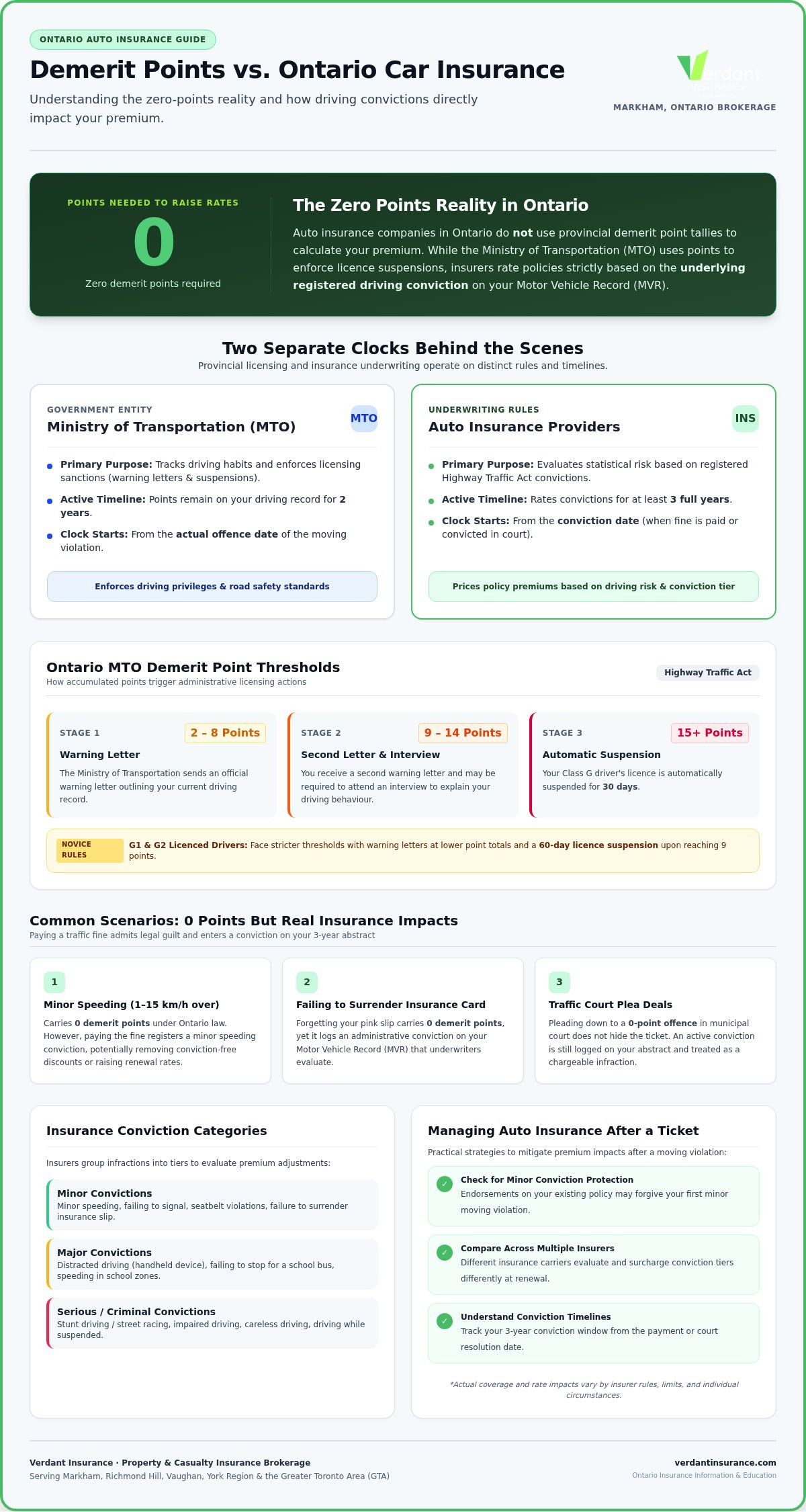
Drivers asking how many demerit points to affect insurance in Ontario are often surprised to learn that zero demerit points are required. Demerit points do not directly impact your car insurance rates. The Ministry of Transportation of Ontario (MTO) uses points solely to track driving habits and enforce provincial licensing sanctions, such as warning letters or suspensions. Insurance companies, on the other hand, price policies based on underlying driving convictions rather than point tallies.
While many jurisdictions rely on administrative demerit point systems to regulate driver behaviour, Ontario auto insurers operate under distinct underwriting rules. A moving violation that carries zero points can still increase your premium at renewal just as easily as an infraction that carries four points.
Why Insurance Companies Ignore Demerit Point Totals
Insurance underwriters assess risk by ordering your official Motor Vehicle Record (MVR) through ServiceOntario. This three-year driving abstract lists the specific Highway Traffic Act convictions on your file, along with the date of each conviction. Crucially, underwriters price risk based on the severity and frequency of those convictions, not the active points logged by the ministry. Your insurer cares whether you broke the law, not how many administrative points the government assigned to the incident.
Common Scenarios Where Zero Points Still Raise Rates
Several traffic situations involve zero demerit points yet still create significant underwriting consequences:
- Minor Speeding (1 to 15 km/h over): Driving within this bracket carries zero demerit points under the Highway Traffic Act. However, paying the fine enters a minor speeding conviction onto your record. This can remove your conviction-free discount or trigger a rate increase at renewal.
- Failing to Surrender an Insurance Card: Forgetting your pink slip when pulled over carries zero demerit points, but it registers an administrative conviction on your abstract that underwriters take into account.
- Traffic Court Plea Deals: Drivers often negotiate a ticket down to a zero-point offence at municipal court, believing their insurance will remain untouched. Because the court still logs an active conviction on your record, insurers treat it as a chargeable infraction regardless of the reduced points.
Whenever you pay a fine for a traffic ticket, you admit legal guilt. That single action registers an official conviction against your name. If you are wondering how many demerit points to affect insurance in Ontario, remember that the conviction itself is what insurers examine.
How the Ontario Demerit Point System Works vs. Insurance Underwriting
To understand why driver confusion is so common, you have to look at the two separate clocks ticking behind the scenes. The Ministry of Transportation monitors driving privileges to keep roads safe, while private carriers calculate statistical risk. Because these entities operate independently, points and insurance penalties follow different rules and timelines.
Demerit points remain on your driving record for two years from the actual offence date. Once those 24 months pass, the points drop off your provincial record. Insurance companies, however, rate traffic convictions for at least three years starting from the conviction date, which is the day you pay the ticket or get convicted in court. Drivers checking how many demerit points to affect insurance in Ontario quickly realize that a ticket can impact insurance rates long after the points have disappeared from their licence.
MTO Demerit Point Thresholds for Ontario Drivers
Under the Ontario Ministry of Transportation's demerit point rules, drivers start with zero points and accumulate them for moving violations. For fully licenced Class G drivers, the ministry applies specific enforcement stages:
- 2 to 8 points: The ministry sends a warning letter outlining your driving record.
- 9 to 14 points: You receive a second warning letter and may need to attend an interview to explain your driving behaviour.
- 15 or more points: Your licence is suspended automatically for 30 days.
Novice drivers with G1 or G2 licences face stricter rules. They receive warning letters at lower point thresholds and face a 60-day suspension upon reaching nine points, along with escalating sanctions for serious individual offences.
How Insurers Discover Tickets on Your Record
Insurance companies do not receive real-time notifications when a police officer issues a ticket. Instead, carriers review your record by pulling an updated Motor Vehicle Record abstract from ServiceOntario during policy renewals or new applications. This means an infraction won't alter your premium mid-term, but it will appear when your policy renews.
Honesty remains critical throughout this process. Intentionally withholding conviction details on an insurance application can lead to a cancelled policy or denied claim due to misrepresentation. If you expect your rates to shift at renewal, speaking with a broker about your Ontario auto insurance options can clarify how different carriers treat past convictions.
Traffic Ticket Categories: Minor, Major, and Serious Convictions
Rather than tracking how many demerit points to affect insurance in Ontario, insurance underwriters evaluate the specific category of your moving violation. Ontario insurers divide tickets into three broad tiers: minor, major, and serious (or criminal). Underwriting guidelines established under FSRA auto insurance rate determination factors allow carriers to weigh these infractions according to risk, meaning the severity of the offence shapes your renewal premium far more than provincial points.
An isolated minor infraction might only remove a conviction-free discount, particularly if you have an endorsement protecting your record. However, multiple minor tickets within a three-year window or a single major infraction can push your policy out of the standard market and into high-risk territory.
Minor Driving Convictions in Ontario
Minor convictions reflect common regulatory infractions under the Highway Traffic Act. While they carry lower provincial penalties, they remain visible to underwriters for three years. Common examples include:
- Speeding up to 49 km/h over the posted limit
- Failing to signal or making improper lane changes
- Failing to obey stop signs, red lights, or yield signs
- Failing to wear a seatbelt
Premium adjustments for minor tickets vary across insurance carriers. Some companies excuse a single minor violation, while others apply a surcharge at your next policy renewal.
Major and Serious Driving Convictions
Major and serious offences reflect severe driving risks and result in substantial financial penalties. Major convictions include distracted driving for handheld phone use, failing to stop for a school bus, and speeding in designated school zones. Ontario classifies distracted driving as a major conviction carrying an automatic licence suspension, which prompts significant premium surcharges from standard carriers.
Serious and criminal convictions carry the harshest consequences. This category includes stunt driving, driving while suspended, and impaired driving. A conviction for stunt driving brings court fines between $2,000 and $10,000 CAD, mandatory licence suspensions, and almost always requires placement in the high-risk auto insurance market with non-standard carriers.
How Long Driving Convictions Affect Ontario Auto Insurance
A common misconception among drivers researching how many demerit points to affect insurance in Ontario is assuming insurance surcharges end when demerit points expire. In reality, insurance carriers review a mandatory minimum three-year window that follows a completely different calendar than the province's two-year point system.
While standard minor convictions stay on your record for three years, serious or criminal offences follow you longer. Suspensions resulting from stunt driving, impaired driving, or significant point accumulation can influence your insurance eligibility and rates for up to six years, often requiring non-standard coverage.
Offence Date vs. Conviction Date Explained
Understanding the difference between your offence date and your conviction date is vital when anticipating rate changes. The offence date is simply the day a police officer pulled you over and handed you a citation. The conviction date, however, is the exact day legal guilt is established.
This establishment happens when you pay your fine online, plead guilty, or receive a guilty verdict from a justice of the peace in traffic court. Insurance companies calculate their three-year lookback strictly from the conviction date. If you request a trial and your court date takes ten months to arrive, that three-year insurance window only starts after the court reaches its final decision.
The Impact on Clean Record Discounts
For many motorists, the steepest financial shock after a moving violation isn't a direct surcharge; it is losing their clean driving credit. Many Ontario carriers apply significant discounts to policies for drivers who maintain an infraction-free record. An isolated minor ticket can immediately remove that preferred tier at your subsequent renewal.
Explore how maintaining clean driving habits protects rates in our cheap car insurance Canada guide.
Because every insurance company approaches traffic infractions with different underwriting formulas, working with a licensed broker in Markham or across the GTA helps you compare policy options when a conviction disrupts your clean status.
How to Manage Your Car Insurance After Getting a Ticket in Ontario
Receiving a traffic citation does not mean your car insurance is immediately doomed to spike. Knowing your options early gives you room to make practical decisions that help protect your budget before your policy renewal date arrives.
Start by reviewing your existing auto policy to check whether you have a conviction protection endorsement. Much like accident forgiveness, this optional endorsement shields you from a rate increase following your first minor conviction. If your coverage includes this feature, an isolated minor ticket might have no impact on your premium at all, keeping your rate stable.
Understanding Ticket Resolution Options
Before making any payment, understand what happens next. You generally have three options on the back of an Ontario offence notice:
- Pay the fine: This is a plea of guilty that immediately places a conviction on your record.
- Early resolution: Meeting with a municipal prosecutor allows you to discuss the circumstances. In many cases, prosecutors offer to reduce the charge to a less severe infraction or drop secondary charges.
- Trial: Contesting the ticket gives you an opportunity to review the evidence. If the officer fails to appear or the court dismisses the charge, no conviction is registered, completely protecting your insurance record.
Shopping Rates with an Ontario Brokerage
When asking how many demerit points to affect insurance in Ontario, many drivers forget that every insurance company rates violations differently. A minor infraction that prompts a heavy surcharge with one carrier might result in only a modest adjustment with another. Because individual carrier guidelines vary so broadly, comparing options across the market is essential.
Working with an independent Ontario brokerage gives you direct access to multiple insurance carriers. A broker evaluates your complete driving profile to find standard carriers that view your record favourably. If multiple tickets require high-risk placement, a broker can place coverage through specialized non-standard markets until your record clears.
For personalized guidance on selecting coverage, consult our Ontario digital insurance broker guide.
Beyond shopping across carriers, consider adjusting your policy structure to offset premium increases. Enrolling in a telematics program that rewards safe driving habits, increasing your comprehensive or collision deductibles, or accurately updating your annual commute mileage can help balance out ticket-related surcharges.
Take Control of Your Ontario Auto Insurance Coverage
Now that you know how many demerit points to affect insurance in Ontario, you can separate licensing penalties from insurance rating rules. Underwriters look at registered convictions and their severity rather than provincial point balances. Whether an infraction carries zero demerit points or several, the three-year conviction window dictates your rate changes.
A traffic ticket does not have to leave you stuck with unreasonable premiums. As an independent brokerage based in Markham, Verdant Insurance connects Ontario drivers with multiple competing insurance providers. Whether you maintain a clean abstract or need guidance navigating non-standard coverage after a moving violation, experienced brokers can help you find a tailored policy fit.
Staying informed gives you the clarity you need to handle policy renewals smoothly and keep your vehicle protected on Ontario roads.
Frequently Asked Questions
Do demerit points directly increase car insurance premiums in Ontario?
No, demerit points don't directly increase your car insurance premiums in Ontario. Demerit points belong entirely to the Ministry of Transportation's licensing framework to monitor repeat violations. When drivers ask how many demerit points to affect insurance in Ontario, they learn that insurers price policies based on the driving conviction itself rather than the points attached to it. Any rate change depends on your insurer and the conviction's severity.
How long do traffic convictions stay on an Ontario driving record for insurance?
Standard traffic convictions stay on your driver's abstract and can affect auto insurance premiums for three years from the conviction date. This differs from provincial demerit points, which the ministry clears two years from the offence date. More serious offences, including stunt driving or licence suspensions, can influence your insurance underwriting eligibility and premium tier for up to six years, depending on individual carrier guidelines.
Will a speeding ticket under 15 km/h raise my insurance rates?
Yes, it can raise your insurance rates even though it carries zero demerit points. Once you pay the fine or plead guilty, the infraction logs on your driving abstract as a minor moving conviction. While some carriers may forgive a first minor infraction or only remove a conviction-free discount, others apply an automatic renewal surcharge. How your premium responds depends on your specific insurance provider's underwriting rules.
What happens to my insurance if my licence is suspended due to demerit points?
A licence suspension triggered by accumulating demerit points significantly impacts your insurance profile. Standard insurance carriers generally decline to renew coverage for drivers who have served an administrative suspension. Instead, you'll likely need coverage through a non-standard or high-risk insurer. Licence suspensions remain visible on your record for up to six years, resulting in noticeably higher premiums across all available Ontario carriers.
Does a parking ticket add demerit points or affect Ontario auto insurance?
No, parking tickets don't add demerit points or affect Ontario car insurance rates. Municipal parking infractions represent non-moving violations issued against the vehicle itself rather than an identified driver. Because parking fines never appear on your three-year driving abstract, insurance underwriters cannot see or rate them. However, unpaid parking fines will prevent you from renewing your vehicle licence plate with ServiceOntario until settled.
Can an insurance company cancel my auto policy because of demerit points or tickets?
An insurer cannot cancel your existing policy mid-term solely due to minor traffic tickets or points, but they can choose not to renew your policy when your term expires. If you accumulate multiple convictions, a major offence like distracted driving, or a demerit-related suspension, you may no longer meet the carrier's underwriting criteria. Failing to disclose new convictions when applying for coverage can also invalidate your policy.
What is conviction protection and how does it protect my insurance rates in Ontario?
Conviction protection is an optional policy endorsement offered by many Ontario insurance carriers. It acts as a safety net by shielding you from premium increases following your first minor moving violation. If you wonder how many demerit points to affect insurance in Ontario with this endorsement in place, the answer remains zero. Even with a conviction, your rate stays protected as long as the violation qualifies under policy terms.