

If your business inventory disappeared overnight during a frozen pipe burst in Ontario, would your personal home policy really step in to cover the loss? Many entrepreneurs in Markham and throughout the GTA realize too late that their personal coverage doesn't extend to their professional tools. It's a common source of stress, especially when you're trying to balance the cost of high-end equipment with the reality of local weather risks. Securing the right small business property insurance is about more than just checking a box. It's about ensuring that your physical assets, from your storefront to your specialized stock, are backed by a solid financial safety net.
We understand that the terminology can feel overwhelming and the fear of underinsuring expensive gear is real. That's why we've put together this clear 2026 guide to help you protect what you've built. You'll learn the essential differences between building, contents, and stock coverage so you can choose exactly what you need. We'll also show you how to accurately value your assets and prepare for specific Ontario challenges like winter water damage. By the end, you'll have the clarity and confidence to make informed decisions for your business's future.
Key Takeaways
- Learn how small business property insurance protects your essential physical assets, from the building itself to specialized equipment and inventory.
- Identify specific Ontario risks like winter weather and water damage that could disrupt your operations if left unprotected.
- Understand the critical difference between Replacement Cost and Actual Cash Value to ensure you aren't underinsured during a claim.
- Discover why working with an Ontario insurance broker provides more customization and choice compared to buying directly from a single insurer.
- Get a clear roadmap for accurately valuing your business property so you can secure a policy that matches your specific needs.
What is Small Business Property Insurance?
Commercial property insurance is the safeguard for a business’s physical foundation in Ontario. While many entrepreneurs focus on their daily sales or service delivery, the physical assets are what actually keep the doors open. Property insurance is designed to protect the tangible items your company uses to generate revenue. This includes everything from the building you occupy to the laptop sitting on your desk. Without this protection, a single incident could halt your operations indefinitely.
It's vital to distinguish this coverage from liability insurance. While liability covers legal costs and damages if someone gets hurt on your premises, small business property insurance focuses strictly on your "stuff." If a fire damages your storefront in Markham or a theft occurs at your Richmond Hill office, this is the coverage that helps you repair or replace your assets. It provides the financial stability needed to recover from physical losses that would otherwise be devastating to your cash flow.
The Home-Based Business Insurance Myth
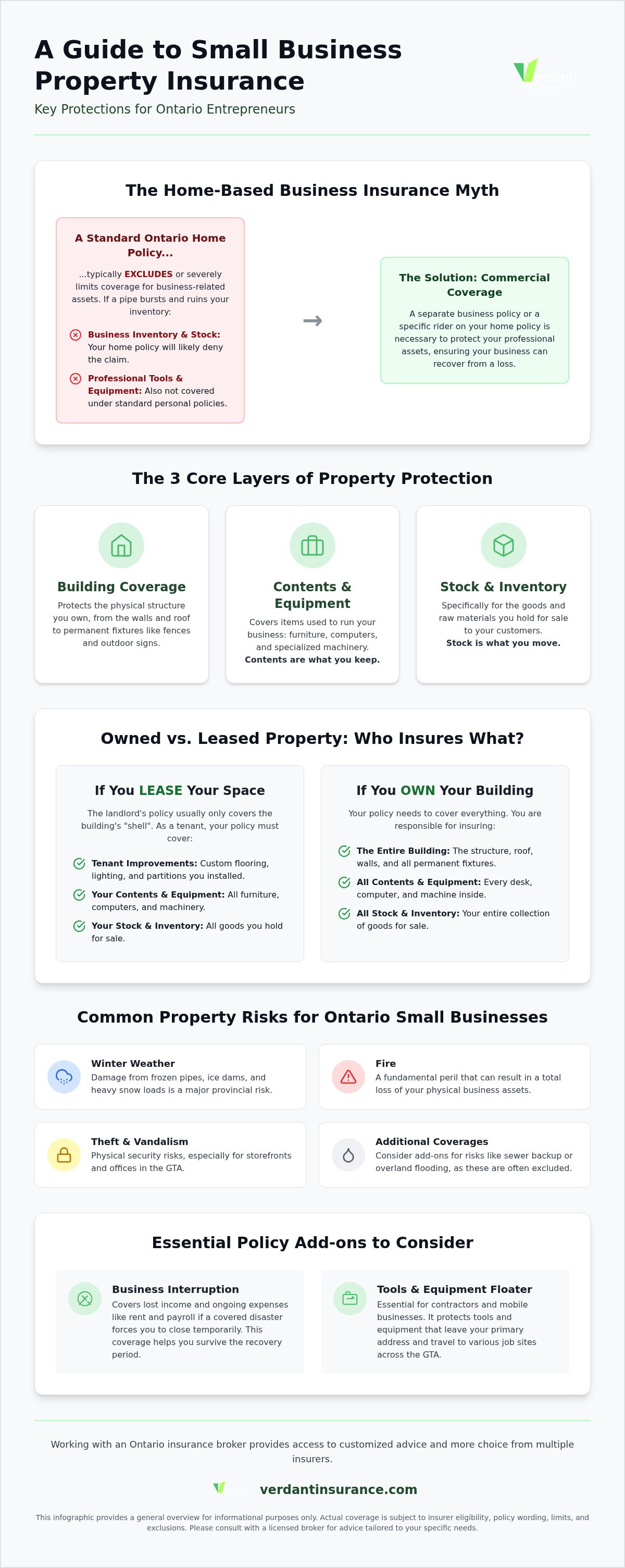
Many entrepreneurs in the GTA start their journey at their kitchen tables or in their basements. There is a common belief that a standard homeowner policy provides enough protection for these ventures. Unfortunately, most Ontario home policies specifically exclude business equipment, professional tools, and inventory. If a pipe bursts in your basement and ruins $10,000 worth of stock, your home insurer will likely deny the claim. Running a business without a commercial property rider or a standalone policy leaves your professional assets completely exposed. This is especially risky for those storing significant inventory in a residential garage or York Region home office.
Owned vs. Leased Property: Who Insures What?
If you lease a commercial space in Vaughan or Toronto, you might assume the landlord's insurance covers the entire unit. This is a dangerous misconception. A landlord's policy usually only covers the "shell" of the building. As a tenant, you are often responsible for what insurers call "Tenant Improvements." These are the specific upgrades you made to the space, such as custom lighting, new flooring, or interior partitions.
A typical Ontario lease requires you to protect these improvements along with your own furniture and electronics. You need your own policy to cover your contents, while the landlord handles the structural walls and roof. Understanding this division is essential so you don't end up paying out of pocket for damage to a space you don't even own.
What Does Property Insurance Cover in Ontario?
Small business property insurance isn't a single, rigid policy. It's a customizable shield made of several specific layers designed to protect different parts of your operation. Building coverage protects the "bones" of your workspace, including permanent fixtures like fences and fixed outdoor signs. Contents and equipment coverage handles the items you use to do your job, such as office furniture, specialized machinery, and electronics. Then there's inventory and stock coverage, which is specifically for the goods you sell. Many owners confuse these two, but they're distinct. Contents are what you keep; stock is what you move.
Learning about commercial property insurance coverage and costs helps you identify which layers are mandatory for your lease and which are optional for your peace of mind. If you're unsure which coverage layers apply to your specific industry, our team can help you review your requirements to ensure your business insurance policy meets every obligation.
Protecting Your Tools and Equipment
If your work takes you across the GTA, your coverage needs to follow you. A contractor in Vaughan or a mobile groomer in Markham needs protection for tools used at client sites, not just at a home office. Standard property forms often limit coverage to a specific address. You should also consider Electronic Data Processing (EDP) coverage if you rely on servers or high-end hardware. This protects against hardware failure from power surges or environmental issues that basic policies might exclude. We recommend creating a digital inventory with photos and serial numbers. This preparation makes the process of getting business insurance in Canada much smoother.
Understanding Business Interruption Coverage
Property damage often causes a secondary, invisible crisis: the loss of income. If a pipe burst ruins your Richmond Hill retail shop, you can't generate sales while the floors are being replaced. However, your rent, utilities, and payroll don't stop. This is where business interruption coverage becomes vital. It replaces your lost net income and covers fixed expenses during the restoration period. It's designed to put your business back in the same financial position it was in before the loss occurred. It's the difference between reopening successfully and being forced to close permanently due to debt accumulated during repairs.
Common Property Risks for Ontario Small Businesses
Fire and lightning remain the most severe threats to your physical assets. While these events are less frequent than other claim types, they are the primary drivers of total loss property claims in Ontario. A single electrical fire in a Markham warehouse or a lightning strike on a Richmond Hill storefront can instantly destroy years of hard work. Theft and vandalism also pose constant challenges, particularly for retail businesses with street-level windows in the GTA. These incidents don't just result in stolen stock; they often leave behind damaged doors, broken glass, and compromised security systems that require immediate repair.
Water damage is actually the most common claim type for businesses across the province. Whether it's a burst pipe during a cold snap or a slow leak behind a wall, the resulting mold and equipment damage can be extensive. It's crucial to understand that water damage often requires specific endorsements in Ontario policies to be fully covered. Without these tailored add-ons, your small business property insurance might only provide protection for a very narrow range of water-related incidents, leaving you exposed to the most likely risks.
Ontario Winter Risks: Ice and Snow
Our local climate presents unique challenges that national insurance guides often overlook. During heavy winters, ice damming occurs when melted snow refreezes at the edge of a commercial roof, trapping water that eventually seeps into the building's structure. This moisture can ruin ceilings, insulation, and expensive electronics. Commercial buildings with flat roofs are also at an increased risk of roof collapse under the weight of accumulated snow. Frozen pipes are another major concern during extreme cold snaps in York Region. If a pipe bursts because a building wasn't heated properly or lacked adequate insulation, the insurance implications can be complex. Owners should also distinguish between property damage caused by snow and the liability risks associated with snow removal, as these are handled differently within a policy.
Sewer Backup and Overland Water
Many basic policies exclude coverage for flood or sewer backup by default. For businesses operating in basement levels or areas of Toronto with aging infrastructure, these endorsements are essential. Local factors, such as the prevalence of combined sewer systems in older GTA neighbourhoods, can significantly affect your property risk profile. Overland water coverage protects against damage from heavy rain or melting snow entering your building from the ground level. Since these risks vary based on your specific postal code and building elevation, it's best to have a professional review your location. Selecting the right small business property insurance means looking at these local environmental factors to ensure your foundation is truly secure.
How to Value Your Business Property
Accurately valuing your assets is the most critical step in setting up your small business property insurance. If you underestimate the cost to replace your equipment or rebuild your workspace, you could face significant financial gaps during a claim. One of the most misunderstood aspects of this process is the "co-insurance" clause found in many Ontario policies. This clause requires you to maintain coverage for a specific percentage of your property's total value, usually 80% or 90%. If you under-report your values to save on premiums, the insurer may reduce your payout proportionally. For example, if you only insure half of your true value, the insurer might only pay half of your claim, even for a small loss.
With the shifting economy in regions like York Region and Toronto, replacement costs for construction and electronics are constantly rising. Reviewing your limits annually ensures your policy keeps pace with inflation. It's not just about what you paid for your equipment five years ago; it's about what it costs to buy it again today. A professional broker helps you navigate these complex valuations so you aren't left with an unexpected bill after an incident.
Replacement Cost vs. Actual Cash Value
Replacement Cost coverage allows you to buy new items of similar kind and quality at today’s market prices. This is the preferred choice for tech-heavy businesses in Markham that rely on the latest servers and hardware. Actual Cash Value (ACV) is a cheaper alternative that pays out based on the depreciated value of your items. While ACV lowers your monthly premium, it often leaves you with a substantial bill to cover the difference between the old item's worth and the cost of a brand-new replacement. We generally recommend Replacement Cost for any business where the tools are essential for daily operations.
The Importance of Bylaw Coverage
Rebuilding after a loss involves more than just replacing what was there. Ontario building codes are frequently updated to include new requirements for accessibility, fire safety, and energy efficiency. A standard policy typically only covers the cost to restore the building to its original state. Bylaw coverage is an essential endorsement that pays for the mandatory upgrades required by local municipalities like Vaughan or Richmond Hill. Without it, you might be responsible for thousands of dollars in code-mandated improvements. While you protect your physical assets, it's also worth reviewing how to safeguard your professional advice with our Professional Liability Insurance: Ontario Comparison Guide.
Speak with a Verdant broker to accurately value your business assets
Customizing Your Policy with an Ontario Broker
Choosing how to purchase your coverage is just as important as the coverage itself. While direct insurers sell only their own products, working with an Ontario brokerage like Verdant Insurance provides access to multiple competing insurers. This model ensures you aren't forced into a generic policy that doesn't account for your specific industry. A broker acts as your ally when shopping for small business property insurance, providing the comparison power you need to find the right fit. More importantly, we act as your advocate during a claim. If a fire or water incident occurs, you have a professional partner who understands the fine print and works to ensure your settlement is handled fairly.
One of the most efficient ways to protect your foundation is through a Business Owners Policy (BOP). This package bundles your property coverage with general liability into a single, streamlined contract. It simplifies your administration and often provides a more cost-effective solution than buying separate policies. With commercial property rates in Canada showing a 6% decrease in the first quarter of 2026, it's an ideal time to review your existing plan. Before you start the process, gathering a comprehensive list of your physical assets will help your broker secure the most accurate pricing from our network of insurers.
The Verdant Advantage in Markham and Beyond
Our team understands the unique landscape of the York Region and the wider GTA. We know the specific risks faced by businesses in Richmond Hill, Vaughan, and Toronto because we live and work here too. This local expertise allows us to provide personalized advice that automated online platforms simply cannot match. We take the time to understand your inventory cycles and equipment needs. For entrepreneurs operating in the digital space, we also offer specialized guidance through our Ontario E-commerce Business Insurance: 2026 Buying Guide.
Speak with an Ontario Insurance Expert
Getting a tailored quote starts with a conversation about your unique operations. Whether you run a retail shop in Markham or a tech startup in Toronto, your property needs are specific to your industry. We also recommend conducting an annual property review to ensure your limits stay current as your business grows. This prevents the underinsurance risks associated with rising replacement costs. Contact a Verdant broker to safeguard your business assets today and ensure your physical foundation is truly secure.
Secure Your Business Foundation in Ontario
Protecting your assets starts with understanding exactly what's at risk. From choosing replacement cost over actual cash value to ensuring you have the right bylaw endorsements for Ontario's evolving codes, every detail matters. By accounting for local winter risks and accurately valuing your equipment, you build a safety net that truly holds up when you need it most.
Securing small business property insurance shouldn't feel like a cold, bureaucratic chore. Our Markham-based experts provide the friendly, professional brokerage support you deserve. We offer access to top Ontario insurers so you can compare options and find a policy that matches your unique goals in the GTA.
Get a Customized Ontario Business Insurance Quote
You've worked hard to build your business foundation. We're here to help you keep it safe so you can focus on growing your venture with total peace of mind.
Frequently Asked Questions
Is business property insurance mandatory in Ontario?
No, business property insurance isn't legally mandatory under Ontario law. However, it's often a practically mandatory requirement for most entrepreneurs. Commercial landlords in the GTA usually require proof of property and liability coverage before you can sign a lease. Additionally, if you have a business loan or equipment financing, your lender will almost certainly require you to protect those physical assets as a condition of the funding.
Does small business property insurance cover my home office?
Your standard Ontario homeowner policy likely excludes or severely limits coverage for business-related equipment and inventory. If you run a venture from your home in Richmond Hill or Vaughan, you generally need a specific commercial rider or a separate small business property insurance policy. This ensures that items like professional-grade computers, specialized tools, or stock stored in your garage are protected against risks like fire, theft, or water damage.
What is the difference between property insurance and general liability?
Property insurance protects the physical things your business owns or leases, such as your building, furniture, and electronics. In contrast, commercial general liability covers you if your business is held legally responsible for bodily injury or property damage to a third party. Think of property insurance as protecting your own foundation, while liability insurance protects your bank account from the costs of lawsuits and legal settlements.
How much property insurance does a small business need?
Your coverage limit should equal the total cost to replace all your physical assets at today's market prices. This includes your equipment, furniture, and current stock levels. You should also factor in the potential loss of income through business interruption coverage. It's vital to value these items accurately to avoid the penalties associated with co-insurance clauses, which can reduce your claim payout if you're found to be underinsured.
Does property insurance cover my business vehicle?
No, property insurance doesn't cover vehicles. In Ontario, any vehicle used for business purposes must be protected under a commercial auto insurance policy, which is legally mandatory. While your property policy might cover the tools or inventory inside the van while it's parked at your office, the vehicle itself and the risks associated with driving it require specific automotive coverage tailored to your business use and driving history.
What happens if I rent my office space and have a fire?
If a fire occurs in a rented space, the landlord's insurance typically covers the structural shell of the building. As the tenant, you're responsible for insuring your tenant improvements, which include any flooring, lighting, or partitions you installed. You also need coverage for your own contents and equipment. Without your own policy, you would have to pay out of pocket to replace your furniture and rebuild your specific interior workspace.
Does property insurance cover theft by employees?
Standard property policies usually cover theft by third parties, but they often exclude theft committed by your own employees. To protect against internal losses, you need to add an employee dishonesty or crime insurance endorsement to your small business property insurance. This specific coverage helps recover losses if a staff member steals money, securities, or physical property. It's a common addition for retail and service businesses in the GTA.
Are my business tools covered when I am working off-site?
Basic property insurance often limits coverage to the specific address listed on your policy. If you frequently take tools to client sites in Toronto or Markham, you need an inland marine or mobile equipment floater. This ensures your gear is protected while in transit and while being used at various locations across Ontario. It's an essential consideration for contractors, photographers, and mobile service providers who don't stay in one office.