
If your dining room table has become your shipping department, do you know if your home insurance policy actually covers that stack of inventory? Many Ontario entrepreneurs assume their residential coverage extends to their digital shop, but that is a risk that could lead to a sudden, expensive surprise. Finding the right business insurance for e-commerce Canada is about more than just checking a box. It is about ensuring a single data breach or a product liability claim does not erase your hard work. Whether you are operating out of Markham or shipping across the GTA, your protection needs to be as modern as your business model.
We understand the anxiety that comes with cyber threats and the confusion over liability for products manufactured overseas. It is a lot to manage while trying to grow a brand. This 2026 guide will show you exactly how to protect your online store with coverage tailored for Ontario based businesses. You will learn which coverages are truly essential and how to use a broker to compare options from multiple insurers. We will also help you understand how to safeguard your business against international shipping risks so you can focus on your next sale with total peace of mind.
Key Takeaways
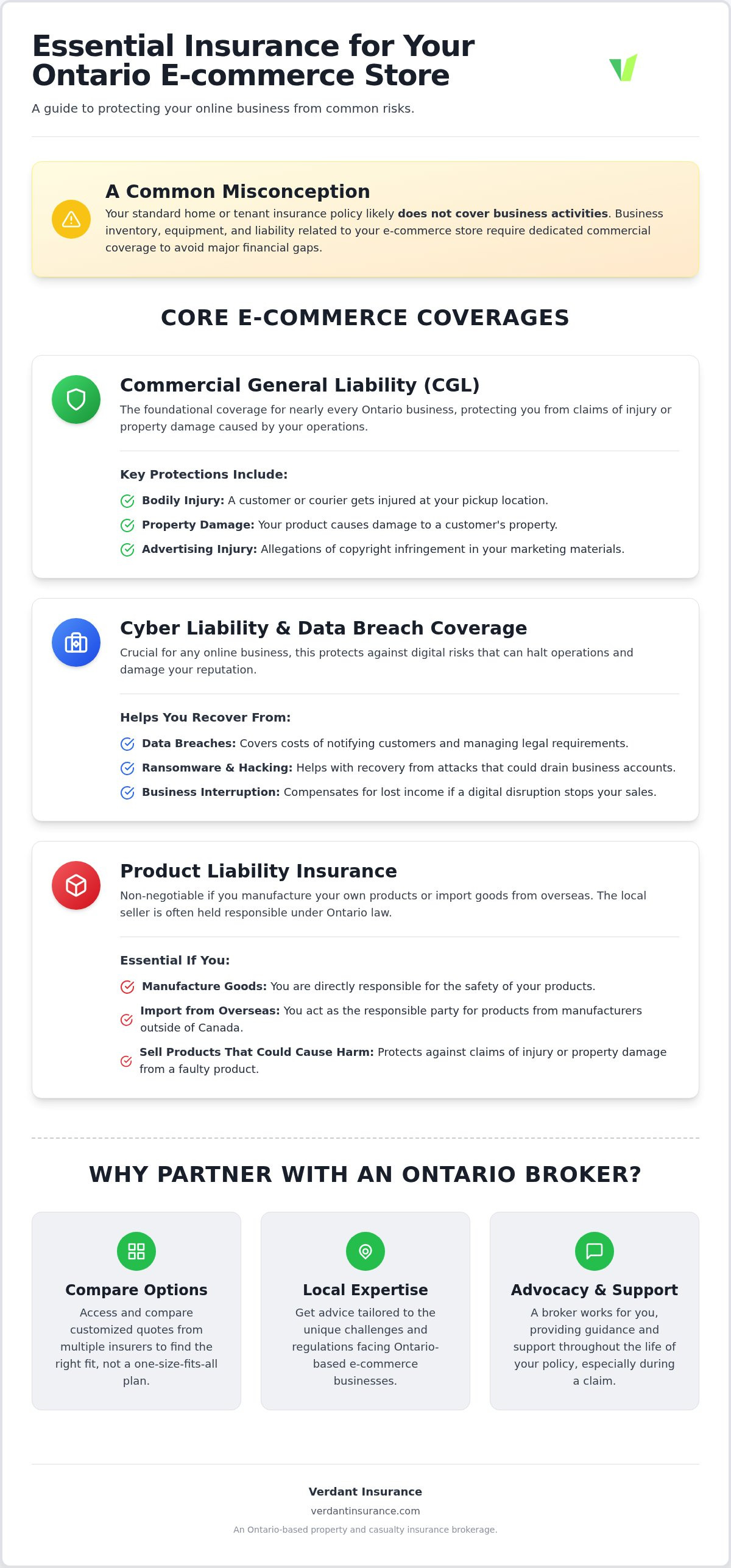
- Identify why standard home insurance often excludes business activities and when you need a dedicated policy for your Ontario online store.
- Learn about the core components of business insurance for e-commerce Canada, specifically how Commercial General Liability and Cyber Liability protect your digital assets.
- Understand how your fulfillment strategy, such as warehousing inventory in the GTA, influences your specific coverage needs and premium factors.
- Discover the benefits of using a local brokerage to compare customized quotes from various insurers instead of settling for a one-size-fits-all plan.
- Gain clarity on managing risks associated with international shipping and product liability for goods sourced from overseas manufacturers.
Understanding E-commerce Risks for Ontario Online Retailers
E-commerce insurance isn't a single policy you buy off a shelf. Instead, it is a customized bundle designed to protect both your digital storefront and the physical products you sell. For many entrepreneurs in the GTA, what started as a small Etsy shop or a weekend Shopify project can quickly evolve into a full-scale operation. Once you move beyond occasional sales, you've outgrown "hobby" status. This transition is exactly when securing Commercial General Liability (CGL) insurance becomes a priority to protect your growing assets.
Operating in Ontario presents unique logistical challenges. If you are shipping orders across Toronto or York Region, you're likely dealing with complex delivery schedules and the rising concern of porch piracy. These shipping risks, combined with the potential for product liability claims, mean that business insurance for e-commerce Canada is no longer optional. It's the foundation of a resilient business strategy. It usually doesn't take much for a small mistake to lead to a large financial loss.
The Limitations of Home-Based Business Coverage
A common misconception among local sellers is that a standard homeowner or tenant policy provides enough protection. It usually doesn't. Most residential policies in Ontario have strict limits on business property. If a pipe bursts in your Richmond Hill basement and ruins $10,000 worth of inventory, your home insurance provider might deny the claim because the items were for commercial use. Liability is another concern. If a courier trips on your porch while picking up a package, your personal liability coverage may not apply to a business-related injury. It's vital to notify your broker as soon as you start shipping products from home to avoid coverage gaps.
Digital Risks in the Canadian Market
Your physical inventory is only half the story. Digital risks are a daily reality for Ontario retailers. Small businesses are often seen as easier targets for cyber attacks because they may lack the robust security of major corporations. A single data breach could expose sensitive customer information, leading to legal trouble and a damaged reputation that's hard to repair. Beyond hacking, service disruptions can halt your revenue in an instant. Protecting your brand means having a plan for when things go wrong online, ensuring you can restore your operations and maintain the trust of your Canadian customers.
Essential Coverage Types for Your Online Store
Building a successful digital brand involves more than just great marketing. It requires following the legal and financial frameworks for E-commerce in Canada, which establishes your shop as a legitimate commercial entity. Once you're official, you need a safety net that addresses the specific risks of the digital marketplace. The right business insurance for e-commerce Canada acts as a shield, ensuring that a single lawsuit or technical failure doesn't wipe out your progress.
Commercial General Liability (CGL) is the baseline for almost every Ontario business. It covers you if a third party claims bodily injury or property damage caused by your operations. For example, if you have a local pickup spot in Vaughan and a customer slips on the ice, CGL helps manage the resulting legal costs. It also provides protection against "advertising injury," which is vital if you're accidentally accused of copyright infringement in your social media ads.
Cyber Liability: Beyond Just Data Breaches
Many sellers think cyber insurance is only for giant corporations, but small shops are often more vulnerable. In 2026, insurers have implemented stricter requirements for this coverage. You'll likely need to show you use multi-factor authentication (MFA) and secure backups to qualify. Cyber liability goes beyond fixing a hacked website; it covers the significant costs of notifying customers after a data leak, which is often a legal requirement. It also helps you recover from ransomware attacks or phishing scams that could otherwise drain your business accounts. If a digital disruption halts your sales for a week, this coverage can help bridge the financial gap.
Product Liability and the Ontario Importer
If you manufacture your own goods or import products from overseas to sell in Ontario, product liability is non-negotiable. Under provincial law, if a product you sold causes injury or property damage, the courts often hold the local seller or importer responsible, especially if the original manufacturer is located outside of North America. Imagine a rechargeable battery you imported from overseas overheating and causing a fire in a customer's home in Markham. Product liability coverage helps defend your business against these claims. It's also a smart move to ask your suppliers to name you as an "Additional Insured" on their policies to add an extra layer of security to your supply chain.
Every online shop has a different risk profile based on what they sell and where they ship. If you aren't sure which specific policies fit your current stage of growth, you can speak with an Ontario business insurance broker to review your options and find a plan that scales with you.
Matching Insurance to Your E-commerce Model
Your business model is the blueprint for your coverage. An Ontario entrepreneur selling hand-poured candles in Markham has very different needs than a tech-forward retailer using 3PLs in Brampton. Because risk is tied to your physical operations, securing business insurance for e-commerce Canada isn't just about the digital storefront; it's about the physical journey of your products. Whether you are a "private label" brand or a "handmade" artisan, the way you handle goods determines your liability.
Handmade sellers often face unique risks related to the materials they use. If you create jewelry or skincare products, you are the manufacturer in the eyes of the law. This means you are responsible for any adverse reactions or injuries your products might cause. Private label sellers face similar scrutiny. Even if you don't physically build the item, putting your brand on it makes you legally responsible for its safety and performance in the Canadian market. It is a significant responsibility that requires a clear understanding of your policy limits.
Inventory and Warehousing in Ontario
If your model involves holding stock, your location matters. Many Ontario businesses use third-party logistics (3PL) providers in Mississauga or Brampton to manage fulfillment. While these warehouses have their own insurance, it usually only covers their liability, not your actual inventory. You need specific property coverage to protect your stock from fire, theft, or water damage while it sits on their shelves. Don't forget about transit insurance. This protects your goods as they move from the Port of Montreal to your Ontario facility, covering potential losses during the most vulnerable part of the supply chain. You should also consider coverage for specialized packaging and shipping equipment used in your daily operations.
The Dropshipping Insurance Gap
Dropshipping is often marketed as a low-risk model, but that is a dangerous misconception. Even if you never physically touch the product, you are the seller of record. If a customer in Toronto is injured by a defective item you dropshipped from an overseas supplier, they will likely sue your Ontario business. Managing this risk is difficult because many international suppliers don't carry insurance that meets Canadian standards. You may need a mix of product liability and professional liability to cover both the goods you sell and the service of facilitating the transaction. It's a complex area where a broker can help you identify exactly where your supplier's responsibility ends and yours begins.
How to Choose the Right E-commerce Policy
Selecting the right policy is a balancing act between your current budget and your future peace of mind. You don't want to pay for coverage you'll never use, but you also can't afford to be underinsured when a crisis hits. Finding the right business insurance for e-commerce Canada starts with a clear look at your numbers. Your annual revenue and transaction volume are the first things an insurer will look at, as they represent your total "surface area" for potential claims. The more products you ship, the higher the statistical chance of a shipping mishap or a product defect.
Your geographic reach is another major factor. If you only ship within Ontario, your risk profile is relatively stable. However, if you sell to customers in the United States, your insurance needs will change. The research brief for 2026 indicates that e-commerce businesses with significant U.S. sales often face stricter underwriting. This is due to the higher risk of litigation in the American court system. You'll also need to tally the total value of your business assets, including specialized laptops, high-end cameras for product photography, and any specialized packaging machinery you use in your Markham or Toronto workspace.
Determining Your Coverage Limits
Most small e-commerce shops start with a $1 million or $2 million liability limit. If you are a high-volume seller or deal in higher-risk categories like electronics or children's toys, you might want to consider $5 million. Your premiums are influenced by your location, the type of products you sell, and your claims history. You can also manage your monthly costs by adjusting your deductible. A higher deductible usually lowers your premium, but you must be certain your business has the cash on hand to cover that amount if you ever need to file a claim. It's a simple way to customize your plan to fit your cash flow.
Navigating Marketplace Requirements
If you sell on major platforms, the choice of coverage might already be made for you. For instance, Amazon requires Pro Sellers to maintain at least $1 million in commercial general liability insurance per occurrence. They also require this policy to include product liability. Other gateways and partnerships may have similar compliance rules. Your Certificate of Insurance (COI) becomes a vital document here; it is the formal proof that your Ontario business meets these professional standards. Keeping this document updated ensures you stay in good standing with your retail partners and payment providers.
Get a customized business insurance quote for your online store
Why Work with an Ontario Insurance Broker for E-commerce
Choosing how to buy your policy is just as important as the coverage itself. A direct insurer only offers their own products, which means you're limited to their specific rules and pricing. If your online shop doesn't fit their narrow criteria, you might face a rejection or higher costs. Working with an Ontario-based brokerage like Verdant is different. We act as your proactive guide, searching through various insurance partners to find the specific fit for your business. This approach is especially valuable when looking for business insurance for e-commerce Canada, as different insurers have widely varying appetites for digital risks and international shipping.
A broker also serves as your dedicated advocate. If you ever need to file a claim for a data breach or damaged inventory in your Toronto warehouse, you aren't stuck dealing with a faceless call center. Your broker understands your history and helps you manage the process from start to finish. We simplify the application phase by knowing exactly what information underwriters need, which reduces the back and forth and gets you protected faster. It's about providing peace of mind through a relationship built on trust and transparency.
The Broker Advantage: Choice and Clarity
You get access to multiple Canadian insurance carriers through a single point of contact. This saves you the time of repeating your business details to five different companies. We also take the time to translate dense industry jargon into clear, actionable advice. Understanding your obligations is much easier when you have a local expert explaining the fine print. For a broader look at the national landscape, you can review our Business Insurance Canada: The 2026 Small Business Buying Guide to see how regional needs fit into the bigger picture. We want you to feel secure and well-cared for as you make these important decisions.
Local Support for Ontario Entrepreneurs
Our team is based in Markham, and we understand the specific challenges of the Ontario business landscape. We know the logistics of the GTA, from the shipping hubs in Mississauga and Brampton to the retail climate in Richmond Hill and Vaughan. This local insight allows us to help you transition from a basic startup policy to a comprehensive commercial package as your sales volume grows. Securing the right business insurance for e-commerce Canada is simpler when you have a partner who knows the local rules and market trends. Your insurance should be an asset that scales with you, not a hurdle that holds you back. If you're ready to move forward, the next step is a simple conversation with a Verdant broker to customize your e-commerce protection.
Protecting Your Online Store for Sustainable Growth
Protecting your business means more than just securing a website; it is about building a foundation that can withstand data breaches and product liability claims. As you move beyond the hobby stage, your coverage must evolve to reflect your actual operations, whether you use 3PL warehouses in Brampton or ship directly from Markham. Your home insurance won't bridge the gap when commercial risks arise, so professional protection is your best asset.
Finding the right business insurance for e-commerce Canada doesn't have to be a complicated process. By working with a local brokerage, you gain access to multiple top-rated Canadian insurance partners and policies tailored for both startups and established online retailers. Our Markham-based team brings deep local expertise to every conversation, ensuring you never pay for coverage you don't need while staying fully protected against digital threats and shipping liabilities.
Get a customized business insurance quote for your Ontario e-commerce store
Your hard work deserves a safety net that works just as hard as you do. We are ready to help you grow with total confidence.
Frequently Asked Questions
Is business insurance mandatory for e-commerce stores in Ontario?
No provincial law in Ontario mandates general business insurance for e-commerce, but it is often required by third parties. Landlords in the GTA usually require Commercial General Liability (CGL) to lease office or storage space. Marketplaces like Amazon also mandate coverage once you reach certain sales thresholds. Without it, you may be unable to fulfill contracts or protect your personal assets from business-related lawsuits and expensive legal defense fees.
Does my Ontario home insurance cover my online business inventory?
Most standard Ontario home or tenant policies don't cover commercial inventory or business liability. If you store stock in your Richmond Hill basement and it's damaged by a flood, your residential policy will likely deny the claim. You need a specific commercial endorsement or a separate business policy to ensure your equipment, inventory, and business-related visitors are protected. This prevents expensive out of pocket losses that could cripple a growing online retail operation.
How much does e-commerce business insurance typically cost in Canada?
The cost of business insurance for e-commerce Canada varies significantly based on your annual revenue, the types of products you sell, and your claims history. Insurers also look at your geographic sales reach and security protocols. Since every business is unique, the best way to determine your premium is to have a broker compare quotes from different carriers to find a plan that fits your budget and specific risk profile.
Do I need insurance if I only sell on Amazon or Etsy?
Yes, you still need protection. Amazon specifically requires professional sellers to provide a Certificate of Insurance once they hit a monthly sales limit. While Etsy may not mandate it, you are still legally responsible for any injuries or damages your products cause. Insurance ensures that a single customer complaint doesn't lead to a devastating financial loss for your Ontario shop, regardless of the platform you use to reach your customers.
What is cyber liability insurance and why do online sellers need it?
Cyber liability insurance protects your business from digital threats like data breaches, ransomware, and phishing attacks. Online sellers are prime targets because they handle sensitive customer information and payment data. This coverage helps pay for legal fees, customer notification costs, and system recovery. In 2026, many Ontario insurers require businesses to show they use multi-factor authentication to qualify for this essential protection, ensuring your digital storefront remains secure and compliant with privacy standards.
Can I get business insurance for a dropshipping company in Ontario?
Yes, you can secure coverage for a dropshipping business, although the process is more specialized. Even though you don't physically handle the products, Ontario law still views you as the seller of record. This means you are liable for defective items. Finding business insurance for e-commerce Canada for this model requires a broker who can identify insurers willing to cover risks involving suppliers located outside of North America and manage the associated liability gaps.
How long does it take to get a business insurance quote through a broker?
The time it takes to receive a quote varies depending on the complexity of your business and the requirements of individual insurers. A simple retail operation might see options quickly, while a business with high-risk products or large U.S. sales volumes may take longer for a full underwriting review. Working with a broker simplifies this by managing the communication with multiple insurance companies on your behalf to find the right fit for your timeline.
Does e-commerce insurance cover products I sell to customers in the United States?
Coverage for U.S. sales is not automatic and depends on your specific policy wording. Many Canadian insurers are cautious about the high litigation risks in the United States. If you ship across the border, you must disclose this to your broker to ensure your policy includes North American coverage. Failing to mention international sales could result in a denied claim if an issue arises with an American customer or a product liability lawsuit occurs.