

Did you know that 41% of Canadian renters are currently living without any form of tenant insurance? For many, the hesitation comes down to a single, confusing question: how much tenant insurance do I need Canada? It's easy to feel like you're just paying for an invisible "maybe" or rushing into a policy just to get a landlord off your back. You want to be protected, but you certainly don't want to overpay for coverage that doesn't fit your actual life.
We understand that trying to value every shoe, laptop, and piece of furniture you own feels like a chore. You're likely looking for that "Goldilocks" number, enough to satisfy your lease and protect your savings without draining your monthly budget. This guide will show you exactly how to calculate your coverage limits so you never end up underinsured or overcharged. We'll walk through the three pillars of a policy, from replacement costs to liability, giving you the clarity you need to secure a customized rate and total peace of mind.
Key Takeaways
- Discover the three pillars of coverage including contents, liability, and living expenses, so you can stop guessing and start protecting what matters.
- Learn the simple room-by-room audit technique to accurately determine how much tenant insurance do I need Canada without overestimating your premiums.
- Find out why a $1,000,000 liability limit is the essential safety floor for most Canadian renters to meet lease requirements and avoid financial risk.
- See how calculating your specific Additional Living Expenses ensures you always have a place to stay if your rental ever becomes uninhabitable.
- Explore how working with a broker allows you to customize your limits and unlock discounts of up to 30% for a claim-free history.
Understanding the Basics: Why "How Much" is the Right Question
Asking how much tenant insurance do I need Canada is the smartest move you can make before signing a new lease. Many renters view insurance as a flat fee or a simple box to tick for their landlord. In reality, it's a customizable safety net designed to catch you if things go sideways. To get the right amount, you need to understand that your policy is actually a three-part package. It covers your contents, your personal liability, and your additional living expenses. Understanding Insurance Basics helps clarify that these three parts work together to transfer your financial risk to a provider so you aren't left footing a massive bill alone.
A common misconception is that you only need insurance if you own expensive jewelry or fine art. You might think you don't own enough to bother. However, if you had to replace every shirt, appliance, and electronic device in your apartment tomorrow, the total would likely reach tens of thousands of dollars. Landlords require this coverage because it also protects their interests. If you accidentally cause a leak that damages the unit below, your liability coverage handles the repair costs that would otherwise fall on you or the building owner. It's about protecting your future income just as much as your current stuff.
Is Tenant Insurance Mandatory in Canada?
Technically, no federal or provincial law in Canada mandates tenant insurance. However, it is a standard requirement in almost every professional lease agreement in Ontario and across the country. Landlords have the legal right to refuse your application or even terminate a lease if you fail to provide proof of coverage. Since it's usually a non-negotiable part of renting, finding tenant insurance affordable Canada is the most efficient path to staying compliant. It keeps your landlord happy and ensures you aren't one accident away from a financial crisis.
The Risk of Underinsuring Your Life
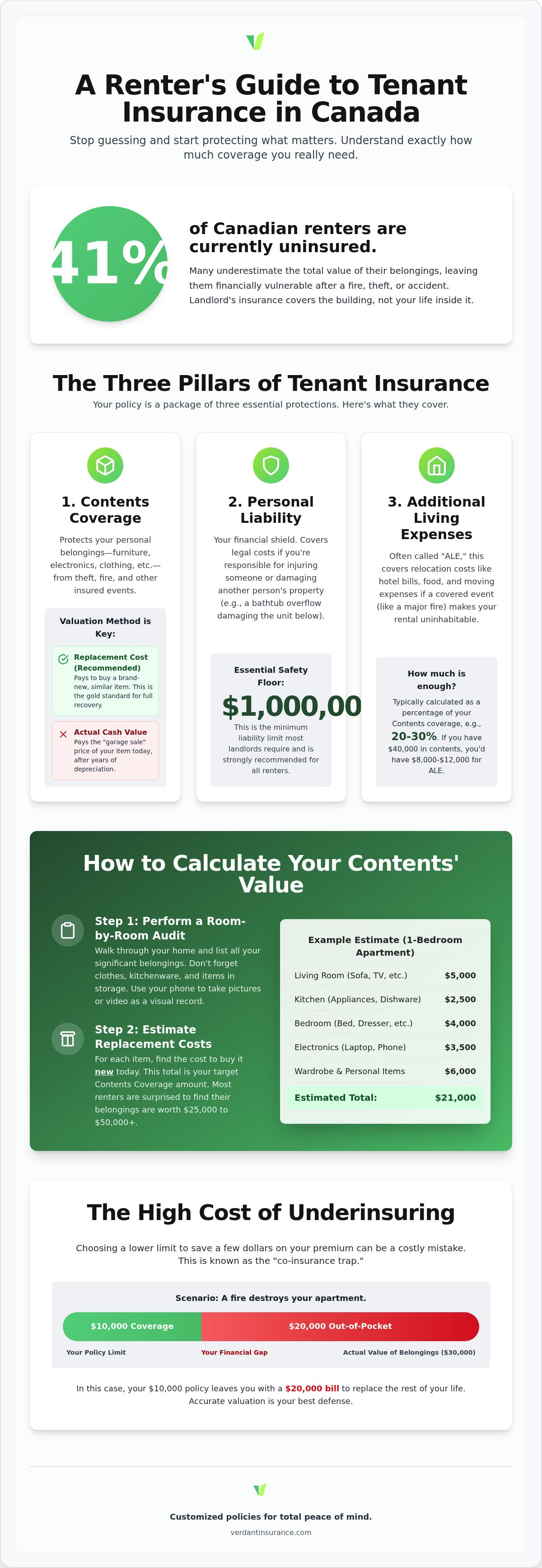
Choosing a limit that's too low can be just as risky as having no insurance at all. Imagine a fire destroys your apartment. If you have $10,000 in coverage but your belongings are actually worth $30,000, you are stuck paying for the majority of your life out of pocket. This is often linked to the co-insurance trap. When you underestimate your needs to save a few dollars on a premium, you're essentially agreeing to share the loss with the insurance company. We want to avoid that. Finding the right limit is a simple, logical process that starts with a clear inventory of what you own, ensuring you only pay for the protection you actually need.
The Three Pillars of Canadian Tenant Insurance Coverage
Calculating your coverage doesn't have to be a guessing game. By breaking your policy into three distinct buckets, you can simplify the math and ensure every dollar of your premium is working for you. When you ask how much tenant insurance do I need Canada, you are really looking for three different numbers that combine into one protective shield. Knowing these categories helps you avoid paying for "invisible" protection you don't actually require.
- Bucket 1: Contents. This covers your personal property, from the couch in your living room to the clothes in your closet.
- Bucket 2: Liability. This is your financial defense if you are held legally responsible for damage to the building or injury to a guest.
- Bucket 3: Additional Living Expenses (ALE). This pays for your relocation costs if a covered event, like a fire or flood, makes your home uninhabitable.
Most renters focus solely on their stuff, but the other two buckets are often what save you from true financial hardship. A well-balanced policy ensures that a single accident doesn't wipe out your savings or leave you without a place to sleep.
Personal Property: Replacement Cost vs. Actual Cash Value
Defining how your belongings are valued is crucial for your peace of mind. Replacement Cost coverage means if your five-year-old laptop is stolen, your insurer pays for a brand-new model of similar quality. Actual Cash Value is different. It pays what your laptop is worth today, which might only be "garage sale" prices after years of depreciation. We find that tenant insurance coverage explained through the lens of replacement cost is the gold standard. It ensures you can actually rebuild your life without spending thousands of your own money to buy new items.
Liability: The Most Important Number You’ll Choose
Liability is the "invisible" part of your policy, yet it is arguably the most vital. If you accidentally leave a tap running and flood the unit below, the repair bills for the floors and ceilings could easily reach six figures. In Canada, $1 million is the standard floor for liability coverage. You might consider bumping this to $2 million if you live in a high-density building or frequently host guests. This is a key consideration for students who share space with roommates, as one person's mistake shouldn't ruin everyone's financial future. Once you've decided on your limits, you can get a customized tenant insurance quote to see how these choices impact your monthly rate. Knowing exactly how much tenant insurance do I need Canada allows you to shop with confidence, knowing you are legally compliant and fully protected.
Step-by-Step: How to Calculate the Value of Your Belongings
To move from guessing to knowing, you should use a Room-by-Room Audit, which remains the gold standard for calculating your personal property limits. This method ensures you answer the question of how much tenant insurance do I need Canada with actual data rather than a random estimate. By taking a methodical approach, you'll avoid the common mistake of picking a round number that sounds "close enough" but leaves you vulnerable if a total loss occurs.
Start by grouping your life into logical buckets. Electronics, furniture, and clothing are the obvious starting points; however, don't overlook the "kitchen sink" items. The small things add up faster than most renters realize. Think about your linens, expensive skincare products, and even your cleaning supplies. Replacing an entire pantry or a fully stocked medicine cabinet after a disaster can cost thousands of dollars on its own. This is why a detailed inventory is the only way to find your true number.
Your smartphone is the most powerful tool in this process. Grab your phone and record a slow, narrated walk-through of each room in your home. Open drawers, peek into closets, and film the labels on your electronics. This visual record provides concrete proof of ownership and condition. It's much easier to settle a claim when you have video evidence of everything you owned before the incident occurred.
The 10-Minute Room Audit
Start in the bedroom. Open your closet and estimate the total cost to replace your entire wardrobe, including shoes and winter gear. Next, list your "Big Three" electronics; your laptop, phone, and television usually represent your highest individual values. Finally, walk through the kitchen. Small appliances like air fryers, blenders, and high-end espresso machines often total more than your living room furniture when combined. These three steps alone will give you a solid baseline for your contents coverage.
Special Limits: Jewelry, Bikes, and Collectibles
Be aware that standard policies often include sub-limits for specific high-value categories. While your total limit might be $30,000, your policy might only cover $5,000 for jewelry or $1,500 for a bicycle. If you own a $3,000 e-bike or a high-value engagement ring, you'll need to "schedule" that item separately. This means adding a specific rider to your policy to ensure the item is covered for its full replacement value. It's helpful to review the renter insurance Canada cost guide to see how these specific add-ons might influence your monthly premium. Scheduling ensures you receive the full value without being capped by standard policy restrictions.
Choosing Your Liability and Additional Living Expense Limits
Once you've audited your belongings, it's time to look at the numbers that protect your future income and your temporary housing. While contents coverage is about replacing stuff, liability and Additional Living Expenses (ALE) are about preventing financial ruin. When determining how much tenant insurance do I need Canada, the liability portion is often the most critical choice you'll make. It serves as your financial shield if you're sued for accidentally causing property damage or if a guest is injured in your home.
Most Canadian experts agree that $1,000,000 is the absolute floor for liability. It might sound like a lot, but legal fees and medical settlements can deplete this amount faster than you'd expect. Your lifestyle plays a massive role here. For instance, if you're a smoker or own a pet, your risk of a fire or a dog-bite claim increases. Students often face unique risks too. High-traffic living situations with frequent guests and parties create more opportunities for accidents, making a $2,000,000 limit a much safer bet for those in university housing or shared rentals.
Calculating ALE for the Canadian Market
Additional Living Expenses (ALE) is the part of your policy that pays for your life if you're forced out of your home. If a pipe bursts in your Toronto apartment, you'll need a place to stay. Considering local hotel rates in major hubs like Toronto or Ottawa, which can easily exceed $250 per night, your ALE limit needs to be robust. A reliable rule of thumb is to set your ALE at 20% to 30% of your total contents limit. This ensures you can cover two to four weeks of hotel stays, takeout meals, and even the cost of professional moving and storage while your unit is being repaired.
The Roommate Factor
A common question is whether one policy can cover everyone in a shared house. Usually, the answer is no. Most policies only cover the person named on the document and their immediate family. If you're living with friends, separate policies are almost always the safer choice. This prevents one person's claim from affecting everyone else's future premiums. For a deeper dive into how to handle these situations, check out our guide on tenant insurance for roommates. Keeping your coverage separate ensures you're only paying for your own risk and your own belongings.
Getting these limits right is the difference between a minor inconvenience and a major debt. You can build your custom tenant policy online to see how adjusting these limits changes your monthly cost. Understanding how much tenant insurance do I need Canada gives you the power to choose protection that fits your specific Canadian city and lifestyle perfectly.
Customizing Your Policy: How Verdant Insurance Simplifies the Process
Once you have determined how much tenant insurance do I need Canada, you want a platform that respects your research. Verdant Insurance simplifies this final step by acting as your digital ally. Our online platform is built to take the specific numbers you've calculated and find the carrier that offers the best fit. We don't just give you a generic price. We help you customize every detail so you are never paying for "ghost" coverage you don't actually require.
Safety pays off with our model. If you have a claim-free history, you can unlock savings of up to 30% on your premiums. This reward for responsible renting makes high-quality protection much more accessible. While our process is tech-forward, we haven't lost the human touch. If you feel stuck on your inventory math or want a professional to verify your liability limits, our brokers are ready to assist. We provide the stability of an expert with the ease of a modern app.
The pressure from a landlord to provide proof of insurance can be stressful. We solve this by providing instant digital proof the moment your policy is active. There is no waiting for the mail or chasing down a representative. You can sign your lease with confidence, knowing your compliance is handled immediately.
Getting a Quote in Minutes
Our online interface is designed for total clarity. You can easily adjust your deductibles to see exactly how they impact your monthly premium. A higher deductible can lower your monthly cost, giving you control over your budget. This transparency ensures that the final policy feels tailored to your financial goals. It's about providing peace of mind through a simple, logical sequence that respects your time and your wallet.
Why a Broker Beats a Direct Insurer
Verdant operates as a broker, which gives you a significant advantage over going directly to a single insurance company. We compare multiple partner carriers to find the most competitive rates for your specific needs. It's the same logic used for customizable car insurance, applied to your rental home. We work for you, not the insurance company, ensuring you get the best value available in the Ontario market. Finding the right answer to how much tenant insurance do I need Canada is only half the battle; the other half is finding a broker that offers the flexibility to match those numbers. Get your personalized tenant insurance quote from Verdant today!
Secure Your Space with Confidence
Finding the right balance for your policy doesn't have to be a stressful calculation. By breaking your needs into contents, liability, and living expenses, you've already done the heavy lifting. You now know that a simple room-by-room audit is the best way to answer how much tenant insurance do I need Canada without overpaying for coverage you'll never use.
Ready to put those numbers to work? You can calculate your needs and get a quote in 3 minutes through our streamlined platform. We help you set customizable limits for every budget while offering instant digital proof for your landlord. Plus, if you have a clean record, you could save up to 30% on your premiums.
Protecting your home should feel like a relief, not a chore. Our team is ready to ensure you have the peace of mind you deserve today.
Frequently Asked Questions
How much tenant insurance do I need for a 1-bedroom apartment in Canada?
Most 1-bedroom renters find that $30,000 to $40,000 in contents coverage is the ideal sweet spot for their belongings. This amount typically covers a standard setup of furniture, mid-range electronics, and a full wardrobe. You should also ensure you have at least $1 million in liability to satisfy your lease. Since every apartment is unique, your specific inventory might require higher limits if you own high-end hobby gear or designer items that add significant value.
Is $10,000 enough for my personal belongings?
For most Canadian renters, $10,000 is rarely enough to replace a full household of items. While it might cover a basic bed and a laptop, it often falls short when you factor in clothing, kitchen appliances, and linens. Underestimating your needs can lead to significant out-of-pocket costs after a claim. We recommend a minimum of $30,000 to ensure you aren't left struggling to rebuild your lifestyle from scratch after a disaster.
Does tenant insurance cover my laptop if it’s stolen outside my apartment?
Yes, most comprehensive tenant policies include worldwide coverage for your personal property. If your laptop is stolen from your car or a coffee shop, your insurance typically treats it as a covered loss, subject to your deductible. This off-premises protection is a massive benefit for students and professionals who travel frequently. Always check your specific policy limits to ensure high-value electronics are fully protected while you are on the move.
Can I change my coverage limits after I’ve already bought the policy?
You can absolutely adjust your coverage limits at any time during your policy term. If you buy a new expensive mountain bike or upgrade your home theater, simply contact your broker to increase your contents limit. This flexibility ensures your protection evolves alongside your lifestyle. It's a good habit to review your numbers annually or after any major purchase to ensure you are never underinsured as your collection of personal belongings grows.
What is a deductible and how does it affect my "how much" calculation?
A deductible is the amount you agree to pay out of pocket before your insurance coverage kicks in. For example, if you have a $500 deductible and a $2,000 claim, your insurer pays $1,500. Choosing a higher deductible will lower your monthly premium, while a lower deductible makes it easier to file small claims. When asking how much tenant insurance do I need Canada, consider your savings and pick a deductible you can comfortably afford in an emergency.
Will my tenant insurance cover my pet if they bite someone?
Most tenant insurance policies include liability protection that covers legal fees and medical bills if your pet bites a guest. This coverage usually applies both inside your home and at the park. However, certain high-risk breeds or pets with a history of aggression might be excluded from standard policies. It is vital to disclose your pet details to your broker so they can find a partner carrier that offers the specific protection you need.
Is tenant insurance cheaper if I bundle it with my car insurance?
Bundling your tenant and auto insurance is one of the most effective ways to lower your overall costs. Most insurance providers offer a multi-policy discount that can save you a percentage on both premiums. This approach also simplifies your life by keeping all your protection under one roof. When you speak with a broker, always ask about bundling options to see if you can maximize your savings while maintaining high coverage limits.
What does tenant insurance NOT cover in Canada?
Tenant insurance typically does not cover the physical structure of the building, as that is your landlord's responsibility. It also excludes damage from specific events like pests, wear and tear, or intentional acts. High-value items like rare collectibles or expensive jewelry often require a separate "floater" because they exceed standard sub-limits. Understanding these exclusions helps you determine how much tenant insurance do I need Canada to fill any potential gaps in your safety net.