

If your upstairs neighbor accidentally leaves a tap running and ruins your laptop, do you know who actually pays for the replacement? Many Canadians believe their landlord's policy covers their personal items, but that's a mistake that can cost thousands. Getting tenant insurance coverage explained doesn't have to be a chore. It's about making sure your favorite tech and your financial future stay safe, regardless of what happens in the unit above or below you.
We understand that insurance often feels like a confusing mix of "contents" and "liability" talk that seems designed to be complicated. You're likely looking for a way to stay protected without breaking the bank, especially with the 2026 rent increase guidelines in Ontario set at 2.1 percent. You deserve to feel secure in your home without worrying about the fine print or being held responsible for building damage you didn't cause.
This guide promises to clear the air. You'll discover exactly what your policy covers and how to value your belongings so you aren't paying for more than you need. We will walk through the three main pillars of coverage, from protecting your gear to shielding you from liability claims. By the end, you'll have the tools to choose a policy that offers total peace of mind.
Key Takeaways
- Understand why tenant insurance is your personal safety net, focusing on your belongings and liability rather than the building's physical structure.
- Identify the three core pillars of protection that work together to shield you from property loss, legal liability, and unexpected relocation costs.
- Having tenant insurance coverage explained helps you distinguish between replacement cost and actual cash value payouts to secure the right level of protection.
- Discover how your coverage travels with you, protecting your tech and gear in your vehicle, storage units, or even while on vacation.
- Learn how a digital broker helps you compare customizable policies and find potential savings of up to 30 percent for being claim-free.
What is Tenant Insurance Coverage and Why is it Essential?
Think of your policy as a three-part safety net designed specifically for renters. While it might seem like just another monthly bill, it's actually a comprehensive shield for your lifestyle. Having tenant insurance coverage explained clearly helps you see that it isn't just about "stuff." It is a financial tool that protects your savings if a disaster strikes. This protection is vital because it covers your financial interests in ways a landlord never will.
Essentially, What is Tenant Insurance Coverage is a contract between you and an insurer. It ensures that your personal interests are protected, regardless of what happens to the building itself. Most policies come in two flavors: "named perils" and "all-risk." A named perils policy covers specific events like fire, smoke, or wind. An all-risk policy is much more robust. It covers everything except for specific items explicitly listed as exclusions. It's the gold standard for those who want to sleep soundly at night, knowing they are prepared for the unexpected.
The Landlord vs. Tenant Insurance Myth
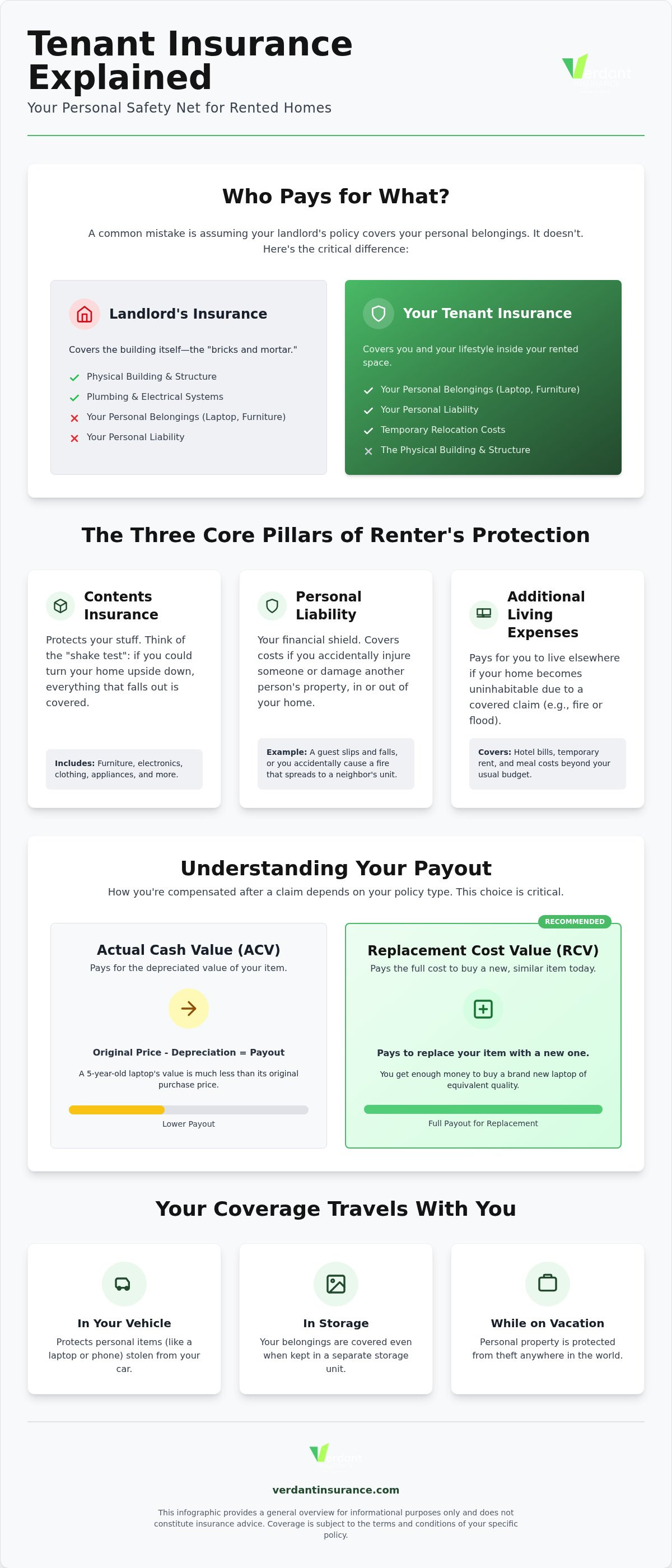
A common mistake is assuming your landlord has you covered. They don't. A landlord's policy is strictly for the "bricks and mortar." They protect their investment, not yours. If a pipe bursts in the unit above you, the landlord's insurance will pay to replace the soggy drywall and fix the plumbing. However, it won't pay a cent for your water-damaged laptop, your designer rug, or your bed frame. This is why having your own policy is non-negotiable for anyone who values their belongings.
This divide is clear. You are responsible for everything inside the four walls of your home. Without your own policy, a single accident could result in a total financial loss of your belongings. You'd be starting from scratch at a time when you're already dealing with the stress of a damaged home.
Is Tenant Insurance Mandatory in Ontario?
Technically, there is no provincial law in Ontario that forces every renter to buy insurance. However, the legal landscape allows landlords to make it a requirement of your lease agreement. In 2026, it's becoming rare to find a professional property manager who doesn't insist on seeing a certificate of insurance before handing over the keys. This is a standard contractual requirement that protects both parties and ensures the landlord isn't held liable for your personal losses.
If your lease includes an insurance clause, you are legally bound to maintain that coverage throughout your tenancy. It's a small price to pay for the security it provides. By ensuring you have tenant insurance coverage explained before you sign, you can move into your new home with total confidence. You'll know that you're meeting your obligations while securing your own financial future.
The Three Core Pillars of Renter’s Protection
Insurance isn't a single, rigid product. It's a customizable safety net built on three distinct pillars that work together to prevent a total financial loss. Getting tenant insurance coverage explained means looking at how these parts protect your belongings, your savings, and even your temporary housing needs. Because every renter has a different lifestyle, these pillars are flexible, allowing you to adjust your limits based on what you actually own.
Many people delay getting covered because they assume it's a major expense. However, tenant insurance affordable Canada is more accessible than most realize, often costing less than a few takeout coffees a month. When you see how much protection you get in return, the value becomes clear.
Contents Insurance: Protecting Your Stuff
This is the part most people are familiar with. A simple way to think about contents is the "shake test." If you took your apartment, turned it upside down, and shook it, everything that would fall out is covered under this pillar. This includes your furniture, electronics, clothing, and even smaller appliances. To get the most out of this, it's a great idea to keep a digital home inventory. Having photos and receipts of your gear makes the process much faster if you ever need to file a claim after a fire or theft.
Personal Liability: Your Financial Shield
Liability is arguably the most important part of your policy. It protects you if you're held responsible for accidental damage to the building or if someone gets hurt in your home. For example, if you accidentally leave a bathtub running and it floods the apartment below, you could be on the hook for thousands in repairs. Liability coverage steps in to handle those costs and legal fees. Interestingly, this protection often follows you outside the home, shielding you if you accidentally cause damage while you're traveling or away from your unit.
Additional Living Expenses (ALE): Your Backup Plan
If a disaster like a fire in a neighboring unit makes your home unliveable, ALE is your financial lifeline. It covers the "increase" in your cost of living while you're displaced. If you have to stay in a hotel for a month and spend more on meals because you don't have a kitchen, ALE helps cover those extra bills. It ensures that a temporary crisis doesn't turn into a long-term debt problem. If you're ready to see how these pillars fit your specific budget, exploring a customized quote is the perfect next step for your peace of mind.
Replacement Cost vs. Actual Cash Value: How Claims are Paid
When you have tenant insurance coverage explained by a professional, one of the most critical details to grasp is how your insurer calculates a payout. It isn't just about having coverage; it's about how much money actually lands in your bank account after a loss. This choice is a major factor in determining your renter insurance Canada cost, as premiums vary based on the level of protection you select. Understanding these payout methods ensures you aren't left with a financial shortfall when you need to refurnish your apartment.
Most renters find that the cheapest policy isn't always the best value in the long run. Balancing your monthly budget with your potential out of pocket expenses is key to true financial security. We always suggest looking at the payout method before signing your documents. It changes everything about your recovery process after an accident.
Understanding Replacement Cost
Replacement cost coverage is the gold standard for most Canadian renters because it focuses on your future, not the past. It pays for a brand new version of your item at today's market prices, regardless of how old the original was. Imagine a fire ruins your five year old television. With replacement cost, your insurer provides enough funds to buy a new TV of similar quality at 2026 prices. It's the stress free choice because it allows you to maintain your current lifestyle without dipping into your personal savings. This coverage essentially ignores the wear and tear your belongings have faced, making it the most supportive option for a quick recovery.
The Reality of Actual Cash Value (ACV)
Actual Cash Value, or ACV, is a different story altogether. This method defines the value of your items as "Replacement Cost minus Depreciation." It essentially pays you what your items were worth as used goods on the day they were lost. Let's look at that same five year old TV again. While a brand new model might cost $600, a used five year old version might only be worth $50 at a second hand shop. Under an ACV policy, $50 is all you would receive. This creates a "depreciation trap" that can leave you with a significant financial gap. While ACV policies often have lower monthly premiums, they can turn a claim into a major financial hurdle. Always double check your policy to ensure your tenant insurance coverage explained matches your actual needs for protection.
Beyond the Apartment: Storage Units and Roommates
One of the most surprising benefits of a modern policy is that it doesn't just stop at your front door. When you have tenant insurance coverage explained by a proactive guide, you'll find that your protection actually follows you. Whether your laptop is stolen from your car while you're at the gym or your luggage goes missing during a flight to Vancouver, your off-premises coverage is there to help. This portability is a huge win for active renters who spend a lot of time on the go, as it ensures your lifestyle is protected wherever you happen to be.
Things get a bit more complex when you live with others. Shared housing is common in 2026, but sharing a single policy isn't always the best move. Each person typically needs their own individual protection to ensure their specific belongings and liability are fully covered. If you're living in a shared space, checking out this guide on tenant insurance for roommates will help you decide the best way to structure your policy. It's a simple step that prevents massive headaches if one person has a claim and the other doesn't.
Tenant Insurance for Storage Units
If you're between moves or just decluttering, you'll be happy to know that most policies extend a percentage of your coverage to off-site storage units. Typically, this is limited to about 10 percent of your total contents limit or a specific flat amount. It's a vital safety net, but it isn't unlimited. If you're planning to keep high-value items in a unit for more than 30 days, you should notify your broker. They can help you adjust your limits so your "extra" space is just as secure as your main living room.
High-Value Items and "Scheduling"
Standard policies are great for general belongings, but they often have "sub-limits" for specific categories. This means there's a maximum payout for things like jewelry, high-end bicycles, or specialized tech. If you own a $5,000 mountain bike, a standard policy might only cover $1,000 of it. To fix this, you can "schedule" an item. Scheduling involves adding specific, extra protection for a prized possession to ensure you're covered for its full value. We recommend keeping digital photos and receipts for any item worth over $1,000. It makes the tenant insurance coverage explained in your policy much more effective during a claim. If you have a collection that needs extra care, getting a quick quote from a digital broker is the best way to see how affordable customized protection can be.
Finding Your Best Policy with Verdant Insurance
Choosing the right protection shouldn't feel like a second job. As a digital broker, Verdant Insurance acts as your proactive guide, navigating the complex Canadian market to find the best fit for your specific needs. Instead of checking dozens of websites, you can use our online platform to compare rates from multiple trusted partners in minutes. It's a modern approach designed for busy Ontario renters who value both their time and their budget. When you have tenant insurance coverage explained by experts who prioritize your experience, the process becomes transparent and surprisingly simple.
Our focus is on delivering a service that feels personal yet efficient. If you've maintained a clean record, you could see savings of up to 30 percent on your premiums. We believe in rewarding responsible renters with affordable options that don't compromise on the quality of protection. By combining a tech-forward interface with a dedicated support team, we ensure you get the best of both worlds: speed and reliable human expertise.
How to Estimate Your Coverage Limit
One of the most common questions we hear is "how much coverage do I actually need?" A simple way to find your number is to do a quick room-by-room mental walkthrough of your apartment. Start in the living room and tally up the cost of your sofa, television, and sound system. Move to the bedroom and consider your mattress, bed frame, and the total value of your wardrobe. Don't forget the kitchen, where small appliances and cookware can quickly add up to several thousand dollars. For a standard one-bedroom apartment in Ontario, $30,000 is often a solid starting point for a contents limit. It's always better to slightly over-estimate your needs than to find yourself under-insured after a major loss. This ensures that your tenant insurance coverage explained earlier in this guide actually covers the full cost of your lifestyle.
The Verdant Advantage: Simple, Digital, Reliable
We've built our platform to provide reassurance through clarity. While our interface is sleek and modern, there is a dedicated team of professionals standing behind every quote. We help you customize your policy so you're only paying for the protection you actually need. Whether you're a student in a studio or a family in a three-bedroom rental, we tailor the limits to match your reality. This level of care provides true peace of mind, knowing your financial security is handled by a team that genuinely wants to simplify your life. You can rest easy knowing that your home, your gear, and your future are in good hands.
Secure Your Rental Future Today
Your home is where your life happens, and it deserves to be protected. Now that you've had tenant insurance coverage explained, you have the knowledge to choose a policy that truly fits your lifestyle. Whether you're protecting a high-end bike or simply making sure you have a place to stay if a pipe bursts, the right coverage offers a level of security that a landlord's policy simply cannot match.
We believe that finding this peace of mind should be fast and straightforward. By working with a trusted Ontario-based brokerage, you can access customizable policies built for any budget. Responsible renters with a clean record can even save up to 30 percent, making professional protection more affordable than ever. It's a simple way to shield your savings and your future from the unexpected.
Don't leave your financial stability to chance. Get your personalized tenant insurance quote in minutes and enjoy the comfort of knowing you're fully covered. You've worked hard for what you have; let's make sure it stays safe.
Frequently Asked Questions
Does tenant insurance cover my roommates belongings?
No, your policy generally only covers the people named on the document. Unless you have a specific joint policy, your roommate needs their own separate protection for their gear. Having each person's tenant insurance coverage explained clearly is the best way to avoid confusion during a claim. It ensures that your friend's laptop and your own furniture are both protected by dedicated limits, preventing any financial strain if an accident occurs.
Will tenant insurance cover a bed bug infestation?
Generally, no. Most insurance policies view bed bugs and other vermin as a maintenance issue rather than a sudden, accidental event like a fire. While your policy covers many perils, pest control and the replacement of infested furniture usually fall outside standard protection. You should check your lease agreement, as Ontario landlords are often responsible for pest treatment costs in the building, though they won't pay to replace your personal items.
Does tenant insurance cover my car if it is stolen from my driveway?
No, your car itself is covered by your auto insurance policy, not your tenant insurance. However, if personal items inside the car, like your laptop or gym bag, are stolen, your tenant policy usually steps in to cover those contents. This is a great example of how different policies work together to protect your lifestyle. Just remember that the vehicle's physical loss belongs to your auto insurer, while the items inside belong to your renter's policy.
How much does tenant insurance typically cost in Ontario?
Prices vary based on your specific location and the total value of your belongings. Many renters in Ontario find that basic protection is quite budget-friendly, often costing less than a monthly streaming subscription. Your final rate depends on your claims history and the deductible you choose. By working with a digital broker, you can compare different partner rates to find a plan that fits your financial goals while providing total peace of mind.
Is my bicycle covered if it is stolen from outside my apartment?
Yes, most policies include "off-premises" coverage that protects your gear even when you're away from home. If your bike is locked outside a shop or at work and gets stolen, you can typically file a claim. Be sure to check your policy's sub-limits for bicycles. If you have a high-end racing bike, you might need to "schedule" it to ensure you receive its full replacement value if it disappears from a bike rack.
What happens to my insurance if I move to a different rental?
Your coverage doesn't automatically follow you to a new address forever, but most policies offer a grace period during the move. You must notify your broker as soon as possible to update your address. Your premium might change slightly depending on the new building's location and safety features. Keeping your tenant insurance coverage explained and updated ensures there are no gaps in your protection while you settle into your new home and unpack your boxes.
Can my landlord force me to get a specific amount of liability coverage?
Yes, landlords in Ontario can legally require a specific amount of liability coverage, such as $1 million or $2 million, as a condition of your lease. This protects them if you accidentally cause major damage to the building, like a fire or flood. While the law doesn't mandate insurance, your signed contract does. It's a standard practice that helps both you and the landlord manage potential risks and ensures you aren't personally sued for damages.
Does tenant insurance cover damage I accidentally cause to my own stuff?
No, standard policies typically don't cover "accidental damage" you cause to your own property, like dropping your phone or spilling wine on your own rug. Insurance is designed to protect against specific perils like fire, theft, or water damage from a burst pipe. However, if you accidentally damage the landlord's property or a neighbor's belongings, your liability coverage will likely step in to handle the repair costs and any potential legal fees you might face.