

Would you let your roommate co-sign for your credit card or share your personal credit score? Probably not. Yet, many people treat tenant insurance for roommates as a simple shared expense without realizing it creates a similar, high-stakes financial bond. You're likely looking for the easiest way to satisfy your landlord's lease requirements while keeping your monthly costs low. It's natural to feel confused about whether your landlord's policy covers your belongings or how to split a premium fairly when everyone in the house has different stuff.
In this guide, you'll learn exactly how to protect your personal belongings and liability without risking your future insurance history. We'll show you why a "financial marriage" with a roommate might be a mistake and how keeping separate policies can actually secure you a claim-free discount of up to 30 percent later on. We will provide a clear answer on shared versus separate policies, break down the 2026 Ontario rental regulations, and offer a step-by-step path to getting the right coverage for your specific living situation.
Key Takeaways
- Learn why tenant insurance for roommates is a vital three-part shield that protects your belongings, liability, and temporary housing costs.
- Discover why separate policies are often safer than shared ones for protecting your claim-free status and potential 30 percent savings.
- Understand the "Joint and Several Liability" risk where one roommate's claim can negatively impact your own insurance rates for years.
- Follow a simple guide to reviewing your Ontario lease requirements and setting clear expectations with your housemates.
- See how easy it is to use digital tools to compare quotes from multiple carriers and find the best rate for your specific rental unit.
Understanding Tenant Insurance for Roommates in Ontario
When you sign the Ontario Standard Lease Agreement, you'll likely notice a clause requiring proof of insurance. Landlords mandate this because it reduces their risk, but it's just as important for you. Many renters assume their landlord's policy covers them. In reality, the building owner's insurance only protects the physical structure, not your personal property. If a fire breaks out, the landlord gets a new roof, but you're left replacing your own furniture and tech. Tenant insurance for roommates is a specialized policy that provides coverage for individuals living together in a shared rental unit.
The Three Pillars of Renter Protection
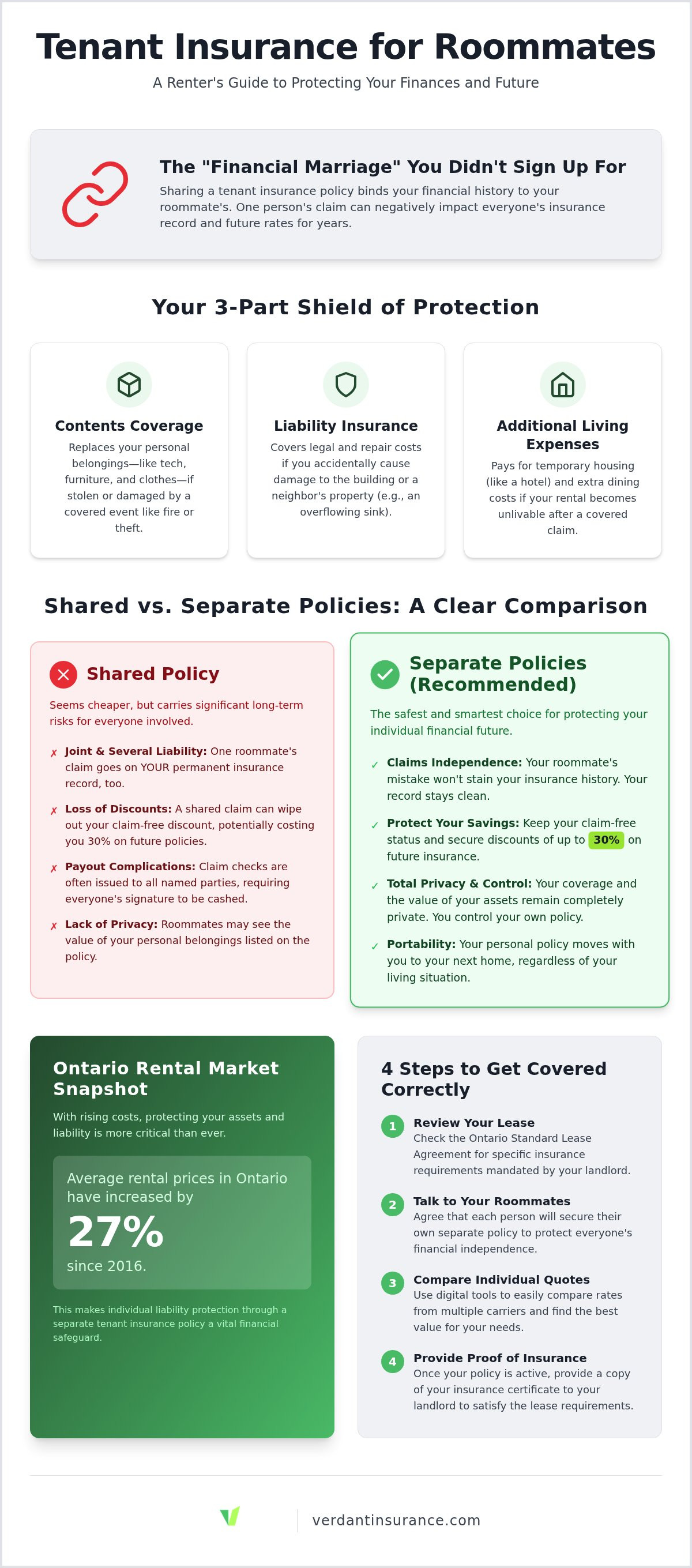
Think of your policy as a three-part shield designed to keep you financially stable when things go wrong. It's about more than just your stuff; it's about your legal and financial safety. A standard policy includes:
- Contents Coverage: This replaces your tech, clothes, and furniture if they're stolen or damaged by a covered peril like fire or water damage.
- Liability Insurance: If you accidentally cause damage to the building or a neighbor's property, such as an overflowing sink that floods the unit below, this covers the legal and repair costs.
- Additional Living Expenses (ALE): If your apartment becomes unlivable after a claim, this pays for hotel stays and extra dining costs while you're displaced.
Why Roommates Are a Unique Insurance Category
Insuring a shared home isn't the same as insuring a family home. Roommates have distinct financial interests and separate assets. Unlike a married couple, your belongings aren't "shared" in the eyes of an insurer. Most companies follow an "unrelated parties" rule. This means they view each roommate as a separate entity with their own risk profile.
In Ontario's 2026 rental market, where rental prices have increased by 27 percent since 2016, protecting your individual liability is more critical than ever. One roommate's mistake shouldn't have to ruin your financial future. Having the right tenant insurance for roommates ensures that your credit and history remain protected, even if your housemate is less careful than you are. It creates a professional boundary in a shared living space, giving everyone peace of mind without the messy overlap of shared financial records.
Shared vs. Separate Tenant Insurance: Which Is Better?
Deciding how to handle tenant insurance for roommates often feels like a choice between saving a few dollars or keeping your independence. While splitting a single policy might seem like a quick way to lower your monthly expenses, it often creates a "financial marriage" that can lead to complicated breakups. Most roommates don't realize that a shared policy binds your insurance records together, potentially impacting your ability to get affordable coverage years down the road.
In a shared policy, you are tied by "Joint and Several Liability." This legal term means the insurance company views all roommates as one entity. If your roommate leaves a candle burning and causes smoke damage, the claim is filed against the policy. Because your name is on that document, the claim goes on your permanent record too. This can wipe out the 30 percent claim-free discount you might have spent years building.
Another headache arises during the payout process. When a claim is approved, the insurance company typically issues a check made out to every person named on the policy. You'll need your roommate's signature to cash that check. If you aren't on good terms or they've already moved out, getting your hands on those funds becomes a logistical nightmare. Finding "Tenant Insurance Affordable Canada" options doesn't have to mean sharing a policy; individual plans are often the smarter long-term investment.
The Case for Separate Policies (Recommended)
This is our recommended path for most renters in Ontario. It offers total privacy because your roommate won't know the value of your laptop, jewelry, or other personal assets. It also provides portability. Your policy moves with you to your next rental, even if your current roommate stays behind. Most importantly, it ensures claims independence. If your roommate has a mishap, it doesn't leave a "stain" on your insurance record. If you're unsure which path fits your current rental, you can compare individual rates online to see how affordable your own policy can be.
When a Shared Policy Might Work
Sharing might make sense if you are living with a sibling or a common-law partner. In these cases, your assets and financial lives are often already intertwined. Some landlords might also strictly require one policy per unit for their own administrative ease. However, for most unrelated roommates, the small monthly savings aren't worth the long-term risk to your insurance history. Individual tenant insurance for roommates allows you to satisfy your lease requirements while keeping your financial life completely separate.
The Risks of Sharing a Renter’s Insurance Policy
A common question many renters ask is: "Why should I care if my roommate makes a claim?" It seems logical that if your housemate causes a kitchen fire or loses their laptop, it shouldn't affect you. However, when it comes to tenant insurance for roommates, insurance providers don't see individuals; they see a single policy. If you share a policy, you're viewed as a single entity. This means a claim by one is legally a claim by all.
This "one for all" approach has a significant impact on your wallet. For instance, Verdant offers a claim-free discount of up to 30 percent for clients with a clean history. If your roommate files a claim on a shared policy, that discount vanishes for everyone named on the document. You could end up paying higher premiums for years, even after you've moved into your own place. Some advanced policies include a "Roommate Exclusion" clause to mitigate certain risks, but these are rare and often complex to navigate.
The Liability Firewall
Individual policies act as a professional firewall between you and your roommate's guests. Imagine a scenario where your roommate hosts a party and a guest trips over a loose rug, resulting in an injury. If you have a shared policy, you are both potentially liable in a lawsuit. However, with separate tenant insurance for roommates, your policy only responds to your own negligence. This prevents you from being legally entangled in a roommate's personal accidents. Being a primary policyholder on your own plan is far more secure than being listed as an additional insured on someone else's, as it gives you full control over your coverage limits and claim decisions.
Roommate Turnover and Policy Cancellations
Ontario's rental market is transient, with people moving frequently for work or school. Shared policies are notoriously fragile during these transitions. If the lead roommate who set up the account moves out without notifying the insurer, the entire policy could be cancelled for misrepresentation. This leaves you unknowingly uninsured and in violation of your lease. Individual policies are the cleanest solution for this environment. Your coverage stays active regardless of who moves in or out of the other bedrooms, ensuring you never face a gap in protection or a sudden cancellation notice.
Step-by-Step: Setting Up Roommate Insurance the Right Way
Getting your tenant insurance for roommates sorted doesn't have to be a bureaucratic headache. By following a logical sequence, you can ensure everyone is protected without overpaying or leaving gaps in your coverage. Start by reviewing your lease agreement. In Ontario, most landlords specify a minimum liability coverage, typically $1 million or $2 million. Failing to meet these minimums could put your tenancy at risk if your landlord decides to strictly enforce lease terms under the updated 2026 Residential Tenancies Act provisions.
Next, sit down and draft a simple "Roommate Agreement." This document isn't just about who buys the milk; it should outline insurance expectations, such as who is responsible for paying the premium and how you'll handle any deductibles if a common area is damaged. After that, take a quick inventory of your high-value items. Laptops, e-bikes, and musical instruments are expensive to replace, and having a list ready makes the quote process much faster. Finally, get individual quotes to compare the costs of a shared policy versus the price of two separate plans. Often, the independence and "claim-free" protection of a separate plan are worth the small difference in monthly cost.
The Roommate Insurance Conversation Guide
Before you sign anything, have an honest chat with your housemates. This isn't about being nosy; it's about protecting your own insurance record and future discounts. Ask these three specific questions to gauge the risk level of your shared home:
- "Have you ever been denied insurance or had a policy cancelled for any reason?"
- "Do you own any high-risk items like a trampoline or have a pet breed that might affect our liability coverage?"
- "Can we agree to a protocol for reporting any potential accidents or damages to each other immediately?"
Setting these ground rules early prevents awkward surprises during a claim and ensures that everyone understands the importance of maintaining their coverage.
Managing Your Policy Online
The modern rental market moves fast, and your insurance should keep up. Using digital tools allows you to update your address or coverage limits in minutes without waiting on hold. It's also vital to store digital receipts and photos of your belongings in the cloud so they're accessible even if your phone is lost or damaged. If you're ready to start your search, check out our Tenant Insurance Affordable Canada guide for step-by-step instructions on getting a quote.
Verdant makes the entire process effortless by offering 100 percent online policy management. You can get a customized tenant insurance quote in just a few clicks and have your proof of insurance ready for your landlord today.
Finding Affordable Tenant Insurance with Verdant Insurance
Securing your financial independence shouldn't be a stressful chore. At Verdant Insurance, we act as your proactive guide, simplifying the complexities of the Ontario rental market so you can focus on enjoying your home. We've built our platform to be the friendly expert you need, stripping away the dense jargon and replaced it with clear, actionable solutions. By choosing an individual policy, you're taking a significant step toward protecting your personal credit and insurance history, ensuring that a roommate's accidental mishap doesn't derail your future plans.
Our digital brokerage model is designed for efficiency and transparency. We partner with 16 different insurance carriers to compare rates and coverages instantly. This means you don't have to spend hours calling different companies to find the best tenant insurance for roommates. Instead, our platform does the heavy lifting, presenting you with customized options that fit your specific budget and coverage needs. It's a modern approach that puts you in the driver's seat of your own protection.
One of the biggest advantages of our model is the potential for long-term savings. We reward responsible renters with a claim-free and conviction-free discount of up to 30 percent. As we discussed earlier, keeping your policy separate is the only way to guarantee that your roommate's claims history doesn't strip you of this valuable benefit. We believe in rewarding your care and attention to detail, helping you keep more money in your pocket as you move through your rental journey.
Why Ontario Renters Choose Verdant
Our team understands the specific challenges of renting in Ontario, from the high costs in cities like Toronto to the strict enforcement of the 2026 Residential Tenancies Act updates. We prioritize your peace of mind by offering:
- Localized Expertise: We know Ontario's unique laws and Standard Lease requirements inside and out.
- Clarity and Comfort: Our process is designed to be supportive, making you feel secure and well-cared for from start to finish.
- Seamless Transitions: If you move to a new apartment or change roommates, our team makes updating your policy effortless.
Get Your Quote in Minutes
You shouldn't have to wait days for a response from a traditional broker. Our application process is 100 percent online, allowing you to secure coverage during your lunch break or while you're packing boxes. You can easily customize your limits to ensure you're meeting your landlord's requirements without paying for "fluff" you don't need. Take control of your rental experience and get your personalized tenant insurance quote today.
Secure Your Independence and Peace of Mind
Living with others in Ontario's fast-paced rental market requires more than just a shared chore list; it requires a plan to protect your financial future. You now understand that while sharing a policy might seem like a simple way to save, choosing separate tenant insurance for roommates is the most effective way to safeguard your own record. By maintaining your own policy, you build a professional boundary that protects your personal belongings and ensures a roommate's accidental claim doesn't follow you for years to come.
Verdant Insurance is here to help you move forward with confidence. We offer 100 percent online quotes tailored specifically for Ontario renters, making it easy to satisfy your lease requirements in minutes. Trusted by thousands of Canadian tenants, our platform compares multiple carriers to find you the best value. You can even save up to 30 percent if you maintain a claim-free record. Don't leave your protection to chance or tied to someone else's history.
Get an Affordable Tenant Insurance Quote Online
Your home is your sanctuary, and we're ready to help you protect it with the care and attention you deserve. You've got this!
Frequently Asked Questions
Can roommates share a single tenant insurance policy in Ontario?
Yes, most insurance companies in Ontario allow unrelated roommates to share a single policy, though some providers limit this to two people. While this satisfies the landlord's requirement for tenant insurance for roommates, it means you're both legally responsible for the policy. You'll need to decide who manages the payments and how to divide the coverage limits for your individual belongings to ensure everyone's tech and furniture are sufficiently protected.
Is it cheaper to have separate tenant insurance policies or one shared policy?
A shared policy is typically cheaper in the short term because you split one premium. Separate policies are often more cost-effective over time. If a roommate makes a claim on a shared plan, your future rates will likely increase. By keeping your own policy, you maintain your eligibility for claim-free discounts of up to 30 percent. This can save you hundreds of dollars as you move through different rentals in Ontario.
Does my roommate’s insurance cover my belongings if I am not on the policy?
No, your roommate's policy won't protect your personal items unless your name is explicitly listed as a named insured. Insurance contracts are specific to the individuals mentioned on the document. If a theft or fire occurs, the insurer will only pay for the belongings owned by the person named on the policy. To avoid being left with nothing, you should either join their policy or secure your own individual coverage.
What happens to our insurance if my roommate moves out?
You must contact your insurance broker immediately to update the policy. If the person who moved out was the primary contact, the insurer may need to cancel the old policy and issue a new one in your name. Failing to update this information can lead to a claim denial later. Keeping separate policies avoids this administrative hurdle because your coverage remains active regardless of who moves into or out of the other bedrooms.
Will a claim made by my roommate affect my insurance record?
Yes, any claim filed on a shared policy becomes part of the insurance history for every person named on that document. This means even if you weren't involved in the accident, the claim stays on your record. This can make it more difficult or expensive to get tenant insurance for roommates in the future. Separate policies provide a protective barrier, ensuring your housemate's mistakes don't impact your personal insurance standing or future premiums.
How much liability coverage should roommates have in Ontario?
While most Ontario landlords require a minimum of $1 million in liability coverage, many experts suggest increasing this to $2 million for shared households. Shared living situations often carry higher risks due to more foot traffic from guests and a higher likelihood of accidental damage. Increasing your limit is usually very affordable, often costing only a few extra dollars per month. It provides much better protection against potential lawsuits or major building repairs.
Does tenant insurance for roommates cover damage to the landlord’s property?
Yes, the liability portion of your policy covers accidental damage you or your roommates cause to the building. This includes common incidents like a kitchen fire or an overflowing bathtub that damages the floors or the unit below. It doesn't cover intentional damage or wear and tear. Having this coverage is a standard requirement in the Ontario Standard Lease because it ensures the landlord can recover costs without taking you to court.
Can I add a roommate to my existing insurance policy later?
Most insurers allow you to add a roommate to your existing policy by filing an endorsement. You'll need to provide their full legal name and potentially details about their insurance history. Keep in mind that adding a person usually increases the premium and changes your policy to a shared legal interest. It's often simpler to have your new roommate get their own individual quote online to keep your financial records and claim histories completely separate.