

What if your condo building's insurance policy covers the roof and the lobby but leaves your custom kitchen and hardwood floors completely unprotected? It is a common worry for Canadian condo owners who feel overwhelmed by jargon like "betterments" or "loss assessment." You likely pay your monthly fees and hope the corporation has everything handled, yet the line between their responsibility and yours is often a confusing blur. When you start looking for condo insurance quotes online, you deserve a clear path that respects your time and your budget.
We understand that you want to feel secure in your home without overpaying for coverage you do not need. This guide will help you discover the critical differences between condo and home insurance so you can protect your personal belongings and upgrades with confidence. We will break down the essential "walls-in" coverage concept and explain how to bridge the gap between your unit and the building's master policy. By the end, you will have a stress-free way to compare options and ensure you are not left footing the bill for a major building leak.
Key Takeaways
- Understand the "walls-in" concept to ensure every inch of your unit, from the flooring to the paint, is properly protected.
- See how condo insurance offers a more affordable way to secure your lifestyle since you only pay to protect your specific unit and belongings.
- Avoid the financial shock of building-wide repairs by including Loss Assessment coverage in your policy.
- Learn how to properly document betterments so your granite counters and luxury upgrades aren't left out of a claim.
- Use a modern digital platform to compare condo insurance quotes online and find a policy that fits your budget in minutes.
What is Condo Insurance? Understanding the 'Walls-In' Concept
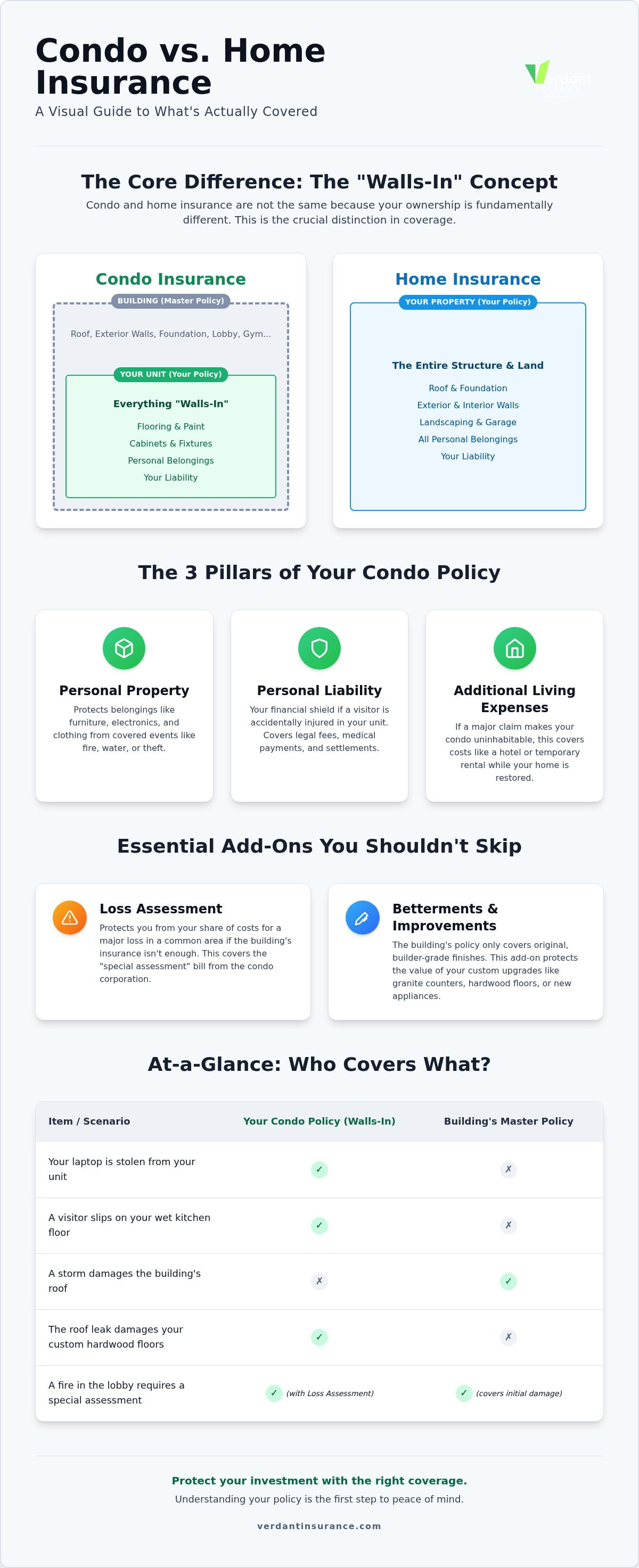
Condo insurance, often referred to as an HO-6 policy, is a specialized type of protection designed specifically for unit owners. While many people start by researching home insurance basics, condo coverage is unique because you don't own the entire physical structure. Instead, your policy focuses on the "walls-in" concept. This means you're responsible for everything from the drywall inward, including your flooring, cabinetry, and light fixtures. It's a personal contract between you and your insurer that exists entirely separate from your building's board or the condo corporation.
In Ontario, carrying a personal policy isn't a legal requirement under provincial law. However, almost every mortgage lender in Canada will demand proof of insurance before they release your funds. Even if you've paid off your mortgage, most condo bylaws now require owners to have active coverage. It's a vital step in protecting your investment and ensuring you're not personally liable for accidents that happen inside your unit.
Why Your Condo Corporation’s Policy Isn't Enough
Many owners assume their monthly maintenance fees cover all necessary protection. They don't. The "Master Policy" held by the condo corporation is designed to protect the building's shell, common areas like the lobby or gym, and the original structure. Your personal furniture, high-end electronics, and designer clothing are completely excluded from that coverage. The building policy stops at your front door. If a pipe bursts in the hallway, the building covers the hallway carpet, but they won't replace your soaked velvet sofa or your laptop.
The Three Pillars of Individual Condo Protection
When you start comparing condo insurance quotes online, you'll notice three main categories of coverage that form your safety net. Each one serves a distinct purpose in your overall protection plan.
- Personal Property: This protects the items that make your unit a home. From your bed to your kitchen appliances, this ensures you can replace your belongings if they're damaged by fire, water, or theft.
- Personal Liability: This is your financial shield if someone is accidentally injured while visiting your unit. It covers legal fees and potential settlements so a simple trip and fall doesn't become a financial disaster.
- Additional Living Expenses: If a major claim makes your condo uninhabitable, this pillar helps cover the costs of a hotel or temporary rental. It ensures you have a place to stay while your home is being restored.
Finding the right balance across these pillars is much easier when you use a modern digital broker to browse condo insurance quotes online. This approach allows you to see how different coverage limits impact your premium in real-time.
Condo Insurance vs. Home Insurance: The Structural Difference
Understanding the structural difference between a detached house and a condominium unit is the first step toward getting accurate condo insurance quotes online. When you buy a traditional house, you own the land, the foundation, the siding, and the roof. You're responsible for every brick. In a condo, you technically own the "air space" between your walls and the interior finishes. This distinction creates a shared responsibility model where you and your neighbours collectively manage the building's exterior while remaining individually responsible for your own living spaces.
Because of this split, home insurance includes the cost of maintaining and replacing the entire exterior structure. If a tree falls on a house, the owner's policy covers the roof repair. In a condo, the corporation's policy handles the roof, but you must insure your own floors and cabinets. According to NAIC Homeowners Insurance resources, these ownership boundaries are the primary factor in how insurers calculate your risk and determine your monthly costs.
Ownership Limits: Structure vs. Unit
Homeowners must insure every shingle and structural beam. If a storm hits the siding, their policy pays for the fix. Condo owners depend on the corporation's master policy for these exterior elements. However, if that same storm causes a leak that ruins your custom hardwood floors or designer wallpaper, the building's policy won't help you. Your personal policy must step in to cover those "walls-in" repairs. This limited scope is a major reason why the average cost of home insurance Ontario residents pay for detached houses is significantly higher than what a unit owner pays for their specific space.
The Premium Gap: Why Condo Insurance Costs Less
The main reason for the price difference is the "rebuild value." A homeowner's policy covers the entire cost of rebuilding the house from the ground up, including the foundation and framing. A condo policy only covers the cost of replacing your interior finishes and personal belongings. You aren't paying to rebuild the entire building's concrete shell or its parking garage. This makes the entry point much more accessible for many. For those looking at home insurance for first time buyers, starting with a condo is often a more budget-friendly way to enter the property market.
Deductibles also work differently in a condo environment. While a homeowner pays one deductible for a claim, a condo owner might face their own deductible plus a portion of the corporation's massive deductible if a loss originates in their unit. If you want to see how these structural differences impact your monthly budget, you can compare plans with a friendly expert who can help you find the best condo insurance quotes online for your specific building.
Deciphering Loss Assessment: The #1 Reason for Online Quotes
Imagine opening your mail to find a surprise bill for C$20,000 from your condo board. It isn't a mistake; it's a special assessment. This happens when the building faces a massive claim that exceeds its insurance limits or falls under a high deductible. Many owners mistakenly believe the building's corporation will always foot the bill. In reality, when the corporation's funds run dry, the unit owners are legally responsible for the balance. This financial shock is the single biggest reason people seek out condo insurance quotes online to find a policy that includes robust protection.
Loss assessment is essentially your share of a collective loss. Whether it is a major fire in the lobby or a significant liability lawsuit filed against the condo board, these costs are shared. Relying on the assumption that "the building will just pay for it" is a dangerous gamble. While the corporation manages the common areas, the financial burden of a shortfall eventually lands on the individuals living inside. Having the right coverage prevents these shared losses from turning into personal financial ruin.
When the Master Policy Hits Its Limit
Every building policy has a ceiling. If a catastrophic event occurs and the costs spiral beyond that limit, the board has no choice but to levy a special assessment. For example, if total damages reach C$15 million but the building only carries C$12 million in coverage, that C$3 million gap is divided among the owners. Without Loss Assessment Coverage, you would be forced to pay your portion out of pocket. Your personal policy acts as a vital safety net, stepping in to cover these shared expenses so your savings remain protected.
Deductible Assessment: A Stealthy Cost
Building deductibles in Canada have increased significantly, often reaching C$50,000 or even C$100,000 for water damage claims. If a leak starts in your dishwasher and damages the units below, the board may hold you responsible for the corporation's entire deductible. This is a stealthy cost that many owners don't see coming until it's too late.
We highly recommend that you check your building's status certificate to confirm the current deductible amounts. Knowing these specific numbers allows you to be precise when you compare condo insurance quotes online. By matching your personal coverage to the building's deductible, you ensure you're never left vulnerable to a sudden, massive bill from your board.
Key Coverage Pillars to Evaluate in Online Quotes
When you start looking for condo insurance quotes online, it is easy to get distracted by the lowest price. However, the real value of a policy lies in its specific coverage pillars. You need to ensure your policy addresses the unique risks of high-density living, from shared plumbing systems to the custom upgrades that make your unit feel like home. A good policy doesn't just check a box for your mortgage lender; it acts as a comprehensive safety net for your lifestyle.
Beyond the basics, you should consider modern add-ons like identity theft protection and personal umbrella liability. Identity theft coverage helps with the legal fees and administrative costs of restoring your credit, while an umbrella policy provides an extra layer of liability protection that extends beyond your unit. These options are often very affordable and provide significant peace of mind in our increasingly digital and litigious world.
Insuring Your Upgrades (Betterments)
One of the most misunderstood areas of condo insurance is "Betterments and Improvements." Your building's corporation is typically only responsible for returning your unit to its "standard" condition. If the original building plan included laminate counters but you've installed premium granite, the board's insurance will only pay for laminate. You are responsible for the price difference. This applies even if a previous owner did the renovations. When you request condo insurance quotes online, take a moment to estimate the total value of your custom flooring, cabinetry, and lighting to ensure your limit is high enough to cover a full replacement.
Water Damage: The Condo Owner's Biggest Risk
Water damage is the most frequently claimed item for Ontario condo owners. It is important to distinguish between different types of water risks. A burst pipe inside your wall might be covered by your basic policy, but a heavy rainstorm or a sewer backup requires specific endorsements. We recommend looking for these two essential additions:
- Sewer Backup: This protects you if water or sewage flows backward through your drains, a common issue in older urban infrastructure.
- Overland Water: This covers damage from water entering your unit from the ground level during extreme weather events.
Many insurers offer "water-wise" discounts if your unit has a leak detection system or an automatic shut-off valve. Mentioning these safety features during your search can help lower your premium. If you're ready to see how these pillars fit into your budget, get your personalized quote today and protect your investment with the right level of care.
Unit Contingency Protection
Unit contingency is your "just in case" coverage. It steps in if your condo corporation's master policy is inadequate or simply doesn't exist at the time of a loss. While rare, building-wide insurance lapses can happen. This pillar ensures that your own unit remains protected regardless of the board's financial health or administrative errors. It is a proactive way to maintain control over your own security.
How to Get the Best Condo Insurance Quotes Online
Securing the right protection doesn't have to be a chore. When you look for condo insurance quotes online, having a few key documents ready will speed up the process significantly. You should have your building's status certificate on hand, as this document outlines the corporation's deductibles that you need to match. Additionally, keep your mortgage information and a detailed list of your unit's upgrades nearby. This preparation ensures that the quote you receive is a precise reflection of your actual needs rather than a rough estimate.
Once you have your details ready, the most efficient path is to use a digital broker. While direct insurers only offer you one price from one company, a broker platform like Verdant Insurance does the heavy lifting for you. We compare multiple partner carriers to find a rate that fits your specific situation when you start your search for condo insurance quotes online. This approach often reveals significant savings, such as our "Clean Record" discount. If you have been claim-free and conviction-free for several years, you could save up to 30% on your premiums. It's a simple way to reward your responsible history.
The Verdant Insurance Advantage: Broker Expertise Meets Digital Ease
Verdant Insurance acts as your "Friendly Expert" by combining a modern digital interface with deep industry knowledge. We understand that you want the convenience of an online tool but the security of knowing a professional has reviewed the fine print. Instead of a generic estimate, you get a personalized quote that bridges the gap between your corporation's master policy and your individual unit. This level of care provides true peace of mind, ensuring you aren't overpaying for redundant coverage or leaving critical gaps in your protection. We handle the comparison work so you can focus on enjoying your home.
Next Steps: Securing Your Peace of Mind
Taking the next step is simple and usually takes less than five minutes. By starting your journey online, you can quickly see how bundling your condo and auto insurance can simplify your life. Managing multiple policies through one digital dashboard reduces administrative stress and often unlocks deeper loyalty discounts. We pride ourselves on being transparent and supportive, helping you move from confusion to complete confidence. Our goal is to make the insurance process feel effortless and accessible. Start your journey today and discover how easy it is to protect your Canadian lifestyle with a policy built just for you.
Protecting Your Lifestyle with Confidence
Protecting your home is about more than just checking a box; it's about securing the life you've built within those walls. You now understand the "walls-in" concept and how to bridge the gap where your building's master policy stops. By focusing on essential pillars like loss assessment and betterments, you can avoid the financial shock of unexpected building-wide claims or repair costs.
Finding the right balance of coverage and cost is easy when you use our simple platform to compare condo insurance quotes online. You can evaluate top Canadian insurers in minutes and see how a clean record could save you up to 30% on your premiums. Our Ontario-based team is here to provide expert support whenever you need it, ensuring your experience is smooth and stress-free.
Ready to see how much you can save? Get your personalized condo insurance quote online with Verdant today. It takes less than five minutes to secure the peace of mind you deserve. We are excited to help you protect your home with a plan that truly fits your budget and your life.
Frequently Asked Questions
Is condo insurance mandatory in Ontario?
Provincial law in Ontario does not require you to carry condo insurance. However, your mortgage lender will almost certainly make it a condition of your loan. Most condo corporations also include a requirement in their bylaws that all unit owners must maintain a valid personal policy to protect the community from shared liability risks.
Does my condo insurance cover the building's roof or lobby?
Your personal policy does not cover the building's roof, lobby, or elevators. These common elements fall under the condo corporation's master policy, which is funded through your monthly maintenance fees. Your individual coverage is strictly for your unit and personal liability, ensuring you don't pay for structural repairs that the collective board manages.
What is the difference between a master policy and a unit owner policy?
The master policy is a collective contract that protects the entire building structure and shared spaces against major perils. In contrast, a unit owner policy is your personal safety net for everything inside your home. While the master policy handles the "bones" of the building, your policy covers your furniture, clothing, and the specific finishes unique to your unit.
How much does condo insurance typically cost per month in Ontario?
While costs vary based on your location and coverage limits, the national average for a standard policy is approximately C$68 per month. In Ontario, your specific rate will depend on the age of your building and the value of your belongings. You can find the most accurate pricing for your specific unit by comparing condo insurance quotes online through a digital broker.
Will my condo insurance cover my roommate's belongings?
Typically, your policy only covers the belongings of the person named on the contract and their immediate family members living in the unit. A roommate's furniture, electronics, and clothing are not protected under your policy. Your roommate should secure their own tenant insurance policy to ensure their personal assets are fully covered in the event of a fire or theft.
What happens if I make upgrades to my kitchen after I buy my policy?
If you renovate your kitchen, you must notify your insurance provider to adjust your "Betterments and Improvements" limit. Failing to update your policy means your new granite counters or custom cabinets may only be insured for the value of the original, builder-grade finishes. Keeping your insurer informed ensures your investment is protected at its current market value.
Can I get a discount if I have a clean driving record?
Yes, maintaining a clean driving record can lead to significant savings on your total insurance costs. Many providers offer a discount of up to 30% for clients who are claim-free and conviction-free. When you look for condo insurance quotes online, bundling your auto and home policies is one of the most effective ways to lower your monthly premiums.
How do I know if I have enough loss assessment coverage?
You should match your loss assessment limit to the highest deductible listed in your building's status certificate. For example, if your corporation has a C$50,000 deductible for water damage, you should ensure your personal policy can cover that full amount. This prevents you from being forced to pay a massive special assessment out of your own savings if a major loss occurs.