

Did you know that while home insurance isn't legally required in Ontario, your mortgage lender won't let you close on your dream house without it? It's a sudden hurdle that many people face just as they're ready to celebrate. Between confusing mortgage insurance with home insurance for first time buyers and worrying about a premium adding to your monthly payment, the process can feel like a lot to handle. We understand that you want to move in on time and feel confident that your new home is truly protected.
This guide will help you secure a great rate and get your proof of insurance ready for your lawyer long before closing day. We'll walk through the specific coverage types you need in the current Canadian market, explain why residential rebuild costs have climbed over 23% in recent years, and show you how to find a policy that fits your budget. You'll gain a clear understanding of what you're paying for, including how to leverage credits like the C$4,000 land transfer tax refund, so you can focus on the excitement of your new keys.
Key Takeaways
- Moving day shouldn't be delayed by last-minute paperwork. Learn why your lender requires proof of coverage and how to get it ready for your lawyer on time.
- Navigate the choices between comprehensive and named perils to secure the best home insurance for first time buyers while staying within your budget.
- You have more control over your costs than you might think. Discover how your credit score and bundling options can lead to significant savings on your monthly premiums.
- Use our simple step-by-step timeline to ensure your policy is active and your financing is secure before your closing date arrives.
- See the broker advantage in action. We'll show you how shopping multiple carriers helps you find a policy that fits your specific needs and provides total peace of mind.
Home Insurance for First Time Buyers: More Than a Closing Requirement
You’ve finally found the right place in Ontario. The keys are almost in your hand. Then, your lawyer calls and asks for "proof of insurance." It can feel like one more hurdle in a long race, but this requirement is actually a safety net for your future. Buying home insurance for first time buyers ensures that your biggest financial investment is shielded from the unexpected. Homeowner insurance is a policy covering the physical structure, contents, and legal liability of the owner. It provides essential peace of mind during one of the biggest transitions of your life.
The Insurance Trinity: Home vs. Mortgage vs. Default Insurance
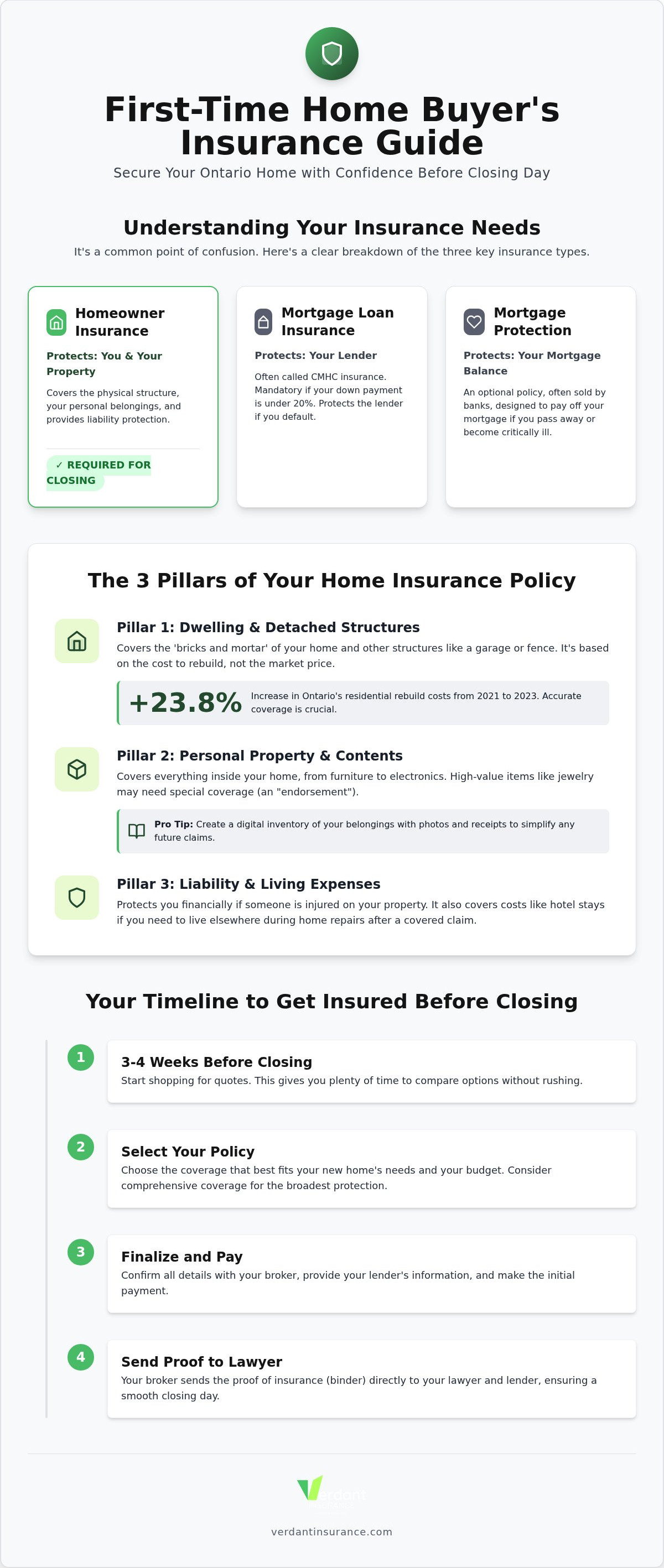
Confusing these three terms is common. Let's clear the air so you know exactly what you're buying. First, there is Homeowner Insurance. This is the policy you get through a broker like Verdant. It covers your house, your personal belongings, and provides liability protection if someone gets hurt on your property. For a deeper dive into the basics, you can read more about What is Homeowners Insurance? and how it functions.
Second, you might encounter Mortgage Loan Insurance, often called CMHC insurance. In Canada, if your down payment is less than 20%, this is mandatory. It doesn't protect you or your house; it protects the lender if you stop paying your mortgage. Finally, there is Mortgage Life or Protection Insurance. This is an optional product often sold by banks. It’s designed to pay off your mortgage balance if you pass away or become critically ill. While all three involve your home, only homeowner insurance protects your actual physical asset.
Why Your Lender Cares About Your Policy
Your bank has a massive stake in your property. Until that mortgage is paid off, the house is their collateral. If a fire or major storm occurs, the lender needs to know the value of that collateral can be restored. This is why they set minimum coverage requirements. They want to ensure the loan is secure even if the building is destroyed.
Lenders specifically look for a "Loss Payable" clause. This legal addition names the financial institution on your policy. It ensures that in the event of a total loss, the lender is compensated for the remaining mortgage balance. It’s a standard part of the process that your broker handles behind the scenes. By securing a solid policy, you're proving to the bank that their investment is in safe hands. This keeps your closing day on track and your move-in date secure.
Decoding Your Policy: What Does First-Time Homeowner Insurance Cover?
Understanding your policy is the first step toward true peace of mind. Most home insurance for first time buyers falls into two categories: "Named Perils" or "Comprehensive." A Named Perils policy only covers specific events listed in the document. In contrast, a Comprehensive policy covers everything except for a small list of exclusions. We usually recommend Comprehensive coverage because it offers the widest safety net. You should also look for "Replacement Cost" coverage. Unlike "Actual Cash Value," which subtracts for age and wear, Replacement Cost pays to buy new items or rebuild your home at today's prices.
Pillar 1: Dwelling and Detached Structures
This part of your policy covers the "bricks and mortar" of your new home. It’s important to remember that your rebuild value isn't the same as your purchase price. While the market price includes the land and location, your insurance focuses on the cost of labour and materials to build the house from scratch. This pillar also extends to detached structures like your garage, garden sheds, or fences. Since residential rebuild costs in Ontario rose by 23.8% between 2021 and 2023, having an accurate estimate is vital for full protection.
Pillar 2: Personal Property and Contents
Everything you move into your new home, from your sofa to your laptop, is covered under personal property. However, standard policies often have "special limits" for high-value items. If you have an engagement ring or a high-end mountain bike, you might need an endorsement to cover their full value. We suggest creating a digital home inventory as soon as you move in. Taking photos of your receipts and belongings makes the process much smoother if you ever need to file a claim. For more tips on preparing for your move, check out this Home Buyer's Insurance Guide for practical advice.
Pillar 3: Personal Liability and Additional Living Expenses
Liability coverage is your shield against legal trouble. If a visitor slips on your icy driveway or a delivery person trips on your porch, this coverage handles legal fees and settlements. It’s a quiet hero in your policy that prevents a single accident from becoming a financial disaster. Similarly, Additional Living Expenses (ALE) step in if a covered event, like a fire, makes your home uninhabitable. It pays for your hotel stays and extra meal costs while your home is being repaired. If you want to see how these coverages fit your specific budget, you can get a custom quote online in just a few minutes.
The Cost of Coverage: How Ontario Home Insurance Premiums are Calculated
Understanding how insurers set your price helps you find savings. While premiums in Ontario rose by 6.2% year-over-year in 2026, you aren't stuck with a high bill. One of the biggest factors in Ontario is your credit score. If you have a solid credit history, insurers often see you as lower risk and reward you with better rates. You can also adjust your deductible to manage your costs. Choosing a higher deductible, like C$1,000 instead of C$500, can lower your annual payments. To see how your quote compares to others, check the average cost of home insurance Ontario for a better perspective on local pricing.
Property-Specific Factors in Ontario
The physical state of your new house plays a huge role in home insurance for first time buyers. Insurers prefer newer roofs and updated heating systems because they are less likely to fail. If you’re looking at an older home in the GTA, pay close attention to the wiring and plumbing. Many companies are cautious about knob and tube or aluminium wiring because they pose fire risks. Similarly, older galvanised pipes can lead to leaks and water damage. Upgrading these systems before you move in can significantly drop your premiums. Check how close your home is to a fire hydrant or station too. Being within 300 metres of a hydrant usually qualifies you for a discount.
Location and Environmental Risks
Where you live in Ontario matters just as much as what you live in. In 2026, climate-related risks like windstorms and hail affect about 35.4% of Ontario postal codes. Because of this, insurers look closely at local flood zones and historical claim data. Sewer backup is now one of the leading causes of claims in the province. Adding specific water damage coverage is essential, especially if you have a finished basement. If your new neighbourhood is considered a low-risk zone for crime and environmental hazards, you'll likely see a more favourable rate. We help by shopping around to find the carrier that views your specific postal code most favourably.
Your Step-by-Step Guide to Securing Coverage Before Closing Day
The weeks leading up to your move are usually a whirlwind of packing and paperwork. To keep things stress-free, follow the "15-day rule." Start shopping for home insurance for first time buyers at least 15 days before your closing date. This gives you enough time to compare options and ensures your lawyer has the necessary documents well in advance. Having a clear timeline prevents last-minute panics and keeps your closing day on track.
Step 1: Gather Your Home's Data
You don't need to be a construction expert to get a quote. Your MLS listing contains most of the details your broker will ask for, including the year the home was built, the total square footage, and the type of heating system. Having these documents handy prevents the back-and-forth emails that can slow down your application. Your home inspection report is another goldmine of information, providing specific details about the age of the roof and the type of electrical panel. An accurate home inspection is the best tool for an accurate insurance quote.
Step 2: Compare and Customise
This is where a broker makes your life easier. Instead of calling five different companies yourself, we do the shopping for you. We'll help you find a balance between a deductible you're comfortable with and a monthly payment that fits your new budget. One of the best ways to save is by bundling your policies. If you link your vehicle to your new property, you can find cheap car insurance Canada options that might drop your home rates by 15% to 20%.
Step 3: Finalise and Forward
Once you've chosen a policy, you'll need to "bind" the coverage. This involves signing the application and making your first payment to ensure the policy is active. Your broker will then issue a "Binder of Insurance." You must send this document to your real estate lawyer immediately. They need it to finalise your mortgage and get the keys ready for you. Make sure the effective date on the policy is your actual closing date, even if you don't plan on moving your boxes in until the weekend.
Ready to check this off your list? Start your free online quote today and get your proof of insurance ready in minutes.
Finding Peace of Mind with Verdant: Your Ally in Home Ownership
Getting the keys to your first house is a milestone worth celebrating. While the paperwork can feel heavy, securing home insurance for first time buyers shouldn't be the part that keeps you up at night. At Verdant, we’ve built our platform to match the pace of your life. Our digital-first approach means you can manage your coverage from your phone while you’re at the hardware store or waiting for the movers. We combine modern technology with a human touch, acting as a friendly expert ready to guide you through the fine print without the cold, bureaucratic tone often found in the industry.
The Broker Advantage for First-Timers
Unlike direct insurers who only offer their own branded products, our broker model connects you with multiple partner carriers across Ontario. This is a massive advantage when you're busy coordinating a move. Instead of spending hours filling out repetitive forms on different websites, you give us your details once, and we do the heavy lifting to find the best fit. This personalised guidance is especially helpful if you’re buying a unique property, such as a historic home in a mature neighbourhood or a rural property with specific needs. We stay with you long after the boxes are unpacked, providing steady support for your first renewal and any life changes that follow.
Start Your New Chapter Today
We believe that being a responsible homeowner should come with tangible rewards. Our team is committed to finding the most affordable rates by identifying every discount you qualify for. If you have a clean driving record and a claims-free history, you could see savings of up to 30% on your premiums. We also look for opportunities to bundle your home and auto policies to maximise your budget. Our streamlined platform allows you to get a quote in under 5 minutes, giving you one less thing to worry about before your closing day arrives.
We’re proud to help new neighbours across the province protect their futures with confidence, clarity, and ease. Your home is your sanctuary, and we’re here to make sure it stays that way. Get your first-time home insurance quote with Verdant and start your journey into homeownership on the right foot.
Protecting Your New Beginning in Ontario
You’ve navigated the house hunt and the mortgage approval; now you have the tools to handle the final hurdle with ease. By understanding the core pillars of coverage and following the 15-day rule for your closing timeline, you’ve turned a complex requirement into a manageable step. Securing home insurance for first time buyers doesn't have to be a source of stress when you have a proactive guide in your corner. You’re no longer just ticking a box for your lender; you’re building a customisable safety net for your future.
Our Ontario-based experts are ready to help you find a policy that fits your budget without sacrificing the protection you need. With access to over 10 partner insurers, we shop around so you don't have to. You can even save up to 30% if you have a claims-free record. It’s time to stop worrying about the fine print and start focusing on where the furniture goes. Secure your first home with an easy online quote from Verdant today. Welcome to the world of homeownership; we’re excited to see you settle in.
Frequently Asked Questions
Is home insurance mandatory for first-time buyers in Ontario?
No, home insurance is not legally mandatory in Ontario, but it is practically required for anyone with a mortgage. Virtually all Canadian lenders demand proof of insurance as a condition of financing. Without an active policy, your bank will not release the funds for your purchase. It is a vital step that ensures both your investment and the lender's collateral are protected from the very first day you own the property.
What is the difference between home insurance and mortgage insurance?
Home insurance protects your physical house, personal belongings, and legal liability. In contrast, mortgage insurance, like CMHC insurance, protects the lender if you stop making your payments. Many people confuse the two, but only home insurance for first time buyers provides a safety net for your own assets. You will likely pay for both if your down payment is under 20%, but they serve completely different purposes in your financial plan.
How much does home insurance cost for a first-time buyer?
The cost varies based on your home's location, age, and rebuild value, but the average annual premium in Ontario was approximately C$2,235 in 2026. Factors like your proximity to a fire station and the age of your roof play a significant role in the final number. While we don't provide set prices without a quote, choosing a higher deductible is a common way for new owners to lower their annual expenses.
Can I bundle my home and auto insurance as a first-time buyer?
Yes, you can almost always bundle your home and auto insurance to unlock significant discounts. Most insurers offer a reduction of 15% to 20% on your premiums when you keep both policies with the same provider. This is one of the most effective ways for a first-time buyer to manage new monthly expenses. It simplifies your paperwork by keeping your coverage under one roof while ensuring both your car and home are secure.
When should I buy home insurance when purchasing a house?
You should start shopping for coverage at least 15 to 30 days before your closing date. This gives your broker enough time to find the best rate and allows your lawyer to review the proof of insurance before the big day. Waiting until the last minute can cause stressful delays in your move. It is much better to have your policy ready and waiting well before you need to pick up your keys.
Does home insurance cover my belongings while I am moving?
Most standard homeowner policies do cover your personal belongings while they are in transit to your new home, typically for a period of 30 days. However, there are often specific limits on how much the insurer will pay for items damaged during the move. It is a good idea to check with your broker to see if you need additional transit insurance. This is especially important if you have high-value items or are using a professional moving company.
What happens if I don't have home insurance on closing day?
If you don't have proof of insurance on closing day, your lender will refuse to release the mortgage funds. This means your real estate lawyer cannot complete the transaction, and your move will be delayed. You might also face financial penalties for breaching your purchase agreement with the seller. To avoid this, ensure your broker sends the insurance binder to your lawyer at least a week before you expect to move in.
Do I need special insurance if I'm buying a condo instead of a house?
Yes, if you are buying a condo, you need a specific condo insurance policy rather than a standard homeowner policy. While the condo corporation usually has a master policy for the building's exterior and common areas, you are responsible for everything inside your unit. This includes your flooring, appliances, personal belongings, and liability. It also covers any upgrades made to the space, ensuring your personal investment is fully protected regardless of the building's main policy.