

Did you know that home insurance premiums in Ontario rose by 4.2% in the second quarter of 2026 alone? For many homeowners, seeing those numbers climb feels like a constant battle against inflation and changing weather patterns. It's completely understandable if you feel frustrated by the lack of transparency in how rates are calculated, especially when a house just a few kilometers away might have a significantly different price tag.
We believe that finding the right protection should be simple and stress-free. This guide provides a clear look at the average cost of home insurance Ontario residents are currently paying, giving you a reliable benchmark for your own property. You'll discover how local factors like aging infrastructure and climate risks impact your bill, and more importantly, how you can take control of your costs.
We are going to break down the latest 2026 price trends for cities across the province, provide actionable tips to lower your premiums, and explain the easiest way to get a customized quote that reflects your unique situation. By the end of this article, you'll have the tools to ensure you're getting the best possible value for your home.
Key Takeaways
- Learn the current average cost of home insurance Ontario residents pay in 2026 to see how your premium compares to the provincial benchmark.
- Discover why your specific postal code is the single biggest factor in your rate and how urban versus rural locations shift your annual costs.
- Understand the critical difference between your home's market value and its replacement cost to ensure you aren't overpaying or underinsured.
- Identify immediate ways to lower your annual bill by strategically adjusting your deductible or bundling your home and auto policies.
- Find out how a broker-led approach can help you secure claim-free discounts of up to 30% through a simple, transparent online process.
What is the Average Cost of Home Insurance in Ontario in 2026?
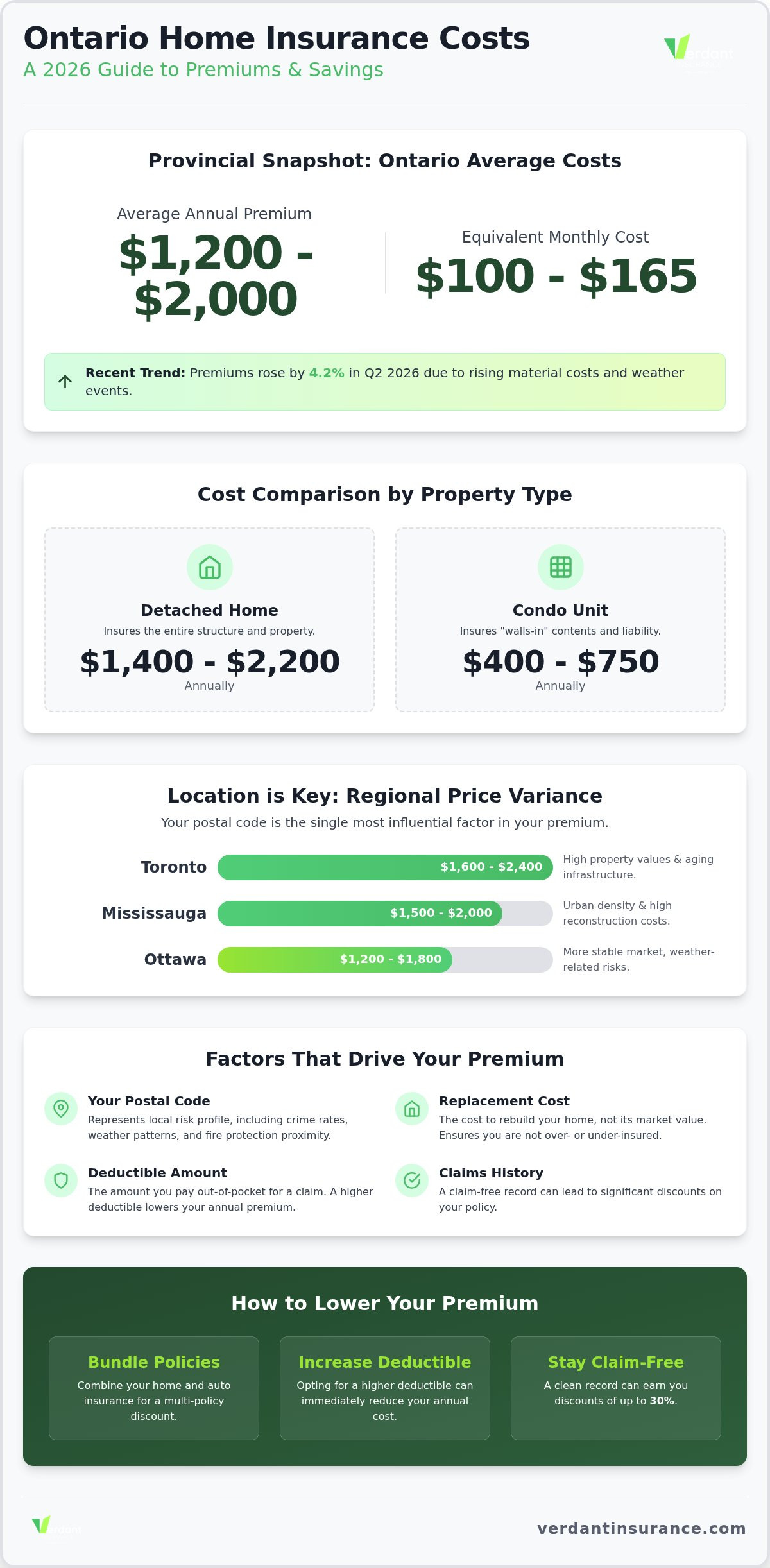
As of mid-2026, the provincial average for home insurance in Ontario typically falls between $1,200 and $2,000 per year. For most families, this translates to a monthly bill of approximately $100 to $165. It's a broad range because the "average" includes everything from high-value lakeside estates to modest studio condos. While the provincial benchmark is a helpful starting point, the price you actually see on a quote depends heavily on your specific property type.
For example, a detached single-family home currently carries a higher typical premium, ranging from $1,400 to $2,200. In contrast, condo owners enjoy much lower rates, usually between $400 and $750 annually, because they only need to insure the "walls-in" portion of their unit. Rates have shifted upward recently, with a documented 4.2% increase in the second quarter of 2026. This rise is largely due to the escalating cost of construction materials and a higher frequency of localized weather events like basement flooding and ice storms.
Understanding Your Premium Components
Your total bill is more than just a single flat fee. It's built from several layers, starting with a base rate that covers the core structure of your home. From there, you add specific riders or endorsements. These are extra protections for risks that aren't always standard, such as sewer backup or overland water coverage. Home insurance in Canada often requires these add-ons in regions prone to heavy rainfall or aging municipal infrastructure. Your choice of deductible also plays a huge role; choosing a higher deductible can pull your personal average down, while a lower one provides more immediate financial relief during a claim but raises your monthly cost.
Why Ontario Rates Differ from the Rest of Canada
Ontario operates within a unique regulatory environment managed by the Financial Services Regulatory Authority of Ontario (FSRA). This oversight helps maintain market stability, but our prices are often higher than those in Quebec due to different liability standards and higher average property values. When comparing the average cost of home insurance Ontario residents pay to those in Alberta, Ontario homeowners generally face fewer wildfire-related surcharges but deal with higher costs driven by extreme urban density. The sheer concentration of high-value real estate in the Greater Toronto Area significantly pulls the provincial average upward, creating a price gap between major cities and more affordable northern communities like Sudbury or Thunder Bay.
Regional Variance: How Your Ontario City Impacts the Price
Your postal code is the single most influential factor in your insurance quote. It's more than just a mailing address; it represents a specific risk profile that includes local crime rates, historical weather patterns, and even the proximity of the nearest fire hydrant. Insurers use this data to determine the likelihood of a claim in your neighborhood, which is why two identical houses in different towns can have vastly different premiums.
While the average cost of home insurance Ontario homeowners pay provides a provincial benchmark, your local reality might look quite different. High-density urban centers often face higher liability risks and increased reconstruction costs, while rural areas deal with unique challenges like limited fire protection services. Understanding these regional nuances helps you see where your money is going and where you might find hidden savings. If you're curious about your specific neighborhood, you can compare local rates online to see how your city stacks up.
The GTA Factor: Toronto, Brampton, and Mississauga
In the Greater Toronto Area, high property values and extreme population density naturally push premiums toward the top of the scale. Toronto homeowners typically pay between $1,600 and $2,400 per year. These costs are driven by the high price of labor and materials in the city, along with aging municipal infrastructure. Older sewer systems in Toronto and Hamilton, for example, lead to a higher frequency of basement flooding claims during heavy rain. In suburbs like Mississauga, premiums remain high, often ranging from $1,500 to $2,000, due to similar density and property value pressures.
Ottawa and Eastern Ontario Benchmarks
Ottawa offers a more stable market compared to the GTA, with average annual premiums ranging from $1,200 to $1,800. The risks here are often weather-related rather than density-driven. Insurers in Eastern Ontario pay close attention to heavy snowfall and wind damage. Historic homes in older Ottawa neighborhoods also carry a surcharge because they often require specialized craftsmanship or obsolete materials to repair after a loss. Despite these factors, Ottawa remains a relatively predictable region for insurance costs.
Northern and Rural Ontario Considerations
Northern Ontario cities like Sudbury and Thunder Bay are among the most affordable, with averages between $1,000 and $1,350. However, rural living introduces the "Distance to Fire Station" rule. If your home is more than 8 kilometers from a fire station or lacks a nearby hydrant, your premium will likely increase. While some worry about "Insurance Deserts" in high-risk zones, this is largely a myth. Even in areas with rising wildfire risks, specialized carriers usually provide coverage, though it may require specific safety upgrades to your property.
Factors That Drive Your Home Insurance Above or Below Average
While the average cost of home insurance Ontario residents pay provides a useful baseline, your specific premium is shaped by the unique details of your life and property. Insurers don't just look at the house; they look at your history. For instance, maintaining a claim-free record is one of the most effective ways to lower your costs. Many providers offer claim-free discounts of up to 30%, which can significantly pull your rate below the provincial average. Conversely, a history of frequent small claims can lead to surcharges or even a loss of standard coverage eligibility.
Technology also plays a growing role in 2026. Installing a monitored security system or smart home sensors that detect water leaks can trigger immediate savings. These devices provide peace of mind and show your insurer that you're proactive about preventing damage before it starts. It's a simple way to demonstrate that your home is a lower risk than the typical property in your neighborhood.
Replacement Cost vs. Market Value
One of the most common points of confusion is why your home is insured for a different amount than its selling price. Your market value includes the land and the desirability of your neighborhood. However, insurance focuses strictly on the replacement cost, which is what it would cost to rebuild your home from scratch today. With construction material costs rising through 2026, the price of lumber and skilled labor has pushed replacement values higher. Adding a "Guaranteed Replacement Cost" rider ensures that even if rebuilding costs exceed your policy limit due to sudden inflation, you're fully covered. This rider adds a small amount to your premium but prevents a massive financial gap during a total loss.
Systemic Upgrades: Roof, Plumbing, and Electrical
The age of your home's vital systems is a major pricing factor. Many insurers now follow a strict "15-year roof rule," where an aging roof might lead to higher premiums or a limited payout for wind damage. Upgrading to impact-resistant shingles can often reverse this trend. Your home's "internal organs" matter just as much. Knob-and-tube or aluminum wiring are considered higher fire risks and can double your premium compared to modern copper wiring. Similarly, installing a backwater valve or a sump pump with a battery backup is a smart move. These upgrades protect you from the basement flooding risks common in Ontario urban centers and are frequently rewarded with lower annual rates.
How to Beat the Ontario Average: Savings Strategies
Beating the provincial benchmark isn't just about luck; it's about using the right strategies to tip the scales in your favor. While the average cost of home insurance Ontario residents face has trended upward, many savvy homeowners pay significantly less by making a few smart adjustments. One of the most effective methods is working with an online broker. Unlike a single agent tied to one company, a broker compares rates across multiple carriers to find the one that rewards your specific home profile with the lowest premium.
Another powerful tool is the deductible. By increasing your deductible from $500 to $2,500, you could reduce your annual premium by 10% to 20%. This math makes sense if you have an emergency fund ready to cover that initial cost in the event of a claim. It's a trade-off that rewards you with lower monthly payments for as long as you remain claim-free. Since claim-free discounts can reach up to 30%, avoiding small, out-of-pocket repairs can preserve your status as a low-risk client and keep your long-term costs down.
The Bundling Advantage
Combining your homeowner and auto insurance under one roof is a classic win-win. Most Ontario insurers offer a discount of 10% to 15% on each policy when you bundle them together. This does more than just save money; it simplifies your life by putting all your coverage details in a single digital portal. For those looking to maximize these savings, check out our Cheap Car Insurance Canada: Ultimate Buying Guide 2026 to see how your vehicle coverage fits into the bigger picture.
Improving Your Insurance Profile
Your lifestyle and financial habits also influence your final quote. In Ontario, insurers are permitted to use a specific metric to help determine risk. An Insurance Credit Score is a numerical representation of your credit history used by insurers to predict the likelihood of future claims. Maintaining a strong credit score can lead to lower rates, as can lifestyle choices like being a non-smoker. These small factors add up, helping you secure a rate that is well below the provincial average. If you're ready to see how much you can save, you can start your customized quote online today.
Get Your Personalized Home Insurance Quote with Verdant
Understanding the average cost of home insurance Ontario residents pay is just the first step toward securing your property. The real goal is finding a rate that fits your budget without sacrificing the protection your family deserves. At Verdant Insurance, we use modern technology to scan the market, identifying specialized policies that often fall below the provincial benchmark. You shouldn't have to pay for a one-size-fits-all policy that includes risks your property doesn't actually face. Instead, we focus on customization, ensuring you only pay for the specific protections that make sense for your home and lifestyle.
The Verdant Insurance Broker Advantage
When you work with a single insurance company, you're limited to their specific pricing math. As a broker, we connect you with multiple partner carriers across the province. This competition works in your favor. It allows us to find the specific insurer that views your home's unique features, like a recent renovation or a smart security system, as a major risk reducer. We also strip away the confusing jargon. Our team explains your policy in plain English, ensuring you feel confident in every choice you make. We're also proactive guides. We help you understand how to maintain your claim-free status to protect those valuable 30% discounts year after year. This long-term approach ensures your rates stay stable even when the provincial average fluctuates.
Start Your Quote Today
You can relieve the stress of overpaying in just a few minutes. Our online platform is designed for simplicity, walking you through a transparent process that respects your time. In about five minutes, you'll have a clear, honest picture of your coverage options compared to the average cost of home insurance Ontario homeowners typically see. There are no hidden fees or complex clauses to decode. Whether you're in a high-density area of the GTA or a quiet town in Northern Ontario, we provide a dedicated support team that understands your local market conditions. We're here to answer your questions and help you navigate the complexities of property protection with ease. Secure your peace of mind today and ensure your home is protected by a policy tailored specifically to your life. Get your personalized home insurance quote now.
Take Control of Your Home Protection Today
We've explored how everything from your postal code to the age of your roof influences your final premium. While the average cost of home insurance Ontario homeowners face has shifted due to inflation and construction costs, you have more control over your bill than you might think. By focusing on smart systemic upgrades, strategic deductibles, and the power of bundling, you can secure a rate that protects your budget as much as it protects your property.
Finding the right coverage doesn't need to be a complex or cold process. At Verdant, we combine modern technology with approachable, local expertise to help you navigate the market. You can compare multiple Ontario carriers in one place, ensuring you never pay for coverage you don't need. Plus, if you've maintained a clean record, you could save up to 30% on your annual bill. Our team is ready to provide the clarity and personalized support you deserve throughout your insurance journey.
Ready to see your real price? Get a customized home insurance quote in minutes and enjoy the comfort of knowing your home is in good hands. Protecting your future should feel this easy.
Frequently Asked Questions
Is home insurance mandatory in Ontario?
Home insurance is not legally required by provincial law, but it is almost always mandatory if you have a mortgage. Lenders require proof of insurance to protect their investment in your property. Even if you own your home outright, maintaining a policy is a smart way to protect yourself from devastating financial losses caused by fire, theft, or liability claims.
How much has the average cost of home insurance in Ontario increased in 2026?
The average cost of home insurance Ontario residents pay rose by 4.2% year-over-year in the second quarter of 2026. This shift is primarily due to the increased cost of skilled labor and construction materials needed for property repairs. Local weather patterns, including ice storms and heavy rainfall, also play a role in driving these provincial averages higher as insurers adjust for more frequent claims.
Does my credit score affect my home insurance rate in Ontario?
Yes, your credit score can significantly influence your home insurance rate in Ontario. Insurers use what is known as an "Insurance Credit Score" to help predict the likelihood of future claims. While it is just one of many factors, maintaining a healthy credit history can lead to more favorable premiums and help you secure rates that sit well below the provincial average.
Can I lower my premium by installing a security system?
You can definitely lower your premium by installing a professionally monitored security system. Most Ontario insurers offer discounts for homes equipped with alarms that alert a central station in case of fire or break-ins. Modern smart home technology, such as water leak sensors, can also trigger savings by reducing the risk of expensive flood damage before it starts, showing your insurer you're a lower risk.
What is the average cost of home insurance for a condo vs. a detached house?
A detached house typically costs between C$1,400 and C$2,200 per year, while condo insurance averages between C$400 and C$750. This significant price gap exists because condo owners only need to insure the interior of their unit and personal belongings. The condo corporation's master policy handles the building's exterior and common areas, which keeps your individual premium much more affordable than a standalone home.
How does a swimming pool affect my Ontario home insurance average?
Adding a swimming pool will generally increase your home insurance premium because it raises your liability risk and the total replacement cost of your property. Insurers consider pools a higher risk feature due to the potential for accidents. You may need to increase your liability coverage limits to ensure you're fully protected, which adds a small, manageable amount to your annual bill for the extra peace of mind.
Why is my home insurance quote higher than the provincial average?
Your quote might be higher than the provincial average if you live in a high-density area like Toronto or own an older home with aging systems. Factors like knob-and-tube wiring, a roof older than 15 years, or a history of recent claims can all push your rate upward. Customizing your policy to remove unnecessary riders or increasing your deductible are effective ways to bring that number back down.
Does home insurance cover sewer backups in Ontario?
Sewer backup coverage is typically not included in a standard home insurance policy and must be added as a specific endorsement. Because aging municipal infrastructure in cities like Hamilton and Toronto has led to more frequent flooding, adding this protection is a smart move. It provides peace of mind by covering the expensive cleanup and repair costs that follow a basement backup, which standard policies usually exclude.