

Why does moving just two blocks away or switching to a hybrid SUV suddenly add hundreds of dollars to your monthly bill? You've likely felt the frustration of watching a car insurance premium calculator Canada tool spit out a number that feels completely arbitrary. It's exhausting to feel like you're stuck inside a pricing "black box" where the rules change without warning. Most drivers assume these rates are set in stone; however, the truth is much more flexible once you understand the underlying math.
We're here to help you regain control and find peace of mind. You'll discover the specific variables insurers use to settle your rates, including how the July 2026 Ontario reforms regarding optional accident benefits might change your perspective on value. We'll show you how to use online tools effectively and explain why a personalized broker approach often beats a generic algorithm. This guide provides a clear roadmap to lower your premiums and the confidence to choose coverage that actually protects your wallet.
Key Takeaways
- Using a car insurance premium calculator Canada is a great starting point, but knowing how to interpret the results is what leads to the lowest possible rate.
- Your postal code and driving history are the heavy hitters in insurance math, but they aren't the only variables you can influence.
- Simple strategic shifts, like adjusting your deductibles, can create immediate downward pressure on your calculated premium estimates.
- The July 2026 Ontario auto insurance reforms offer new ways to customize your coverage and potentially reduce your costs by choosing only the benefits you need.
- Generic tools often overlook specialized discounts, making the human expertise of a broker essential for finding the most competitive market price.
What is a Car Insurance Premium Calculator in Canada?
A car insurance premium calculator Canada is a sophisticated online tool designed to simplify the complex world of actuarial science. It uses historical data and mathematical models to estimate what you might pay for coverage either monthly or annually. Essentially, it acts as a digital bridge between your personal information and the vast databases insurers use to measure risk. Think of it as a helpful starting point that provides clarity before you commit to a specific policy. It helps you see how different choices, like your deductible amount, might impact your bottom line.
The math behind these tools changes depending on where you live. Vehicle insurance in Canada operates under a mix of public and private systems. In provinces like British Columbia or Saskatchewan, public entities set the rates. However, in Ontario's private market, competition and individual risk factors play a much larger role. A premium is the cost of transferring your financial risk to an insurer. By using a calculator, you're essentially getting a preview of how an insurer views your risk profile based on regional statistics.
Estimates vs. Firm Quotes: Know the Difference
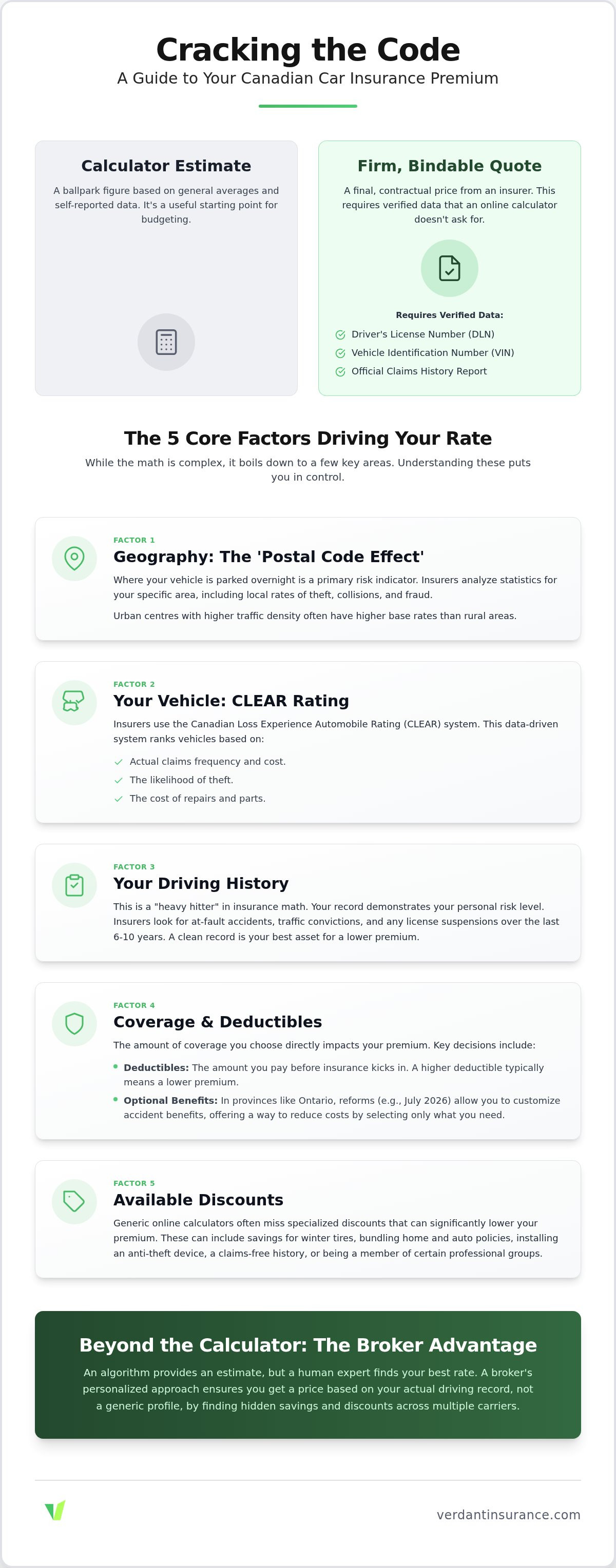
Calculators provide a ballpark figure based on general averages and your self-reported data. While they're incredibly useful for budgeting, they aren't final contracts. A firm, bindable quote requires verified data that a basic calculator doesn't ask for, including:
- Your Driver’s Licence Number (DLN)
- The Vehicle Identification Number (VIN)
- Your specific claims history report from Autogreen or similar databases
At Verdant Insurance, we use your initial estimate as a launchpad. It helps our team understand your needs so we can begin a personalized search across our partner carriers. This human-led approach ensures you get a price based on your actual driving record rather than a generic profile. We act as your Friendly Expert, interpreting these numbers to find hidden savings that an algorithm might miss.
Why Ontario Drivers See Different Results
Ontario uses a private, "no-fault" insurance system. This means your own insurer handles your claims regardless of who caused the accident. Because of this structure and the high density of vehicles in areas like the Greater Toronto Area (GTA), calculator algorithms often show higher averages for Ontario drivers compared to other provinces. High traffic volumes and repair costs in urban centers directly influence the math.
Recent reforms effective July 1, 2026, have also changed how these calculations work. For instance, the property damage threshold for minor accidents has increased to $5,000. Additionally, auto insurance is now the primary payer for medical expenses before supplementary health plans are used. These factors, along with your choice of optional accident benefits, are the "hidden" gears turning inside every car insurance premium calculator Canada. Understanding these nuances helps you make better decisions about which benefits to keep and which to customize for your peace of mind.
The 5 Main Factors Driving Your Insurance Math
Every car insurance premium calculator Canada uses a set of core variables to determine your risk level. While it might feel like the tool is picking numbers out of thin air, it's actually following a strict logical framework. Insurers look at thousands of data points to predict the likelihood of you making a claim. You can review the official factors determining your rate to see how regulators oversee these categories. By understanding these five pillars, you can begin to see where your specific savings are hidden.
Geography and the 'Postal Code Effect'
Your neighbourhood is often the most significant "hidden" factor in the calculation. Insurers group drivers into risk pools based on where the vehicle is parked overnight. If your postal code has high rates of auto theft or frequent collisions at local intersections, your estimate will reflect that collective risk. For example, urban centres in the Greater Toronto Area often see higher premiums due to increased traffic density and theft statistics. Parking in a private, secure garage rather than on a public street can sometimes help lower that risk profile in the eyes of a provider. Moving even a few blocks into a different postal zone can noticeably shift your results.
The Vehicle's Role: CLEAR Ratings Explained
The type of car you drive is just as important as your driving record. Canadian insurers use the Canadian Loss Experience Automobile Rating (CLEAR) system. This system ranks vehicles based on actual claims data rather than just the retail price. A car with a high safety rating that is rarely targeted by thieves will result in a lower premium estimate. Modern vehicles equipped with Advanced Driver Assistance Systems (ADAS) are also starting to influence these algorithms. While these features make cars more expensive to repair, their ability to prevent accidents often leads to long term savings on your premium.
Beyond where and what you drive, your personal history and habits complete the picture. Consider these three final factors:
- Driving History: This is your most powerful tool for savings. Being claim-free and conviction-free can lead to discounts of up to 30%.
- Usage Patterns: A 50-kilometre daily commute costs more to insure than a vehicle used only for weekend errands. Be honest about your annual mileage to ensure your estimate is accurate.
- Demographics: Age and experience play a massive role. Data shows that a driver with 35 years of experience can pay up to 4.7 times less than a new learner.
It's helpful to remember that an algorithm can't see the full context of your life. Our team can help you interpret your results and identify specific discounts that a generic tool might overlook.
Why Calculators Aren't Quotes: Avoiding Common Pitfalls
Many drivers experience "quote shock" when their final monthly bill doesn't match the number from a car insurance premium calculator Canada. This gap usually happens because of the "Garbage In, Garbage Out" rule. If the data you provide is even slightly off, the estimate won't be useful. These digital tools are designed for speed rather than surgical precision. They often rely on broad averages that don't account for your unique lifestyle, professional affiliations, or the nuances of your driving record.
At Verdant, we see these tools as a starting point. They're great for getting a general sense of the market, but they can't replace the insight of a broker who knows which specific carriers reward your particular habits. We bridge the gap between a ballpark estimate and a real, bindable policy that fits your budget.
Common Data Entry Errors
Small mistakes during the input phase lead to large discrepancies later. Accuracy is your best friend when looking for a reliable estimate. Consider these three common areas where data often goes wrong:
- Annual Mileage: Many people guess their commute distance. Underestimating your mileage might give you a lower estimate, but it will lead to a price jump once the insurer verifies your daily habits.
- Secondary Drivers: Forgetting to list a spouse or a licensed teenager in the household is a frequent oversight. Adding them later often changes the risk math significantly.
- Insurance History: Reporting a "clean" record when you had a minor fender-bender three years ago will trigger a recalculation. Insurers will eventually pull your official reports, so it's better to be upfront from the start.
The 'Hidden' Discounts Calculators Miss
Generic algorithms are rarely programmed to find every niche discount available in the Canadian market. This is where you can find substantial savings that a car insurance premium calculator Canada might overlook. For example, bundling your auto policy with homeowner or tenant insurance is one of the most effective ways to lower your total cost. Most calculators treat these as separate silos, missing the multi-policy synergy.
We also focus on rewards for your personal history. Claim-free and conviction-free drivers can see savings of up to 30% through our partner carriers, a tier that generic tools often fail to apply automatically. Additionally, many insurers now offer telematics or usage-based insurance. These programs use a smartphone app to track your actual driving behavior, offering a personalized rate that goes far beyond what a standard calculator can predict. By working with a human guide, you ensure these "hidden" opportunities are actually applied to your final price.
How to Lower Your Estimated Premium Before You Buy
Before you commit to a vehicle, you can compare the insurance cost before buying the car to see how different makes and models may affect your premium.
You don't have to accept the first number a car insurance premium calculator Canada gives you. Think of these digital tools as a sandbox where you can test different scenarios to see what sticks. By making a few strategic adjustments to your profile, you can often see the estimated cost drop in real-time. This proactive approach gives you the power to design a policy that fits your budget without sacrificing the protection you need. By experimenting with these variables, you can see exactly how a car insurance premium calculator Canada reacts to different levels of risk.
Adjusting Your Deductibles Wisely
A deductible is the amount you pay out-of-pocket for repairs before your insurance coverage kicks in. It's one of the most effective levers you can pull to change your rate immediately. For example, moving from a C$500 deductible to a C$1,000 deductible can significantly lower your monthly premium. It makes sense to take on this slightly higher risk if you have an emergency fund ready for unexpected repairs. You're essentially betting on your own safe driving habits to save money every single month.
Evaluating Your Coverage Needs
Not every vehicle needs every type of protection listed on a screen. If you're driving an older car with a low market value, you might decide to drop collision coverage entirely. The cost of the premium over a few years could actually exceed the total value of the car. However, you should never skimp on liability protection. In Ontario, while the legal minimum is lower, the C$2 million liability standard is the modern benchmark to protect your assets from major lawsuits. You should also look at endorsements like "Loss of Use." If you have access to a second vehicle, you might not need to pay for a rental car endorsement, which trims even more from your bill.
One of the smartest moves you can make is looking at your home and auto insurance together. Bundling these policies with a single broker often unlocks deep discounts that generic calculators miss. Additionally, focus on the long-term game of maintaining a clean record. As we've noted, staying claim-free and conviction-free can lead to savings of up to 30%. This isn't just about road safety; it's a direct investment in your financial future. When you're ready to move beyond the estimates, our team is here to help you finalize a plan that prioritizes your peace of mind.
Beyond the Calculator: How Verdant Insurance Finds Your Best Rate
A car insurance premium calculator Canada is an excellent way to get your bearings, but it’s only the first chapter of the story. While algorithms are incredibly fast, they lack the nuance and context of a human expert who understands the Ontario market. Relying solely on a digital tool means you might miss out on specialized carrier programs that aren't easily captured in a standard web form. We believe that technology should make your life easier, not replace the personalized care you deserve when protecting your assets.
At Verdant, we use modern digital tools to handle the heavy lifting, but our brokers provide the critical final review. We don't just give you a number; we give you a strategy. By shopping across our network of partner insurance carriers, we ensure that the rate you see is the most competitive one available for your specific profile. This hybrid approach combines the speed of a car insurance premium calculator Canada with the advocacy of a dedicated professional.
Human Expertise Meets Digital Efficiency
Automated systems sometimes struggle with the "grey areas" of a driving history. A broker can spot errors in automated calculations that might unnecessarily inflate your costs. For instance, if a calculator misinterprets a minor glass claim as a major collision, your broker will step in to correct the record and save you money. Beyond the initial quote, we act as your advocate. If you ever need to make a claim, you won't be fighting a faceless algorithm; you'll have a reassuring partner ready to guide you through every step of the process with clarity and simplicity.
We take pride in rewarding those who prioritize safety on Ontario roads. Our team specializes in finding the "30% Advantage" for drivers who have remained claim-free and conviction-free. While a generic tool might hint at these savings, we ensure they are fully applied to your policy from day one. We focus on the details that matter to you, ensuring your coverage is customized to your actual life rather than a set of statistical averages.
Your Path to Savings Starts Here
Transitioning from a ballpark estimate to a solid, bound policy is a smooth and effortless process with our team. To get the most accurate results, it's helpful to have a few items ready before you begin. Having your current policy on hand allows us to compare your existing coverage side-by-side with new options. You'll also need your driver's licence and the vehicle details for every car you plan to insure. Our modern interface makes it simple to upload this information securely from your phone or computer.
Ready to see how much you could save? Get a personalized car insurance quote with Verdant Insurance today and experience the peace of mind that comes from having a proactive guide in your corner.
Take Control of Your Insurance Future Today
Understanding the math behind your rates turns a confusing process into a manageable one. You've learned that while a car insurance premium calculator Canada provides a helpful starting point, it's your personal driving habits and strategic choices that truly settle the final number. By adjusting your deductibles and exploring bundling options, you can actively steer toward significant savings. You don't have to navigate these complex variables alone; we're here to help you interpret every result.
At Verdant Insurance, we specialize in helping Ontario drivers find peace of mind through local expertise and access to top Canadian carriers. If you've maintained a claim-free record, you could save up to 30% on your policy. We believe in providing clarity and support throughout your entire journey. Start your personalized auto insurance quote with Verdant to move beyond general estimates and secure a rate that reflects your actual needs. You deserve a policy that offers both protection and value, and we're ready to help you find it.
Frequently Asked Questions
Is a car insurance premium calculator accurate?
A car insurance premium calculator Canada provides a reliable estimate based on general actuarial data, but it isn't 100% accurate because it lacks verified personal details. To get a final price, an insurer must confirm your official driving record and vehicle history. Think of it as a helpful ballpark figure that guides your budgeting rather than a binding legal contract that guarantees a specific monthly rate.
Why is my car insurance so high in Ontario?
Ontario has the highest average annual premiums in Canada, reaching approximately C$1,920 in 2026. This is driven by high traffic density in urban hubs like the GTA and significant rates of auto theft in recent years. The province's private insurance model also factors in complex "no-fault" benefits, making localized risk assessment a major driver of your monthly costs compared to other provinces.
Can I get an insurance quote without giving my phone number?
You can often get an initial estimate from a generic car insurance premium calculator Canada without providing a phone number. However, most professional brokers and insurers require a contact method to provide a firm, bindable quote. This allows them to follow up with personalized advice and verify the specific data points that ensure your coverage is accurate, valid, and tailored to your needs.
What is the average car insurance premium in Canada for 2026?
The average premium varies significantly across the country in 2026. While Ontario drivers pay around C$1,920 annually, Quebec remains the most affordable province with an average of about C$900. Alberta follows Ontario closely with average rates at C$1,735. These differences are largely due to the mix of public and private insurance systems and varying provincial regulations regarding medical and property damage claims.
Does checking my insurance rate with a calculator affect my credit score?
No, using an online calculator to check your rates won't impact your credit score. Insurers perform what is known as a "soft pull" to determine your eligibility and pricing, which is invisible to lenders and other creditors. You can compare as many estimates as you like with total peace of mind, as these inquiries don't count against your credit history or lower your score.
How much can I save by bundling my home and auto insurance?
Bundling your home and auto insurance is one of the most effective ways to lower your overall monthly costs. While specific savings vary by carrier, combining your policies with one broker simplifies your payments and often triggers multi-line discounts that a single-policy search would miss. It’s a proactive way to ensure all your assets are protected under a single, cohesive strategy that prioritizes your financial comfort.
What information do I need for a car insurance calculator?
To get the most accurate result from a car insurance premium calculator Canada, you should have your vehicle's make, model, and year ready. You will also need your annual mileage estimates and your current postal code. For a firm quote later, you'll need more specific details like your Driver’s Licence Number and your Vehicle Identification Number (VIN) to verify your history and finalize your policy.
How often should I use a calculator to check my rates?
It is a smart practice to check your rates annually or whenever a major life event occurs. If you move to a new neighbourhood, buy a different car, or reach a milestone like a decade of claim-free driving, the math behind your premium will likely change. Regular check-ins ensure you aren't overpaying and that your policy still aligns with your current lifestyle and protection requirements.