

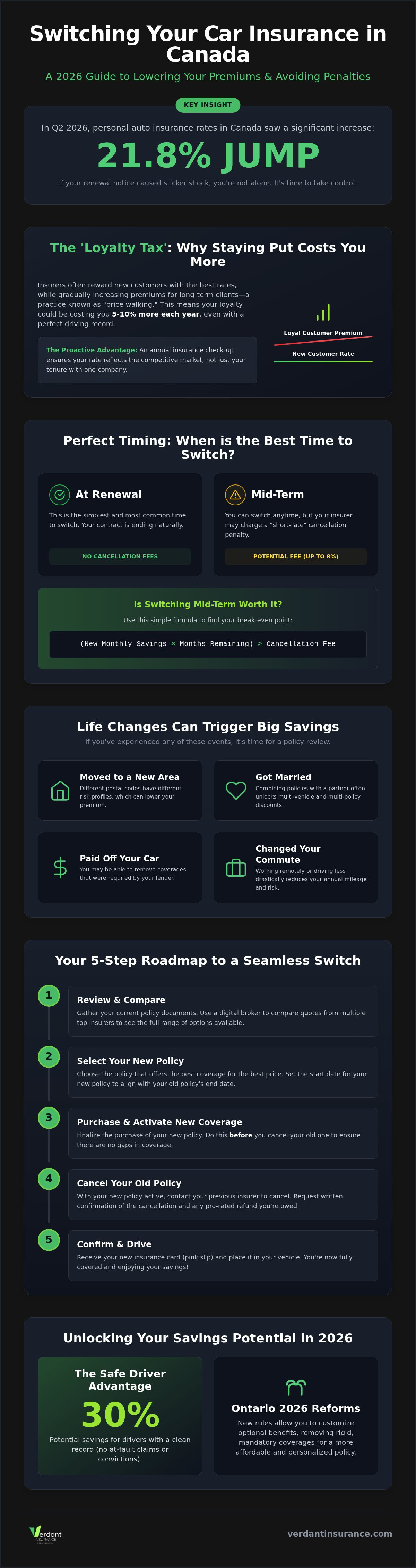
Did you know that personal auto insurance rates in Canada jumped by 21.8% in the second quarter of 2026? If your latest renewal notice left you with sticker shock, you aren't alone. It's completely natural to feel frustrated when your monthly costs rise despite a clean driving record. You likely want to switch car insurance Canada-wide to find a more competitive rate, but the fear of complex paperwork or expensive mid-term cancellation fees often makes the process feel too intimidating to start.
We believe that finding a better deal shouldn't be a source of stress. This guide will teach you exactly how to move to a superior auto insurance policy without experiencing gaps in coverage or paying unnecessary penalties. We'll break down the 2026 Ontario benefit changes and Alberta rate caps, then provide a clear, step-by-step roadmap to help you secure lower premiums and better service with total confidence.
Key Takeaways
- Identify the specific life milestones, such as moving or a shorter commute, that can help you secure a much lower monthly premium.
- Follow a clear 5-step roadmap to switch car insurance Canada smoothly while ensuring your vehicle remains fully protected throughout the transition.
- Learn how to calculate "short-rate" cancellation penalties to determine if switching mid-term will still save you money in the long run.
- Understand how the July 2026 Ontario insurance reforms allow you to customize optional benefits for a more affordable, personalized policy.
- Discover the ease of using a digital-first broker to compare the market and unlock potential savings of up to 30% for claim-free drivers.
Why Switching Car Insurance is a Smart Move in 2026
Staying with the same insurer for a decade used to be a badge of honor. In 2026, it's often a recipe for overpaying. While you might expect a "loyalty discount," many providers use a practice called "price walking." This is where rates slowly creep up for long-term clients while new customers receive the most competitive introductory deals. If you want to switch car insurance Canada has a vibrant market that rewards those who take a proactive approach to their coverage.
Recognizing the 'Loyalty Tax' in Insurance
The loyalty tax isn't an official fee; it's the invisible cost of staying comfortable. Insurers often bet that you won't bother comparing rates at renewal time. Over time, your premium might rise 5% to 10% annually without a single claim or ticket on your record. By performing an annual insurance check-up, you can see if your current provider still aligns with the broader market. In many cases, new customer incentives can significantly outperform any long-term member perks you're currently receiving.
Life Events That Warrant a Policy Review
Life moves fast, and your insurance needs to keep up. If you've recently moved to a new postal code in Ontario, your risk profile has changed instantly. Different neighborhoods have different theft and accident statistics, which can lead to lower rates if you've moved to a quieter area. Other common triggers for a policy review include:
- Getting married or moving in with a partner, which often unlocks multi-vehicle or multi-policy discounts.
- Paying off a car loan, which might allow you to adjust certain mandatory lender coverages like gap insurance.
- Transitioning to a remote or hybrid work model, drastically reducing your annual mileage and risk.
The Safe Driver Advantage and 2026 Features
If you have a clean record, you're in a position of power. In Ontario, safe drivers with no convictions or at-fault claims can often unlock discounts of up to 30%. This is a massive advantage that many traditional insurers don't automatically apply to existing accounts as your "safe years" stack up. You have to ask for it, or better yet, find a broker who prioritizes these savings.
Additionally, the July 1, 2026 Ontario insurance reforms have changed the landscape. Many benefits that were once mandatory are now optional, allowing for much higher levels of customization. If your policy was written back in 2021, you're likely paying for a rigid structure that doesn't reflect these modern choices. The process of finding a better deal varies by province. For example, drivers in provinces with a public auto insurance system have more standardized rates for basic coverage. However, in private markets like Ontario or Alberta, the savings from a strategic switch car insurance Canada move can be substantial. It's about ensuring your policy reflects who you are as a driver today, not who you were years ago.
When is the Best Time to Switch Your Policy?
Timing is everything when you decide to switch car insurance Canada drivers often assume they must wait for their renewal date to make a move, but you actually have the flexibility to change providers whenever you like. However, the timing you choose can impact your wallet. While switching at renewal is the most seamless path, a mid-term switch can still be a brilliant financial move if your new savings are high enough to offset any early exit costs.
Switching at Renewal vs. Mid-Term
The simplest time to walk away is during your renewal window. This is the period, usually 30 to 60 days before your current policy expires, when you can notify your insurer that you won't be renewing. Since the contract is naturally ending, there are no cancellation fees. It's a clean break.
If you find a massive deal in the middle of your policy year, you'll likely face a "short-rate" cancellation fee. Unlike a pro-rata refund, which gives you back every unearned cent, a short-rate refund allows the insurer to keep a small penalty for administrative costs. This penalty can be up to 8% of your annual premium. To see if it's worth it, calculate your break-even point. If your new monthly savings multiplied by the months left in your term exceed the cancellation fee, switching mid-term is the right call. Understanding your rights as a consumer ensures you aren't pressured into staying in a policy that no longer serves you.
The Shopping Timeline
Don't wait until the final 48 hours of your policy to start looking. Many insurance companies offer an "early shopper" discount if you sign up 15 to 30 days before your new policy takes effect. This lead time also gives you space to gather your documents without stress. If you're looking for a hassle-free way to see what's available, you can get a quick digital quote to compare your options well in advance.
Locking in your rate early protects you from sudden industry-wide price hikes. It also ensures that your new coverage starts exactly when your old one ends. Even a one-day gap in coverage can lead to higher premiums in the future because insurers view any lapse in insurance as a risk factor. By synchronizing your dates, you maintain a continuous insurance history, which is vital for keeping your rates low over the long term. If you've recently had a claim or a conviction, it's especially wise to shop early. While some insurers might hike your rates immediately, others may have different underwriting rules that offer you a softer landing.
How to Switch Car Insurance in Canada: A 5-Step Guide
The process of moving your business to a new insurer is straightforward when you follow a logical sequence. It isn't just about finding a lower number; it's about making sure your transition is legally sound and financially beneficial. To switch car insurance Canada drivers should view these five steps as a roadmap to total peace of mind. By organizing your details first, you can move through the digital quote process with ease and confidence.
Gathering Your Essential Information
Before you start your comparison, pull together your vehicle's VIN, the driver's license numbers for everyone in your household, and your current policy’s declaration page. This page shows your current limits and helps you make an apples-to-apples comparison. In Ontario, obtaining your Autogreen or Motor Vehicle Record (MVR) report gives you a clear view of what insurers see on your record. You should also request a 'Letter of Experience' from your current provider. A 'Letter of Experience' is a formal statement from your insurer detailing your history of coverage and any past claims, which acts as vital proof of your reliability as a driver.
The Golden Rule: No Gaps in Coverage
The most critical part of the process is ensuring you are never without protection. A single day of lapsed coverage can lead to significant premium spikes in the future, as insurers often categorize any gap as a major risk factor. To avoid this, always bind your new policy before you send a cancellation notice to your old company. "Binding" means the new insurer has officially accepted your application and your coverage is confirmed to start on a specific date. This ensures you have "double coverage" for a few hours rather than no coverage at all.
Once your new policy is bound, formally cancel your old one in writing. Don't simply stop your auto-payments. If you stop paying without a formal notice, the insurer may cancel your policy for non-payment. This can stay on your record for years and make it much harder to find affordable rates later. Instead, send a clear email or a signed letter to your broker or agent. Aim to have your new policy start at 12:01 AM on the same day your old policy terminates. This creates a seamless handoff that keeps you protected and your insurance history pristine. By using a digital-first broker like Verdant Insurance, you can handle this entire comparison and transition process from your phone, making the switch feel like a simple upgrade rather than a bureaucratic chore.
Understanding Cancellation Fees and Pro-Rated Refunds
One of the biggest hurdles drivers face when they want to switch car insurance Canada is the fear of hidden penalties. It's a common worry that prevents people from pursuing lower rates. However, once you understand how insurers calculate these costs, the mystery disappears. Most Canadian insurance companies follow a standardized set of rules for returning your money, and knowing the difference between "short-rate" and "pro-rata" calculations can save you hundreds of dollars.
Calculating the Cost of Leaving
If you cancel your policy exactly on its renewal date, you typically won't owe a cent in fees. If you decide to leave in the middle of your term, your insurer will likely use a "short-rate" cancellation table. This isn't a simple 50/50 split of your remaining premium. Instead, the insurer keeps a small percentage to cover administrative costs and the fact that they are losing your business early. In 2026, the penalty for early cancellation in Canada can be up to 8% of your annual premium. This percentage usually scales down as you get closer to your original expiry date.
You can find the specific details of these penalties in the "Statutory Conditions" section of your policy. While the insurer handles the bulk of the calculation, some independent brokers may also charge a flat administrative fee, often ranging from C$25 to C$75, to process the paperwork. Before you make the leap, calculate your potential savings to ensure that your new, lower monthly premium will quickly cover these one-time exit costs.
Getting Your Money Back
Once you've formally submitted your notice of cancellation, the clock starts on your refund. Standard timelines for receiving your unearned premium range from 10 to 30 days. If you paid your entire annual premium upfront, you'll receive a check or a direct deposit for the remaining balance minus the short-rate penalty. For those on monthly payment plans, the insurer will determine if your last payment covered your final days of protection or if you're owed a small credit.
A common myth is that you can just "stop the payments" at your bank to cancel. This is a dangerous mistake. Stopping a pre-authorized withdrawal without formal notice can lead to a "cancellation for non-payment" on your record. This mark can make it incredibly difficult to find affordable coverage in the future. If your old insurer accidentally withdraws funds after your cancellation date, don't panic. Contact your broker immediately with your new policy's binding document. They can usually resolve the error and ensure your funds are returned within a few business days. By handling the process professionally, you keep your insurance history clean and your transition stress-free.
Why Choose Verdant Insurance for Your Switch?
Deciding to switch car insurance Canada is a smart financial move, but you don't have to navigate the transition alone. While the steps we've covered provide a clear roadmap, having a dedicated partner can make the process even smoother. Verdant Insurance acts as your proactive guide, combining modern technology with the personalized care of a local expert. We understand that your time is valuable, so we handle the heavy lifting of comparison shopping to ensure you get the best possible value without the stress of endless research.
Our deep Ontario expertise is built into everything we do. We stay ahead of local regulations, such as the July 2026 benefit updates, so you don't have to worry about the fine print. For drivers with a clean record, our 30% Safe Driver Promise is a core part of our mission. We believe that safe, conviction-free driving should be rewarded with significant savings. By focusing on your individual profile rather than a one-size-fits-all model, we help you secure a policy that truly fits your lifestyle and budget.
The Broker Advantage vs. Direct Writing
When you work with a direct writer, you only see one set of products. If their rates go up, you're stuck. As a broker, Verdant Insurance gives you an advocate who looks across multiple partner carriers through a single, streamlined platform. This means we can find the right match for your specific needs, whether you're looking for the lowest monthly premium or specialized coverage. We also simplify the paperwork involved in a switch, guiding you through the binding process and ensuring your old provider receives the correct notice. It's about having someone in your corner who prioritizes your interests over the insurance company's bottom line.
Bundling for Maximum Savings
Efficiency doesn't stop at your car. You can unlock an extra layer of discounts by combining your auto insurance with homeowner or tenant insurance. Managing all your policies through one user-friendly digital interface makes it easy to track your coverage and make updates on the fly. Our onboarding process is designed to be seamless, taking you from a quote to active coverage in just a few minutes. If you're ready to see how much you can save, get your personalized Verdant auto quote today and experience a simpler way to protect what matters most. We're here to make your transition effortless, transparent, and rewarding from the very first day.
Take the Next Step Toward Smarter Savings
You now have the tools to handle your insurance transition with total confidence. We've explored how to navigate the 2026 Ontario regulatory changes and why calculating short-rate fees is essential for a mid-term move. By following a clear, five-step roadmap, you can ensure your vehicle stays protected without a single day of lapsed coverage. It's time to stop paying a loyalty tax and start rewarding your clean driving record with a policy that reflects your life today.
When you decide to switch car insurance Canada has a competitive market ready to offer you better value if you know where to look. As Ontario's trusted digital insurance broker, we provide 5-star support for every step of your journey. You could save up to 30% for maintaining a clean driving record while enjoying a seamless, tech-forward experience. Start your 3-minute quote and see how much you can save with Verdant. You deserve coverage that works as hard as you do.
Frequently Asked Questions
Is there a penalty for switching car insurance in Canada?
You only face a penalty if you cancel your policy before the term's official end date. This is known as a short-rate cancellation fee, which covers the insurer's administrative costs. If you wait until your renewal date to switch car insurance Canada providers, you can walk away without paying any fees at all.
Can I switch car insurance mid-policy in Ontario?
Yes, you have the legal right to cancel your auto insurance policy at any time for any reason. While a mid-term switch may trigger a small cancellation penalty, it is often financially beneficial if your new monthly savings are significant. Many drivers find that the lower premiums on a modern, customized policy quickly offset the one-time exit cost.
Will switching car insurance affect my credit score?
No, getting a quote to change your coverage will not impact your credit score. Insurance companies use a "soft inquiry" to check your credit information where permitted by provincial law. Unlike the hard pulls used for car loans or mortgages, these soft checks are invisible to other lenders and do not lower your score.
Do I get a refund if I cancel my car insurance early?
You are entitled to a refund for the "unearned premium," which is the portion of your payment that covers the remainder of your term. If you paid your annual premium upfront, you'll receive a check or direct deposit for the unused months minus any applicable short-rate fees. Monthly payers will simply have their final installment adjusted to their exact cancellation date.
How long does it take to switch car insurance providers?
The digital quoting process typically takes less than five minutes on a modern platform. Once you select a policy and provide your documents, your new coverage can be bound on the same day. For the smoothest experience, it's best to start shopping about 30 days before you want your new policy to begin to ensure a seamless transition.
What happens to my 'no-claims' discount if I switch?
Your clean driving record is a personal asset that follows you to any new insurance company. Your new insurer will verify your history through a Letter of Experience or provincial reports to ensure you receive the proper credit. At Verdant Insurance, safe drivers can unlock discounts of up to 30% based on their claim-free and conviction-free history.
Should I tell my current insurance company I am shopping around?
You aren't required to notify your current insurer that you're looking elsewhere, though you can use a lower quote to see if they'll match it. However, direct-writing companies often have rigid pricing structures. Working with a broker is usually more effective because they compare multiple carriers simultaneously to find the most competitive rate available for your specific profile.
Can I switch car insurance if I have an open claim?
Yes, you can move to a new provider even if you have an ongoing claim with your current insurer. The company that provided coverage at the time of the accident remains legally responsible for managing and paying out that specific claim. Your new insurance company will simply handle any new risks or incidents that occur after your new policy's effective date.