
If you think choosing a "liability-only" policy means you're only covered for the damage you do to others, you might be surprised to learn how Ontario's laws actually work. Many drivers in Markham and across the GTA are searching for ways to manage rising premiums, but understanding what is liability-only insurance requires looking past the name. In our province, this isn't just one type of coverage. It's actually a bundle of four mandatory protections that keep you legal and provide a safety net, even if they don't pay to repair your own vehicle.
It's understandable to feel confused by Ontario's "no-fault" system, especially with the major reforms that took effect in July 2026. You want to lower your costs without leaving yourself vulnerable after a serious collision. This guide helps you handle these changes by clarifying exactly what a basic policy includes and what has now become an optional add-on. We'll provide a clear look at mandatory requirements so you can decide if a minimum policy provides enough protection for your specific needs and your family's security.
Key Takeaways
- Understand that "liability-only" in Ontario is actually a bundle of four mandatory coverages required by law to protect your legal standing and financial security.
- Discover exactly what is liability-only insurance and how it safeguards you against third-party claims while leaving your own vehicle's physical damage uncovered.
- Learn how to use the "10% rule" to determine if the cost of collision and comprehensive coverage is still a practical investment for your vehicle's current value.
- Identify the critical gaps in a minimum policy, particularly regarding the 2026 Accident Benefits reforms that moved several previously standard protections to optional add-ons.
- Find out how a Verdant broker can help you customize a basic policy to balance lower premiums with the essential protections your family needs.
Defining Liability-Only Insurance in the Ontario Context
When people ask "what is liability-only insurance," they are usually referring to the bare minimum coverage required to legally operate a vehicle on Ontario roads. In our province, driving without insurance isn't just a financial risk; it's a serious legal offense that can lead to heavy fines, vehicle impoundment, and license suspensions. While the name suggests you are only protecting other people, the reality is more complex. A standard Ontario policy is a bundle that provides a foundational level of security for you and your passengers, making it the essential starting point for customizable car insurance policies.
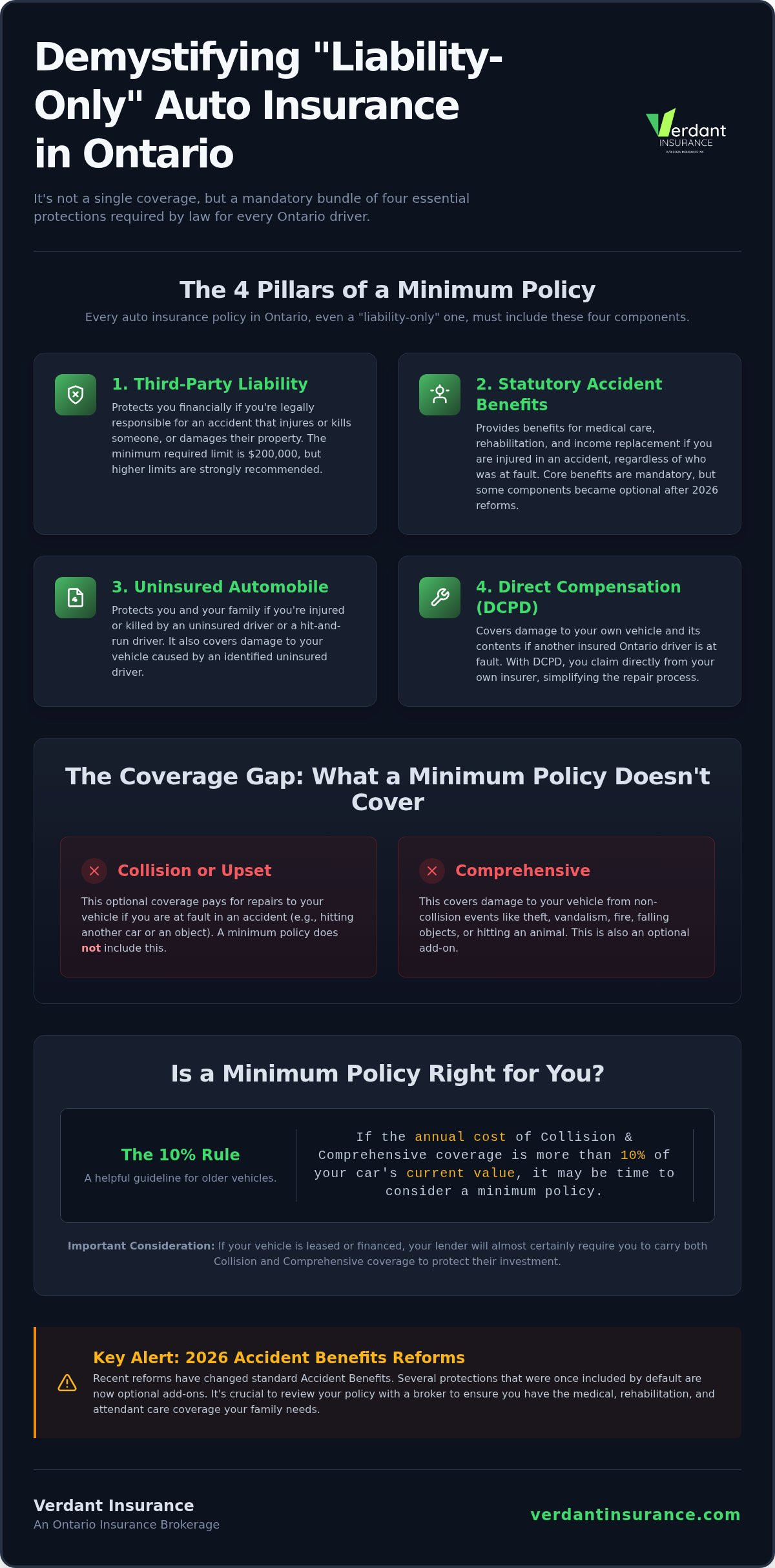
At its core, liability insurance is designed to protect your assets if you are held legally responsible for injuring someone else or damaging their property. However, in Ontario, a "minimum" policy actually includes four specific pillars: Third-Party Liability, Statutory Accident Benefits, Uninsured Automobile Coverage, and Direct Compensation Property Damage (DCPD). This structure ensures that even a basic policy offers some protection for your own medical recovery and vehicle repairs, provided you aren't at fault for the accident.
The Legal Minimum vs. Full Coverage
The main difference between a liability-only policy and what many call "full coverage" is the protection of your own vehicle in at-fault scenarios. Understanding what is liability-only insurance helps you decide if you're comfortable with that gap. Full coverage adds Collision and Comprehensive protections. Drivers in Markham or Vaughan often choose the minimum path for older vehicles where the cost of the premium might outweigh the car's actual cash value. It's important to remember that if your car is financed or leased, your lender will almost certainly require you to carry full coverage to protect their investment.
Why Ontario Drivers Choose Minimum Coverage
The most common reason for selecting a minimum policy is the immediate impact on your monthly budget. With the average premium in the GTA reaching approximately $2,638 in 2026, many households are looking for ways to reduce fixed costs. Choosing a simpler policy often allows for easier digital management through modern platforms. If you are comfortable managing your policy through an app or web portal, you might find our guide on choosing an online insurance broker in Canada helpful for finding the right digital fit. While savings are a major draw, the goal is always to balance a lower price with the legal protections you cannot afford to skip.
What is Included in an Ontario Minimum Liability Policy?
In Ontario, every standard auto insurance policy must include four mandatory coverages. When drivers ask what is liability-only insurance, they are often surprised to find it isn't just one single protection. It's a structured safety net designed to protect the public while providing a baseline of care for you. This bundle ensures that even if you choose the most basic plan, you aren't left entirely without support after an accident.
The four mandatory pillars of an Ontario policy are:
- Third-Party Liability: This protects you if you are legally responsible for an accident that causes someone else injury or death, or damages their property.
- Statutory Accident Benefits: These provide medical, rehabilitation, and attendant care benefits regardless of who caused the accident. Recent 2026 reforms have made some parts of this coverage optional, but the core medical benefits remain mandatory.
- Uninsured Automobile Coverage: This protects you and your family if you are involved in an accident with a driver who doesn't have insurance or a "hit-and-run" driver who cannot be identified.
- Direct Compensation-Property Damage (DCPD): This covers damage to your vehicle and its contents when another driver is at fault.
The Role of Direct Compensation-Property Damage (DCPD)
DCPD is a vital part of Ontario's "no-fault" system. It allows you to collect compensation directly from your own insurance brokerage rather than having to sue the other driver. Even on "liability-only" plans, this coverage is included to ensure your vehicle is repaired if you aren't at fault. DCPD is the mechanism that handles vehicle repairs when another Ontario driver is at fault for a collision occurring within the province. It simplifies the process, getting you back on the road faster without the stress of dealing with another person's insurer.
Bodily Injury vs. Property Damage Liability
The Third-Party Liability section of your policy is split into two components: Bodily Injury and Property Damage. While the legal minimum in Ontario is $200,000, this amount is often insufficient for drivers in the GTA. If you are found at fault in a multi-vehicle accident or a collision involving serious injuries, legal fees and settlements can easily exceed this limit. Most brokers in Markham and Toronto recommend an industry standard of $1 million or $2 million to protect your personal assets from being seized in a lawsuit. If you're looking for a balance between price and protection, our team can help you compare Auto Insurance options tailored to your daily route.
The Gap: What Liability-Only Insurance Does Not Cover
While we've explored the mandatory protections provided by the province, understanding what is liability-only insurance also requires a clear view of the risks you're choosing to carry yourself. When you opt for a minimum policy, you're essentially deciding to "self-insure" the physical value of your car. This means that if your vehicle is damaged or lost in a situation where you are responsible, your insurance provider won't pay for the repairs or replacement. You are trading a lower monthly premium for the risk of paying thousands of dollars out of pocket if something goes wrong.
The most significant absence in these policies is Collision coverage. If you lose control on an icy road and hit a guardrail, or if you cause a fender bender in a busy Markham parking lot, a liability-only policy provides zero dollars for your own car's damage. Similarly, you lose the protection of Comprehensive coverage. This leaves you vulnerable to non-collision events like fire, vandalism, or a cracked windshield from flying gravel on the 404. For many drivers, the cost of a single repair can quickly exceed the savings gained from a lower premium.
Understanding At-Fault Accidents
In Ontario, fault is determined by a specific set of provincial regulations known as the Fault Determination Rules. These rules are used by every insurer to assign a percentage of responsibility to each driver involved in a collision. If you have a liability-only policy and are found even 50% at fault, you'll be responsible for paying half of your own repair costs. If you're 100% at fault, you receive nothing for your vehicle. Before deciding to skip this protection, getting an insurance quote online in Ontario can help you see how affordable adding collision coverage might actually be for your specific vehicle.
Environmental and Non-Collision Risks
Living in the GTA comes with unique environmental hazards that a basic policy simply doesn't handle. Deer strikes are common in more rural parts of York Region, and road salt or loose gravel can easily ruin a paint job or shatter a windshield. Furthermore, vehicle theft remains a significant concern in areas like Vaughan and Toronto. Without Comprehensive coverage, which is missing from a liability-only plan, you have no financial protection if your car is stolen or damaged by a falling tree branch during a storm. For many, the peace of mind that comes with knowing these "random" events are covered is worth the additional investment.
Is a Liability-Only Policy Right for You?
Deciding on what is liability-only insurance for your specific situation involves more than just looking at the bottom line. It's a strategic calculation of risk versus reward. For many Ontario drivers, the choice comes down to the "10% Rule." If the annual premium for adding Collision and Comprehensive coverage is more than 10% of your vehicle's actual cash value, the cost of the insurance may eventually exceed the potential payout. This makes a 15-year-old sedan with high mileage a prime candidate for a minimum policy, as the insurer's payout after a deductible might be negligible.
Your driving history also plays a major role in this decision. If you've maintained a clean, conviction-free record, you're likely already eligible for lower rates on full coverage. In these scenarios, the price difference between a basic policy and one that protects your own car is often so small that the "savings" of dropping coverage don't outweigh the peace of mind you lose. A liability-only policy is most effective when the vehicle's value is so low that you are comfortable walking away from it after an accident.
When to Keep Full Coverage
Skipping physical damage protection can be a mistake in several scenarios. If you drive a high-theft model or a rare vehicle where parts are expensive, the market value might not reflect your true replacement cost. Additionally, consider how much you rely on your car. If you commute from Richmond Hill to downtown Toronto every day and don't have the immediate funds to buy a new car, the loss of your vehicle is a catastrophic risk. Safe drivers with significant discounts should always look at the total cost before assuming a minimum policy is the only way to save.
Check current rates for full coverage in Ontario
Evaluating Your Financial Buffer
Before you commit to a minimum policy, take an honest look at your emergency fund. This choice is essentially a form of self-insurance where you accept the financial burden of replacing your car if you are at fault in a collision. It's a logical move if you have a stable financial buffer and your car is simply a tool for getting from point A to point B. However, if your car is your most valuable asset, the "cheap" choice today could become the most expensive mistake you ever make.
How to Customize Your Coverage with a Verdant Broker
Choosing a minimum policy doesn't have to be a gamble with your financial future. While we've established that the legal baseline protects you from the most catastrophic third-party claims, the way you structure those mandatory components matters. A Verdant broker helps you look beyond the surface of what is liability-only insurance to ensure your "minimum" plan is still a smart plan. Since the provincial reforms in July 2026, drivers have more control over their Accident Benefits. Even if you decide to skip collision coverage for an older car, you may still want to enhance certain medical or rehabilitation limits to protect yourself and your family.
The advantage of working with a brokerage is the ability to compare multiple Ontario insurers in one place. Every company has different underwriting rules and pricing for basic policies. We do the heavy lifting by scanning the market to find the best value for the specific limits you need. This saves you the time of visiting multiple websites while ensuring you don't miss out on insurers that specialize in your specific driver profile or region.
The Value of Professional Advice
Our team is based in Markham, which gives us a unique perspective on the local GTA insurance landscape. We understand the specific risks of commuting through Vaughan or parking in downtown Toronto. An online calculator provides a fast number, but it often misses the "sweet spots" in coverage. A broker can identify situations where a tiny increase in your premium could double your liability protection, providing much better value than a bare-minimum plan. We act as your ally, simplifying the technical jargon and helping you feel confident in your choices.
Getting Started with Your Quote
Before making a final decision, take a few minutes to review your current policy and check your vehicle's market value on a Canadian resale platform. This data is essential for the 10% Rule calculation we discussed earlier. Once you have those details, you can use our online tool to establish a baseline for your costs. The next step is a quick conversation with one of our experts to see if a liability-only approach truly fits your life in Ontario.
Speak with a Verdant Insurance broker today to tailor your Ontario auto policy.
Secure Your Drive with Confidence
Choosing the right level of protection doesn't have to be a stressful process. By now, you know that understanding what is liability-only insurance is about more than just finding the lowest price. It's about recognizing that while a minimum policy keeps you legal and provides essential medical benefits, it also leaves the physical value of your vehicle in your hands. This strategy works well for older cars that have already served you for many years, but it requires a solid financial plan if an accident occurs.
Our Markham-based expert support team is here to help you navigate these choices with ease. As Ontario-licensed brokers, we specialize in finding the right balance between premium savings and essential legal security. If you've maintained a clean record, you might even qualify for up to 30% savings for claim-free drivers, though actual savings vary by insurer and your individual circumstances. We're ready to help you drive with peace of mind.
Get a Tailored Auto Insurance Quote for Ontario
Frequently Asked Questions
Is liability-only insurance legal in Ontario?
Yes, liability-only insurance is completely legal and represents the minimum requirement to drive in the province. Every standard policy must include third-party liability, statutory accident benefits, uninsured automobile coverage, and direct compensation property damage. While this is the legal baseline, many drivers in the GTA choose to increase their limits to better protect their personal assets. Driving without at least this level of coverage can lead to heavy fines and vehicle impoundment.
Does liability-only insurance cover my car if someone else hits me?
Yes, your car is covered if someone else hits you, provided the accident happens in Ontario and involves another insured driver. This protection comes from Direct Compensation-Property Damage (DCPD). It is a mandatory component included even when you ask what is liability-only insurance for an older vehicle. Your own insurer handles the repairs, which helps you get back on the road faster. In most cases, you won't have to pay a deductible.
What is the minimum liability insurance limit required in Ontario?
The legal minimum for third-party liability in Ontario is $200,000. This amount is designed to cover claims if you are held responsible for injuring someone or damaging their property. However, in busy environments like Markham or Toronto, legal settlements can easily exceed this small amount. Most brokers recommend increasing this limit to $1 million or $2 million. This ensures your personal savings and home aren't at risk during a serious lawsuit.
Does liability insurance cover theft or fire?
No, a liability-only policy does not provide any protection against theft, fire, or vandalism. These specific risks are covered under Comprehensive insurance, which is an optional add-on. If you live in a high-theft area of the York Region, skipping this coverage means you'll be responsible for the full cost of replacing your vehicle if it's stolen. It is a strategic choice often reserved for cars with a very low resale value.
Can I get liability-only insurance on a leased car?
Technically you can purchase a liability-only policy, but your leasing company will almost certainly forbid it. Most lease and finance contracts in Ontario require you to maintain both Collision and Comprehensive coverage to protect the lender's financial interest in the vehicle. If you drop these coverages, you may be in breach of your contract. This could lead to the repossession of the car or the lender purchasing expensive insurance on your behalf.
How much can I save by switching to liability-only insurance?
The amount you save depends on your insurer, your driving record, and the value of your vehicle. By removing Collision and Comprehensive, you're eliminating the portion of the premium that covers your car's physical damage. While this reduces your monthly costs, the exact price difference varies by individual circumstances. Claim-free drivers often see the most competitive rates regardless of the coverage levels they choose for their policy, making the savings even more impactful.
Does liability-only include medical coverage for me?
Yes, liability-only policies include Statutory Accident Benefits, which provide medical and rehabilitation coverage for you and your passengers. Even with the 2026 reforms, certain core medical benefits remain mandatory in every Ontario policy regardless of who caused the accident. However, other benefits like income replacement are now optional. You should discuss these specifics with a broker to ensure your health coverage meets your family's actual needs after a serious collision.
What happens if I am at fault in an accident with only liability insurance?
If you're at fault in an accident with only liability insurance, your policy covers the damage to the other person's vehicle and their medical costs. However, you'll receive zero dollars for your own car's repairs or replacement. This is the primary risk of choosing what is liability-only insurance for your daily driver. You'll be responsible for all out-of-pocket costs related to your own vehicle while your insurer handles the third-party legal claims.