

If you're moving between homes in Markham or simply decluttering your condo in Toronto, you probably assume your belongings are safe once the storage unit door is locked. But what if you return to find water damage or discover a theft has occurred? It's a common worry for many Ontarians who rely on external facilities to hold their most prized possessions. You want the peace of mind that comes with knowing your items are protected, without the confusion of buying redundant policies from a storage facility manager.
Understanding how tenant insurance for storage units Canada works is the first step to securing your property. While most policies in Ontario do extend coverage to items kept off-premises, there are often hidden limits that could leave you vulnerable. In this 2026 guide, we'll show you how to identify these coverage gaps and explain the impact of recent Ontario fire code updates on storage requirements. You'll learn exactly what's covered, when your policy's protection might expire for long-term storage, and how a quick conversation with your broker can ensure your unit is properly backed by your existing tenant insurance.
Key Takeaways
- Understand how your existing policy typically protects your belongings against fire and theft even when they are kept away from your home.
- Identify the specific "off-premises" limits that often restrict tenant insurance for storage units Canada to a percentage of your total coverage.
- Evaluate the differences between standard personal policies and facility-sold protection plans to ensure you aren't paying for unnecessary or limited coverage.
- Learn how to document your stored items effectively and why choosing a facility with modern security features is essential for risk management.
- Discover when to consult a broker to adjust your policy limits or add endorsements for belongings kept in long-term storage.
Does Tenant Insurance Cover Storage Units in Ontario?
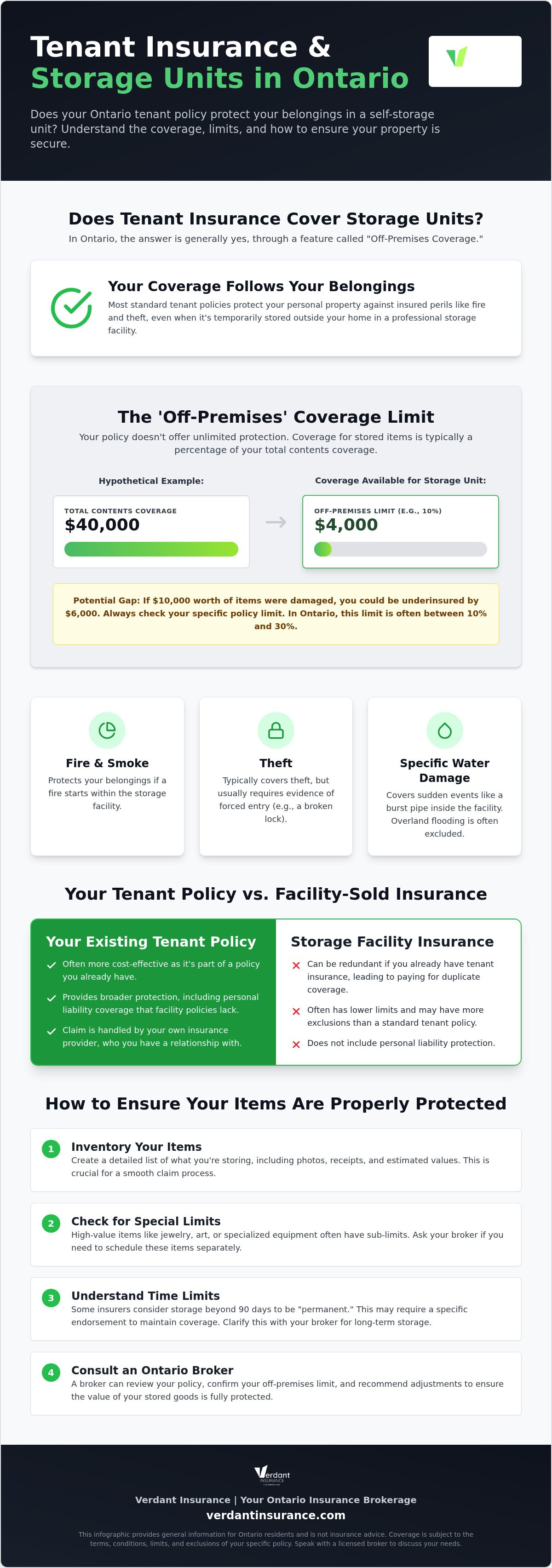
The short answer is yes. Most standard policies in Ontario are designed to protect your belongings whether they're inside your Markham apartment or sitting in a secure facility in Vaughan. This feature is a core part of how Renters' insurance functions; it focuses on the property you own rather than just the building you live in. However, while your coverage follows your items off-site, it doesn't always provide the same high limits you enjoy at home. Understanding how tenant insurance for storage units Canada works helps you avoid surprises if you ever need to file a claim.
What is Off-Premises Personal Property Coverage?
In the insurance world, items kept in a storage unit are considered "temporarily removed" from your principal residence. Your policy includes a clause for off-premises coverage that applies to these items. Whether you're using a facility in the GTA during a renovation or storing seasonal gear, your policy stays active. It's important to remember that if something happens, you'll still be responsible for your deductible. If you have a $500 deductible and $1,000 worth of items are damaged, the insurer will pay out the remaining $500, subject to your policy's specific limits and exclusions.
Common Perils Covered in Self-Storage
Your policy protects against specific risks, known as perils. In a professional Ontario storage facility, you're typically covered for:
- Fire, Lightning, and Smoke: Protection if a fire breaks out within the facility.
- Theft and Vandalism: This usually requires evidence of forced entry, such as a broken lock or tampered door.
- Specific Water Damage: Coverage often applies to sudden issues like a burst pipe in the facility, but rarely extends to "seepage" or external flooding.
Insurers in Ontario generally require you to use a professional, licensed storage business to maintain this protection. Storing your couch in a friend's unheated garage in Richmond Hill might not qualify for the same coverage. Additionally, most insurers distinguish between temporary and permanent storage. If your items are stored for longer than 90 days, many Ontario companies consider this a "permanent" arrangement. In these cases, your standard off-premises limit might no longer apply, and you'll need to speak with a broker to add a specific endorsement to your policy. Because every insurer has different rules regarding time limits and eligibility, checking your specific policy wording is the only way to be certain of your protection.
Understanding 'Off-Premises' Limits for Stored Items
While your policy follows your property, it usually comes with a specific ceiling known as an 'off-premises' limit. For most people using tenant insurance for storage units Canada, this limit is a fixed percentage of your total contents coverage. In Ontario, this typically ranges between 10% and 30% depending on your specific insurer. If you're storing a few seasonal items, this might be plenty. However, if you're putting your entire life into a unit in Markham while waiting for a house closing, you might find yourself significantly underinsured. When insuring items in a storage unit, the key is knowing exactly where your policy stops and where a potential gap begins.
Calculating Your Storage Coverage Limit
Let’s look at a hypothetical scenario to see how these percentages play out. If your policy has a total contents limit of $40,000 and your off-premises limit is 10%, you only have $4,000 of protection for items in storage. If a fire damaged $10,000 worth of furniture in that unit, you'd be responsible for the $6,000 gap yourself. You can find these specific numbers on your Ontario Policy Form (OPF) under the 'Coverage C' section. It's always best to declare the full value of your stored goods to your broker to ensure the limits match your reality. If you're unsure how these limits apply to your specific situation, speaking with an Ontario broker can help clarify your policy wording.
Special Limits for High-Value Goods
Even if your percentage limit is high enough, certain items have 'special limits' or sub-limits that apply regardless of where they are kept. Jewellery, fine art, and high-end electronics often have caps as low as $1,000 to $2,000 unless they are specifically 'scheduled' or added as an endorsement to your policy. Additionally, standard policies typically exclude motorized vehicles, cash, and business inventory from off-premises coverage. You should also check if your policy provides 'replacement cost' or 'actual cash value.' Replacement cost pays for a brand-new version of your item; actual cash value subtracts depreciation, which can be a painful surprise during a claim for older furniture or electronics.
Storing your entire household requires a different strategy than storing a few boxes of holiday decorations. If the value of your stored items exceeds 10% of your total policy limit, you are at risk of being underinsured. In these cases, your broker can often increase your off-premises limit for a specific period, providing the comfort of full protection without the need for a separate, more expensive policy from the storage facility itself.
Storage Facility Insurance vs. Your Personal Tenant Policy
When you're standing at a storage facility counter in Markham or Vaughan, the pressure to sign up for their "in-house" protection plan can be high. Most facilities in Ontario now require proof of insurance before they'll hand over the keys. While these facility-sold plans offer immediate convenience, they often lack the depth and legal protections of a personal policy. Understanding how tenant insurance for storage units Canada differs from these "quick-fix" plans can save you hundreds of dollars in premiums and thousands in potential claim denials.
Pros and Cons of Facility Protection Plans
Facility plans are designed for speed. They don't require a credit check or a detailed inventory list, making them an attractive option for people who need a unit immediately. However, this convenience comes at a cost. These plans are typically more expensive per dollar of coverage than a standard tenant policy. They also tend to have very low maximum payouts, often capping your recovery at $2,000 or $5,000 regardless of what you've lost. In Ontario, these plans are often structured as "limited peril" agreements, which means they only pay out for a very specific list of events. If your loss doesn't fit their narrow definition, you're out of luck.
Why Your Personal Tenant Policy is Often the Better Choice
Your personal policy is governed by the Financial Services Regulatory Authority of Ontario (FSRA), ensuring a level of consumer protection that facility "protection plans" might not provide. One of the most significant advantages of using your own policy is liability coverage. If you accidentally cause a fire or a flood that damages the storage building or other tenants' property, your personal liability coverage protects you. Facility plans almost never include this, leaving you personally responsible for third-party damages.
Choosing your own policy also ensures consistency. If you have a claim, you'll work with your own broker and a professional adjuster who understands your entire insurance history. You won't be stuck dealing with a facility manager who isn't a licensed insurance professional. Since you are likely already paying for tenant insurance, adding an endorsement or adjusting your off-premises limit is usually much more cost-effective than paying a separate monthly fee to the storage company. This approach keeps all your assets under one roof, making the claims process smoother and more predictable.
How to Ensure Your Stored Belongings are Properly Protected
Securing your property requires a proactive approach that goes beyond just locking the unit door. While having tenant insurance for storage units Canada provides a financial safety net, the physical environment and your documentation habits determine how smoothly a claim will proceed. You should treat your storage unit as an extension of your home, applying the same level of care to security and record-keeping to ensure your assets remain protected.
Choosing an Insurance-Friendly Storage Facility
Not all facilities are created equal in the eyes of an Ontario insurer. When selecting a site in Markham or Richmond Hill, look for professional security standards like 24/7 CCTV monitoring, gated access with individual codes, and well-lit hallways. These features don't just deter theft; they demonstrate to your insurer that you've taken reasonable steps to protect your property. Climate control is another critical factor. Many policies exclude damage caused by "gradual deterioration," mold, or extreme temperature swings. A climate-controlled unit helps prevent these issues, ensuring your furniture and electronics remain in the same condition as the day you packed them. Location also plays a role in risk assessment, as high-traffic areas in Toronto may have different theft profiles than quieter suburban facilities in York Region.
Documenting Your Assets for a Future Claim
If you ever need to file a claim, the burden of proof lies with you. Ontario claims adjusters require evidence of what was lost and its value. A simple handwritten list is rarely enough. Instead, use a mobile inventory app to track your items, including photos and digital copies of receipts. Before you close the unit door, perform a slow video walkthrough. Record yourself opening boxes or showing the labels on high-value furniture. This visual evidence is invaluable during a claim process. Most importantly, never store your only copy of this inventory inside the unit itself. Keep a digital backup in the cloud or a physical copy at your primary residence in the GTA.
Once your items are moved, notify your broker immediately. They need to know the facility's address and how long you plan to keep your items there. Many Ontario insurers have a 90-day window for off-premises coverage. If you're planning for long-term storage, your broker may need to add a specific endorsement to keep your tenant insurance for storage units Canada active. Review these limits annually during your policy renewal to ensure they still align with the current value of your stored goods.
Speak with a Verdant broker to review your storage coverage
Finding the Right Tenant Coverage with an Ontario Broker
Automated online tools can provide a price in minutes, but they often fail to ask the specific questions that matter for storage users. Are you storing sensitive electronics in a basement unit in Toronto? Do you have high-value collectibles that exceed standard sub-limits? A broker does more than just find a price; they act as a guide through the complex wording of your policy. By comparing multiple Ontario insurers, Verdant Insurance helps you find a policy that balances cost with the actual risks your property faces. We work for you, not the insurance company, ensuring your interests come first during the selection process.
Customizing Your Policy for Peace of Mind
Standard policies are a starting point, but they aren't always enough for unique storage needs. If your unit is located in an area prone to heavy rain, adding a Sewer Back-up or Flood endorsement to your tenant insurance for storage units Canada can be a wise investment. Most people don't realize that standard off-premises coverage might exclude these specific water perils. We help Markham and GTA residents identify these gaps before a loss occurs. We can also work with you to increase your off-premises percentage limit if you're storing a significant portion of your household assets. This level of customization ensures you aren't paying for coverage you don't need while being fully protected where it counts.
Next Steps for Ontario Renters
Your insurance strategy should evolve as your life changes. If you've recently moved items into a facility or changed the value of what you're storing, your current policy might need an update. Our team at Verdant takes a holistic view of your needs, often looking for ways to link your storage protection to a broader home or car insurance strategy for better efficiency. It's about creating a seamless safety net that covers you at home, on the road, and at the storage facility. This proactive approach helps prevent the "hidden limits" that often surprise policyholders during a claim.
Reviewing your current coverage is a simple process that provides lasting clarity. Whether you're a new renter in York Region or a long-time resident in Richmond Hill, we're here to help you navigate the fine print and ensure your belongings are secure.
Speak with a Verdant Insurance broker today to review your coverage.
Securing Your Property for the Long Term
Protecting your items in storage doesn't have to be a source of stress. By understanding your policy's off-premises limits and documenting your assets thoroughly, you can avoid the common pitfalls of underinsurance. Your personal tenant policy remains your strongest tool; it offers essential liability protection and comprehensive peril coverage that facility-sold plans often lack. Taking these small steps now ensures that your belongings are just as secure in a unit as they are in your own living room.
Our Markham-based experts understand the nuances of Ontario insurance law and provide the personalized attention your property deserves. We offer access to multiple leading Canadian insurance carriers, allowing us to find a policy that fits your specific risk profile. Working with a licensed broker means you'll have a dedicated ally to help you navigate the fine print of tenant insurance for storage units Canada, ensuring your coverage is always ready when you need it most.
Get a Customizable Tenant Insurance Quote in Ontario
You deserve the peace of mind that comes with a well-crafted insurance strategy. We're here to help you simplify the process and find the comfort of knowing your possessions are truly protected. Reach out today to start your journey toward effortless security.
Frequently Asked Questions
Is storage insurance mandatory for units in Ontario?
Storage insurance is not legally mandatory in Ontario, but most professional facilities in the GTA and York Region require it as part of your rental agreement. You must provide proof of coverage before moving your items into a unit. While you can buy a plan directly from the facility, using your existing tenant policy is often a more comprehensive and cost-effective way to meet this requirement.
Will my tenant insurance cover theft from a storage unit?
Yes, your policy generally covers theft, provided there is visible evidence of forced entry. If a lock is cut or a door is tampered with at a facility in Vaughan or Markham, your policy typically responds. However, "mysterious disappearance" where there is no sign of a break-in is often excluded from coverage. Always ensure you use a high-quality lock to meet insurer requirements.
Does tenant insurance cover items in a moving truck in Canada?
Your policy usually protects your belongings while they are in a moving truck, as they are considered "temporarily removed" from your home. Most Ontario insurers provide this coverage for a specific window, often 30 days, while you transition between residences. It's important to confirm if your coverage is for the full value or limited to the off-premises percentage during the move.
What is the "off-premises" limit on a typical Ontario tenant policy?
The off-premises limit is the maximum amount your insurer will pay for items kept away from your primary residence. In Ontario, this is typically set at 10% to 30% of your total personal property limit. For example, if you have $50,000 in total contents coverage, your storage protection might be capped at $5,000. You can find this specific percentage in your Ontario Policy Form (OPF).
Are there items that tenant insurance will not cover in storage?
Standard policies typically exclude motorized vehicles, such as motorcycles or jet skis, and business inventory from storage coverage. Other common exclusions include cash, securities, and damage caused by vermin, insects, or mold. If you're storing high-value items, tenant insurance for storage units Canada may have specific sub-limits, so you might need a separate endorsement to be fully protected while off-site.
How do I prove the value of my items if they are stolen from storage?
You can prove the value of stolen items by maintaining a detailed digital inventory that includes photos, serial numbers, and purchase receipts. A video walkthrough of your unit in Toronto or Richmond Hill is also highly effective for claims adjusters. Storing these records in the cloud ensures they remain accessible even if the physical unit is compromised, allowing for a much faster and smoother claims process.
Does my insurance cover water damage in a storage unit?
Coverage for water damage depends on the cause of the loss. Most policies cover sudden and accidental damage, such as a burst pipe within the storage facility. However, damage from external flooding, sewer backups, or slow seepage is typically excluded unless you have added specific endorsements to your policy. It's best to choose a climate-controlled unit to minimize the risk of moisture-related issues that insurance won't cover.
Can I get a separate insurance policy just for my storage unit?
You can purchase a standalone "protection plan" from most storage facilities, but these are often more restrictive than a personal policy. These plans generally have lower maximum payouts and don't include personal liability coverage, which protects you if you accidentally damage the facility. Most Ontario brokers recommend enhancing your existing tenant insurance for storage units Canada instead, as it provides broader protection for a similar or lower cost.