

Did you know that the moment you cross the border at Niagara Falls or board a flight at Pearson, your OHIP coverage essentially drops to zero? Most Ontario travelers assume the province provides a safety net for emergencies abroad, but the reality in 2026 is that you're responsible for 100% of your medical costs once you leave Canada. It's a heavy burden to carry when you're just trying to enjoy a well-earned getaway.
We understand how confusing it can be to weigh the costs of different policies while worrying about stability periods for pre-existing conditions. This guide will help you settle the annual vs single trip travel insurance Canada debate by showing you exactly how to find the most cost-effective protection for your upcoming travels. Whether you're planning a single big vacation or several quick cross-border shopping trips, we'll help you find the "break-even" point where a multi-trip plan makes the most sense. We'll explore how these plans work for Ontario residents, the specific gaps in provincial coverage, and how to ensure you're never left unprotected during a spontaneous trip south of the border.
Key Takeaways
- Understand the fundamental difference between single-trip coverage for specific dates and annual multi-trip plans that protect you for an entire year of departures.
- Apply the "Rule of Three" to decide if annual vs single trip travel insurance Canada policies offer better value based on your expected travel frequency in 2026.
- Identify the critical gaps in OHIP coverage to ensure you aren't left paying out-of-pocket for expensive medical emergencies or evacuations while abroad.
- Learn how to customize your protection based on your travel style, from quick cross-border shopping trips to extended stays for Ontario snowbirds.
- Discover how a local Markham broker can simplify your search by comparing options from multiple partner insurers to find a policy that fits your specific health and stability needs.
Single Trip vs. Annual Multi-Trip Insurance: Defining the Basics
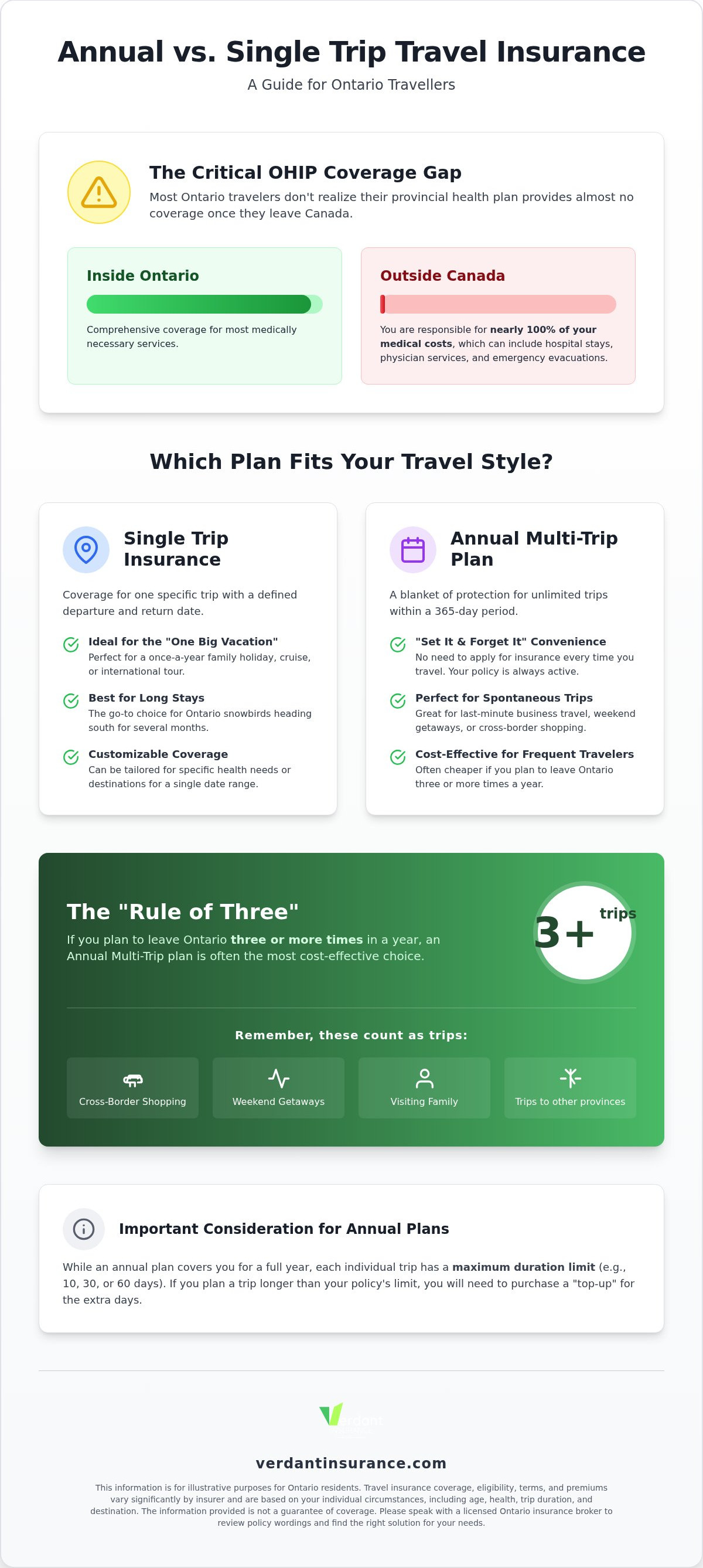
Before you book your next flight out of Pearson or drive across the border, it helps to understand travel insurance basics. Single trip insurance is exactly what it sounds like: coverage for one specific trip with a set departure and return date. It's a focused solution for a specific getaway. On the other hand, annual multi-trip insurance provides a blanket of protection for an unlimited number of trips within a 365-day window. When comparing annual vs single trip travel insurance Canada options, the primary difference lies in how often you plan to leave the province.
A common point of confusion for Ontario travelers is the "trip duration limit." While an annual plan covers you for a full year, it doesn't mean you can stay away for 365 days straight. Instead, these policies have a cap on how long each individual trip can be. Depending on the insurer and the specific plan you choose through a broker, these limits might be 4, 10, 30, or even 60 days per departure. If you stay longer than your limit, you'll need to "top up" your coverage for those extra days. This is why destination risk and trip length play such a major role in your decision.
When to Choose Single Trip Coverage
This option is usually the right fit for the "one big vacation" traveler. If you're planning a once-in-a-lifetime two-week tour of Europe or a family cruise, a single trip policy is straightforward. It's also the go-to choice for Ontario snowbirds who head south for several months at a time. Since most annual plans have shorter duration limits, a single trip policy can be customized to cover the entire length of a long-stay winter retreat. It simplifies the underwriting process for travelers who have specific, one-time insurance needs for a high-risk destination or those with complex health histories that require a specific stability period check for just one date range.
The Convenience of Annual Multi-Trip Plans
For those who live in Markham or the GTA, spontaneous travel is common. Whether it's a last-minute flight for a business meeting or a weekend cross-border shopping trip to Buffalo, an annual plan means you're already covered. You don't have to worry about forgetting to buy insurance or filling out forms every time you leave home. It's a "set it and forget it" approach that offers significant peace of mind. Every time you cross the Ontario border, your policy is active. This makes it an efficient choice for frequent flyers and road trippers who want the freedom to travel without administrative hurdles.
The Cost-Benefit Analysis: When Does an Annual Plan Save You Money?
Determining the financial "sweet spot" for annual vs single trip travel insurance Canada policies depends largely on your travel frequency. Industry guidelines for 2026 suggest the "Rule of Three." If you plan to leave Ontario three or more times in a calendar year, an annual multi-trip policy often becomes the more cost-effective choice. This calculation includes those quick weekend getaways to Buffalo for shopping or short flights to visit family in other provinces. When you add up the individual premiums for each departure, the one-time annual fee frequently comes out ahead.
Beyond the dollar amount, consider the value of your time. Applying for a new policy every time you leave the province creates an administrative burden. You have to re-enter medical data, review stability periods, and manage multiple sets of documents. An annual plan streamlines this into a single application, ensuring you're ready for spontaneous departures without the paperwork. It's a convenient solution for busy professionals and families in the GTA who don't want to spend their Friday evening filling out insurance forms.
Calculating Your Personal Break-Even Point
When calculating your break-even point, don't overlook "hidden" trips. Many Ontarians forget that OHIP coverage outside Canada is essentially non-existent, meaning a single night in a U.S. hospital could cost more than your entire vacation. Even domestic trips to other Canadian provinces can incur costs for services like private ambulances that OHIP doesn't cover. Adding trip cancellation to an annual plan can also change the math. While it adds to the premium, it protects all your scheduled departures throughout the year under one umbrella, often for a lower total cost than insuring each high-value trip separately.
Premium Factors for Ontario Residents
Your destination drastically changes the premium calculation. A policy that includes travel to the United States is typically priced higher due to the extreme cost of American medical care. If you only travel internationally to Europe or Asia, you might find different rate structures. Age and health status are the final pieces of the puzzle. As we age, the price gap between plan types can widen, making it vital to have a Markham insurance broker compare multiple partner insurers to see which one offers the most favorable terms for your specific medical history.
Choosing higher emergency medical limits also influences the cost. For frequent flyers, multi-trip plans often include better "base" coverage levels that might be more expensive if purchased individually. If you're a healthy traveller, the annual option is often a clear winner for frequency. However, if you have complex pre-existing conditions, the stability period requirements of an annual plan might be more rigid than a one-off single trip policy. Finding the balance requires looking at the total cost of all planned trips versus the one-time annual fee.
The 'OHIP Gap': Why Travel Insurance is Essential for Ontarians
A common myth among Ontario residents is that Canadian citizenship guarantees free healthcare wherever they go. While we're proud of our provincial system, the reality is that OHIP provides virtually no coverage once you cross the border. Since January 1, 2020, the province has stopped reimbursing emergency hospital and physician services for Ontarians travelling abroad. This means if you end up in a Buffalo or Detroit emergency room, you're responsible for the entire bill. When deciding between annual vs single trip travel insurance Canada plans, it's vital to consider the cost of medical repatriation. If you're seriously injured in the U.S. or overseas, the cost to fly you back to a hospital in Markham or Toronto can reach tens of thousands of dollars. OHIP does not cover air ambulances or medical escorts. Even travelling within Canada carries risks. While provinces share some costs, items like ground ambulances or prescription drugs are often not covered outside Ontario.
What OHIP Does and Doesn't Cover Abroad
OHIP's reimbursement rates are non-existent for almost all foreign medical care. The only exception is for hemodialysis, which is reimbursed at a set rate of $210 CAD per treatment. Beyond that, you're on your own. A single overnight stay in a foreign intensive care unit can exceed $10,000 CAD per day. Without private insurance, you must pay these costs upfront. A quality travel policy ensures the insurer coordinates with the hospital to pay bills directly. This prevents you from having to find thousands of dollars in the middle of a health crisis. It's about protecting your savings as much as your health.
Stability Periods and Pre-Existing Conditions
Every policy includes a "stability period." This is a set number of days before your trip where your health must remain unchanged. If you have a pre-existing condition and your medication changes during this window, you might not be covered for related emergencies. Comparing the stability terms of annual vs single trip travel insurance Canada is easier when you consult an online insurance broker Canada. They can help you find an insurer whose stability requirements match your specific health history. Keep in mind that actual coverage is always subject to insurer eligibility, policy wording, and specific exclusions. Whether you're travelling once or several times a year, understanding these terms is the key to ensuring your claim is paid if the unexpected happens.
Matching Your Policy to Your Ontario Travel Style
Your travel personality is the single most important factor when weighing annual vs single trip travel insurance Canada options. In the GTA, we have unique travel patterns that don't always fit into a one-size-fits-all box. Whether you're a frequent cross-border shopper or a long-term winter traveler, your policy needs to reflect the reality of your 2026 schedule. Choosing the wrong structure can lead to coverage gaps that only become apparent when it's too late to fix them. A local broker can help you navigate these choices by comparing multiple insurers to see which one aligns with your specific habits.
Cross-Border Shopping and Short US Trips
Many residents in Markham and Richmond Hill are "Weekend Warriors" who head to Buffalo or Detroit for quick shopping trips. It's a common mistake to think a four-hour trip doesn't require insurance. However, US medical costs don't care how long you've been in the country. An annual plan is the perfect safety net for these travelers because it's always active. You don't have to worry about the "trip duration trap" either. Most annual policies have a set limit per trip, such as 4 or 10 days. As long as your shopping spree stays within that window, you're protected without having to buy a new policy every Saturday morning. Trip interruption coverage is also a major benefit here, helping you manage costs if a sudden storm or car trouble leaves you stranded in New York state.
Family Travel and Multi-Person Plans
Coordinating coverage for a family in Vaughan or Toronto can be complicated, especially when children or spouses have different travel schedules. Annual family plans can simplify this by covering everyone under one umbrella. Even if one parent travels for business while the other takes the kids to visit relatives in another province, the protection remains consistent. For 2026 vacations, we recommend comparing the total cost of individual single-trip policies against one comprehensive annual family plan. This often provides better value and ensures that no one is left unprotected during a spontaneous getaway. For a deep-dive checklist on what to include in your policy, you can review this Travel Insurance Canada Online guide.
Business travelers should also be cautious. Many professionals rely on employer group plans, but these often have restrictive medical limits or exclusions for high-risk activities. If your job takes you to remote regions, ensure your policy covers medical evacuation back to a hospital in the GTA. A local broker can help you identify where your employer's plan falls short and suggest a supplemental policy to fill those dangerous gaps. This ensures you aren't left with a massive bill while representing your company abroad.
Consult a Markham insurance broker today
How an Ontario Insurance Broker Simplifies the Choice
Choosing between annual vs single trip travel insurance Canada plans shouldn't feel like a solo mission. While large banks or direct insurers only sell their own specific products, an insurance brokerage acts as your personal ally. We compare options from multiple partner insurers to find the policy that aligns with your specific health history and budget. This local expertise is vital for residents in Markham and the GTA who have diverse travel patterns, from frequent cross-border shopping trips to extended winter stays in the south. Instead of fitting your life into a rigid policy, we find a policy that fits your life.
If you face a medical emergency abroad, having a broker in your corner makes a world of difference. We provide a human touch that "one-size-fits-all" online forms simply can't match. You aren't just a policy number; you're a neighbor. If things go wrong, you have a professional advocate in Ontario who can help guide you through the claims process and ensure you're treated fairly by the insurer. This support provides a level of comfort that's hard to find when dealing with a faceless call centre.
Accessing Multiple Quotes with One Application
Verdant Insurance simplifies the buying process by connecting you with various carriers through a single, streamlined application. We help you navigate complex policy wording and stability periods, ensuring you don't accidentally purchase a plan that excludes your pre-existing conditions. Our digital-first platform also allows you to manage your travel protection alongside your homeowner insurance or auto policy. This holistic approach ensures all your assets and travels are protected in one place, making the path forward feel effortless and transparent.
Final Steps: Securing Your 2026 Travel Peace of Mind
Before you book your next departure from Ontario, take a moment to review your 2026 travel calendar. Estimate how many times you'll leave the province, including those quick weekend getaways. It's also wise to check the coverage on your premium credit cards. Many travelers assume these cards provide full protection, but they often have low medical limits, restrictive age caps, or short trip duration limits that leave you vulnerable. For more help navigating these choices, you can review our Ontario digital guide to selecting a broker.
Once you have a rough idea of your frequency, speak with a Verdant broker for a tailored comparison. We'll help you run the numbers on annual versus single-trip options to see which plan offers the most cost-effective protection for your upcoming travels. By taking these steps now, you can focus on enjoying your trip with the confidence that your health and finances are secure.
Ready for Your Next Ontario Departure?
Choosing between annual vs single trip travel insurance Canada comes down to your personal travel rhythm. If you're heading south of the border or to another province three or more times this year, the convenience and cost-effectiveness of an annual plan are hard to beat. It's vital to remember that OHIP won't pay your medical bills once you leave the country. This reality makes private protection a necessity for every traveler. As a Markham-based brokerage serving the GTA, we provide expert advice and access to multiple insurance partners. This local connection allows us to advocate for you if things go wrong abroad. We ensure your policy meets your unique health and stability requirements so you don't have to guess. Our goal is to simplify the process and provide a safety net that works for your specific 2026 travel style. We're here to help you navigate the fine print so you can focus on the journey ahead with total peace of mind.
Get a personalized travel insurance quote from a Verdant broker today
Safe travels start with the right protection. We look forward to helping you secure your next adventure.
Frequently Asked Questions
Is travel insurance mandatory for Ontario residents travelling to the US?
Travel insurance isn't legally mandatory for Ontario residents crossing into the U.S., but it's a financial necessity. Without a policy, you're responsible for 100% of medical costs. A single emergency room visit in New York state can cost thousands of dollars. Since OHIP stopped reimbursements for out-of-country emergency care in 2020, even a short shopping trip to Buffalo carries immense financial risk if you're unprotected.
Can I upgrade a single trip policy to an annual plan later in the year?
Generally, you cannot "upgrade" a single trip policy into an annual one after the trip has started or ended. Each policy type is a separate legal contract. If your travel plans change and you find yourself leaving the GTA more frequently, you'll need to purchase a new annual multi-trip plan. A broker can help you compare annual vs single trip travel insurance Canada options to ensure you choose the right structure from the start.
Does annual travel insurance cover trips within Ontario or other provinces?
Yes, annual plans typically provide coverage for travel within Canada but outside of Ontario. While OHIP covers some physician services in other provinces, it doesn't always pay for ground or air ambulances, prescription drugs, or emergency dental work. Having an annual policy ensures that whether you're visiting family in British Columbia or flying to Quebec for business, those supplemental medical costs are managed by your insurer rather than your own pocket.
What is the maximum trip length allowed on a standard annual multi-trip policy?
Maximum trip lengths vary significantly by insurer and the specific plan you select. Common options for Ontario residents include 4, 10, 30, or 60 days per departure. It's important to choose a limit that covers your typical stay. If you're a "Weekend Warrior" from Markham heading to the U.S., a shorter limit might suffice. However, if you plan longer vacations, you'll need a policy with a higher per-trip cap to maintain coverage.
Are pre-existing medical conditions covered differently in annual vs. single trip plans?
Both plan types use "stability periods" to determine eligibility for pre-existing conditions, but the requirements can differ. For an annual plan, your health must usually remain stable for a set number of days before each individual departure. In contrast, a single trip policy only looks at the period before that specific trip. If your health is fluctuating, a single trip policy might offer more flexibility. Always check the policy wording for specific exclusion details.
How much does OHIP actually cover for emergency medical expenses outside of Canada?
OHIP provides virtually zero coverage for emergency medical expenses outside of Canada. Since 2020, the province has eliminated its out-of-country reimbursement program for emergency hospital and physician services. The only current exception is for hemodialysis, which is reimbursed at a fixed rate of $210 CAD per treatment. For all other emergencies, including surgery or intensive care, you are responsible for the full cost of your treatment while abroad.
Do I still need travel insurance if my credit card provides some coverage?
You should carefully review your credit card's benefits, as they often contain significant gaps. Many cards have low medical limits, strict age restrictions, or only cover trips under 15 days. Additionally, they may not provide the comprehensive trip cancellation or medical repatriation support that a dedicated policy offers. A broker can help you identify these gaps and determine if a supplemental annual vs single trip travel insurance Canada policy is necessary for your protection.
What happens if I stay longer than the trip limit on my annual policy?
If you stay longer than your policy's trip limit, your coverage will typically end on the last day of that limit. To stay protected, you must purchase a "top-up" from your insurer before the original limit expires. For example, if your annual plan allows for 10-day trips but you stay for 15, you need to buy coverage for those extra 5 days. Failing to do this could leave you entirely unprotected for the remainder of your stay.