
You've spent months saving for a down payment and weeks touring houses in Markham or Richmond Hill, but now that your offer's finally been accepted, a new hurdle appears: the "insurance binder" request from your real estate lawyer. It's a moment that often sparks a flurry of questions. Do you need mortgage insurance or home insurance? What does "replacement cost" actually mean for your budget? Buying your first home is an incredible milestone, yet the technical jargon and tight closing deadlines can make the final stretch feel overwhelming.
It's completely natural to feel anxious about getting the paperwork right. This first time home buyer insurance checklist is designed to clear the fog and give you a straight path to closing day. As an Ontario insurance brokerage, we're here to act as your proactive guide, helping you secure the right protection while satisfying your lender's requirements without the stress.
In the following guide, we'll outline the specific documents you need to gather for an accurate quote and explain which coverages are mandatory versus those that are simply smart to have. You'll learn how to coordinate with your lawyer and ensure your new investment is fully protected the moment you get the keys.
Key Takeaways
- Distinguish between mortgage default insurance (CMHC), which protects the lender, and homeowner insurance, which protects your physical property and legal liability.
- Use our first time home buyer insurance checklist to gather critical property details like the age of the roof and electrical system updates before you start the quoting process.
- Understand that dwelling coverage limits are based on the actual cost to rebuild your home in Ontario rather than its current real estate market value.
- Begin your insurance search at least 2-3 weeks before closing to ensure your real estate lawyer receives the required insurance binder in time for a smooth transaction.
- Partner with an Ontario insurance broker to compare options from multiple insurers, ensuring you find coverage that fits your specific needs and budget.
Understanding Home Insurance vs. Mortgage Insurance in Ontario
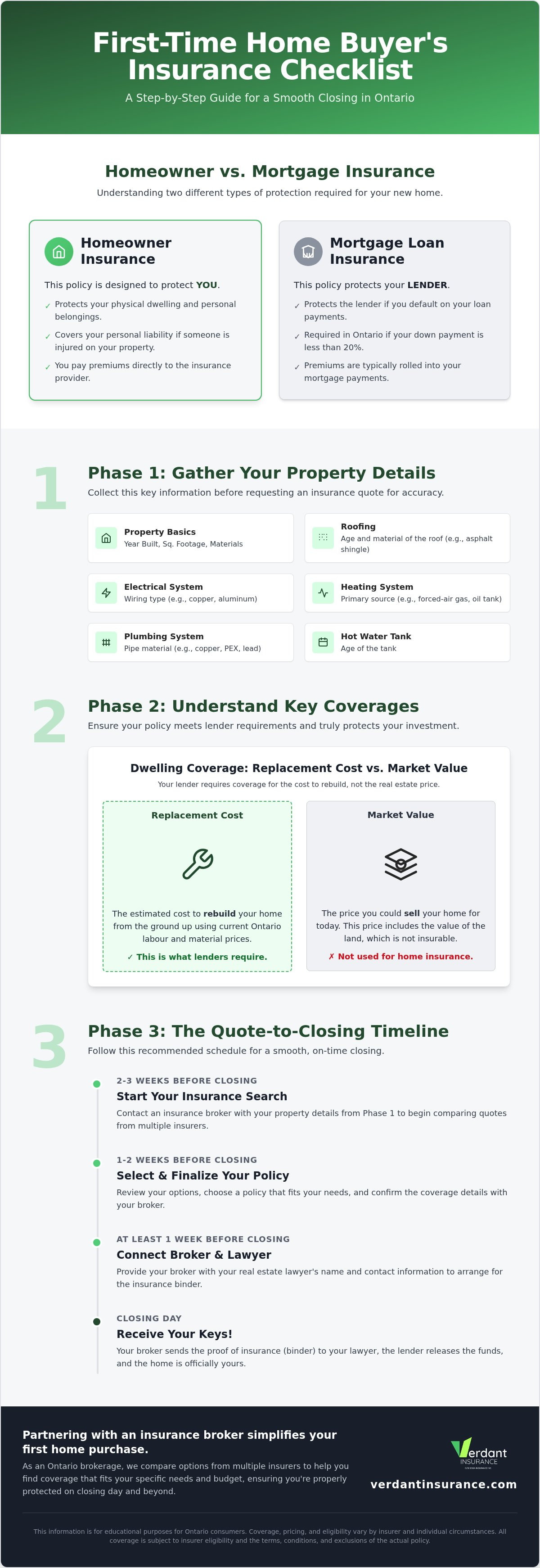
One of the most common points of confusion on any first time home buyer insurance checklist is the difference between mortgage loan insurance and homeowner insurance. These two products serve entirely different purposes. Mortgage loan insurance, often provided by the CMHC, is required in Ontario if your down payment is less than 20%. This insurance protects the lender if you default on your loan payments. Homeowner insurance, however, is for your benefit. It protects your physical dwelling, your personal belongings, and your legal liability. While CMHC premiums are typically rolled into your total mortgage amount, homeowner insurance is a separate recurring cost you'll manage directly.
Ontario lenders won't advance your mortgage funds on closing day without seeing a valid insurance binder. They view your home as collateral. If a fire or major storm damages the property, the bank needs to know the asset can be rebuilt to its original state. This is why Understanding Home Insurance is so critical before you sign your final paperwork with a lawyer in Markham or Toronto. Without this proof, your closing could be delayed, causing unnecessary stress during an already busy time.
Why Your Ontario Lender Cares About Your Policy
Your lender will insist on being named as the "loss payee" or "mortgagee" on your policy. This legal designation ensures the bank is compensated if the home is destroyed. They also require "Full Replacement Cost" coverage on the dwelling. This means the policy must cover the actual cost to rebuild the structure from the ground up at current Ontario labour and material rates, regardless of the home's market value. A basic "fire insurance" policy rarely meets modern lending standards because it doesn't account for the full spectrum of risks, such as wind, hail, or theft, that could devalue the lender's security.
Distinguishing Between Mandatory and Recommended Coverage
Most standard policies in Ontario cover "perils" like fire, lightning, windstorms, and smoke damage. While these are foundational, liability coverage is equally vital for a new homeowner. If a visitor slips on an icy walkway at your York Region home or a delivery person is injured on your property, liability protection helps cover legal fees and potential settlements. Homeowners insurance is a comprehensive package including property and liability protection. Adding these specific details to your first time home buyer insurance checklist ensures you aren't just meeting a bank requirement, but actually protecting your family's financial future. While some endorsements are optional, having a robust policy provides the peace of mind you need as you settle into your new community.
Phase 1: The Information Gathering Checklist
Before you contact a broker for a quote, you need a specific set of data ready. Every first time home buyer insurance checklist should start with the physical structure of the property. You'll need the total square footage, the year the house was built, and the primary construction materials, such as brick, wood frame, or stone. Insurers also look closely at your heating source. In Ontario, natural gas forced air is the standard, but if the property uses an oil tank, it can significantly impact your eligibility or premium costs due to potential environmental risks. If you aren't sure about these details, your real estate listing or home inspection report are excellent places to start.
If you're buying a property in a more rural part of Ontario, the distance to the nearest fire hydrant and fire station is a critical rating factor. Properties within 300 metres of a hydrant and 8 kilometres of a station usually qualify for protected rates. Having this information ready prevents delays during the application process and ensures your quote is as accurate as possible from the beginning.
Technical Details for Older Ontario Homes
Many homes in the GTA, especially in older neighbourhoods in Toronto or Vaughan, feature aging infrastructure that requires extra attention. You must identify if the house has knob-and-tube or aluminum wiring. These systems can be difficult to insure or may require a higher premium. Similarly, insurers will ask about the plumbing. Galvanized steel or lead pipes are often seen as high-risk for water damage. Don't forget to check the age of the hot water tank and the roof. If the roof is over 20 years old or the tank is past its 12-year mark, some companies may require updates before they offer full coverage.
Personal Information You Will Need
Your own history matters as much as the house itself. Insurers will ask for the claims history of everyone listed on the mortgage. Even if you haven't owned a home before, your record under a previous tenant policy is relevant. If you plan to run a home-based business, you should disclose it now. This ensures your homeowner insurance is tailored correctly from day one, preventing coverage gaps if you're using the space for professional purposes. Taking the time to gather these personal details helps an Ontario broker advocate for you more effectively when comparing partner insurers.
Phase 2: Choosing Your Coverage Limits
Once you have the property details ready, it's time to decide how much protection you actually need. The most important figure on your first time home buyer insurance checklist is the dwelling limit. It's a common mistake to confuse your home's purchase price with its insurance value. In Ontario, your dwelling limit is based on the cost to rebuild the structure from scratch, not the market value of the land or the house. Since residential rebuild costs in Ontario increased by 23.8% between 2021 and 2026, ensure your broker uses an up-to-date replacement cost calculator to reflect current labour and material prices.
Personal liability coverage is another critical component. This protects you if someone is accidentally injured on your property or if you unintentionally damage someone else's property. While $1 million is often the minimum requirement, many homeowners in the GTA opt for $2 million. This higher limit offers better protection against the rising costs of legal settlements in Ontario, providing an extra layer of security for your new assets.
You also need to account for your personal belongings and temporary living expenses. Contents coverage should reflect the total value of your furniture, electronics, and clothing. Walk through your new home and mentally tally these items to get an accurate estimate. Additionally, ensure your policy includes Additional Living Expenses (ALE). If a covered loss like a fire makes your home uninhabitable, ALE covers the cost of a hotel and meals while repairs are underway, so you aren't stuck with a massive bill during a crisis.
Ontario-Specific Endorsements to Consider
Standard policies don't cover every possible scenario, so consider adding specific endorsements to fill the gaps. Sewer back-up coverage is essential for many Ontario municipalities where aging infrastructure can lead to basement flooding. Overland water protection is also highly recommended; it covers damage from heavy rain or melting snow, which is a growing concern across the province. Finally, service line coverage protects the expensive pipes and utility lines running from the street to your house. These are typically the homeowner's responsibility to repair if they fail.
Deductibles and Your Premium
Choosing your deductible is a balancing act between your monthly budget and your out-of-pocket risk. A deductible is the portion of a claim you agree to pay yourself. Opting for a higher deductible, such as $1,000 or $2,500, can lower your annual premium. However, you should only choose a limit you can comfortably afford to pay on short notice if an emergency happens. Your broker can help you compare different deductible levels to find the right fit for your financial situation.
Phase 3: The Step-by-Step Quote and Closing Checklist
Timing is everything when you reach the final stretch of your purchase. You should contact an Ontario insurance broker at least two to three weeks before your closing date. This window gives you enough time to review various options and ensure every detail on your first time home buyer insurance checklist is addressed without rushing. Because a broker works with multiple partner carriers, they can help you compare different policies. This is much more efficient than calling individual companies yourself, as the broker does the legwork to find a fit that respects your budget and your new home's specific needs.
Once you select a policy, you'll need to finalize the application and arrange payment. Most Ontario insurers allow you to pay the annual premium in full or set up a monthly payment plan via credit card or automatic bank withdrawal. Completing this step early prevents any last minute hitches that could delay the transfer of funds from your lender. It's one less thing to worry about as you start packing your boxes and coordinating with movers in Markham or across the GTA.
The Role of the Insurance Binder
An insurance binder is a temporary document that serves as legal proof that your coverage is active before the full policy document is issued. It's the most important piece of paper your real estate lawyer needs from you. Without it, the bank won't release the mortgage funds because they have no guarantee their collateral is protected. You must provide your broker with the exact legal name and address of your mortgage lender to ensure the binder is perfectly accurate. Most brokers in York Region can send this directly to your lawyer's office once you give the green light, ensuring a seamless transition on closing day.
Final Walkthrough and Insurance
Your final walkthrough is usually scheduled a day or two before closing. This is your chance to verify that the home is in the same condition as when you signed the offer. Check that no new damage, like a burst pipe or a leaking roof, has occurred since you last saw the property. If you notice any major changes to the home's systems or condition, notify your broker immediately as it could affect your underwriting. It's also vital to confirm that your policy's start date matches your closing date exactly. You don't want a gap in coverage the moment you take possession of the keys, especially if you plan to start moving items in on day one.
Working with a Broker: Simplifying Your First Purchase
Completing your first time home buyer insurance checklist is a major step toward homeownership, but the final hurdle is often the most complex. As an Ontario insurance brokerage based in Markham, Verdant Insurance acts as your personal advocate. Unlike a direct insurer that only offers their own products, we work for you. We understand the specific local risks in York Region and the GTA, from basement flooding concerns to the rebuild costs of historic homes. Our goal is to provide clarity and support, ensuring you feel confident when you sign your final papers.
One of the greatest advantages of the brokerage model is the ability to compare multiple partner insurers with a single application. You don't have to spend hours repeating the same technical details about your roof or electrical system to different agents. We take that information and do the shopping for you. This professional guidance is invaluable for first-time buyers who want to ensure they aren't missing any mandatory lender requirements while still finding a policy that fits their monthly budget.
Bundling for Better Value
Smart financial planning for new homeowners often starts with looking for combined savings. Many insurance providers offer significant discounts when you bundle your Home and Auto Insurance Bundles in Ontario. Beyond the potential cost benefits, bundling offers a high degree of convenience. Managing your property and vehicle protection through one digital platform makes it easier to track your payments and policy documents. It also ensures that your coverage limits are coordinated, reducing the risk of accidental gaps in your protection.
Your Peace of Mind Starts Here
Our relationship doesn't end once you get the keys to your new house. As your proactive guide, we provide ongoing support for any future questions or claims you might have. Whether you're planning a kitchen renovation in Richmond Hill or welcoming a new member to the family, we help you adjust your coverage to match your changing life. We also assist with your annual renewals, reviewing your policy to ensure it remains the right fit for your needs. This long-term partnership gives you the peace of mind to enjoy your new home, knowing you have a dedicated expert in your corner.
Speak with a Verdant Insurance broker today
Secure Your New Home with Confidence
You've reached the final stages of a major life milestone. By distinguishing between mortgage default insurance and homeowner insurance, you've already cleared the biggest hurdle for most new buyers. Following this first time home buyer insurance checklist ensures you have the technical details and coverage limits ready to satisfy both your lender and your own peace of mind. You now know exactly how to coordinate with your lawyer to provide the required insurance binder in time for a smooth closing.
Verdant Insurance is an Ontario-based brokerage located in Markham, offering you access to multiple top-tier Canadian insurance partners. Our licensed brokers provide the personalized service you need to navigate the closing process without any unnecessary stress. We're ready to help you cross the finish line and get those keys in your hand with total confidence.
Congratulations on your first home purchase. We look forward to helping you protect your new investment and welcoming you to your new community.
Common Questions for New Homeowners
Do I need home insurance before I close on my house in Ontario?
Yes, you must have a policy bound and effective on your closing date. Lenders require an insurance binder as proof of coverage before they will release mortgage funds to your lawyer. This is a vital item on your first time home buyer insurance checklist to avoid stressful closing delays. You should start the quoting process at least two to three weeks before your move to ensure everything is ready.
Is home insurance mandatory in Ontario if I don’t have a mortgage?
No, Ontario law doesn't mandate home insurance for owners who own their property outright. However, it's highly recommended to protect your significant investment against fire, theft, and liability claims. Without a policy, you're personally responsible for all repair costs or legal damages if someone is injured on your property. Most homeowners choose to maintain coverage to ensure long term financial security for their families.
What is the difference between replacement cost and market value?
Market value is what a buyer pays for your home and land in the current real estate market. Replacement cost is the actual expense to rebuild the structure from scratch using current labour and material rates. Residential rebuild costs in Ontario increased by 23.8% between 2021 and 2026. Insurers use replacement cost because it ensures you can restore the property even if construction costs rise beyond your purchase price.
How much does home insurance typically cost for a first-time buyer in the GTA?
Premiums vary based on your property's specific features and location. In 2026, the average annual home insurance premium in Ontario is approximately $2,235. For a detached single family home, you can typically expect to pay between $1,400 and $2,200 annually. Your final rate depends on individual circumstances, such as the age of the home's systems and the coverage limits you choose for your personal belongings and liability protection.
Can I change my insurance provider after I have closed on the house?
Yes, you can switch providers at any time, though it's usually easiest at your annual renewal. If you switch mid term, you may face short rate cancellation fees from your current insurer. You must also notify your mortgage lender immediately to ensure they have the updated policy details on file. A broker can help you compare options to see if switching provides better value for your specific needs.
Does my home insurance cover the belongings in my moving truck?
Most comprehensive homeowner policies in Ontario include coverage for personal property while it's in transit to your new principal residence. This protection is usually limited to a specific percentage of your total contents limit and may exclude certain types of damage like breakage. You should verify these details with your broker before moving day to ensure your items are protected during the trip from your old home to your new one.
What information does my lawyer need from my insurance broker?
Your real estate lawyer needs a formal insurance binder to finalize your purchase. This document acts as temporary proof that coverage is in place and lists your mortgage lender as a loss payee. It must confirm that the policy start date matches your closing date exactly. Providing your broker with your lawyer's contact information early helps ensure this paperwork arrives at the law office in Markham or Toronto well before your appointment.
Will a home inspection report help me get a better insurance rate?
While a report itself doesn't automatically lower your rate, the information it contains is essential for an accurate quote. It helps you complete your first time home buyer insurance checklist by identifying the age of the roof, type of wiring, and plumbing materials. Updating old systems identified in a report, like replacing an aging roof, can qualify you for better rates and more coverage options with many Ontario insurers.