
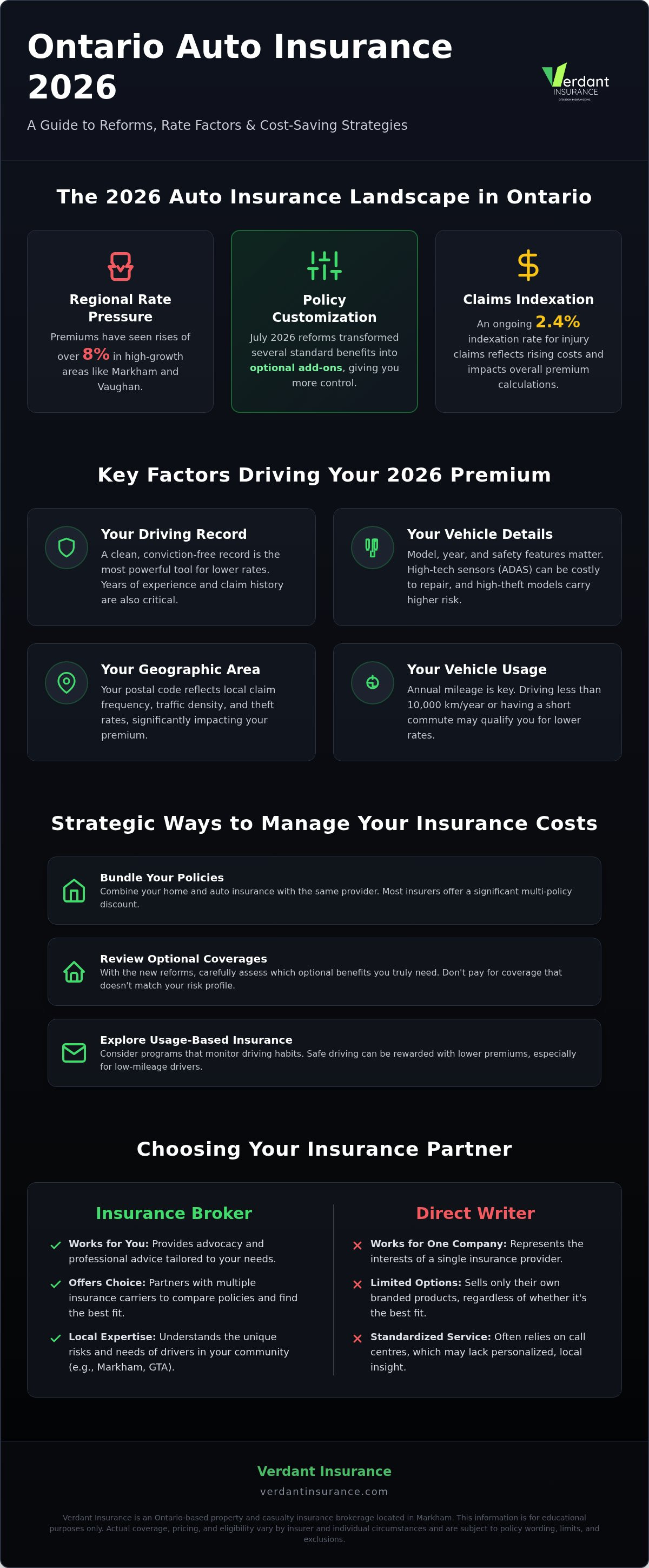
Could opting out of a standard benefit today cost you your financial security tomorrow? With the major provincial reforms that took effect in July, car insurance rates Ontario 2026 are no longer just about the number on your renewal notice; they're about the specific choices you make regarding your coverage. We understand that seeing premiums rise by over 8% in areas like Markham and Vaughan feels overwhelming, especially when you're trying to figure out which benefits are now optional and which remain mandatory under the new law.
It's completely normal to feel a bit anxious about these changes or like just another number to a massive direct insurer. Our goal is to replace that confusion with confidence. This guide provides a clear look at the 2026 rate drivers, from the 2.4% indexation rate for injury claims to the specific insurers currently offering rate decreases. You'll learn how to navigate the new unbundled system so you can choose a policy that balances your budget with the protection your family needs. We've simplified the process to make your next quote feel like a conversation with a helpful ally, not a bureaucratic hurdle.
Key Takeaways
- Learn how the July 2026 insurance reforms transformed several standard benefits into optional add-ons, giving you more control over your policy structure.
- Discover the specific regional and technical factors driving car insurance rates Ontario 2026 to better understand your renewal notice.
- Understand the critical difference between mandatory and optional coverages to ensure you don't accidentally opt out of essential financial protections.
- Explore practical strategies for managing costs, such as bundling your home and auto policies or leveraging modern usage-based insurance programs.
- Gain confidence in navigating the quoting process by working with a local broker who understands the unique needs of drivers in Markham and the GTA.
Understanding the Ontario Auto Insurance Market in 2026
The landscape for car insurance rates Ontario 2026 is shaped by a combination of sophisticated vehicle technology and provincial oversight. As cars become more like computers on wheels, the cost to repair them has climbed. A simple bumper replacement now often involves recalibrating sensors and cameras, which puts upward pressure on premiums across the Greater Toronto Area. Inflation also plays a role, as the cost of parts and labour continues to rise. Despite these pressures, the market remains highly regulated to protect consumers.
The Regulatory Landscape: FSRA and Rate Filings
Every insurance provider in the province must submit their proposed pricing to a government body for approval. The Financial Services Regulatory Authority of Ontario (FSRA) serves as the primary regulator responsible for reviewing and approving all auto insurance rate filings to ensure they are justified and fair for drivers. Insurers can't simply raise prices on a whim; they must provide data-driven evidence that their current rates aren't sufficient to cover claims and operating costs.
Public policy changes, like the 2026 reforms to Accident Benefits, also influence your renewal notice. When the government changes what's included in a standard policy, insurers adjust their filings to reflect these new risk levels. This regulatory process ensures that while car insurance rates Ontario 2026 may fluctuate, they remain grounded in actuarial reality rather than arbitrary increases.
Brokerage vs. Direct Writer: Why Advocacy Matters
When you look for coverage, you'll likely choose between a direct writer and a brokerage. A direct writer is an insurance company that sells only its own branded products. If their specific underwriting rules don't favour your profile, your options are limited. In contrast, a broker works for you, not the insurance carrier. We partner with multiple insurers to compare different policies, helping you find a fit that respects your budget and your coverage needs.
Understanding the broader context of Vehicle Insurance in Canada helps clarify why this distinction is so important. Since Ontario uses a private delivery system for mandatory coverages, having a licensed professional to navigate complex policy wording is a significant advantage. Our team serves as a Markham broker with deep roots in the GTA, providing a tailored experience that large, faceless call centres often miss. We help you understand the baseline mandatory protections while ensuring you aren't overpaying for optional add-ons you don't need.
Key Variables Affecting Your 2026 Premiums in Ontario
Your premium isn't a random number. It's a calculated reflection of your unique risk profile. Factors like how long you've held your licence and your daily commute distance play a massive role. In 2026, insurers are looking closer at annual mileage as hybrid work patterns become permanent for many in the GTA. If you drive less than 10,000 kilometres a year, you might qualify for different rating categories than a daily commuter. Knowing how these factors influence car insurance rates Ontario 2026 helps you make informed decisions during your renewal.
Vehicle-specific ratings have also become more complex. While Advanced Driver Assistance Systems (ADAS) like lane-keep assist can prevent accidents, the high cost of repairing these sensors often offsets the safety discount. Additionally, high theft rates for specific SUV models in Ontario continue to influence car insurance rates Ontario 2026. The Financial Services Regulatory Authority of Ontario offers resources to help you understand how these industry-wide trends and vehicle groupings affect your specific policy.
Geographic Rating: From Markham to the GTA
Your postal code remains a significant factor because it reflects local risks. For example, rates in Vaughan or Richmond Hill often differ from downtown Toronto due to local traffic density and claim frequency data. Living in a high-growth area with more construction and congestion can lead to higher localized risk. Always provide an accurate primary garage address. Using a different address to lower your rate is considered misrepresentation and can lead to a denied claim when you need help most.
Driver Profile and the Value of a Clean Record
Maintaining a clean driving record is your most powerful tool for lower premiums. Being conviction-free and claim-free leads to substantial reductions, as insurers view you as a lower-risk client. Even a minor speeding ticket can impact your eligibility for "safe driver" discounts for up to three years. Major convictions, such as distracted driving or impaired operation, have a much more severe and long-lasting impact on your eligibility and rates.
At Verdant, we focus on rewarding safe habits. We connect drivers with partner-led discounts that recognize years of accident-free experience. If you're looking for a Markham insurance broker who understands the local landscape, we can help you navigate these variables. We'll look at your specific profile to find every available credit you've earned through your commitment to safety.
Navigating Coverage Options and Policy Customization
Choosing the right coverage is a balancing act between protection and price. In 2026, the Ontario auto insurance system has become more modular, allowing you to fine-tune your policy like never before. While this flexibility can help manage car insurance rates Ontario 2026, it also requires a deeper understanding of what you're keeping and what you're potentially giving up. Your choices here directly influence your financial safety net if an accident occurs.
Mandatory Coverages: The Ontario Baseline
Every driver must carry a specific set of protections to legally operate a vehicle. These requirements are outlined in Ontario's mandatory insurance laws. The foundation includes Third-Party Liability, which covers you if you're held responsible for injuring someone or damaging their property. While the legal minimum is $200,000, most drivers in the GTA find this insufficient given the high cost of medical care and legal fees; many opt for $1 million or $2 million instead.
Accident Benefits are another mandatory component, providing support for medical and rehabilitation costs regardless of who caused the collision. Since the July 2026 reforms, certain benefits like income replacement, caregiver, and housekeeping expenses have moved to an optional "add-on" status. This means your baseline policy now focuses on core medical needs, leaving you the choice to purchase additional layers of security based on your personal financial situation and employment benefits.
Optional Benefits: Tailoring Your Peace of Mind
Beyond the basics, you have several ways to protect your vehicle and your wallet. Collision coverage handles repairs to your own car after an accident, while Comprehensive coverage protects against non-collision events like theft, fire, or vandalism. For newer vehicles, adding a Waiver of Depreciation (OPCF 43) ensures you receive the full value of your car without depreciation if it's totaled within the first few years. This is especially valuable given the rising prices of vehicles and technology in 2026.
One of the most significant changes for car insurance rates Ontario 2026 involves Direct Compensation - Property Damage (DCPD). Drivers now have the option to opt out of DCPD coverage entirely. While opting out might lower your premium, it means your insurer won't pay for repairs to your vehicle, even if you aren't at fault in a collision. You can also customize your auto insurance with endorsements like OPCF 20 (Loss of Use), which covers the cost of a rental car while yours is in the shop. Choosing a higher deductible is another way to lower your monthly costs, provided you're comfortable paying that amount out-of-pocket if you need to make a claim.
Strategic Ways to Manage Your Insurance Costs
Managing your budget doesn't mean you have to sacrifice quality coverage. While car insurance rates Ontario 2026 are influenced by broad market trends, you still have significant control over your final premium. Small, intentional adjustments can lead to meaningful long-term savings without leaving you vulnerable. It's about being proactive rather than reactive when your renewal notice arrives.
The Power of Multi-Line Bundling
Most Ontario insurers offer reduced rates when you place multiple policies with the same provider. By combining your auto coverage with your homeowner insurance, you simplify your administrative life while unlocking multi-policy discounts. It's an efficient way to build a comprehensive safety net for your family. This approach often results in a lower total cost than buying each policy separately from different direct writers.
Modern Savings: Telematics and Safety Tech
Technology is changing how we earn discounts. In 2026, Usage-Based Insurance (UBI) programs have evolved into sophisticated tools that track safe driving behaviours in real-time. If you don't speed and you avoid late-night driving, these programs can offer personalized car insurance rates Ontario 2026 that reflect your actual risk rather than just your demographic. Seasonal safety is also a factor. Installing winter tires isn't just a safety choice; it's a way to secure a recurring discount during the snowy months in Markham and the GTA.
Increasing your deductible is one of the fastest ways to lower your annual premium. If you're comfortable paying $1,000 instead of $500 out-of-pocket for a claim, your monthly rate will reflect that shift. Finally, don't let your policy run on autopilot. An annual review with a broker ensures your coverage still matches your lifestyle. If you've started working from home or moved to a different part of York Region, your broker can update your profile to ensure you aren't overpaying.
Finding Your Ideal Policy with a Local Ontario Broker
Finding the right coverage shouldn't feel like a chore. While automated engines give you numbers, they often lack the context of your daily life in the GTA. We combine digital speed with the steady hand of a licensed professional. This approach ensures you aren't just looking at the lowest number, but at car insurance rates Ontario 2026 that actually provide the security you need. A broker acts as your advocate, especially when claims arise or provincial regulations shift, providing a layer of support that direct insurers can't match.
Personalized Support from a Markham-Based Team
Our team lives and works in the same communities you do. We understand the specific risks of Ontario roads, from the congestion on the 404 to the unique traffic patterns in Richmond Hill and Vaughan. This local expertise allows us to serve as a proactive guide for your insurance journey. You aren't just a policy number in a database; you're a neighbour who deserves clear answers and tailored advice. Having a dedicated contact for policy changes or coverage questions provides the peace of mind that comes from professional reliability and approachable warmth.
The long-term value of a brokerage relationship becomes clear during the renewal process. Instead of you having to shop around every year, we do the work for you. We monitor the market and your specific profile to ensure your coverage remains aligned with your needs. If your circumstances change, such as adding a new driver or changing your commute, we're here to adjust your policy effortlessly. Our goal is to make the path forward feel secure and well-cared for, regardless of how the broader market fluctuates.
Starting Your Quoting Journey Online
We've designed our platform to be as transparent and user-friendly as possible. You can get an insurance quote online to begin the process at your own pace. Once you've entered your details, we compare our partner insurers to find a rate that respects your budget while maintaining high standards of protection. This hybrid model gives you the efficiency of modern tech with the reassurance of human expertise. Before you bind your 2026 Ontario auto policy, keep this checklist ready:
- Your current policy document and renewal notice.
- The Vehicle Identification Number (VIN) for all cars on the policy.
- Driver's licence numbers for all household members.
- A summary of your driving history, including any recent convictions or claims.
- Your primary garage address and estimated annual mileage.
By preparing these details in advance, you ensure that your quote for car insurance rates Ontario 2026 is as accurate as possible. We'll walk you through the final steps to ensure every credit and discount is applied, leaving you confident in your choice.
Secure Your Road Ahead in 2026
The landscape of Ontario's auto insurance has shifted significantly toward more choice and modularity. By understanding the new optional benefits and the factors driving car insurance rates Ontario 2026, you can build a policy that truly reflects your unique lifestyle. Whether you're commuting through Markham or driving less frequently, the right coverage depends on balancing these new regulatory choices with your personal comfort level and financial goals.
Our team at Verdant is ready to act as your proactive guide through this evolving market. We connect you to multiple leading Canadian insurance partners to find a policy that respects your budget. We prioritize savings for safe drivers, with up to 30% savings available for those who remain claim-free and conviction-free. As Markham-based experts, we know the local roads and the specific risks you face every day in the GTA, ensuring your protection is never left to chance.
Speak with a Verdant Broker for a Personalized Ontario Auto Quote
You don't have to navigate these regulatory changes alone. We're here to provide the clarity and professional support you deserve for a smooth, stress-free experience. Let's work together to ensure you drive with total peace of mind.
Frequently Asked Questions
What is the average car insurance rate in Ontario for 2026?
Average car insurance rates Ontario 2026 are influenced by regional trends and individual risk factors rather than a single provincial number. Industry data from the first half of 2026 shows a 4.45% year-over-year increase in premiums, driven largely by rising repair costs for high-tech vehicles. Because rates vary significantly between a driver in Markham and one in a rural area, looking at broad averages can be misleading. A personalized quote is the only way to determine your actual cost.
Is it mandatory to have auto insurance in Ontario?
Yes, auto insurance is a legal requirement for all drivers in Ontario. You must carry a minimum of $200,000 in Third-Party Liability, although most brokers suggest $1 million or $2 million for better protection. Your policy must also include Statutory Accident Benefits, Uninsured Automobile coverage, and Direct Compensation - Property Damage (DCPD). Driving without valid insurance can result in heavy fines, licence suspension, and vehicle impoundment, making it essential to keep your coverage active at all times.
How can I lower my car insurance premium as a young driver in the GTA?
Young drivers in the GTA can manage their costs by completing a government-approved driver training course and maintaining a clean record. Staying on a parent's policy as a secondary driver is often more affordable than a standalone policy. Many insurers also offer discounts for students with high academic standing. In 2026, enrolling in a telematics or usage-based insurance program is a popular way to prove safe driving habits and earn personalized discounts based on actual performance.
What does 'DCPD' mean on my Ontario insurance policy?
DCPD stands for Direct Compensation - Property Damage. It typically means that if you are involved in an accident where you are not at fault, your own insurance company pays for repairs. This system is designed to speed up claims by removing the need to recover costs from other insurers. As of the 2026 reforms, you can choose to opt out of this coverage to reduce your premium, though actual coverage depends on your specific policy wording and limits.
Does my driving record from another province affect my Ontario rates?
Yes, your driving history from other Canadian provinces is typically factored into your Ontario premium. Insurers generally review your claims history and any convictions from the last three to ten years. When moving to Ontario, it's helpful to obtain a claims experience letter from your previous insurer and a copy of your driver's abstract. This documentation helps your new broker accurately reflect your experience and ensure you receive any eligible safe-driver discounts you've earned through your commitment to safety.
Can I change my insurance broker in the middle of a policy term?
You can change your insurance broker at any time, but the process depends on whether you want to stay with the same insurance company. If you keep your current insurer, you simply sign a Broker of Record letter. If you want to switch both your broker and your insurance company mid-term, you may face a short-rate cancellation fee from your current insurer. Waiting until your 2026 renewal date is often the most cost-effective way to make a change.
How does bundling my home and auto insurance save me money?
Bundling refers to purchasing multiple policies, such as home and auto insurance, through the same insurance provider. Most Ontario insurers offer a multi-policy discount that reduces the premium for both lines of coverage. Beyond the financial savings, bundling simplifies your life by centralizing your billing and providing a single point of contact for your insurance needs. It's an efficient way to ensure there are no gaps in your overall protection while keeping your total monthly costs lower.
What happens if I opt out of certain optional coverages in 2026?
Opting out of optional coverages, such as income replacement or caregiver benefits, can lower your monthly premium but introduces significant financial risk. If you are injured in an accident and don't have these add-ons, you won't receive those specific payments from your insurer. This change, part of the July 2026 provincial reforms, requires you to carefully evaluate your other sources of disability or health coverage before deciding to remove these core protections from your auto policy.