
Did you know that Toronto drivers saw their premiums climb by an average of 5.26% in 2026 alone? It's no secret that the cost of living across the GTA is reaching new heights. Seeing your monthly bill rise alongside your other household expenses can feel incredibly frustrating. You might feel confused about why your specific postal code seems to carry a higher price tag or anxious about how rising auto theft across Ontario impacts your bottom line.
We're here to help you make sense of the average cost of car insurance in Toronto by looking at the real factors driving these changes. This guide explains the recent July 2026 regulatory shifts that transformed how Ontario accident benefits work and how you can navigate those choices. You'll gain a clear benchmark for city premiums and learn actionable steps to manage your specific rate. As a local brokerage, we want to help you find clarity in a complex market so you can feel secure and well-cared for on the road.
Key Takeaways
- Understand that the average cost of car insurance in Toronto serves as a benchmark, but your actual premium depends heavily on your specific neighbourhood and driving history.
- Learn how the July 1, 2026, Ontario insurance reforms changed standard accident benefits into optional add-ons, impacting how you choose your coverage.
- Discover why your specific postal code within the GTA can cause rates to fluctuate significantly compared to neighbouring regions like York or Vaughan.
- Identify practical ways to manage your insurance expenses, such as adjusting collision deductibles and aligning your policy limits with your actual needs.
- See how working with an independent Ontario broker allows you to shop across multiple insurance partners to find a policy tailored to your unique profile.
The Reality of Car Insurance Premiums in Toronto (2026)
People often search for the average cost of car insurance in Toronto expecting a single, fixed dollar amount. In reality, the "average" is a broad spectrum that reflects the city's diverse driving environments. Toronto consistently ranks as one of the most expensive regions for auto insurance in Ontario. This isn't just about the city's size; it's about the complexity of our roads. Every policy starts with Ontario's mandatory car insurance policy, which provides the baseline protection required by law. However, your specific driver profile acts as the primary dial that moves your premium up or down within that city-wide range.
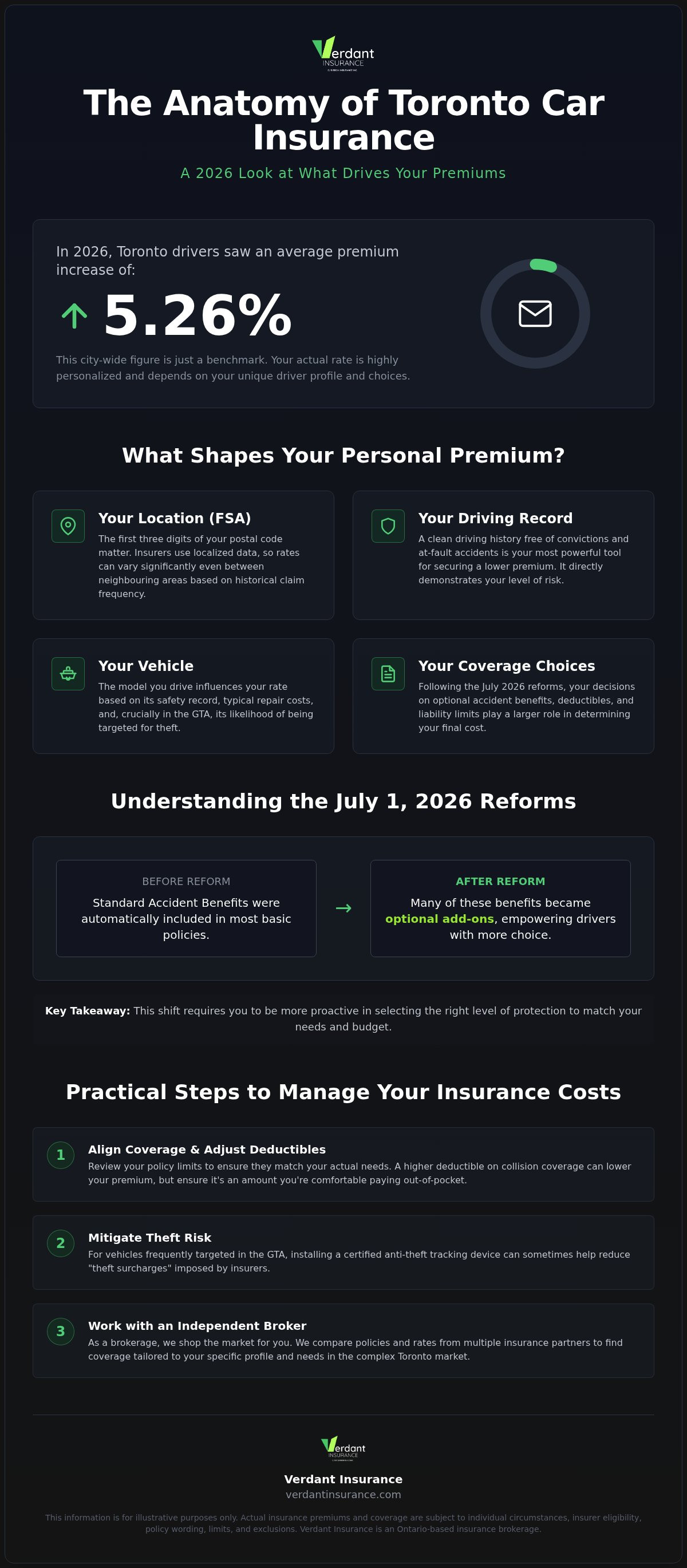
Toronto drivers saw an average premium increase of 5.26% in 2026. While that number provides a benchmark, your individual quote depends on factors like your age, the vehicle you drive, and your years of experience behind the wheel. Because these variables change for everyone, two neighbours living on the same street in North York could have vastly different insurance costs.
Why Toronto Rates Differ from the Rest of Ontario
Driving in the GTA presents risks you won't find in more rural parts of the province. Higher traffic density leads to a statistically higher frequency of collisions, especially during rush hour on the 401 or the Gardiner Expressway. Urban congestion doesn't just slow you down; it increases liability risks because there are more pedestrians, cyclists, and vehicles sharing tight spaces. Many residents refer to their high premiums as a "Toronto tax." From a broker's perspective, this isn't an arbitrary fee. It's a direct reflection of the statistical likelihood of a claim being filed in a high-density area where repair costs and theft rates are higher than the provincial average.
The Role of FSRA in Setting Your 2026 Rates
Insurance companies can't just raise rates whenever they want. They must submit detailed justifications to the Financial Services Regulatory Authority of Ontario (FSRA). This provincial regulator reviews these requests to ensure they're fair and backed by actual data. FSRA issues quarterly rate approvals, which explains why you might see your premium shift at your annual renewal even if your driving record stayed clean. Staying informed about these trends helps you understand the market. For a deeper look at how to manage these shifts, check out our Ultimate Buying Guide 2026. Understanding that rates are regulated provides some peace of mind, as it ensures a level of transparency in how your costs are calculated.
Key Factors Driving Your Toronto Auto Insurance Quote
Your neighbour might pay a different rate than you do, even if you drive the same car. This happens because the average cost of car insurance in Toronto is just a starting point. Your final premium is shaped by your Forward Sortation Area (FSA), which refers to the first three digits of your postal code. Insurers track claim data at a granular level. If your specific neighbourhood has a history of high collision rates or frequent property damage claims, your premium will reflect those local risks. Your daily habits also influence the math. If you commute to the downtown core every day, your high annual mileage increases your exposure to traffic, which statistically raises the likelihood of an incident.
The vehicle you choose to park in your driveway is just as important as where you live. Insurance companies don't only consider the sticker price of a car. They look at safety ratings and the anticipated cost of repairs. Modern vehicles feature sophisticated sensors and advanced materials that can be expensive to replace after a minor accident. Selecting a vehicle with a proven safety record and manageable repair costs can help you find a quote that fits your budget more comfortably.
The Impact of Vehicle Theft Trends in the GTA
Vehicle theft has become a significant concern across the GTA, directly impacting insurance costs for many drivers. If you own a model that's frequently targeted by thieves, such as certain popular SUVs or luxury trucks, you might face a "theft surcharge" on your policy. This is a direct response to the spike in theft-related claims in urban centres like Toronto. You can often mitigate these specific costs by installing certified anti-theft tracking devices or immobilizers. Your choice of vehicle matters much more in a large city than in rural Ontario because the statistical risk of theft is simply higher in densely populated areas.
Driving Record and Convictions: The "Clean Record" Advantage
Your driving history is the most personal factor in your insurance calculation. A single minor conviction, such as a speeding ticket, can stay on your record and affect your premium for three years. At-fault accidents have an even longer-lasting impact on your profile. Maintaining a claim-free status is the most effective way to keep your costs stable over time. Understanding how auto insurance rates are approved by the FSRA helps clarify why insurers place such a heavy emphasis on these personal metrics.
At Verdant, we focus on helping safe drivers find policies that reward their careful habits. If you want to see how your specific history compares to the average cost of car insurance in Toronto, you can speak with a broker to explore your options and find the right fit for your needs.
Comparing Toronto Rates with the Greater Toronto Area (GTA)
While the average cost of car insurance in Toronto provides a helpful benchmark, crossing the street into a different municipality can change your premium entirely. The "Toronto" label actually covers a massive geographic area with diverse risk profiles. Drivers in the 416 area code often face different pricing structures than those in the 905 regions. This happens because insurance companies look at localized data, meaning a move from North York to Vaughan could shift your costs even if your driving habits remain identical. There is also a "commuter effect" to consider. Every day, thousands of drivers from across the GTA flood Toronto's streets. This high volume of external traffic contributes to the city's collision statistics, which indirectly impacts the rates paid by residents who live and park their cars within city limits.
Toronto vs. York Region: A Markham Broker’s Perspective
As a brokerage based in Markham, we often see how rates fluctuate between Steeles Avenue and Highway 7. While Toronto proper frequently sees higher premiums due to density, certain parts of York Region, like Vaughan, have historically seen rates that rival or even exceed downtown averages. Insurers use specific data points to price these areas. For instance, Markham and Richmond Hill might have different theft or collision frequencies than Scarborough or Etobicoke. The Financial Services Regulatory Authority of Ontario (FSRA) oversees these variations to ensure that the geographic differences in pricing are based on actual statistical risk rather than arbitrary boundaries. Understanding these regional shifts is just as important as knowing the Ontario Home Insurance Price Guide, as both reflect the unique costs of living in specific GTA communities.
Urban vs. Suburban Risk Profiles
Insurance companies view the downtown core and the surrounding suburbs through two very different lenses. In downtown Toronto, the risks are defined by high density. You're more likely to experience minor fender-benders, glass damage, or vehicle theft due to the sheer volume of people and street-side parking. In contrast, suburban GTA areas like Brampton or northern York Region often involve higher speeds and longer commute times on major highways. While there might be fewer total incidents, the accidents that do occur in suburban settings tend to be more severe. Insurers balance these two profiles differently. One prioritizes the frequency of small claims, while the other focuses on the potential severity of high-speed collisions. This is why the average cost of car insurance in Toronto remains a moving target; it depends entirely on which specific risks your daily route exposes you to.
Practical Steps to Manage Your Insurance Costs in Toronto
While the average cost of car insurance in Toronto remains high, you have several practical tools to influence what you actually pay. Start by taking a close look at your coverage limits. It's common for drivers to carry limits that no longer reflect the actual value of their vehicle or their current lifestyle. You might also consider increasing your collision and comprehensive deductibles. Raising a deductible from $500 to $1,000 can lead to a noticeable drop in your premium because you're agreeing to cover more of the initial cost in a claim.
Using winter tires is another essential step for GTA drivers. In Ontario, insurance companies must provide a discount for vehicles equipped with winter tires. This doesn't just lower your bill; it provides critical safety on icy Toronto streets. Safe driving habits are the most consistent way to keep your record clean and your rates manageable over the long term. By focusing on these small adjustments, you can move closer to a rate that feels fair for your budget. If you're replacing your vehicle, it's worth comparing insurance costs before buying, because two similarly priced vehicles can have very different premiums.
Bundling Home and Auto for Maximum Efficiency
One of the simplest ways to streamline your insurance is by bundling your policies. When you combine your auto insurance with tenant or home insurance, most insurers offer a multi-policy discount. This approach also makes your life easier. As a digital-first brokerage, we help you manage all your documents in one place, so you don't have to juggle multiple providers. If you're currently renting in the city, our Tenant Insurance Buying Guide explains how these protections work together to safeguard your assets.
Telematics: Is "Pay-How-You-Drive" Right for You?
Telematics, often called User-Based Insurance (UBI), uses an app to monitor how you actually drive. These programs track metrics like braking, acceleration, and the time of day you're on the road. If you're a low-mileage driver or someone who avoids high-risk urban driving times, this could be a great fit. It's especially beneficial for Toronto residents who use public transit for their daily commute and only drive during off-peak hours. By sharing your safe driving data, you can potentially secure a rate that reflects your actual habits rather than just the city average.
Get a personalized Toronto auto insurance quote
Navigating the Toronto Market with an Ontario Broker
Finding the right policy in a competitive market requires more than just looking at a price tag. When you're trying to manage the average cost of car insurance in Toronto, the way you shop makes a significant difference. A direct insurer only sells their own specific products. If their internal rules don't perfectly match your driving profile, you might end up with a higher premium than necessary. An independent brokerage like Verdant acts as your ally. We work with multiple insurance partners across the province to find the coverage that fits your unique life in the GTA.
Local expertise is essential because the Ontario market is unique. A national, one-size-fits-all approach often misses the nuances of driving in the GTA. We understand the specific risks associated with different neighbourhoods, from the busy streets of Scarborough to the suburban roads of Vaughan. This knowledge is incredibly valuable when dealing with complex claims or selecting the right accident benefits. We provide personalized advice that a call centre or a national brand simply can't match, ensuring you feel secure and well-cared for.
The Advantage of a Digital-First Brokerage
We've designed our service to respect your time. You can get a quote online in just a few minutes, utilizing modern technology to simplify the process. While our platform is tech-forward, we haven't removed the human element. You always have access to a friendly expert who can answer questions and provide clarity on your coverage. For more tips on finding the right digital partner, read our guide on Choosing an Online Insurance Broker. We combine the efficiency of an app with the deep reliability of an experienced Markham-based team.
Next Steps: Getting Your Personalized Toronto Quote
Ready to move beyond the average cost of car insurance in Toronto? Start by gathering your vehicle details and the driving records for everyone on your policy. Having this information ready ensures your quote is as accurate as possible. We recommend reviewing your current policy at least 30 days before it's set to renew. This window gives you plenty of time to explore options and make an informed decision without feeling rushed. Our team of brokers is ready to help you find a customized solution that balances your budget with the protection you need.
Take Control of Your Toronto Auto Insurance
Understanding the average cost of car insurance in Toronto is the first step toward managing your household budget with confidence. We've looked at how your specific neighbourhood, your choice of vehicle, and the July 2026 insurance reforms all influence your premium. While the city's market is complex, you don't have to settle for a generic rate. It's about your peace of mind. Small adjustments like increasing deductibles or bundling your policies can help you find a better fit for your lifestyle.
At Verdant, our team of Ontario-based experts in Markham is ready to provide the clarity you need. We're here to help. We specialize in customizable policies tailored specifically to the unique risks GTA drivers face every day. Our supportive and knowledgeable brokers guide you through every choice, ensuring your coverage feels personal and secure. We're committed to making insurance simpler and more transparent for everyone in our community.
Get a personalized Toronto auto insurance quote from a Verdant broker today.
You deserve to feel secure and well-cared for on every journey through the city.
Frequently Asked Questions
Why is car insurance so expensive in Toronto compared to other cities?
Toronto premiums are higher because the city has some of the busiest roads in North America. Increased traffic density leads to a higher frequency of collisions compared to smaller Ontario towns. Additionally, urban centres face higher rates of vehicle theft and vandalism. These statistical risks are factored into the average cost of car insurance in Toronto. Insurers must account for the higher cost of claims in a densely populated environment like the GTA.
What is the minimum car insurance coverage required in Ontario?
To drive legally in Ontario, you must carry a policy that includes third-party liability with a minimum limit of $200,000. You also need statutory accident benefits, uninsured automobile coverage, and direct compensation property damage (DCPD). While these are the legal minimums, many Toronto drivers choose to increase their liability limits to $1 million or $2 million. This provides better protection against the high costs associated with urban accidents and legal claims.
How much does a speeding ticket affect my Toronto insurance rate?
A single minor speeding ticket can stay on your record for three years and lead to a premium increase at renewal. The exact impact varies by insurer, but multiple convictions or a major infraction will have a much more significant effect. Maintaining a clean record is the most effective way to manage the average cost of car insurance in Toronto. Safe drivers who stay conviction-free often qualify for rewards and lower rates over time.
Can I get a discount for using winter tires in Toronto?
Yes, all insurance companies in Ontario are required to provide a discount to drivers who install winter tires. You typically need to have them on your vehicle from November through April to qualify. This discount recognizes the increased safety and reduced risk of collisions during our harsh GTA winters. It's a simple way to lower your monthly costs while ensuring you're better protected on icy or snow-covered city streets.
Does my postal code really change my insurance premium?
Your postal code is one of the most influential factors in your insurance calculation. Insurers use the first three digits, known as your Forward Sortation Area, to track claim statistics in your specific neighbourhood. Areas with higher rates of vehicle theft, insurance fraud, or frequent collisions will naturally see higher premiums. This is why moving just a few blocks away into a different area of the GTA can cause your insurance quote to shift.
How can a new driver in Toronto find more affordable insurance?
New drivers can find more manageable rates by completing a government-approved driver training course. This certification shows insurers you've received professional instruction and are a lower risk. Additionally, staying on a parent's policy as a secondary driver or choosing a vehicle with high safety ratings can help. Maintaining a clean record from day one is essential, as even a small incident can have a long-term impact on a new driver's profile.
What happens to my insurance rate if I work from home and drive less?
Driving less often reduces your statistical risk of being involved in a collision, which can lead to a lower premium. If you've transitioned to a permanent work-from-home setup, you should update your broker about your reduced annual mileage. You might also consider a telematics program. These apps monitor your actual driving habits and can offer rewards for those who spend less time on the road or avoid high-traffic periods in Toronto.
Is it better to use a broker or go directly to an insurance company in Ontario?
Working with an independent broker like Verdant gives you access to multiple insurance partners rather than just one company's products. We shop around to find the best fit for your specific profile and needs. Direct insurers only offer their own rates, which might not be the most competitive for your situation. Our local expertise in the Ontario market allows us to provide personalized advice and support that a national call centre cannot match.