

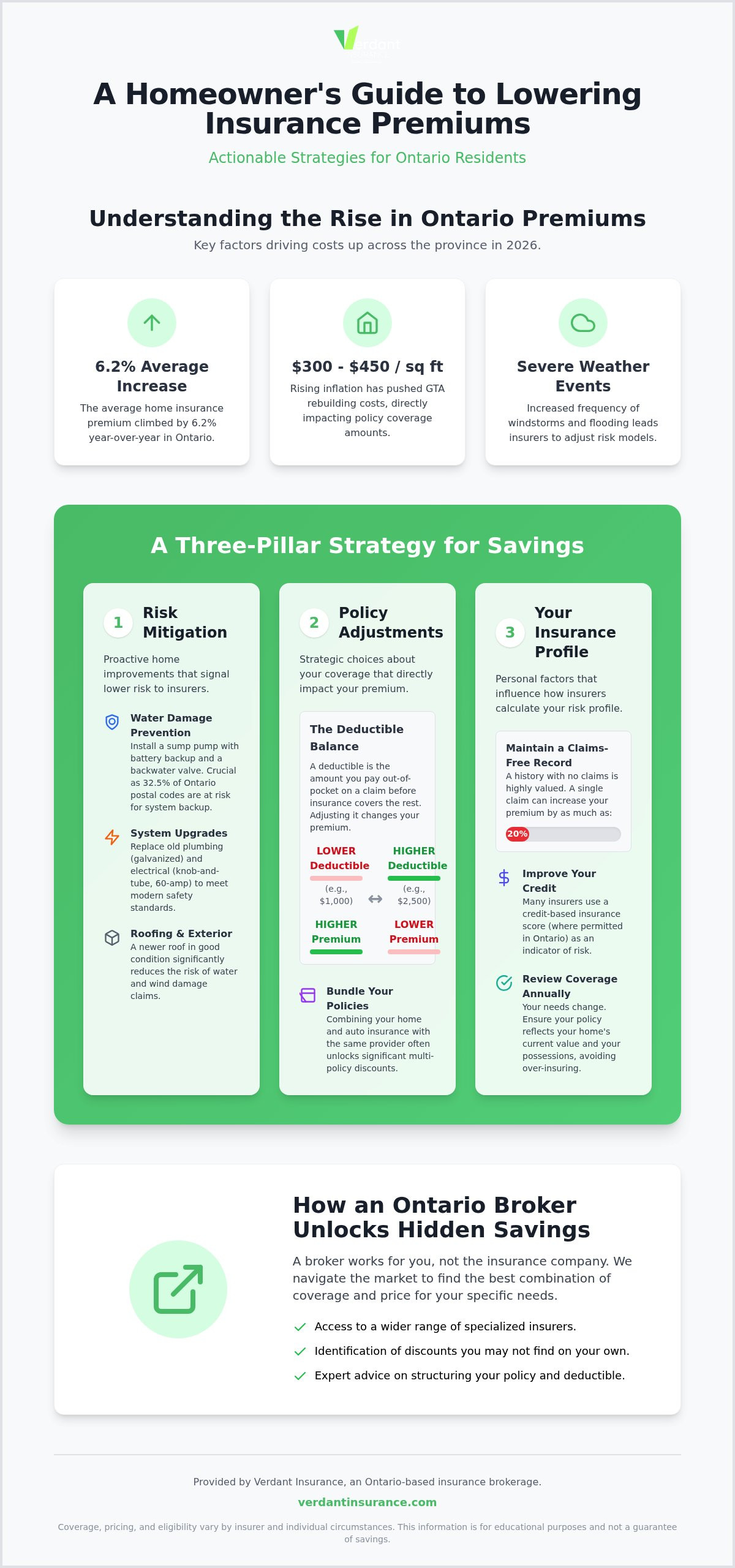
Did you know that home insurance premiums in Ontario climbed by an average of 6.2% in 2026? If your latest renewal notice felt like a surprise you didn't ask for, you aren't alone. Between rising inflation and the increasing frequency of severe weather events across the GTA, many homeowners feel like they're paying more for less. It's frustrating to navigate confusing jargon and feel stuck with a bill that keeps growing year after year.
You don't have to sacrifice your peace of mind to find breathing room in your budget. We'll show you exactly how to trim your costs while keeping your property fully protected. In this guide, we'll dive into a three-pillar strategy for savings. This includes having a home insurance deductible explained Canada style so you can see how your choices impact your monthly bottom line. We'll also explore actionable broker insights, from physical home upgrades to specific discounts available to Ontario residents. By the end, you'll have a clear roadmap to lower premiums and the confidence that your home remains secure. Whether you're in Markham, Toronto, or anywhere else in the province, these steps will help you take control of your coverage.
Key Takeaways
- Learn how proactive upgrades to your home's water and fire prevention systems can help signal lower risk to Ontario insurance providers.
- Discover the financial impact of your policy structure with our home insurance deductible explained Canada section, helping you balance monthly costs and out-of-pocket expenses.
- Identify the specific financial and lifestyle habits that can improve your insurance profile and lead to more stable annual premiums.
- Understand how a local broker helps you access specialized insurers and discounts you won't find through direct search tools.
Understanding Home Insurance Premiums in Ontario for 2026
To start, it helps to answer a foundational question: What is home insurance? At its core, your premium is the specific price you pay for financial protection against risks like fire, theft, or wind damage. In 2026, many Ontario residents are seeing their bills rise due to factors that feel out of their control. Understanding who sets these prices is the first step toward managing them. As an Ontario brokerage, we shop the market to find you the best fit, but the actual rates are determined by insurance companies using complex data models.
Local factors play a massive role in these calculations. In high-density areas like Toronto, Vaughan, or Richmond Hill, the risk of a single incident affecting multiple properties is statistically higher. We're also seeing a shift in Ontario’s climate patterns. Severe weather events, such as intense windstorms and rapid freeze-thaw cycles, have become more frequent. These trends cause insurers to adjust their pricing models across the province to account for the increased likelihood of property damage.
Inflation has also hit the construction sector particularly hard. In the GTA, rebuilding costs can range from $300 to $450 per square foot as of mid-2026. Since your policy is designed to cover the cost of rebuilding your home from scratch, these rising labour and material costs directly push premiums upward. Even if your home's market value stays the same, the cost to replace it has likely grown.
How Insurers Calculate Your Risk Profile
Insurers look closely at your specific Ontario postal code to determine risk. They evaluate fire protection grades, such as how close your home is to a hydrant or a full-time fire station, along with local crime rates. If you live in one of Ontario's historic neighbourhoods, the age of your home and its original construction materials can lead to higher base rates. Your personal record matters just as much. Filing even a single claim can lead to a premium increase of as much as 20% in some cases. This is where having a home insurance deductible explained Canada perspective is useful; choosing a higher deductible can often help offset these rising profile-based costs.
The Impact of Recent Ontario Market Trends
We've seen a notable rise in "secondary" perils lately. Localized flooding in the GTHA, often caused by aging sewer infrastructure or sudden heavy rainfall, is now a top source of claims. This shift has changed the average cost of home insurance in Ontario, which climbed by 6.2% year-over-year in 2026. Regulatory updates also mean insurers are looking more closely at water-related endorsements and sump pump requirements before they will bind a policy.
Risk Mitigation: Home Improvements That Lower Rates
Taking proactive steps to secure your property does more than just provide safety for your family. It signals to insurers that you're a lower-risk client. When you document these improvements, your broker has the concrete evidence needed to shop for better rates on your behalf. There are many ways to Lower Your Homeowners Insurance Costs, but focusing on the "big three," which include water, fire, and theft prevention, is the most reliable path to savings.
Protecting Against Water Damage
Basement flooding is a primary source of claims in Ontario, especially since system backup risk affects 32.5% of the province's postal code areas. Installing a sump pump with a battery backup is a smart move. It ensures your basement stays dry even if a storm knocks out the power. Backwater valves are another critical addition; they prevent sewage from flowing back into your home during heavy rainfall. These devices are so effective that some insurers may offer premium discounts or more flexible options. Having a home insurance deductible explained Canada specialist review your policy can reveal if these water-protection tools allow you to safely carry a higher deductible for even greater savings.
Upgrading Your Home Systems
If you live in one of Ontario's historic neighbourhoods, your home's internal systems might be outdated. Insurers generally prefer modern standards that reduce the likelihood of a sudden failure. Upgrading these systems is a great way to improve your risk profile:
- Plumbing: Replacing older galvanized pipes with PEX or copper prevents corrosion and sudden leaks.
- Electrical: Updating your system from 60-amp service or knob-and-tube wiring to a modern 100 or 200-amp circuit breaker panel is vital for fire safety.
- Roofing: The age and material of your roof impact your eligibility for certain discounts. A roof older than 20 years often carries a higher risk profile, whereas impact-resistant shingles can lead to better standing with many Ontario insurers.
Security and Fire Prevention
A centrally monitored alarm system is a gold standard for insurance providers. While DIY "smart" alarms are popular, they don't always trigger the same discounts because they lack 24/7 third-party monitoring and emergency dispatch. Fire safety is equally vital; ensure your home meets current Ontario fire codes with working smoke and carbon monoxide detectors on every level. In the GTA, local security considerations, often called the "Markham Factor," may influence how insurers view theft risk for specific vehicle or property types. If you've recently completed a major renovation, it's a good idea to speak with a Markham insurance broker to update your policy. Notifying your broker immediately after an upgrade ensures your coverage limits are accurate and that any new discounts are applied to your premium.
Strategic Policy Adjustments for Maximum Savings
Many homeowners treat their insurance policy as a static document, but a "set it and forget it" approach is often a recipe for overpaying. Your life changes, your home evolves, and your risk tolerance might shift as your financial situation stabilizes. Consulting an Ontario broker annually ensures you aren't carrying heavy limits for coverage you no longer need. We help you structure your policy to reflect your current reality rather than who you were when you first bought your home. This proactive review is the first step toward finding a balance between protection and price.
The Power of the Deductible
Adjusting your deductible is one of the most direct ways to influence your premium. To have a home insurance deductible explained Canada style, you need to look at the trade-off between your monthly bill and your out-of-pocket costs during a claim. Moving from a $1,000 deductible to a $2,500 or $5,000 limit can lower your annual premium because you're essentially "self-insuring" for smaller losses. It's a strategic move for those with an emergency fund ready. This approach prevents you from filing minor claims that could trigger a significant rate hike on your next renewal. Just ensure you have those funds set aside and accessible before you decide to increase your limit.
Bundling Home and Auto Insurance
In the Ontario market, bundling your property and vehicle coverage remains the most effective way to secure a multi-policy discount. Many cheap car insurance Canada strategies actually begin with a home insurance bundle. Beyond the financial savings, you'll enjoy the convenience of a single renewal date and a single point of contact for all your insurance needs in Markham or the wider GTA. It simplifies your paperwork while keeping more money in your pocket through a single, streamlined relationship.
Reviewing Your Coverage Limits
Take a close look at your specific limits and endorsements during your next renewal. You might be paying to protect items you no longer own, such as scheduled jewelry or high-end electronics you've since sold. You should also understand the difference between Actual Cash Value and Replacement Cost. While Actual Cash Value is often cheaper, it only pays what your items are worth today after accounting for depreciation. Given the volatility of the current Ontario housing market, we often recommend "Guaranteed Replacement Cost" to ensure you can truly rebuild. However, it's worth discussing with your broker to see if your current limits are still appropriate for your specific property type and location.
Financial and Lifestyle Factors You Can Control
Beyond the brick and mortar of your home, your personal habits and financial stability play a significant role in your premium. Insurers look for indicators of responsibility because they suggest a lower likelihood of future claims. Maintaining a clean insurance record over the long term is often more valuable than chasing a one-year introductory rate elsewhere. While the physical structure of your house in Markham or Vaughan matters, your lifestyle choices signal your risk level to every provider in the Ontario market.
The Role of Credit Scores in Ontario
Most home insurers in Ontario use credit-based insurance scores to help determine your pricing. A strong credit rating often unlocks preferred "tier" pricing because it's statistically linked to a lower frequency of claims. You have the legal right to withhold your consent for a credit check. However, choosing to withhold consent usually means the insurer will default you to a standard rate, which may be higher than the preferred rates available to those with high scores. Keeping your debt levels manageable and paying bills on time can directly impact what you pay for property protection.
Claims-Free and Mortgage-Free Status
Staying claims-free is one of the most effective ways to keep your costs down over time. Since filing even a single claim can lead to a premium increase of as much as 20%, avoiding "nuisance" claims for small repairs is vital. This is where having a home insurance deductible explained Canada perspective helps; it allows you to see that paying for a minor repair out of pocket can save you thousands in premium hikes over the following years. Additionally, many insurers offer a mortgage-free discount. Once your lender is paid off, insurers view you as having a higher "pride of ownership," which typically results in better maintenance and fewer preventable losses.
Professional and Membership Discounts
Your professional background or education can also lead to hidden savings. Many Ontario insurers recognize specific professional designations, such as a P.Eng or CPA, with dedicated discounts. Alumni associations from universities across the province, union memberships, and employer-sponsored group rates are also common. Retirees often qualify for additional savings as well. Since they are home more frequently, they are more likely to spot a leak or a security issue before it escalates, representing a significantly lower risk to the insurer.
The balance between loyalty to one company and shopping around is delicate. While long-term policyholder discounts reward you for staying put, market conditions change. A broker handles this by shopping your policy across multiple partner insurers to ensure your current provider is still offering you the best value for your specific profile.
How an Ontario Broker Unlocks Hidden Discounts
There is a significant difference between simply searching for insurance and truly shopping the market. When you use a search engine, you often only see the companies that spend the most on advertising. Shopping with a broker is different. We provide access to "Broker-Only" insurance companies that do not sell directly to the public. These companies often have highly competitive rates because they rely on brokers to perform the initial risk assessment. Choosing an online insurance broker in Canada, specifically one rooted in Ontario, gives you the speed of digital tools along with the personalized care of a local expert.
The Multi-Market Comparison Advantage
A brokerage like Verdant does not just look at one price. We compare 10 or more partner insurers simultaneously to find the "sweet spot" where your specific profile matches an insurer's target demographic. Some companies prefer insuring newer builds in Vaughan; others offer better standing for mature homes in established Markham neighbourhoods. Instead of filling out ten different applications, a single conversation with us covers a vast portion of the market. This efficiency ensures you don't miss out on a niche discount that a general search would never reveal.
Ongoing Advocacy and Renewal Reviews
Your insurance needs are not static. As your life in Ontario changes, your policy should reflect that. Perhaps you've started working from home permanently, or you've finally finished that basement renovation mentioned earlier. We review your policy every year before your renewal date to ensure your coverage still makes sense. If your current insurer raises rates significantly, we handle the hard work of switching carriers for you. We can have your home insurance deductible explained Canada style once again to see if a higher limit fits your updated emergency fund. This ongoing advocacy means you never have to worry about being "stuck" with a policy that no longer serves your best interests.
Local Expertise in the GTA
National call centers often lack the nuanced understanding of York Region's specific risks. Whether it is understanding the localized flooding patterns in Richmond Hill or the specific security considerations in Markham, local expertise matters. A personalized risk assessment helps identify which endorsements are essential and which are unnecessary for your specific street. We live and work in the same communities you do. This allows us to provide a level of service that a faceless corporation cannot match. Personalized service is about more than just a friendly voice; it is about knowing the local infrastructure and climate trends that affect your property's safety.
Speak with a Verdant broker today to review your Ontario home policy and ensure you are protected at a price that fits your budget.
Secure Your Home and Your Budget for 2026
Navigating the Ontario insurance market doesn't have to be a source of stress. By focusing on modern risk mitigation like water protection and understanding how your choices impact your premium, you can take meaningful control of your costs. We've looked at the big picture, from how local climate trends affect your rates in the GTA to the specific ways your financial stability signals lower risk to insurers. It's about making informed decisions that protect your most valuable asset without overpaying for coverage you don't need.
Having a home insurance deductible explained Canada style shows that a higher deductible can be a powerful tool for savings, provided you have the funds set aside. As Markham-based experts, we do the heavy lifting for you by comparing options across multiple Ontario insurance partners. This allows us to build customizable policies that fit your specific budget and property needs. You don't have to settle for the first renewal notice you receive when professional advocacy is just a conversation away.
Take the first step toward a more affordable and secure future for your home. We're ready to help you find the peace of mind and clarity you deserve.
Frequently Asked Questions
Does a higher deductible always lower my premium in Ontario?
Increasing your deductible typically lowers your premium because you agree to pay more out-of-pocket during a claim. This reduces the insurer's potential payout for minor losses. When looking at a home insurance deductible explained Canada perspective, most Ontario homeowners find that moving from a $1,000 to a $2,500 deductible results in a noticeable annual reduction. However, you should only choose a limit that you can comfortably afford to pay if an emergency occurs.
Can I get a discount for having a new roof on my Ontario home?
Yes, many Ontario insurance companies provide discounts for newer roofs, especially those replaced within the last 10 to 15 years. A newer roof is significantly less likely to suffer from leaks or wind damage, which makes your property a lower risk. Some insurers even offer specific incentives for using impact-resistant materials. Be sure to provide your broker with documentation of the installation date and the materials used to ensure you receive any applicable credits.
How much can I save by bundling home and auto insurance?
Bundling your home and auto insurance is one of the most reliable ways to secure a multi-policy discount in the Ontario market. While the exact savings vary depending on the partner insurer, combining policies simplifies your renewals and often unlocks preferred pricing tiers. Beyond the financial benefits, managing your coverage through a single brokerage in Markham makes it much easier to coordinate your protection and ensures there are no gaps in your overall insurance plan.
Does my credit score really affect my home insurance rate in Ontario?
Your credit score does influence your home insurance rate with most Ontario providers. Insurers use credit-based insurance scores because data shows a correlation between financial stability and a lower frequency of claims. While you can withhold consent for a credit check, doing so usually prevents you from accessing the lowest available rates. Maintaining a healthy credit history is a practical way to signal responsibility and keep your annual property insurance premiums more affordable.
Are there specific discounts for seniors or retirees on home insurance?
Many insurers offer specific discounts for retirees and seniors in Ontario. The logic is simple: retirees are often at home more frequently than those working full-time. This increased presence means you are more likely to detect a leaking pipe or a security concern before it turns into a major claim. If you are over age 50 or 65 and have recently retired, let your broker know so they can search for companies offering these specific age-based savings.
Will installing a smart home security system lower my insurance?
Installing a security system can lower your premium, but the type of system matters. Centrally monitored alarms that notify a third-party dispatch center are the gold standard for Ontario insurers and yield the most consistent discounts. While DIY smart home devices like water sensors and cameras are helpful for your own peace of mind, they may not always trigger a discount unless they are part of a professionally monitored service that meets insurer requirements.
What is the "claims-free discount" and how do I qualify for it?
The claims-free discount is awarded to Ontario homeowners who haven't filed a property insurance claim for a specific period, typically ranging from three to ten years. This discount rewards you for maintaining your property and managing minor repairs out-of-pocket. It's often one of the largest discounts available on a policy. If you haven't filed a claim recently, your broker can help you find insurers that place a high value on your clean insurance record.
How often should I have my broker shop my home insurance policy?
You should have your broker shop your home insurance policy at least once a year, ideally 30 to 60 days before your renewal date. Market conditions in the GTA and across Ontario shift frequently, and an insurer that was competitive last year might not be the best fit today. Regular reviews ensure your coverage limits still reflect current rebuilding costs and that you are taking advantage of every new discount for which you may qualify.