

Could a guest’s injury at your home, or damage you accidentally cause elsewhere, involve a different policy than you expect? If you’re unsure whether home, tenant, auto or business insurance applies, you’re not alone. With personal liability coverage explained in plain language, it’s easier to identify which policy may be relevant and what details to review.
Personal liability coverage is commonly found in home, condo or tenant insurance. It generally relates to certain claims for injury or property damage for which an insured person may be legally responsible. Whether a policy responds depends on the circumstances and its wording, limits and exclusions. Personal liability is different from auto or business liability, so don’t assume one policy covers every situation.
This article explains the purpose of personal liability coverage, how it differs from other liability insurance, and what to look for in your policy. You’ll also find practical questions to bring to an Ontario insurance broker when reviewing your household coverage.
Key Takeaways
- Personal liability coverage is commonly found in home or tenant insurance and relates to certain claims against an insured person.
- Learn what information to keep and what steps to follow if an incident leads to a claim or demand for payment.
- Compare personal, auto and business liability by the activities and policies they generally relate to.
- Use a practical checklist to review household details, limits, exclusions and claim-reporting instructions.
- Find liability wording in your home or tenant policy, then discuss questions with an Ontario insurance broker.
Personal liability coverage explained: what it means for Ontario households
Personal liability coverage may respond when an insured person is legally responsible for injury to another person or damage to someone else’s property. The policy must apply to the circumstances. This is the basic idea behind personal liability coverage explained: it concerns certain claims made against an insured person, not every accident, loss or request for payment.
Being involved in an incident doesn’t automatically mean you’re legally responsible. Receiving a demand for payment also doesn’t establish responsibility or confirm that insurance will cover the claim. The circumstances must be considered alongside the policy wording, applicable limits and exclusions.
Where personal liability coverage may appear
For Ontario households, personal liability coverage is commonly associated with home or tenant insurance. It may be included within the policy, but insurers can organize and describe coverage differently. This general overview of liability insurance can help distinguish liability protection from insurance for damage to your own belongings or home. It doesn’t determine what a particular policy covers.
Check your own policy documents rather than relying on a general description. Coverage terms, limits and exclusions vary by insurer and individual circumstances. A home policy and a tenant policy can also have different wording and coverage details, so don’t assume that another household’s policy works the same way as yours.
What personal liability is intended to address
The focus is a claim that you may be legally responsible for injury to another person or damage to their property. For example, imagine a visitor is injured during a gathering at your home and later seeks compensation. Whether your policy may respond depends on the facts, whether you’re legally responsible, and whether the claim falls within the policy’s coverage.
The same principle applies to property damage. Suppose you accidentally damage a neighbour’s belongings while helping them move. A request that you pay for repairs is something to consider, not proof that you’re legally liable or that insurance applies. The insurer assesses the circumstances under the policy terms.
Personal liability is different from simply having caused an incident in the everyday sense. Legal responsibility can depend on the specific facts and applicable law, while insurance response depends on the contract. Those questions are related, but they aren’t interchangeable. Don’t assume a policy will pay just because another person alleges that you caused harm.
This distinction is useful when you report or discuss an incident. Keep relevant details and documents together, and follow the policy’s instructions for reporting a potential claim. The next step is to understand how the policy handles an allegation, including its assessment of responsibility and coverage.
How personal liability coverage may respond to an injury or damage claim
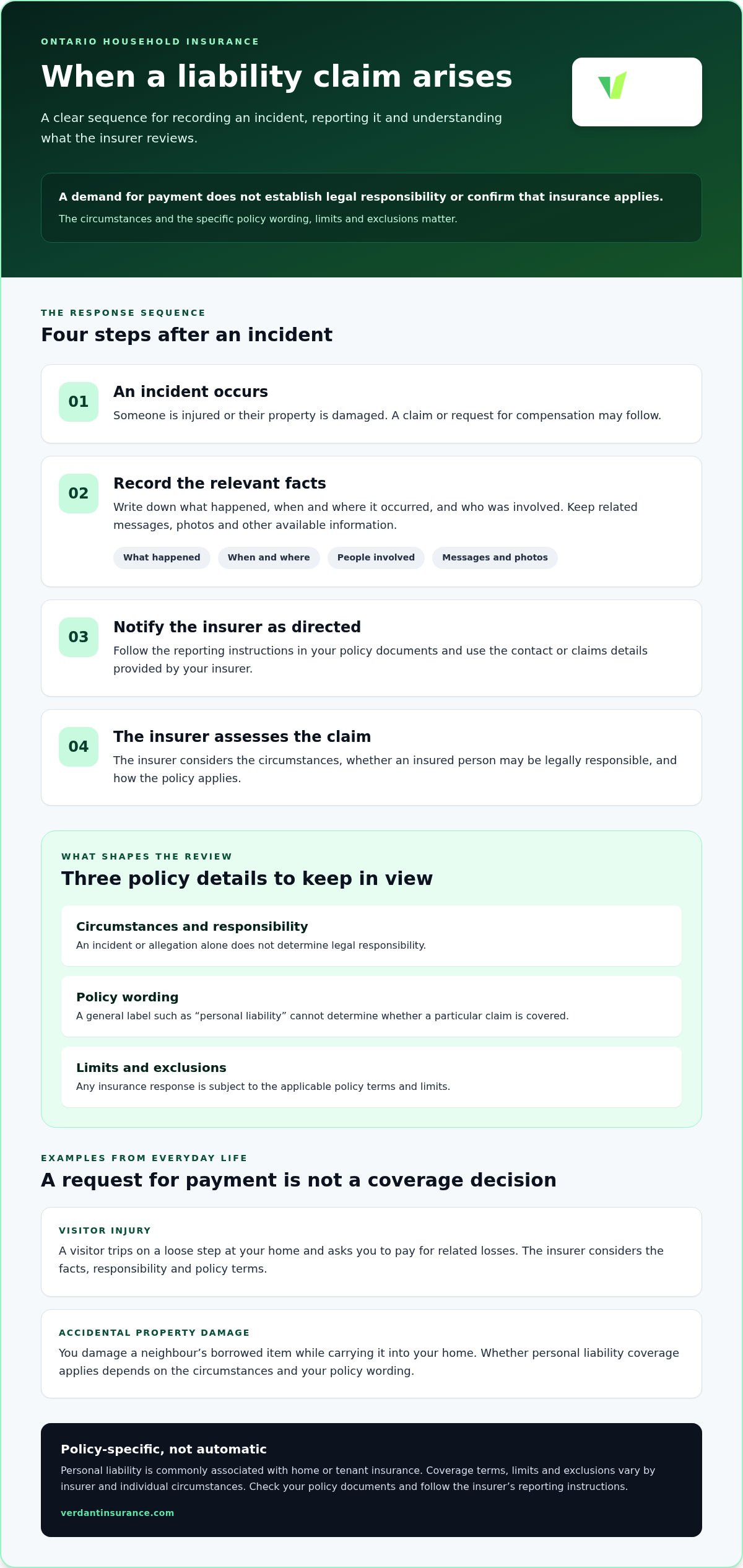
A demand for payment can feel urgent, but it doesn’t establish who is legally responsible or whether an insurance policy applies. If an incident may involve personal liability coverage, take practical steps to preserve information and report it as directed. The insurer’s review and the policy wording guide what happens next.
- An incident occurs. Someone is injured or their property is damaged, and a claim or request for compensation may follow.
- Record the relevant facts. Note what happened, when and where it occurred, and who was involved. Keep related messages, photos and other available information.
- Notify the insurer as directed. Follow the reporting instructions in your policy documents. Use the contact or claims details provided by your insurer.
- The insurer assesses the claim. The insurer considers the circumstances, whether an insured person may be legally responsible, and how the policy’s wording, limits and exclusions apply.
A claim is assessed against the specific policy, not the “personal liability” label alone. A general description can’t determine whether a particular incident is covered. Depending on the wording, legal expenses or payments to another person may be covered, but don’t assume they are. Any response is subject to the applicable policy terms and limits.
Examples that help explain the idea
Imagine a visitor is injured after tripping on a loose step at your home, then asks you to pay for related losses. The request doesn’t establish legal responsibility or guarantee coverage. The insurer considers the facts, any assessment of responsibility, and the policy terms.
In another hypothetical, you accidentally damage a neighbour’s borrowed item while carrying it into your home. Whether personal liability coverage applies depends on the circumstances and your policy wording. The damage alone doesn’t decide the outcome.
What to do when someone says you are responsible
Stay organized and use the reporting process set out in your policy. Keep a clear record of the incident and preserve communications related to the demand. Don’t rely on assumptions about what your policy covers. A claim can involve questions about responsibility as well as questions about the insurance contract.
- Write down the details while they’re fresh, including the date, location and people involved.
- Keep relevant photos, documents and communications together.
- Follow your insurer’s instructions for reporting the incident and providing information.
- Retain copies of any correspondence you receive or send.
These steps can help you communicate the circumstances clearly, but they don’t determine the outcome of a claim. If you’re reviewing household protection, Verdant Insurance, an Ontario brokerage based in Markham, offers home and tenant insurance options for Ontario residents.
Personal liability vs. auto and business liability: understand the difference
Personal, auto and business liability relate to different activities and policy contexts. Identifying the activity involved is a useful starting point, but it doesn’t determine whether a claim is covered. The policy wording, limits and exclusions matter, and coverage varies by insurer and individual circumstances.
| Type of liability | Typical context | Policy to review |
|---|---|---|
| Personal | Household or personal activities, such as an incident at home | Home or tenant policy |
| Auto | An incident connected to using or owning an automobile | Auto policy |
| Business | Activities connected to operating a business or providing services | Business insurance policy |
This table is a general guide, not a coverage determination. The details of an incident can affect which policy is relevant, and policy wording varies.
Personal liability and auto liability are not interchangeable
A household incident, such as damage caused during a personal activity, differs from an incident connected to using or owning an automobile. Auto liability belongs in the auto policy context. If a claim relates to a vehicle, review the applicable auto policy wording rather than assuming that home or tenant insurance applies. The specific coverage and terms depend on that policy.
For example, damage to another vehicle after a collision raises different policy questions from damage to a neighbour’s belongings during a personal visit. These examples help identify the context; they don’t confirm which policy responds or whether coverage applies.
Personal liability and business liability serve different contexts
Activities undertaken for work or a business may be treated differently from personal activities. Don’t assume a household policy addresses every exposure connected to a business, even if the work takes place at home or is part-time. Whether a particular activity is covered depends on the facts and the relevant policy wording.
For a broader overview of business coverage considerations, see Verdant’s business insurance guide. It’s a related resource, not a substitute for reviewing the terms of a specific policy.
To decide which policy to examine, start with the activity connected to the incident. Was it personal, related to an automobile, or part of business operations? Then review the corresponding policy documents and any relevant definitions or exclusions. If the circumstances overlap, don’t decide based on the policy’s name alone. A careful review can help you identify questions about the wording.
That distinction is central to personal liability coverage explained: the setting and activity point to the policy context, while the contract determines how a claim may be handled. Keep the policies separate in your review, and avoid applying one policy’s terms to another.
How to review personal liability limits, exclusions, and household details
Start a policy review with your household details, then check the wording that applies to them. Don’t rely on a general online explanation to determine exactly what your policy covers. Compare the policy wording with the declarations, which summarize details specific to your coverage, and note anything you want clarified.
The policy wording, limits and exclusions control the specific coverage assessment. Coverage varies by insurer and individual circumstances. A checklist can help you locate relevant details without assuming that a term means the same thing in every policy.
- Named insureds: Check who is identified as an insured on the declarations and how the policy describes insured persons.
- Household members: Look for wording about people who live with you. Don’t assume every relative, roommate or other household member is treated the same way.
- Personal liability limit: Locate the stated limit and note which section of the policy it applies to. Don’t treat a limit shown in an online summary as a universal amount.
- Exclusions and conditions: Read the sections that describe situations or activities that may be excluded or subject to specific terms.
- Claim-reporting instructions: Find how the policy directs you to report an incident or potential claim, and keep those instructions accessible.
Questions to ask while reading the policy
Who does the wording include as an insured person? How does it describe household members? Where is the liability limit shown, and which exclusions could be relevant to your circumstances? What steps does the policy set out for reporting an incident? Write down unclear terms and compare them with the declarations rather than relying on a short summary alone.
Household details can matter. Policies may treat pets, children and particular activities differently, so don’t assume there’s one answer for every insurer or situation. Read the relevant definitions and exclusions in your own documents. Verdant’s tenant insurance guide offers related context, but your policy wording remains the reference for your coverage.
When a broker can help clarify policy options
An Ontario insurance broker can help you discuss household circumstances, identify questions about policy wording and explore available home or tenant insurance options. A broker can help you understand your choices, but can’t guarantee how an insurer will assess a future claim. Claim decisions depend on the circumstances and applicable policy terms.
Bring your policy documents and a short list of questions to the discussion. If you’re a renter, include details about who lives in the household and any activities you’re unsure how to describe. This gives the conversation a practical focus without assuming the answer in advance.
Finding personal liability coverage in an Ontario home or tenant policy
To find personal liability coverage, start with the policy that relates to your home or living arrangement. Look through the declarations and policy wording for a liability section or related terms. Insurers may use different labels and layouts, so don’t assume every policy uses the same heading or puts the information in the same place.
Home and tenant policies: start with the policy you have
If you own your home, review your home policy’s declarations and wording. If you rent, start with your tenant policy documents. The declarations can help you locate key details, while the wording explains definitions, conditions and exclusions. Read both together instead of relying on a general online description of what personal liability coverage may include.
As you review, note the liability limit and any terms you want clarified. Coverage depends on the insurer, your circumstances and the policy’s wording, limits and exclusions. A description that fits one policy may not reflect another. Keep your questions tied to the documents in front of you, especially if you’re unsure how a household detail or activity is described.
That’s the practical value of having personal liability coverage explained in context: your policy documents show how the general concept is expressed in your own coverage. They don’t establish in advance how a future claim will be assessed, but they can help you understand what to ask about.
A practical next step with Verdant
Verdant Insurance is an Ontario insurance brokerage located in Markham. It offers home and tenant insurance and is a broker, not an insurer. Ontario residents can explore options through Verdant’s online platform, which supports quotes and policy management. Coverage, limits and eligibility depend on the insurer, individual circumstances and applicable policy terms.
To prepare for a review, gather your declarations and policy wording, then note questions about the liability section, household details or exclusions. A conversation with a Verdant broker can help you discuss your circumstances and explore home or tenant policy options. It can clarify choices, but it can’t guarantee how an insurer would assess a particular claim.
For homeowners and renters in Ontario, begin with the policy already in force. Compare its wording with your questions, and seek help understanding your options before making assumptions about what may apply.
Make your next policy review more confident
Use your next policy review to connect the wording to your household today. A move, a new household member or a change in how you use your home can prompt useful questions. Keep a short list beside your declarations and note anything you’d like explained before making decisions about your coverage.
After having personal liability coverage explained, the practical next step is to understand the documents that apply to you. A broker can help you explore home or tenant insurance options and discuss your circumstances, while the insurer’s policy terms determine how coverage applies.
A thoughtful review can make insurance language more manageable. Take it one question at a time, and move forward with a clearer understanding of your policy.
Frequently Asked Questions
Does personal liability coverage apply if a guest is injured at my home?
It may respond to certain claims, but a guest’s injury doesn’t automatically mean the policy applies. For example, if someone slips near your front entrance and asks you to cover related losses, the insurer would assess the circumstances against your policy’s terms. The practical takeaway from personal liability coverage explained is to avoid assuming the result: follow the policy’s reporting instructions and keep relevant information about the incident.
Can personal liability coverage protect me if I accidentally damage someone else’s property?
It may apply to some claims involving accidental damage to another person’s property, depending on the circumstances and policy terms. For instance, if you damage a visitor’s phone while it’s in your care, the request for payment and the policy wording would need to be considered. Damage to your own possessions is a separate issue. Review the applicable documents or discuss the situation with an Ontario insurance broker.
Are pets or children covered by personal liability insurance?
There isn’t one answer for every policy or incident. If a child or pet is involved in an event that leads to a claim, the insurer would consider who the policy identifies as insured, what happened and whether any exclusions apply. Review the terms that relate to your household rather than relying on a general description. An Ontario broker can help you understand questions about the wording without guaranteeing a claim outcome.
Does personal liability coverage apply to accidents outside my home?
It may apply to certain incidents away from your residence, but being outside the home doesn’t settle whether coverage responds. For example, an accidental injury during a recreational activity could raise different questions from an incident involving a vehicle or work activity. Check the policy for relevant definitions and exclusions, and describe the full circumstances when asking about a scenario. Don’t assume every location or activity is treated alike.
What happens if someone makes a liability claim against me?
Keep communications and information related to the incident, then follow the reporting instructions in your policy. A demand letter or lawsuit doesn’t by itself mean the insurer will pay or establish how the matter will be handled. Use the insurer’s claims process for specific directions, and retain copies of documents you send or receive. The insurer’s assessment depends on the facts and applicable policy wording.
Is personal liability coverage the same as auto third-party liability coverage?
No. Personal liability is generally considered in a home or tenant policy context; auto liability relates to an automobile policy. If a situation involves a vehicle, such as damage during a collision, review the applicable auto policy rather than relying on a home policy summary. The incident’s details and the specific wording determine which coverage may be relevant, so don’t assume one policy’s terms apply to another.


