

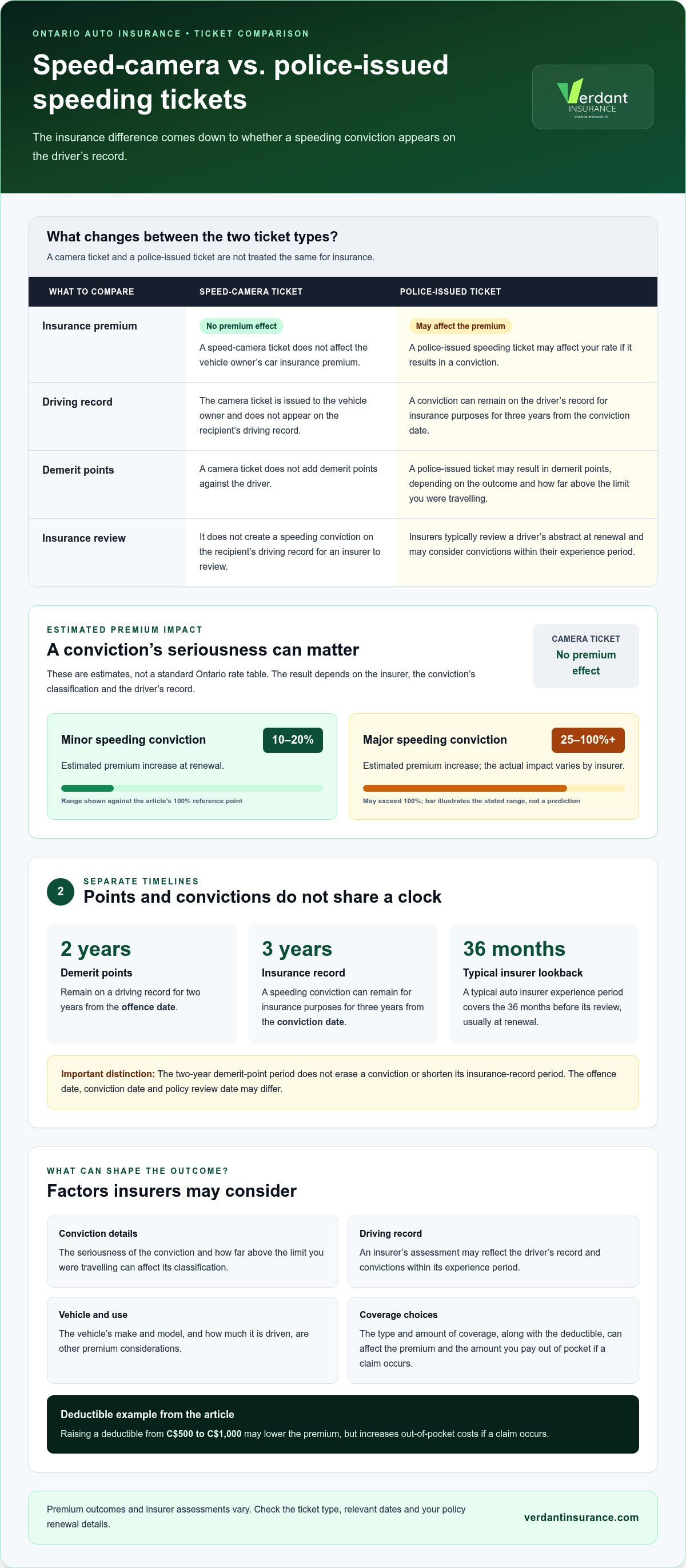
In Ontario, a speed-camera ticket does not affect the vehicle owner’s car insurance premium. A police-issued speeding ticket may affect your rate if it results in a conviction. What happens to your insurance after a speeding ticket in Ontario depends on how the ticket was issued and whether you are convicted. Demerit points remain on your driving record for two years from the offence date, while a speeding conviction can remain on your record for insurance purposes for three years from the conviction date.
It’s understandable to worry that any speeding ticket will raise your premium. But a camera ticket and a police-issued ticket are treated differently, and demerit points and insurance convictions follow separate timelines. Understanding the distinction can help you know what to expect and what details to review.
This article explains how a speeding conviction may affect your premium, when an insurer may consider it, how demerit points fit in, and why camera tickets are different. It also covers other factors that can affect your policy, so you can review your circumstances at renewal.
Key Takeaways
- A police-issued speeding conviction may affect your premium, while a speed camera ticket is treated differently for insurance.
- Demerit points and insurance records follow separate timelines, so the points disappearing doesn’t necessarily mean the conviction is no longer relevant to insurance.
- The impact of a conviction can depend on its seriousness, your driving record, and how your insurer assesses risk.
- Understand what kind of ticket you received before considering how it may affect your policy at renewal.
- Knowing how insurers consider convictions can help you have a more informed conversation about your Ontario auto insurance.
How long demerit points remain on a driving record
Yes. Ontario insurers can see minor speeding convictions when they review a driver’s abstract, typically at policy renewal. A typical auto insurer experience period covers the 36 months before its review. Drivers asking what happens to insurance after a speeding ticket in Ontario should distinguish the insurer’s review period from the time points remain on a record.
Demerit points and convictions follow separate timelines. In Ontario, demerit points remain on a driving record for two years from the offence date. A speeding conviction can remain on a driver’s record for insurance purposes for three years from the conviction date. The two-year point period does not erase the conviction or shorten its insurance-record period.
For example, if a speeding offence leads to a conviction, the demerit-point period starts from the offence date, while the insurance-record period starts from the conviction date. Since those dates may differ, keep track of the offence date, conviction date and policy review date when checking your record. Knowing which date applies helps clarify what happens to insurance after an Ontario speeding ticket.
The 36-month insurer experience period is a lookback window, not the same as the demerit-point period. An insurer typically reviews the driving abstract at renewal and considers convictions within its experience period. A minor speeding conviction can therefore be visible during a renewal review even after its demerit points have expired.
A police-issued speeding ticket may lead to a conviction and demerit points, depending on the outcome and how far above the limit you were travelling. A speed-camera ticket works differently: it is issued to the vehicle owner, does not appear on the recipient’s driving record and does not add demerit points against the driver. This distinction matters when separating a camera fine from a conviction on a driver’s record.
Distracted driving has its own insurance implications. A first distracted-driving conviction in Ontario is associated with an estimated premium increase of 15-25%. Insurers review driving convictions, not only speeding-related points, so a distracted-driving conviction can also matter during a policy review. The key distinction is between the conviction and the separate demerit-point timeline.
A suspended licence is a different consequence from points expiring. Ontario’s point thresholds depend on licence type: a fully licensed driver receives a warning letter at nine points, faces an interview at 12, and a 30-day suspension at 15 or more. A G1 or G2 driver faces a 30-day suspension at nine points. These thresholds show why tracking the total matters, even though individual points remain for two years.
Keep the ticket type and dates clear: the offence date starts the two-year demerit-point period, the conviction date starts the three-year insurance-record period, and a camera ticket does not go on the recipient’s driving record.
Does a Speeding Ticket Affect Your Car Insurance in Ontario?
A speeding conviction may raise an Ontario insurance premium at renewal; estimates range from 10-20% for a minor conviction to 25% to 100% or more for a major one, depending on the insurer. Drivers can manage costs by understanding their ticket, reviewing their coverage choices, and avoiding changes that leave them with unaffordable out-of-pocket costs.
A speed-camera ticket does not affect the vehicle owner’s car insurance premium. A police-issued ticket may have insurance consequences if it results in a conviction.
Premium Effects of Speeding Convictions
A speeding conviction can affect the price an insurer charges for auto insurance. Estimates for a minor conviction range from 10-20% at renewal, while a major conviction may lead to an increase of 25% to 100% or more, depending on the insurer. These figures are estimates, not a standard Ontario rate table. The conviction’s classification and the insurer’s rating approach affect the result.
A camera ticket does not appear on the recipient’s driving record or affect their premium. A police-issued ticket may result in a conviction and demerit points, depending on the outcome. That distinction explains why two speeding tickets may have different insurance effects.
Factors Behind Premium Increases
An insurer’s assessment may reflect the seriousness of a conviction and the driver’s record. How far above the limit you were travelling affects the offence classification. Ontario research estimates distinguish minor and major convictions, with a wider possible increase for major offences. Timing can matter too, as insurers review driving history during policy renewal.
Other premium considerations include the vehicle’s make and model, how much it is driven, and the type and amount of coverage. Drivers seeking to manage costs can review those coverage choices and consider how a deductible affects their own share of a claim. Raising a deductible from C$500 to C$1,000 may lower the premium, but increases out-of-pocket costs if a claim occurs.
Estimated Fine and Premium Costs
The ticket fine is separate from any later insurance change. Even a minor speeding conviction may affect your premium at renewal, so the financial impact could extend beyond the fine.
Paying a traffic ticket fine automatically counts as pleading guilty to the infraction in Ontario. Drivers have 15 days to respond to a speeding ticket. If they dispute it, the court process and its outcome determine whether a conviction follows. Review the ticket details before deciding how to respond, since paying it has a legal consequence beyond settling the fine.
To manage insurance costs after a ticket, review your coverage and deductible choices, and don’t assume that paying the fine resolves any insurance impact. Your insurer’s premium assessment depends on the conviction and its rating approach. A camera ticket, by contrast, does not affect the recipient’s premium.
Demerit Points and Insurance: What's the Connection?
Demerit points track certain traffic violations, but they do not directly determine insurance premiums. In Ontario, insurers may consider the conviction behind the points, while the point total can affect your driver’s licence.
Demerit Point Consequences
Demerit points accumulate after convictions for offences such as speeding, with the total reflecting recorded violations. Points are not an insurance surcharge by themselves, but an insurer may consider the underlying conviction when assessing risk. That’s why a driver’s point total and premium may not change in step.
For example, a police-issued speeding ticket may lead to a conviction and points based on how far above the limit you were travelling. The conviction may be relevant to an insurance review even if you have not reached a licence-related point threshold. A camera ticket does not add points to the vehicle owner’s driving record.
Keep the conviction and point total separate when reviewing your record. Points relate to potential licensing consequences; convictions may be considered in insurance rating. A traffic violation can therefore matter in two different ways, even if the point total itself does not directly change your premium.
Demerit Points and Licence Suspensions
Ontario’s demerit-point thresholds can lead to warnings, an interview, or a suspended licence. For a fully licensed driver, nine points bring a warning letter, 12 points require a mandatory interview, and 15 or more points result in a 30-day suspension.
For a G1 or G2 driver, nine points can result in a 30-day suspension. Licence type therefore changes the point threshold that matters. A driver approaching a threshold should pay attention to each conviction and its point value, rather than focusing only on the latest ticket.
A licence suspension is separate from an insurance premium increase. A suspension follows Ontario’s demerit-point rules, while an insurer’s assessment concerns convictions and its own rating approach. Keeping these outcomes distinct helps explain why a points warning alone does not account for a premium change.
Points for Speeding
Ontario assigns different point totals according to the speed over the posted limit. Driving 16 to 29 km/h over results in three demerit points; driving 30 to 49 km/h over results in four; and driving 50 km/h or more over results in six.
Those differences can affect how quickly a driver approaches a point threshold. For instance, a conviction for driving 30 to 49 km/h over adds four points, bringing a fully licensed driver closer to the nine-point warning level. The conviction may also be considered separately in an insurance review.
Don’t treat points as a direct premium calculation. The conviction, its seriousness and your driving record are relevant to an insurer’s assessment, while the point total indicates possible licensing consequences. Considering both gives you a clearer picture of how a speeding violation may affect your driving privileges and insurance.
How speeding tickets may affect car insurance rates
A speeding conviction is one part of an auto insurance risk assessment, not a stand-alone premium calculation. Your broader driving record, vehicle, vehicle use and selected coverage also matter.
Rate Changes at Renewal
At renewal, compare your updated policy documents with the previous term. Check the premium, listed drivers, vehicle details and selected coverage to see what changed. A different premium does not, by itself, prove that a speeding conviction caused the change, since insurers consider other rating details too.
For a clearer comparison, look at the same vehicle and coverage choices across policy terms. Changes in annual kilometres or vehicle use may also affect the assessment. Keeping these details in view makes it easier to discuss your renewal accurately.
How Long Convictions Affect Insurance
A conviction may form part of an insurer’s assessment of your risk, alongside other relevant information. Its effect is not a fixed surcharge that applies identically to every policy. Insurer-specific rating factors and your overall driving record shape how the conviction is considered.
Multiple speeding convictions may be viewed differently from a single incident. In some cases, they could affect group car insurance rates. Consider your full driving history rather than treating each ticket as an isolated event.
Unsettled Tickets and Insurance Rates
Distinguish a ticket that has not resulted in a conviction from a conviction on your driving record. They are different stages, and an insurance assessment considers recorded information. Keep the ticket paperwork with any court outcome so the details are clear when you discuss a policy review.
When reviewing auto insurance, consider all the rating details, not just the ticket. Your vehicle’s make and model, annual kilometres, vehicle use, selected coverage and claims history can all affect premiums. Comparing these details helps identify what may be contributing to your policy’s price without assuming that one event explains every change.
How does a speeding ticket affect car insurance rates in Ontario?
A speeding conviction is one part of an insurer’s risk assessment, not a stand-alone price calculation. Your driving experience, vehicle, location, annual kilometres, vehicle use, claims history and selected coverage can also shape an Ontario auto insurance premium.
That wider picture matters when you’re trying to understand a price change. Replacing a vehicle, driving it more often or choosing different coverage may affect the overall rating alongside a change in your driving history. Looking at just one factor may not explain the full premium change.
Compare your policy details with your current situation. Confirm that the listed vehicle, drivers, usage and annual kilometres reflect how you actually use the car. Also note any coverage changes between policy terms. This helps distinguish changes in your circumstances from the effect of a conviction.
For example, if you start commuting more often, your annual kilometres and vehicle use may change. If your premium also changes after a conviction, both details may be relevant to the insurer’s assessment. The example shows why you should not automatically attribute a rate change to a single event.
Insurers use different rating factors, so the same driving history and vehicle details may not produce the same premium with every insurer. Coverage options affect what a policy includes, while its wording, limits and exclusions define the protection. Review these elements together instead of comparing only the final price.
A useful review focuses on what changed and what stayed the same. Compare vehicle and driver information, usage, kilometres, claims history and selected coverage. Then consider whether the insurer’s assessment reflects your current record and circumstances. This gives you a fuller basis for understanding your premium than a ticket-related estimate alone.
Ontario drivers can keep a clear record of relevant changes, such as a different vehicle or a new commuting pattern. If you have questions about a premium, accurate information about these factors makes the discussion more specific. It also helps distinguish an updated risk profile from the impact of a conviction alone.
Verdant Insurance: Auto Insurance
Verdant Insurance is an Ontario insurance brokerage that can help you review your auto insurance after a speeding conviction. If your record has changed or renewal is approaching, an insurance broker can explain how your driving history and coverage choices may factor into your policy. Eligibility and coverage availability depend on insurer rules and the details of your situation.
Your auto insurance needs depend on your vehicle, driving history and selected coverage. A conversation with an insurance broker can clarify what information is relevant and which options may suit your situation, without treating an estimate as a guaranteed outcome.
For help reviewing your Ontario auto insurance, contact Verdant Insurance or visit verdantinsurance.com.
Make your next insurance decision with clarity
Understanding what happens to insurance after a speeding ticket in Ontario can help you approach your next policy decision with a clearer picture. Focus on the questions that matter to you, such as how your driving history fits your current needs and whether your coverage still suits your situation.
Insurance pricing and eligibility depend on the insurer and your individual circumstances. An insurance broker can help you explore your options and understand what information may shape a policy review. Verdant Insurance offers auto, homeowner and business insurance to eligible clients throughout Ontario.
When you’re ready, take the next step with a clearer understanding of your options.
Frequently Asked Questions
Are there any other penalties or consequences for speed camera tickets?
Yes. Unpaid speed camera fines and fees can prevent the vehicle owner from renewing the licence plate until the balance is paid. The fine is calculated using the vehicle’s recorded speed over the limit, with a provincial licence plate access fee added. For example, Ontario’s camera penalty rate is C$7.50 per kilometre for speeds 20-29 km/h over. The ticket is addressed to the vehicle owner, not treated as a driver conviction.
Does Fighting a Ticket Help?
A court outcome that changes the charge or results in a dismissal may affect the insurance consequences, but disputing a ticket alone does not change your record. Before deciding how to respond, compare the ticket details with the evidence and consider the consequences of each available response. A reduced ticket that becomes a non-moving violation eliminates the insurance surcharge. The outcome depends on the decision in the case, not simply on requesting a dispute.
When will my rates go up after a ticket?
A premium change is generally considered when the insurer reviews your policy, not automatically on the day an officer issues a ticket. Check your renewal documents for the new premium and any changes to listed drivers, vehicles or coverage. If the price changes, compare those details with the previous term. This review can help you identify whether a conviction or another policy detail may be relevant.
How long does a speeding ticket stay on your Ontario driving record for insurance purposes?
A speeding conviction can remain on a driver’s record for insurance purposes for three years from the conviction date. Use the conviction date shown in the case outcome, not just the date of the roadside stop, to understand this period. If the conviction date is later, the insurance-record period starts later too. Keep the outcome paperwork with your policy records so the dates are easy to check.
How do demerit points from an Ontario speeding ticket affect insurance?
Demerit points do not directly calculate an insurance premium, but the associated conviction may be relevant to an insurer’s risk assessment. When reviewing your record, keep the point total separate from the conviction history: points relate to driving privileges, while a conviction may be considered for insurance. Accurate details about the conviction and its outcome help clarify what information is being assessed.
Do insurance impacts differ for first-time versus repeat speeding tickets in Ontario?
Yes. Insurers may assess a history of repeat convictions differently from a single conviction because they consider the driver’s broader record. Multiple speeding convictions within three years can result in a high-risk driver designation. Renewal options as well as price may be affected. Keep a record of each ticket’s outcome, since an unresolved charge and a conviction are not the same entry in a driving history.
Does the effect on insurance vary by how far over the speed limit you were in Ontario?
Yes. The recorded speed affects the classification and seriousness of a speeding conviction, which may influence an insurer’s assessment. Review the speed and posted limit shown on the offence notice, along with any final court outcome. A change in classification may affect the insurance assessment, even when two tickets involve similar roads or the same vehicle.
Can disputing or having an Ontario speeding ticket dismissed prevent an insurance increase?
A dismissal means there is no speeding conviction from that ticket for an insurer to assess. Keep the court outcome, which documents how the charge was resolved. A changed charge may also affect the insurance consequence if it becomes a non-moving violation. Requesting a dispute does not guarantee a dismissal; the final outcome determines what conviction, if any, is recorded.


