

Could one at-fault collision affect your renewal differently from another driver’s? Yes. The at fault accident insurance increase Ontario drivers may see is not a set amount. It can depend on how fault is assessed, your driving and claims history, your policy, and the insurer’s rating practices.
Ontario’s no-fault system does not mean fault is ignored. No-fault generally refers to how certain claims are handled, while fault can still be assessed and may affect your premium at renewal. Accident forgiveness is a separate policy feature, so check your policy wording before assuming it applies.
This guide explains what can influence an auto insurance renewal after an at-fault accident, how to review your documents, and what to ask your broker or insurer. These steps can help you understand the renewal without relying on a general estimate that may not fit your situation.
Key Takeaways
- An at-fault accident may affect your Ontario premium, but there is no single increase for every driver.
- The at fault accident insurance increase Ontario drivers may face depends on personal circumstances, policy terms, and insurer rating practices.
- Ontario’s no-fault system concerns how certain claims are handled. It does not mean fault is never assessed.
- Compare your renewal with your previous policy, then compare alternatives using equivalent coverage and limits, not price alone.
- A broker can help you understand auto insurance options in light of your circumstances. Pricing and eligibility vary.
Will an at-fault accident increase your Ontario car insurance premium?
An at-fault accident may affect your Ontario car insurance premium, but an increase is not automatic. The effect depends on the collision, your insurance and driving history, your policy terms, and how your insurer assesses risk. The phrase “at fault accident insurance increase Ontario” describes a possibility, not a guaranteed outcome or a standard province-wide percentage.
An at-fault accident can influence how an insurer rates your policy, but the impact depends on the driver, the policy, and the insurer. A general estimate cannot tell you exactly what will happen at renewal.
What does an at-fault accident mean for insurance?
An at-fault accident is a collision where a driver is assigned some or all responsibility under the applicable fault rules. Ontario’s Fault Determination Rules provide a framework insurers use to assess fault in different collision circumstances. The assessment may assign full or partial fault, and the driver’s share can matter to how a claim is handled and how the insurer rates the policy.
Not every reported collision leads to a premium increase. The insurer considers the facts and relevant policy terms. Your impression of what happened, or another person’s opinion at the scene, does not establish the final insurance assessment. The details of each collision need to be evaluated individually.
Why can’t one percentage predict your increase?
Two drivers involved in similar collisions may have different renewal outcomes. Their records, policy details, claim circumstances, and insurers’ rating practices may differ. Partial fault may also be treated differently from full fault, so broad percentage estimates are not reliable predictions of an individual premium.
A collision does not set a new premium at the roadside. The insurer assesses the claim and policy information, and any rating effect may become apparent when the policy is reviewed for renewal. The handling and timing depend on the policy and insurer, so use your renewal documents to understand your own result.
Ontario’s no-fault insurance is a claims-handling concept, not a statement that nobody is assigned fault. Drivers may deal with their own insurer for certain claims while fault is assessed separately. For a general explanation of the no-fault insurance system, see this overview, then refer to Ontario policy terms for details that apply to your situation.
Use general information as a guide, not as a personal renewal calculation. Pricing and eligibility vary by insurer and individual circumstances. If an accident has been assessed as at fault, your insurer or broker can explain how the assessment relates to your policy and what to look for in your renewal documents.
Ontario’s no-fault system: why fault can still affect your premium
“No-fault insurance” can sound as if nobody is held responsible after a collision. In Ontario, it describes how certain claims are handled. Fault may still be assessed and may matter to insurance rating. In short: no-fault claims handling can determine which insurer handles a claim, while fault may still influence how a policy is rated.
What does no-fault insurance mean in Ontario?
In general, no-fault means you may deal with your own insurer for certain claims after a collision, rather than pursuing payment directly from another driver’s insurer. The process depends on the type of claim and the policy. It does not mean all drivers share equal responsibility or that fault is ignored when insurers assess a collision.
For Ontario-specific consumer information, the Financial Services Regulatory Authority of Ontario (FSRA) provides guidance on auto insurance. Use official information alongside your policy documents, since details depend on the claim and your coverage.
How is fault assessed after a collision?
Insurers use Ontario’s Fault Determination Rules, along with information about the collision, to assess responsibility for insurance purposes. A brief description of an accident is not enough to determine how the rules apply in an individual case. Fault may be partial or full, rather than simply a choice between “at fault” and “not at fault.”
This assessment is separate from which insurer handles a particular claim. Dealing with your own insurer does not automatically mean you were found not at fault. The assessment may also be relevant to how the insurer considers your policy at renewal, although it does not guarantee a premium increase.
Keep the questions separate: Who handles this claim under the applicable process? and How has fault been assessed, and could that assessment affect my insurance rating? Your claim documents or insurer can clarify what has been decided and what remains under review. Do not rely only on assumptions about what happened at the scene.
This distinction explains why the at fault accident insurance increase Ontario drivers worry about is not determined by the term “no-fault” alone. Fault assessment, policy terms, and insurer rating practices all matter, and the effect varies by insurer and individual circumstances. Verdant is an Ontario insurance brokerage that helps drivers explore Ontario auto insurance options in light of their circumstances.
What determines an at-fault accident’s insurance impact?
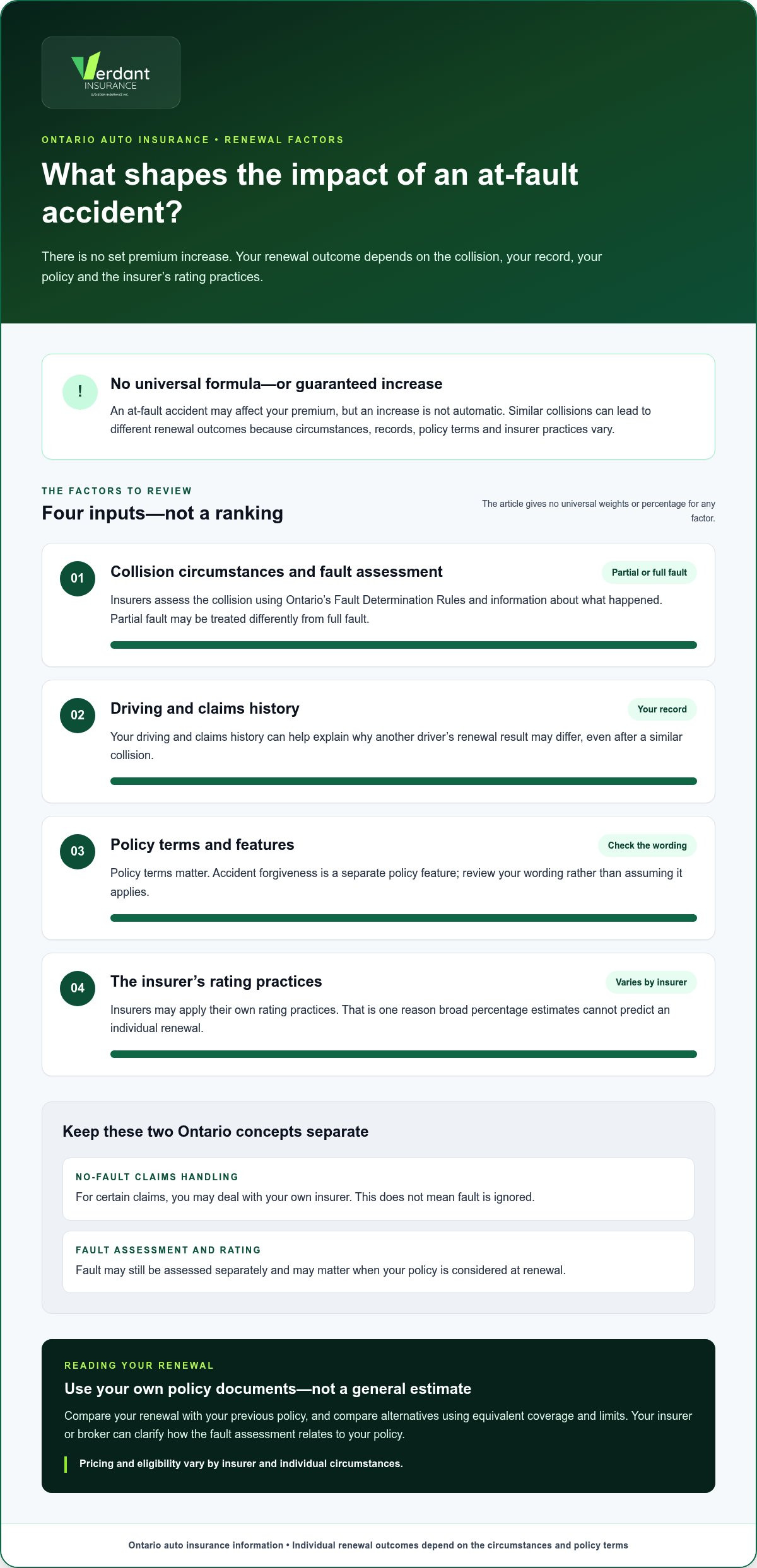
No single factor determines what happens to your premium after a collision. Insurers may consider the collision circumstances, your driving and claims history, policy wording, and their own rating practices. These factors help explain why the at fault accident insurance increase Ontario drivers experience can differ from one policyholder to another. They do not create a universal formula for calculating a renewal.
Fault can be partial or full. An assessment of partial fault may be treated differently from full fault, but the effect depends on the insurer’s rules and policy details. Use the factors below as prompts for reviewing your situation, not as a way to predict a particular premium.
| Factor | Why it may matter | What to review |
|---|---|---|
| Collision circumstances | The details help inform how fault is assessed and how the claim is considered. | Claim documents and the insurer’s fault assessment. |
| Driving and claims history | An insurer may consider relevant past experience under its rating practices. | Your driver and claims information on file. |
| Policy wording | Terms, limits, and endorsements can affect how the policy responds. | Your policy documents, including any accident forgiveness wording. |
| Insurer rating practices | Insurers may assess the same factors differently. | Your renewal explanation and any available policy options. |
How do driving history and collision details matter?
Your driving and claims history provide context beyond one collision. Insurers may consider relevant history according to their rating practices, but the information reviewed and its effect can vary. Do not assume a particular look-back period or that every past incident is treated the same way.
Collision details also inform the assessment. They help the insurer apply the relevant rules, but do not guarantee a specific fault result or premium change. If the assessment is partial, ask how it is reflected in your policy review rather than assuming it will be rated like full fault.
What role can policy terms and accident forgiveness play?
Accident forgiveness is a policy feature that may affect how an insurer treats a qualifying at-fault accident for rating purposes. Its availability, eligibility, and effect depend on the insurer and exact policy wording. It should not be assumed to remove the collision from every record or apply automatically to every policy.
Check your policy documents for the relevant terms and any endorsement that may apply. If the wording is unclear, ask your broker or insurer how it relates to your circumstances. A review can help you understand what may influence renewal, but pricing and eligibility vary by insurer and individual circumstances.
How to review a renewal after an at-fault accident
A renewal increase can be unsettling, particularly if you are unsure whether the collision explains the change. Compare your documents before drawing conclusions. A side-by-side review can show what changed, help you prepare focused questions, and make it easier to assess alternatives without comparing price alone.
- Compare the renewal with your previous policy term. Check the premium and policy details side by side. Note changes to coverage, limits, deductibles, listed drivers, vehicles, or vehicle use.
- Identify every change. Check for updated driver or vehicle information, changes you requested, and other policy adjustments. Do not assume the accident is the only possible reason for a different renewal premium.
- Review relevant policy terms. Read the sections and endorsements that may relate to the collision, including any accident forgiveness wording. The effect depends on the policy language and insurer’s rules.
- Discuss your options. Ask your broker or insurer how the collision and current policy terms may be reflected in the renewal. Compare equivalent coverage and limits if you consider alternatives.
Which renewal details should you compare?
Use the declarations and coverage details for both terms, and mark differences so you can ask about them clearly. Confirm that the same drivers and vehicles are listed, then compare limits, deductibles, and coverage selections. If a line item or change is unclear, ask what it means for your policy rather than assuming it is connected to the accident.
A quote from another insurer does not prove that coverage or eligibility is identical. Proposed terms may differ, and insurers may assess a collision differently under their own rating practices. Verdant’s Ontario car insurance buying guide offers broader context for comparing options carefully.
What should you ask a broker about your options?
Bring your current renewal and previous policy documents to the discussion. Useful questions include:
- How is the collision reflected in the renewal, and which policy terms are relevant?
- Have any coverage, limits, deductibles, or listed-driver details changed?
- Are there alternative quotes with comparable coverage and limits?
- Could eligibility or policy terms differ with another insurer?
A broker can help you understand available options in light of your circumstances. For more on broker support, see Verdant’s guide to online insurance brokers in Ontario. The at fault accident insurance increase Ontario drivers may see cannot be predicted from a quote alone. Pricing and eligibility vary by insurer and individual circumstances.
Get clear Ontario auto insurance guidance after an at-fault accident
No article or universal percentage can predict exactly how an at-fault accident will affect your next renewal. The outcome depends on the collision assessment, your circumstances, your policy terms, and the insurer’s rating practices. Your renewal documents and policy are the practical starting points.
If you are concerned about an at fault accident insurance increase Ontario drivers may face, focus on understanding the renewal rather than relying on a general estimate. Find out how the collision is reflected in your policy, whether any terms or coverages changed, and what comparable options may be available.
When can a broker conversation help?
A broker can help you review policy details, explain insurance options, and consider alternatives in light of your circumstances. Verdant Insurance is an Ontario insurance brokerage, not an insurer. A broker does not determine fault or control an insurer’s decisions, but can help you understand the information available and discuss options across insurers.
Keep the full policy in view as you compare. A different quote may not include the same coverage, limits, deductibles, or terms. Pricing and eligibility vary by insurer and individual circumstances, so compare the details rather than expecting a particular premium or outcome.
What information can help make the discussion useful?
Gather the documents and details that let you describe the situation clearly:
- Your current policy documents and renewal notice, including any listed changes.
- Information about the collision, such as the date, circumstances, and fault assessment communicated to you.
- Relevant letters, emails, or other communication from your insurer about the claim or renewal.
- Questions about policy terms, accident forgiveness, or whether an alternative offers comparable coverage and limits.
Share what you know accurately and distinguish confirmed information from anything still under review. If a renewal detail is unclear, point to the specific document or wording and ask how it applies to your policy. This gives your broker a clearer basis for discussing options, while insurer decisions and final terms remain subject to the insurer and policy.
Ontario drivers in Markham, York Region, Toronto, and the GTA can speak with Verdant to review a renewal and explore auto insurance options.
Take a clear next step at renewal
An at fault accident insurance increase Ontario drivers are concerned about can make renewal feel like a difficult decision. Before choosing how to proceed, review your priorities and note any questions you still need answered.
Keep a brief record of the explanations you receive. It gives you a clear reference point if you need to revisit a policy term or compare options later.
To review your renewal and discuss Ontario auto insurance options, speak with Verdant Insurance.
Frequently Asked Questions
Will my car insurance go up after an at-fault accident in Ontario?
It may, but an increase is not automatic. Your insurer considers the collision assessment alongside your policy and other relevant rating details. Compare the new premium with your previous term and check for changes beyond the accident, such as coverage or driver information. If you are unsure what influenced the price, ask your insurer or broker to explain the renewal using your policy documents.
How much does insurance increase after an at-fault accident in Ontario?
There is no standard amount or percentage for every driver. The at fault accident insurance increase Ontario drivers may experience depends on the insurer’s rating practices, the collision assessment, the driver’s circumstances, and policy terms. An online estimate or another driver’s experience cannot predict your renewal. For a useful comparison, review quotes with the same coverage, limits, and deductibles, and confirm the proposed terms suit your needs.
How long can an at-fault accident affect car insurance in Ontario?
An at-fault accident may remain on a driver’s record and affect premiums for up to six years, though the effect can vary. The premium impact is often greatest during the first two to three years. Your insurer’s rating practices and individual circumstances matter, so ask how the accident is being considered for your renewal rather than assuming one timeline applies to every policy.
Does Ontario’s no-fault insurance system mean nobody is at fault?
No. “No-fault” does not mean every driver is equally responsible or that fault is not assessed. It describes how certain claims are handled, while insurers can still apply Ontario’s Fault Determination Rules to the collision circumstances. You may deal with your own insurer for a claim even if the insurer’s assessment assigns fault to a driver. Ask for clarification if the assessment or claim decision is unclear.
Can accident forgiveness prevent an insurance increase in Ontario?
It may, depending on the policy wording and insurer’s rules. Accident forgiveness is a policy feature that may prevent a premium increase after a qualifying at-fault accident, but it does not necessarily remove the collision from every record or apply to every policy. Review your policy or endorsement for its terms and how it may apply to your circumstances. Do not assume you have this feature unless your documents show it.
Will a not-at-fault accident increase my Ontario car insurance?
A collision assessed as not at fault is different from one where you are assigned responsibility, but a renewal can still change for other reasons. Check whether the insurer’s assessment matches the information you received and review the whole renewal, not just the premium. If the increase seems connected to the collision, ask your insurer or broker to explain the relevant rating factors and whether other policy details changed.
What should I do if my insurance premium increases at renewal after an accident?
Compare your renewal with the previous policy term and note changes to coverage, deductibles, limits, listed drivers, and premium. Ask what factors contributed to the new price and whether the collision assessment is reflected in it. If you consider another option, compare equivalent coverage and limits rather than choosing on price alone. Keep the renewal documents and insurer’s explanation together for your records.
Can I change car insurance companies after an at-fault accident?
You can explore quotes from other insurers, but a new application does not guarantee the same coverage, eligibility, or price. Provide accurate information about the collision and compare policy terms, limits, and deductibles. Before cancelling your current policy, understand when replacement coverage would begin so you can avoid a gap. A broker can help you review available options, while each insurer makes its own decisions.


