

Could an electric vehicle change your insurance even though Ontario uses the same auto insurance framework for EVs and gas-powered cars? Yes. Electric vehicle insurance in Ontario follows the standard system, but a vehicle’s value, repair needs and charging setup can affect how an insurer assesses a quote.
Questions about EV insurance often come down to three things: whether the premium differs, what happens if the battery is damaged, and whether a home charger belongs on an auto policy. The answer depends on the insurer, your circumstances and the wording, limits and exclusions of your policies. You don’t need a separate type of auto policy just because you drive an EV, but the details still matter.
This guide explains Ontario’s required and optional auto coverage, outlines EV details that may influence a quote, and highlights what to review about batteries and charging equipment. It also covers what to prepare before speaking with a broker.
Key Takeaways
- Electric vehicle insurance in Ontario uses the standard auto insurance framework. Know which protections are required and which are optional.
- Battery damage, specialised repairs and mechanical failure raise different policy questions. Review the wording rather than assuming every repair is covered.
- A home charging station may fall under home insurance rather than auto insurance, depending on the policy and circumstances.
- Before requesting a quote, gather your EV’s year, make, model, trim and ownership or lease details, plus information about how and where you use and charge it.
- An Ontario brokerage can help you compare options from partner insurers and review policy terms, limits and exclusions.
What does electric vehicle insurance in Ontario cover?
An electric vehicle is insured through an auto policy, just like a gasoline-powered vehicle. A policy may respond to covered incidents involving the vehicle or its use, but protection depends on the insurer, the coverage selected and the policy’s wording, limits and exclusions. Battery or charging-related concerns do not create automatic protection simply because the vehicle is electric.
Electric vehicle insurance in Ontario is auto insurance for an electric-powered vehicle, with protection determined by the policy’s wording, limits, exclusions and insurer terms. Drivers generally begin with standard auto coverage, then consider which optional protections suit their vehicle and circumstances.
Which Ontario auto insurance rules apply to electric vehicles?
Ontario’s auto insurance requirements apply to EV owners and drivers as they do to other vehicle owners and drivers. Required protections are distinct from optional choices that can broaden a policy. As of July 1, 2026, Medical, Rehabilitation and Attendant Care benefits are mandatory accident benefits; Income Replacement and Caregiver benefits are optional. For current requirements and explanations of coverage, consult the Financial Services Regulatory Authority of Ontario (FSRA).
Optional coverage is not automatically necessary for every driver. Consider your vehicle, finances and comfort with potential out-of-pocket costs. Review each coverage’s limits, exclusions and deductible, if applicable, rather than assuming an option is included or required. A general overview of vehicle insurance can also help explain how different types of protection serve different purposes.
Does an electric vehicle need a special insurance policy?
No separate, universal policy package applies just because a vehicle uses electric propulsion. The vehicle is insured through auto insurance arranged with an insurer. However, EVs do not all receive identical coverage: insurers set eligibility and policy terms under their own rules, and available options and prices can vary by insurer and individual circumstances.
Rather than looking for a policy labelled “EV insurance,” check what the policy says about your specific vehicle and selected protections. Review the declarations page and policy wording to understand what is insured, where limits apply and which exclusions may matter. A broker can help you review options available through partner insurers, but coverage should not be treated as automatic.
Keep the required-versus-optional distinction in mind as you review your policy. Liability and statutory accident benefits form part of Ontario’s auto insurance framework, while other protections depend on your choices and the insurer’s terms. Confirm current regulatory details with FSRA, since requirements and benefit options can change.
How can an EV’s battery, repairs, and charging setup affect insurance questions?
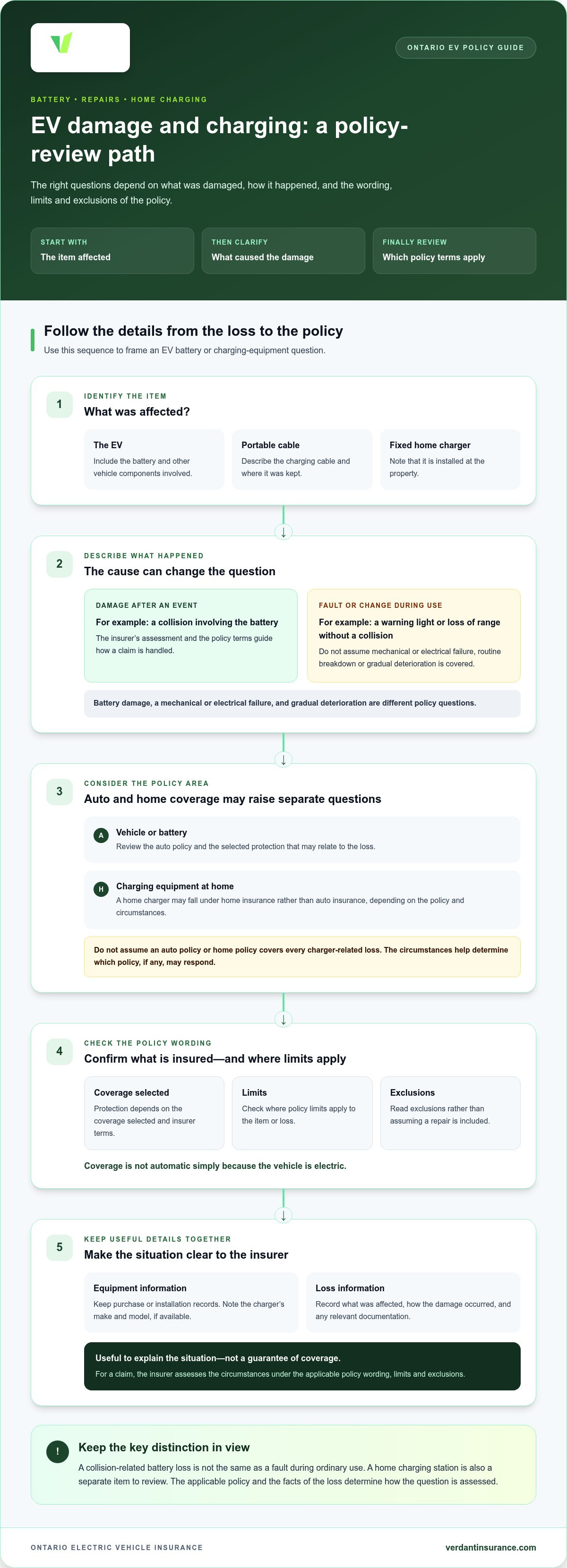
An EV’s battery and specialised components can raise practical questions after damage, but they do not create a universal coverage rule or determine every quote. The key considerations are what was damaged, how the loss happened and which policy may apply. When discussing electric vehicle insurance in Ontario, describe the vehicle and charging equipment accurately, then review the insurer’s wording instead of assuming a particular repair will be covered.
EV coverage questions depend on the loss, the insured item, applicable limits and exclusions, and the wording of the policy. A collision involving the battery is different from a battery fault that develops during ordinary use. That distinction helps frame the question, but only the insurer can assess a claim under the policy.
What should drivers know about battery damage and repairs?
Battery damage may involve assessment, repair or replacement decisions that differ from work on other vehicle parts. If an insured event damages the battery, the insurer’s assessment and the policy terms guide how the claim is handled. Coverage is not automatic, and general information cannot determine whether a specific repair or replacement would be paid.
Describe the event clearly. Damage following a collision raises a different question from a warning light or loss of range without a collision. Do not assume auto insurance covers a mechanical or electrical failure, routine breakdown or gradual deterioration. Review the applicable coverage and exclusions, and direct claim questions to the insurer.
How should home charging equipment be considered?
Consider the EV, portable charging cable and fixed home charger as separate items that may involve different coverage questions. Who owns the equipment, where it is kept or installed, and how it was damaged can all be relevant. Do not assume an auto policy or home policy covers every charger-related loss.
When discussing protection, describe whether you charge at home, what equipment you own, and whether the charger is portable or installed at the property. Then review the relevant policy wording, limits and exclusions. If damage occurs, the circumstances and insurer’s assessment help determine which policy, if any, may respond.
Keep purchase or installation records and note the equipment’s make and model, if available. If a loss happens, record what was affected and how the damage occurred, and retain relevant documentation. These steps do not guarantee coverage, but they can help you explain the situation clearly when reviewing a claim or policy.
Battery and charging questions can involve both auto and home coverage, so reviewing them together may help identify gaps or overlaps. An Ontario broker can help compare available policy options and explain how insurer wording relates to your circumstances. You can also explore Ontario auto insurance options as part of that review.
How does EV insurance compare with gas-car insurance in Ontario?
The basic auto insurance framework applies to electric and gas-powered vehicles in Ontario. A vehicle’s power source does not determine a universal coverage package or mean its premium will always be higher or lower. Quotes can differ based on the vehicle, driver, location, insurer, selected protection and policy terms.
For a useful comparison, look beyond “EV versus gas.” Consider which details may shape the assessment and what each quote actually includes.
| Comparison point | Electric vehicle | Gas-powered vehicle |
|---|---|---|
| Vehicle details | Model, trim, value and battery-related components may be relevant details. | Model, trim and vehicle value may also matter. |
| Repair considerations | Repair pathways may involve EV-specific parts or expertise, depending on the vehicle and damage. | Repair needs depend on the vehicle, parts and damage involved. |
| Charging equipment | A portable cable or home charger may raise separate questions about ownership and applicable policy wording. | Home charging equipment is not part of the vehicle’s setup. |
| Policy questions | Review the same core auto coverage choices, plus any relevant questions about the vehicle or charging arrangements. | Review the core auto coverage choices in light of the vehicle and your circumstances. |
Which details may differ between an EV and a gas vehicle?
An insurer may consider vehicle-specific details when assessing a risk, but practices vary. An EV’s battery, parts and repair pathway can prompt different questions from those for a gas vehicle. That does not establish a particular rate or outcome. In either case, vehicle value, driver profile, intended use and location may also be relevant to a quote.
Charging equipment is another detail to distinguish. It is separate from the car itself, so note whether you own a portable cable or home charger. How those items are treated depends on the circumstances and applicable policy wording, not simply on the vehicle being electric.
Why can two EV insurance quotes differ?
Two insurers can assess the same driver and vehicle differently under their own rules. A quote may also change with selected limits, deductibles and optional protections. Compare these details side by side, along with exclusions and other terms, so a lower headline price is not mistaken for equivalent protection.
For example, an illustrative comparison might show different deductibles or optional coverages across two quotes. It would not predict an actual premium, represent a Verdant quote or guarantee an insurer’s decision. Ask what differs before comparing the totals.
That is the practical approach to electric vehicle insurance in Ontario: compare vehicle details and policy terms rather than relying on assumptions about fuel type. An Ontario broker can help review options from partner insurers, while the insurer determines eligibility, pricing and final policy terms.
What information should Ontario EV owners prepare for an insurance quote?
Preparation can make a quote discussion clearer and help ensure the information is consistent. For electric vehicle insurance in Ontario, work through four steps: identify the vehicle, describe how it is used, consider the protection you want, and review the terms offered. The insurer may ask follow-up questions, and requirements can vary.
Which vehicle and driver details are useful?
Start with the vehicle’s year, make, model and trim. Include its vehicle identification number (VIN), if available, and note whether it is owned, financed or leased. Accurate trim details help identify the specific vehicle. If you are still comparing models, say so rather than guessing.
Have driver and household details ready, too. An insurer may ask about the people who use the vehicle, their driving history and how the vehicle is used. Explain whether it is mainly for commuting, personal errands or another purpose, and where it is usually kept in Ontario. Give accurate details, including if your driving pattern changes between weekdays and weekends.
Describe charging equipment if it is relevant to the coverage discussion. Note whether you have a portable cable or home charger and who owns it. These details help frame the question, but do not establish that the equipment is covered.
How can drivers compare quote details clearly?
Once you have quote options, compare like with like. Check that each insurer has the same vehicle, drivers, address and intended use. If one quote reflects different information, the price and terms may not be directly comparable.
Review policy details alongside the quoted premium. Look at coverage limits, deductibles, exclusions and optional protections. A lower premium may reflect different coverage or terms, so focus on what each option says it will insure and under what conditions. Eligibility, pricing and policy wording vary by insurer and individual circumstances.
Use this sequence to keep the conversation organised:
- Identify the vehicle. Gather its year, make, model, trim, VIN and ownership or lease details.
- Describe its use. Share who drives it, its main purpose and where it is usually kept.
- Consider coverage needs. Think about which protections you want to discuss, without assuming every optional coverage is necessary.
- Review the terms. Compare limits, deductibles, exclusions and optional protections, then ask your broker to explain wording you are unsure about.
Clear details help a broker compare options from partner insurers and support a more informed review. They do not guarantee a particular quote or coverage decision. Before choosing, read the insurer’s policy documents and discuss any uncertainties with your broker.
How can Verdant help Ontario drivers explore electric vehicle insurance?
Understanding EV coverage is easier when you can discuss your vehicle and questions with a broker. Verdant Insurance is an Ontario brokerage that connects drivers with auto insurance options from partner insurers. Verdant does not set insurer rates or underwrite policies. Available coverage, eligibility, pricing and terms depend on the insurer and your individual circumstances.
Verdant’s online platform supports quotes and policy management, with broker assistance to help you navigate your choices. Sharing accurate information about your EV, its use and relevant charging equipment can make the quote conversation more focused. A quote is not a guarantee of eligibility or coverage; the insurer’s final terms and policy wording govern.
What happens when you explore an auto quote?
Start by providing accurate vehicle and driver information through Verdant’s online platform. Include the EV’s model and trim, how it is used, and whether it is owned or leased. If charging equipment is relevant to your question, describe what you have and who owns it. Clear, consistent details help frame the discussion with partner insurers.
A broker can help clarify options available through those insurers and explain differences to consider. The broker acts as an intermediary, not as the insurer. Each insurer assesses the information under its own rules and determines available terms, pricing and eligibility. Online policy management can support your policy tasks, while a specific coverage decision remains subject to the applicable policy.
When is it helpful to speak with a Verdant broker?
A conversation can be useful if you are unsure how to describe your EV, lease arrangement or home charging setup, or if you want help comparing policy options. You can also raise questions about battery-related wording, deductibles, exclusions or optional protections. A broker can help you understand available choices, but the policy documents set out the coverage, limits and exclusions that apply.
Before deciding, read the insurer’s documents and make sure the vehicle and driver details are correct. If the wording is unclear, ask for help understanding the options. Do not rely on a general explanation as a definitive interpretation of a claim or coverage. Final decisions depend on the insurer’s assessment and the specific policy terms.
For Ontario drivers exploring electric vehicle insurance, Verdant offers a place to begin: prepare your details, review available options and discuss questions with a broker. There is no need to assume every EV has the same coverage or terms.
Make your next insurance conversation count
Your EV’s insurance needs can change over time. A new vehicle, a change in who drives it or an update to your home charging setup can be a reason to revisit your questions and make sure your policy information remains accurate. Keep your policy documents somewhere easy to find so you can refer to the wording when something changes.
For electric vehicle insurance in Ontario, bring your vehicle details and specific coverage questions to a broker, then take time to understand the options before deciding. Clear questions can make an unfamiliar topic easier to discuss.
With the right information in hand, you can feel more prepared to choose protection that suits your circumstances.
Frequently Asked Questions
Does electric vehicle insurance cost more in Ontario?
There is no fixed EV surcharge that applies to every Ontario driver. If a quote seems unexpected, ask what vehicle version and driver information were used, and whether the displayed amount uses the same payment schedule as another quote. If the trim or expected annual use was entered incorrectly, the comparison may not reflect your situation. A broker can help clarify quote details.
Is electric vehicle insurance required in Ontario?
Yes. Ontario drivers need to meet the applicable auto insurance requirements to drive on public roads. Before picking up an EV, check that the vehicle is correctly identified on the insurance documents and that the policy’s start date matches when you will take possession. For current regulatory guidance, consult FSRA’s Ontario auto insurance information or discuss your situation with a broker.
Does auto insurance cover an electric vehicle battery?
Do not treat a battery warning or service estimate as a coverage decision. If the battery is involved in an incident, note when the issue appeared, what happened beforehand and any messages displayed by the vehicle. Keep service or diagnostic records and share them through the insurer’s claim process. This information can help describe the circumstances, but it does not determine the claim outcome.
Is a home EV charger covered by auto or home insurance?
Start by identifying exactly what was affected: a fixed charger, a portable cable or another component. Note who owns it, where it was located, and whether you have purchase or installation records. For a charger at a rented home or shared property, keep documents that clarify ownership or responsibility. These details can make a policy review more specific without assuming which policy applies.
Can I get an insurance quote before my electric vehicle arrives?
Yes, you can begin the quote discussion before delivery. If the dealer has not provided the VIN yet, explain that and share the information you do have, then update the details when the VIN becomes available. Keep a note of the planned pickup date and any changes to the vehicle or delivery timing. Do not assume an early estimate means the policy is already active.
Does insurance cover an EV charging cable if it is stolen?
After discovering a missing cable, write down where and when you last saw it and gather any purchase record or identifying details you have. If you report the theft, keep the report reference and related documents. These records can help you give a clear account when discussing the loss. Check the relevant policy documents and follow the insurer’s process for reporting a claim.
What information do I need to insure an electric vehicle in Ontario?
Along with vehicle and driver details, keep a record of the information you submit and review the quote documents for errors in names, addresses, vehicle identifiers or dates. Correct discrepancies before relying on the documents. For electric vehicle insurance in Ontario, an organised record of updates can help you explain what changed if delivery timing, drivers or vehicle use shifts during the process.


