

Does a 30-year-old car automatically qualify for classic car insurance in Ontario? Not necessarily. The classic car insurance Ontario requirements involve two separate questions: what auto insurance Ontario requires for road use, and what criteria an insurer applies to collector-car coverage. A vehicle’s age may matter for historic plates or an insurer’s eligibility rules, but it doesn’t settle both questions.
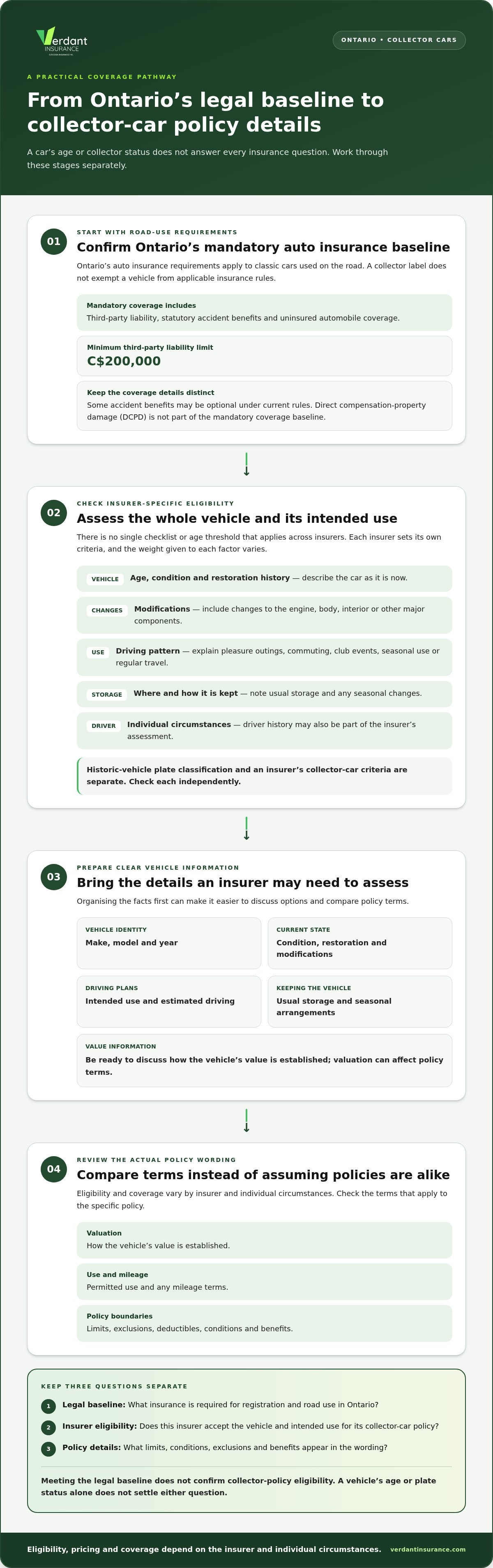
Ontario’s legal insurance requirements set the starting point. Insurers then assess details such as the vehicle’s age, condition, use, storage, modifications and the driver’s history. How the vehicle’s value is established can also affect the policy terms. Preparing these details before discussing coverage can make it easier to compare options.
This guide explains Ontario’s legal baseline and how it differs from insurer-specific collector-car eligibility. You’ll also find practical steps for organizing details about your vehicle, driving plans, storage and valuation. Eligibility, pricing and coverage vary by insurer and individual circumstances, so review the terms that apply to your own situation.
Key Takeaways
- Separate Ontario’s legal auto insurance requirements from the eligibility rules insurers set for collector-car policies.
- Collector-car eligibility can depend on the vehicle’s age, condition, modifications, use, storage and other factors. Insurers apply their own criteria.
- Compare policy wording for valuation, permitted use, mileage terms, exclusions, limits and deductibles instead of assuming every classic-car policy works the same way.
- Gather your car’s make, model, year, condition, modifications, intended use and storage details before discussing coverage.
- An Ontario broker can help explain insurer-specific requirements and policy terms. Eligibility and coverage depend on the insurer and your circumstances.
Classic car insurance Ontario requirements: what is legally required?
Ontario’s auto insurance requirements apply to classic cars used on the road, just as they do to other vehicles. Collector-car eligibility is a separate matter decided by each insurer. Calling a vehicle “classic” doesn’t exempt it from applicable insurance rules or guarantee that it qualifies for a collector policy.
Ontario’s mandatory auto insurance coverage includes third-party liability, statutory accident benefits and uninsured automobile coverage. The minimum required third-party liability limit is C$200,000. Statutory accident benefits include mandatory benefits, while some other benefits may be optional under current rules. Direct compensation-property damage (DCPD) is not part of the mandatory coverage baseline. Check your policy documents and current Ontario guidance to understand the coverage and options that apply to your policy.
What Ontario auto insurance rules apply when driving a classic car?
A car’s age, rarity or collector status doesn’t automatically remove applicable insurance requirements when it’s driven on Ontario roads. The legal baseline is separate from any additional conditions an insurer may set for a collector-car policy. Limited or seasonal driving doesn’t, by itself, change the legal requirements. The policy’s terms, limits and exclusions also matter, and a general explanation can’t determine how wording applies to a particular vehicle or situation.
Keep three questions separate as you arrange coverage:
- Legal baseline: What insurance is required for the vehicle’s registration and road use in Ontario?
- Insurer eligibility: Does the insurer accept this vehicle and its intended use under a collector-car policy?
- Policy details: What limits, conditions, exclusions and benefits are set out in the actual wording?
Answering one question doesn’t settle the others. A car may meet the legal baseline but not fit a particular insurer’s collector-car criteria. Eligibility and coverage vary by insurer and individual circumstances.
Is a classic car definition the same for insurance and plates?
No. An insurer’s definition helps determine eligibility for its product, while a vehicle-plate classification serves a separate licensing purpose. There isn’t one age threshold that applies to every insurer’s definition of a classic car. A vehicle’s age alone may not settle whether it qualifies for a collector policy, and plate status alone doesn’t confirm insurance eligibility.
Before relying on a plate category, check current historic-vehicle plate rules with Ontario’s vehicle licensing authority, such as ServiceOntario or the Ministry of Transportation. Plate requirements and an insurer’s underwriting criteria are separate, so review each independently. If a vehicle has been modified, describe its current condition accurately rather than assuming that its age or plate classification determines its insurance eligibility.
Separating these requirements makes the next steps clearer: confirm the legal and licensing rules, then assess the insurer’s criteria and policy wording. That distinction is central to understanding classic car insurance Ontario requirements without treating a collector designation as a legal exemption.
How classic-car insurance eligibility works in Ontario
There’s no single checklist that determines whether a car qualifies for collector coverage across Ontario. Each insurer sets its own eligibility criteria, and the decision can depend on the vehicle, how you plan to use it and your individual circumstances. Don’t infer eligibility for one policy from another insurer’s rules or from a vehicle’s plate classification.
Think of eligibility as a picture made up of several details, not just the car’s age. An insurer may consider the factors below, but the weight given to each one varies.
Which vehicle details may affect collector-policy eligibility?
Age can be one consideration, but it isn’t a universal pass or cutoff. An insurer may also look at the car’s condition, restoration history and modifications. For example, a vehicle restored close to its original configuration may be assessed differently from one with major performance changes. Neither is automatically accepted or declined; the insurer applies its own criteria to the vehicle and application.
Describe the car as it is now. Include changes to the engine, body, interior or other major components, along with its general condition. Don’t assume that “classic,” “antique” or a particular plate status guarantees eligibility. Those labels can serve different purposes, and an insurer’s criteria may not match a licensing classification.
How can driving habits and storage affect eligibility?
Be specific about how you expect to drive the car. Pleasure outings, commuting, club events and seasonal use are different patterns an insurer may assess when deciding whether a vehicle fits a collector policy. If you plan to use it for errands or regular travel, describe that rather than assuming it counts as occasional use.
Mileage terms and storage conditions depend on the insurer and policy. Don’t apply a distance limit or garage rule you’ve seen elsewhere to your own situation. Explain your estimated driving, where the vehicle will usually be kept and whether that arrangement changes seasonally. The insurer’s terms determine what use and storage conditions apply.
Before discussing options, write down the vehicle’s year, condition and modifications, how often and for what purpose you expect to drive it, and where it will be stored. Include details about other vehicles in the household if asked. Accurate information helps a broker explain insurer-specific criteria without treating one program’s rules as a province-wide standard.
For general information about Ontario auto insurance and consumer rights, consult the Financial Services Regulatory Authority of Ontario (FSRA) Auto Insurance resource. It provides broader insurance context, while the insurer’s eligibility decision and policy wording govern a specific collector-car arrangement. An Ontario broker can help organize your details and explain differences between partner insurers’ requirements.
Compare classic-car policy terms without assuming one standard
A collector policy’s headline features don’t tell the whole story. Compare the written terms that shape how the vehicle is valued, when it can be driven and what conditions apply. Details differ between insurers, so use the same questions for each option rather than assuming a familiar term means identical protection.
What does agreed value mean for a collector vehicle?
Agreed value generally refers to a value set with the insurer when the policy is arranged. It’s a term to understand, not a universal settlement guarantee or a feature to assume every policy includes. Read how the policy defines the value and what it says about a covered total loss. The actual outcome remains subject to the policy wording, limits, exclusions and claim conditions.
Use this table to organize your comparison. Fill in the details from each insurer’s documents or quote information, and note any wording you want clarified.
| Policy term | What to compare |
|---|---|
| Valuation basis | How the vehicle’s value is determined, and what applies in a covered total loss. |
| Permitted use | Whether commuting, leisure drives, events or seasonal use are addressed, and on what conditions. |
| Mileage terms | Whether a stated distance limit applies and how the policy describes it. |
| Exclusions | Situations, uses or types of loss the wording excludes. |
| Limits | The maximum amounts and any sub-limits that apply to relevant coverage. |
| Deductibles | The amount you may be responsible for under applicable claim conditions. |
Which usage, mileage, and exclusion terms deserve attention?
Read use conditions against your actual plans. A policy may describe commuting, leisure driving, club events or seasonal use differently. Check whether the mileage terms fit your expected driving, and note any restrictions tied to how or where the car is used. Don’t assume an event or occasional trip is automatically permitted; the policy wording governs.
Then review exclusions, limits, deductibles, territorial limits and claim conditions. These terms can affect different situations, and their meaning depends on the specific policy. If wording is unclear, ask for an explanation before relying on an interpretation. Coverage, pricing and eligibility vary by insurer and individual circumstances.
When comparing auto insurance, consider price alongside the policy terms. For a classic vehicle, don’t compare on price or a headline benefit alone. Use the table to identify differences, then review the full terms to see whether the valuation and use conditions fit your needs. Careful comparison is a practical part of understanding classic car insurance Ontario requirements.
Prepare your classic car insurance details before requesting coverage
Preparation can make a conversation about classic car insurance Ontario requirements more useful. Organize the vehicle facts, describe how you plan to use it and gather records you already have. Then compare the insurer’s written terms. You don’t need to guess what an insurer will require. Clear, consistent details help a broker understand your situation and explain insurer-specific questions.
- Identify the vehicle. Record its make, model, year and any identifying details requested for a quote.
- Describe its condition. Note its current condition, restoration work and modifications, including changes from its original configuration.
- Explain intended use. Estimate how often and for what purposes you expect to drive it, including seasonal use, events or commuting.
- Describe storage. Note where the vehicle is usually kept and whether that arrangement changes during the year.
- Gather available records. Set aside relevant ownership information, photographs, maintenance records and valuation material.
What vehicle and ownership information should you organize?
Start with information you can provide accurately: the vehicle’s details, ownership information, condition, restoration history and modifications. Existing photographs or maintenance records can help describe its current state. If you have valuation information, keep it handy for discussion. These are useful preparation aids, not documents every insurer necessarily requires. Requirements vary, so don’t treat this list as a universal application checklist.
How should you describe intended use and compare responses?
Be candid about expected driving, including leisure trips, events, commuting and seasonal use. Record your estimated mileage and storage arrangements, too. Then compare each response against the insurer’s eligibility conditions and policy wording, including limits, exclusions and claim conditions. A clear explanation is more useful than assuming a particular type of trip or mileage will be permitted.
Keep a simple record of what you’re told and where the information appears in the quote or policy documents. If an explanation and written wording seem different, ask for clarification before relying on your interpretation. An Ontario insurance broker can help organize your details and explain questions raised by partner insurers, but eligibility and coverage depend on insurer terms and individual circumstances.
As you compare options, focus on how clearly the broker explains differences between insurer requirements and written policy terms. Look for specific answers about valuation, permitted use, mileage, exclusions and claim conditions rather than relying on a general label or headline benefit. No preparation list can guarantee eligibility or a particular coverage outcome.
Arrange classic car insurance in Ontario with informed broker support
Arranging coverage is easier when you treat three questions separately: what Ontario law requires, whether an insurer considers your vehicle eligible for a collector policy, and what the policy wording actually provides. A broker can help you work through those questions and understand which details need closer attention. The requirements for a particular policy depend on the insurer’s terms and your individual circumstances.
What can an Ontario insurance broker help clarify?
Verdant Insurance is an Ontario property and casualty brokerage based in Markham. Through partner insurers, Verdant provides auto insurance. A broker can help organize your vehicle and usage information, relay insurer-specific questions and explain how proposed terms relate to the details you’ve provided. Customers can obtain quotes and manage policies online, with dedicated support. The insurer makes decisions about eligibility and coverage, so broker guidance isn’t a promise of acceptance or a particular outcome.
As you discuss auto insurance options, keep your notes focused on practical questions:
- Does the insurer’s eligibility decision reflect the vehicle’s condition and modifications you described?
- Are the driving activities and estimated use you expect to have addressed in the terms?
- How is the vehicle’s value described, and what wording applies to a covered total loss?
- Which limits, exclusions, deductibles and claim conditions should you understand before proceeding?
Clear answers can help you identify what to review in the documents. If something is explained verbally, compare that explanation with the written policy rather than relying on memory or a general description.
What should you review before choosing a policy?
Before making a decision, check that the details you supplied are accurate and that the written terms match your intended use. Review eligibility conditions, valuation basis, permitted activities, mileage terms, exclusions, limits and deductibles. Read the applicable wording carefully, including any conditions relevant to storage or seasonal use. Coverage, pricing and eligibility vary by insurer and individual circumstances, and policy wording, limits and exclusions apply.
A broker conversation is most useful when you arrive with specific questions and your information organized. If a term is unclear, ask for a plain-language explanation and where it appears in the policy documents. That gives you a clearer basis for comparing insurer terms without assuming similar labels mean identical coverage.
Keep your coverage aligned as your plans evolve
Your relationship with a classic car can change over time. You might complete restoration work, adjust how often you drive or decide to attend more events. Those changes can affect the information an insurer has on file or the terms that suit your needs. Keep a note of significant changes and revisit the applicable policy wording with your broker rather than relying on assumptions based on last year’s arrangement.
Use classic car insurance Ontario requirements as a starting point for informed conversations, not as a substitute for reviewing the terms that apply to your vehicle. A careful review can help you make decisions with greater confidence as your car and driving plans evolve.
Frequently Asked Questions
Is classic car insurance mandatory in Ontario?
Ontario requires applicable auto insurance for vehicles used on the road, but you don’t have to buy a policy specifically labelled “classic car insurance.” The classic car insurance Ontario requirements for legal road use are distinct from an insurer’s eligibility rules for collector coverage. If the vehicle is stored and not being driven, don’t assume the same circumstances apply. Check current Ontario requirements and your policy situation before making changes.
How old does a car have to be to qualify for classic car insurance in Ontario?
There’s no single age threshold used by every insurer for collector-car eligibility. One insurer may assess a vehicle’s age alongside its condition and collectibility, while another may apply different criteria. A 25-year-old car, for example, isn’t automatically eligible just because it meets an age rule you’ve seen elsewhere. Share the model year and vehicle details with a broker so insurer-specific criteria can be considered.
Can I use a classic car as my daily driver in Ontario?
Possibly, but regular commuting may not fit the permitted-use conditions of a collector policy. If you plan to drive the car to work, use it for errands or rely on it as your main vehicle, describe that clearly before arranging coverage. Don’t base your plans on another owner’s policy or assume occasional-use terms allow daily driving. The insurer’s eligibility decision and written policy conditions determine what use is permitted.
Are historic vehicle plates the same as classic car insurance?
No. Historic-vehicle plates are a licensing classification, while classic-car insurance is an insurer’s policy category. Ontario’s historic-vehicle plate rules have their own eligibility requirements, but meeting them doesn’t establish eligibility for collector insurance. If you’re considering historic plates, verify current requirements with Ontario’s vehicle licensing authority. Review insurance separately, since insurers set their own eligibility conditions and may assess the car differently.
Do I need an appraisal to insure a classic car?
Not necessarily. Whether an appraisal is requested depends on the insurer, the vehicle and how its value is being established. An appraisal may help document a car’s condition or support a discussion about valuation, especially after restoration, but don’t assume every insurer requires one. Ask how the insurer will use valuation information and what evidence, if any, its process calls for.
Does classic car insurance always cost less than regular auto insurance?
No. A collector policy isn’t automatically less expensive than standard auto insurance. The price depends on insurer terms and individual circumstances, which may include the vehicle and its intended use. Compare the premium alongside valuation, permitted driving, limits, deductibles and exclusions. A lower price alone doesn’t show whether the terms suit your needs. Review the policy documents and compare the coverage details that matter for your car.
Can modifications affect classic car insurance eligibility in Ontario?
Yes, modifications may affect how an insurer assesses eligibility or policy terms, but the impact depends on the changes and the insurer. Disclose an engine change, body alteration or performance upgrade rather than describing the vehicle as original. Keep a clear record of what was changed and when, if known. The insurer can then assess the car using accurate information; eligibility and coverage remain subject to its terms and policy wording.


