

Ontario law doesn’t require collision coverage to drive. Collision coverage may be an optional part of an auto insurance policy. Drivers must still carry the auto insurance coverage required by law.
It’s easy to confuse insurance required to drive legally with coverage that can help repair your own vehicle after a crash. Here’s what Ontario requires, what collision coverage may do, and what to consider when deciding whether it suits your vehicle and circumstances.
You’ll also learn how collision coverage differs from other parts of an auto policy, what it may mean if you’re at fault or involved in a hit-and-run, and why your vehicle’s value and ability to manage repair costs matter. Understanding the distinction can help you choose the protection you need without mistaking optional coverage for a legal requirement.
Key Takeaways
- Collision coverage isn’t required by Ontario law, but it may help with damage to your own vehicle after a collision.
- Learn which auto insurance coverages Ontario drivers must carry and why driving without valid insurance can have serious consequences.
- Compare collision coverage with Direct Compensation-Property Damage and consider how fault, deductibles, and your vehicle’s value affect a claim.
- Find out where to review Ontario’s insurance requirements and what to consider before choosing coverage for a financed or leased vehicle.
Why should I consider having collision coverage in Ontario?
Is collision insurance mandatory in Ontario? No. Provincial law doesn’t require it, but this optional coverage may help pay for damage to your own vehicle after a collision, subject to your deductible and policy terms. Whether it makes sense depends on your vehicle’s value and the repair costs you could manage yourself.
Collision Coverage Requirements
Collision coverage isn’t legally required, although a lender or leasing company may require it under your financing or lease agreement. That contractual condition is separate from Ontario’s insurance rules. Review your agreement before changing your policy, since removing coverage could conflict with its terms.
If you own your vehicle outright, weigh the premium against the risk of paying for repairs or replacement yourself. The right decision for a car with a low market value may differ from the choice for a newer vehicle.
Collision and Comprehensive Coverage
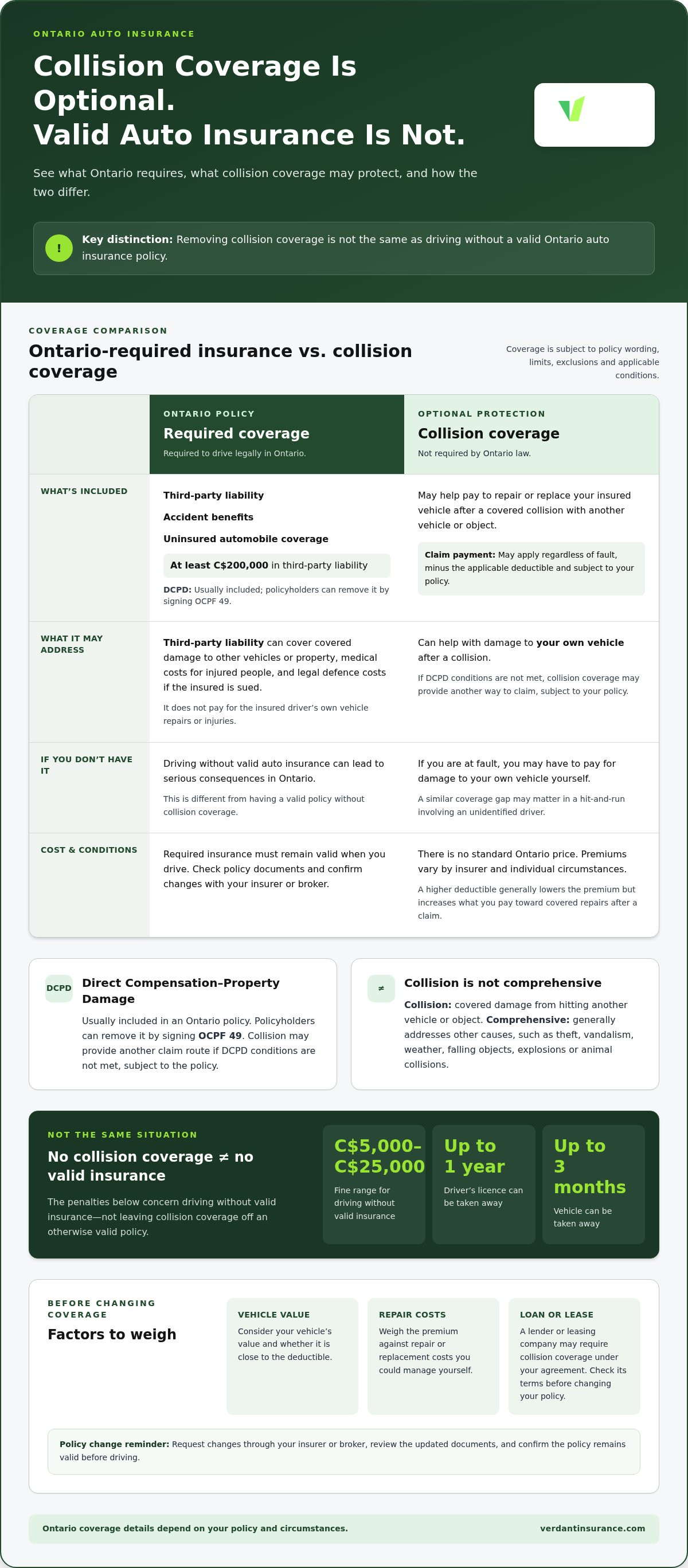
Collision coverage applies to covered damage when your vehicle collides with another vehicle or object. Comprehensive coverage generally applies to other causes, including theft, vandalism, weather, falling objects, explosions, or animal collisions.
For example, damage from hitting another car differs from damage caused by a falling tree while your car is parked. The policy wording, limits, exclusions, and deductible determine how a claim is handled.
Collision coverage may pay to repair or replace your insured vehicle after a collision, regardless of fault, minus the applicable deductible. If Direct Compensation-Property Damage (DCPD) conditions aren’t met, collision coverage may provide another way to claim, subject to your policy.
Without collision coverage, an at-fault driver generally has to pay for damage to their own vehicle. The same gap can matter in a hit-and-run involving an unidentified driver. Liability coverage may respond to covered claims involving other people or their property, but it doesn’t pay to repair the insured driver’s own car.
There’s no standard price for collision coverage in Ontario. Premiums vary by insurer and individual circumstances, including location, vehicle type, driving record, and accident or theft risk. A higher deductible generally lowers the premium but increases what you pay toward covered repairs after a claim.
To add, change, or remove collision coverage, request a policy change through your insurer or broker and review the updated documents. Check your financing or lease terms first. If your vehicle’s value is close to the deductible, compare the potential claim payment with the premium and repair costs you’d pay yourself.
Mandatory auto insurance in Ontario
Ontario requires drivers to have valid auto insurance to drive legally. That requirement is separate from collision coverage: you can have legally required insurance without buying optional protection for your own vehicle. Not having collision coverage does not, by itself, mean you’re driving uninsured.
Driving without valid insurance can lead to serious consequences in Ontario. An uninsured driver can face fines ranging from C$5,000 to C$25,000. Their driver’s licence can also be taken away for up to a year, and their vehicle can be taken away for up to three months.
Those penalties concern driving without a valid policy, not leaving collision coverage off an otherwise valid policy. For example, a driver with required insurance but no collision coverage isn’t in the same situation as a driver with no valid auto insurance. The first may have to pay for their own vehicle damage after an at-fault crash; the second can face the penalties described above.
Keep this distinction in mind when reviewing your policy or considering a change:
- Valid auto insurance: Required for Ontario drivers to drive legally.
- Collision coverage: Optional protection for damage to the insured vehicle after a collision.
- No valid insurance: Can lead to fines, loss of a driver’s licence, and the vehicle being taken away.
Don’t mistake removing collision coverage for cancelling your entire insurance policy. The legal issue arises when you drive without valid insurance; the coverage decision is about how much protection your policy provides for your own car. Keeping the policy active and understanding which protections remain can help you avoid confusing the two.
For example, imagine your vehicle has a valid Ontario policy but no collision coverage. If you cause a crash, you may be responsible for your own vehicle’s repair costs. That doesn’t automatically mean you’re uninsured. If you drive the same vehicle after its insurance is no longer valid, separate legal consequences can apply, including the fines and possible licence or vehicle penalties described above.
Before driving, make sure the policy is valid for both the vehicle and the driver. When changing coverage, distinguish between removing optional collision protection and ending insurance altogether. Ontario’s consequences for driving uninsured can affect your licence and access to your vehicle, so confirm the change’s effective date with your insurer before relying on it.
Ontario's minimum mandatory auto insurance
Ontario’s required auto insurance includes third-party liability, accident benefits, and uninsured automobile coverage. Direct Compensation-Property Damage (DCPD) is usually included, but policyholders can remove it by signing OCPF 49. These coverages address different losses, so knowing their roles helps you understand what a basic policy may respond to after an accident.
- Third-party liability: Ontario drivers must carry at least C$200,000. It can cover covered damage to other vehicles or property, medical costs for injured people, and legal defence costs if the insured is sued. It doesn’t pay for the insured driver’s own vehicle repairs or injuries.
- Accident benefits: This coverage can provide benefits after an accident, subject to the policy and applicable rules. For new policies purchased on or after July 1, 2026, medical, rehabilitation, and attendant care benefits are mandatory. Other accident benefit coverages are optional for those new policies.
- Uninsured automobile coverage: This mandatory coverage applies to certain claims involving an uninsured driver or a hit-and-run. The policy wording sets out applicable coverage, limits, and exclusions.
- DCPD: This can cover damage to the insured vehicle, its contents, or loss of use when an at-fault driver in another insured vehicle is involved in an Ontario accident.
DCPD applies only when its conditions are met. The accident must happen in Ontario, at least one other involved vehicle must have motor vehicle liability insurance, and that vehicle’s insurer must be licensed in Ontario or have filed with FSRA to provide DCPD. For example, a crash with another insured vehicle in Ontario may qualify, while an accident outside the province doesn’t meet the location condition.
Since January 1, 2024, Ontario policyholders have been able to opt out of DCPD by signing OCPF 49. That choice can leave the policyholder responsible for vehicle damage that DCPD otherwise might cover, even when another driver is at fault. A driver who removes DCPD should understand that collision coverage is a separate optional coverage, not an automatic replacement for every DCPD benefit.
Think of a basic policy as protection against specific risks, not a promise to repair your vehicle after every accident. Liability addresses claims against the insured; accident benefits address eligible injuries; and uninsured automobile coverage addresses specified uninsured-driver situations. DCPD and collision coverage both concern vehicle damage, but they apply under different conditions.
When reviewing a policy, compare each coverage name with the loss it addresses. Check whether DCPD remains on the policy, whether OCPF 49 was signed, and which accident benefits apply based on the policy’s purchase date. A broker can help explain how these parts relate to your coverage and deductible. The policy wording, limits, and exclusions determine how claims are handled.
Where to find Ontario insurance requirements
Start with your Ontario auto insurance policy, not a summary or a general description of coverage. A policy summary can help identify the main coverages, but it isn’t a substitute for the policy, the Insurance Act, or Ontario Regulation 34/10, known as the SABS. Those documents set out the details that matter when a claim turns on a specific condition, limit, or exclusion.
Use the policy documents to answer different questions. The coverage summary gives an overview of selected protections. The full policy wording explains how coverage applies and identifies exclusions and limits. Endorsements record changes to the standard policy, including an election to remove Direct Compensation-Property Damage coverage using OCPF 49.
- For minimum requirements: Review the Ontario auto insurance requirements and compare them with the coverages shown on your policy.
- For claim details: Read the wording for the coverage connected to the loss, such as collision or comprehensive coverage.
- For a policy change: Check the endorsements and effective dates to see what was added, changed, or removed.
For example, if you’re reviewing damage caused by vandalism, look at comprehensive coverage rather than assuming collision applies. Collision concerns your insured vehicle striking or being struck by another object or vehicle; comprehensive addresses other causes, including vandalism, theft, weather, falling objects, explosions, and animal collisions. Your policy wording determines how each claim is assessed.
Ontario’s rules can also change over time, so the policy date matters. For new auto insurance policies purchased on or after July 1, 2026, medical, rehabilitation, and attendant care benefits are mandatory, while other accident benefit coverages are optional. A driver comparing a policy issued before that date with a new policy should not assume the accident-benefit options match.
Direct Compensation-Property Damage is another example where the relevant paperwork matters. The relevant policy documents can clarify whether DCPD coverage remains in force. The endorsement records that choice, so reviewing it can clarify whether DCPD remains in force. DCPD and collision coverage aren’t interchangeable: their claim conditions differ, and collision may be relevant when DCPD conditions aren’t met.
For a focused review, match the question to the relevant document: check Ontario’s rules for legal requirements, your full policy wording for claim details, and your endorsements for optional changes. If your vehicle is financed or leased, review that agreement too. It may set insurance conditions beyond Ontario’s legal requirements, so check it before changing optional coverage.
Can Ontario drivers finance or lease a car without collision coverage?
Ontario law doesn’t require collision coverage, but a financing or lease agreement can set separate insurance conditions. The legal and contractual answers may differ: your vehicle can meet Ontario’s insurance requirements while your lender or lessor still requires collision coverage under the agreement.
Before signing, read the insurance terms in your finance or lease documents. Look for requirements about vehicle damage, keeping coverage active, and notifying the lender or lessor about policy changes. If the agreement requires collision coverage, removing it while the contract remains in effect could put you in breach of its terms.
The question isn’t only whether you can get a policy without collision coverage. Consider whether doing so fits your contract and your ability to manage a large repair or replacement expense. Newer vehicles can be costly to repair, and without optional collision coverage, you may be responsible for damage to your own car.
Consider these points together before choosing coverage:
- Read the contract: Identify any collision or physical-damage insurance requirement.
- Review the policy: Confirm which coverages are included and the applicable deductible.
- Consider your finances: Decide whether you could pay for repairs or replacement if your vehicle is damaged.
- Check before changing coverage: Make sure a policy change won’t conflict with the financing or lease agreement.
Ontario’s Direct Compensation-Property Damage coverage can address certain vehicle-damage claims when another insured vehicle is involved in an accident in Ontario and the required conditions are met. It doesn’t make collision coverage unnecessary in every situation. If the DCPD conditions aren’t met, for example, optional collision coverage may provide another way to claim, subject to the policy terms and deductible.
Leasing and financing also differ in who owns the vehicle during the agreement. With a lease, you return or otherwise deal with the vehicle according to the lease terms. With financing, you repay the cost of a vehicle purchase. In either case, a damage-related insurance condition may apply, so review the agreement rather than assuming Ontario’s legal minimum meets the lender’s requirements.
If you own the vehicle outright, there’s no lender agreement to consider, but repair costs still matter. Compare the vehicle’s value with your deductible and the expenses you could manage yourself. For a financed or leased car, first establish what the contract requires, then weigh any remaining coverage choices against the risk of paying for damage yourself.
An Ontario lender or lessor may require collision coverage under the financing or lease agreement. Removing it while the agreement remains in effect could breach the contract.
Verdant Insurance: Auto Insurance
Verdant Insurance is an Ontario brokerage that can help you compare auto insurance options for your vehicle. If you’re weighing collision coverage, a broker can explain how coverage choices and deductibles relate to your needs, alongside any financing or lease requirements.
Coverage, pricing, and eligibility vary by insurer and individual circumstances. Your policy wording, limits, and exclusions determine how coverage responds to a claim, so review those details before making a change. This can help you distinguish Ontario’s legal requirements from optional protection and contract terms.
For help reviewing your Ontario auto insurance options, request a free quote from Verdant Insurance.
Make your next coverage review count
Knowing whether collision insurance is mandatory in Ontario answers the legal question, but your coverage decision may change over time. Revisit it when your vehicle’s value changes, your financing agreement ends, or your ability to manage repair expenses shifts. These are useful moments to review your policy rather than simply renewing without a second look.
Verdant Insurance offers Auto Insurance, Homeowner Insurance, and Business Insurance. For Ontario drivers, an insurance broker can help you compare auto coverage options in light of your vehicle and circumstances. Coverage, pricing, and eligibility depend on insurer rules and your specific situation.
Use your next policy review to make a deliberate choice that fits your situation, rather than relying on assumptions.
A clear next step can make your coverage decisions easier to manage.
Frequently Asked Questions
Do I Need Collision Insurance Coverage for my Vehicle?
Collision coverage may be useful if paying for your vehicle’s repairs or replacement yourself would strain your finances. Consider its current value, your deductible, and how much you could manage out of pocket after a crash. If you own the car outright, weigh those costs against the premium. If you finance or lease it, review the agreement because it may require collision coverage.
If I am not at-fault for an accident and I don’t have collision coverage, am I still covered?
You may have vehicle-damage coverage through Direct Compensation-Property Damage (DCPD), even without collision coverage. DCPD applies when an accident happens in Ontario, another involved vehicle is insured, and its insurer meets Ontario’s requirements for this coverage. If those conditions aren’t met and you don’t have collision coverage, your policy may not cover damage to your vehicle. The applicable policy terms govern the claim.
If I don’t have collision coverage am I still covered if someone hits me?
If another insured vehicle hits yours in Ontario, DCPD may cover damage to your vehicle, its contents, or loss of use when the required conditions are met. For example, the other vehicle’s insurer must be licensed in Ontario or have filed with FSRA to provide DCPD. A hit-and-run involving an unidentified driver is different: without collision coverage, damage to your vehicle wouldn’t be covered by collision protection.
What is the minimum car insurance coverage required?
Ontario’s minimum third-party liability limit is C$200,000. A basic policy generally includes several forms of coverage beyond liability, but check your policy documents to confirm what applies. DCPD is generally part of the policy, but policyholders can opt out by signing OCPF 49. These protections address different situations; the minimum doesn’t mean every kind of vehicle damage is covered. Check your policy documents to see which coverages and limits apply to your vehicle.
Is collision insurance legally required in Ontario?
No. Collision insurance isn’t legally required in Ontario, so not having it doesn’t mean you’re uninsured. However, a finance or lease agreement may require it as a contractual condition. If you own your vehicle outright, you can decide whether to take on repair costs yourself; if you’re still making payments, review the agreement’s insurance terms before changing coverage.
What auto insurance coverage is mandatory in Ontario?
Ontario requires third-party liability, accident benefits, and uninsured automobile coverage. Liability protects against covered claims involving others; it doesn’t pay for repairs to your own vehicle. DCPD may cover certain vehicle-damage claims, but policyholders can opt out using OCPF 49. For new policies purchased on or after July 1, 2026, medical, rehabilitation, and attendant care benefits are mandatory, while other accident benefit coverages are optional.


