

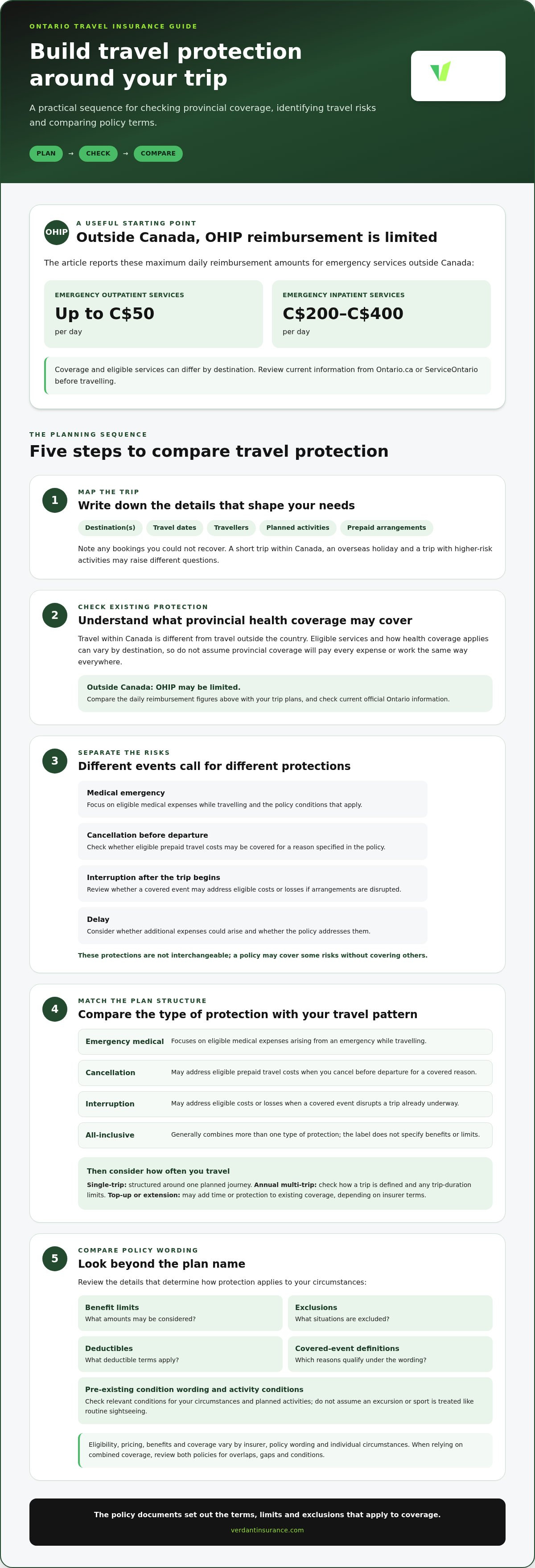
What if your Ontario health coverage paid only a fraction of an emergency medical bill while you were travelling? Outside Canada, OHIP reimburses up to C$50 per day for emergency outpatient services and C$200 to C$400 per day for emergency inpatient services. That gap is one reason travel insurance for Canadians is worth reviewing before you leave.
One policy does not necessarily cover every travel risk. Emergency medical coverage and trip cancellation or interruption coverage serve different purposes. The options that fit your trip depend on your destination, dates, planned activities and personal circumstances, as well as the policy’s terms.
This guide explains the main types of travel insurance, what to compare and how to prepare before choosing coverage in Ontario. Pay particular attention to exclusions, benefit limits and pre-existing condition wording. A clear review of those details can help you decide what questions to ask and which policy terms matter for your trip.
Key Takeaways
- Match travel insurance for Canadians to your destination, trip length, planned activities and personal circumstances.
- Understand the differences between emergency medical, trip cancellation, trip interruption and all-inclusive plans, including single-trip and multi-trip options.
- Compare benefit limits, exclusions, deductibles and covered-event definitions in the policy wording before choosing.
- Use a five-step checklist to map your trip, review existing protection, identify risks, compare policy terms and keep your documents accessible.
- Explore travel insurance through Verdant, an Ontario brokerage with online quote access and policy management.
Travel insurance for Canadians from Ontario: what it can help protect
For Ontario residents, travel insurance can help with eligible losses arising from specified travel risks, subject to the policy’s wording, limits and exclusions. The right protection depends on where you’re going, how long you’ll be away, what you plan to do and the circumstances of each traveller. A short trip to another province may raise different questions from an overseas holiday or an itinerary that includes higher-risk activities.
Travel insurance, in brief: Travel insurance provides policy protections for specified risks during a trip. It may address eligible medical expenses or travel-related losses, but a claim is assessed under the terms and limits of the policy.
What should Ontario travellers consider before leaving the province?
Check what your provincial health plan covers at your destination. Travel outside Ontario but within Canada is different from travel outside the country: eligible services and how health coverage applies can vary by destination. Don’t assume a provincial plan will pay every expense or work the same way everywhere.
Outside Canada, Ontario Health Insurance Plan (OHIP) coverage may be limited. Before leaving, review current information from official Ontario government sources, such as Ontario.ca or ServiceOntario. Then consider whether a travel policy may address eligible expenses beyond provincial coverage. This review is especially relevant for an extended trip, multiple destinations or activities that could affect policy eligibility or coverage. In some cases, travellers heading abroad may also consider destination-specific inbound policies, such as E-COVER when visiting Georgia.
What kinds of unexpected travel events may matter?
Consider each risk separately. An emergency medical event may require treatment away from home. A cancellation before departure or an interruption after the trip begins could affect prepaid travel arrangements. A delay may create additional expenses. These protections are not interchangeable, and a policy may cover some risks without covering others.
For example, if you have non-refundable bookings, review the cancellation and interruption terms. If your main concern is an unexpected medical need, focus on emergency medical benefits and their conditions. Activities matter too: don’t assume a policy treats a planned excursion, sport or other activity the same way as routine sightseeing. The Travel insurance explained overview provides general background, but the policy documents set out the terms that apply to your coverage.
Travel insurance can help with eligible expenses arising from specified travel risks, but only as defined by the policy’s terms, limits and exclusions.
Before comparing plans, list your destinations and travel dates, the people travelling, planned activities and any prepaid arrangements you could not recover. Use those details to identify the benefits and exclusions that matter to your trip. Insurer eligibility, pricing and coverage vary with individual circumstances, so read the policy documents and check current official OHIP information for your destination.
Travel insurance plan types explained for Canadian travellers
Plan names can help you sort options, but the details matter more than the label. For travel insurance for Canadians, first separate protection for medical emergencies from protection for travel costs. Then consider how often you travel and how long each trip lasts. Actual benefits, eligibility, limits and exclusions depend on the insurer and policy wording.
- Emergency medical: Focuses on eligible medical expenses arising from an emergency while travelling. The policy defines what qualifies and which expenses may be considered.
- Trip cancellation: May address eligible prepaid travel costs if you cancel before departure for a reason covered by the policy.
- Trip interruption: May address eligible costs or losses if a covered event disrupts a trip after it has begun.
- All-inclusive: Generally combines more than one type of travel protection. The label alone does not tell you which benefits, limits or conditions apply.
In short: Emergency medical protection focuses on eligible health-related expenses during travel. Cancellation and interruption protection focuses on specified costs tied to travel arrangements.
How does emergency medical travel insurance differ from trip protection?
Emergency medical coverage is intended for eligible expenses related to a medical emergency away from home. Check the policy wording rather than assuming a particular service or expense is included. Cancellation and interruption coverage address different situations: cancelling planned travel before departure or having arrangements disrupted once the trip is underway. Covered reasons, eligible expenses and reimbursement limits are specific to the insurer and policy.
For Canadian consumer information about travel health insurance, the Travel Health Insurance Association offers resources. Use general guidance as background, then rely on the policy documents for the terms that apply to a particular plan.
When might single-trip, multi-trip, or top-up plans be relevant?
A single-trip plan is structured around one planned journey. If you expect to travel more than once, compare an annual multi-trip plan and check how it defines a trip and any trip-duration limits. A top-up or extension option may add time or protection to existing coverage, depending on insurer terms. Before relying on combined coverage, review both policies for overlaps, gaps and conditions.
Consider your expected travel pattern, not just the number of trips. Someone taking one long journey may need to compare different terms from a frequent traveller making several shorter trips. If you already have coverage through another source, read its documents before considering a top-up. Don’t assume additional protection automatically fills every gap or extends every benefit.
As you compare options, note which risks matter for your itinerary and match them to the policy benefits and conditions. Ontario travellers can explore travel insurance options through Verdant Insurance, an Ontario brokerage, and review available plan information against their trip needs.
How to compare travel insurance policies without overlooking limitations
A useful comparison looks beyond the plan name. For travel insurance for Canadians, start with the risks you want to address, then compare how each policy defines benefits, eligibility and exclusions. Two plans with similar labels may have different limits or conditions, so use the policy documents rather than assumptions to guide your decision.
Comparison point | Purpose and trip fit | Terms and limitations to review
Emergency medical | For travellers prioritizing eligible medical expenses during a trip. | Benefit limits, deductibles, exclusions, eligibility and relevant medical-history wording.
Cancellation | For reviewing potential protection for prepaid arrangements if a trip is cancelled. | Covered-event definitions, eligible expenses, limits and exclusions.
Interruption | For considering costs or losses if a trip is disrupted after departure. | Which events qualify, how benefits are limited and which expenses are eligible.
Combined or all-inclusive | For comparing more than one category of protection in a plan. | Which benefits are included, their individual limits, deductibles and exclusions.
Use the comparison to understand trade-offs, not to look for a universal winner. A traveller focused on medical expenses may weigh terms differently from someone with substantial prepaid, non-refundable arrangements. The right fit depends on individual priorities and circumstances; coverage, pricing and eligibility vary by insurer and policy.
What should you check about medical conditions and exclusions?
Read the policy’s pre-existing condition wording closely, including any stability requirements. Check how the insurer defines relevant terms and whether the policy describes eligibility or medical underwriting requirements. These provisions vary between insurers and plans. A general explanation cannot determine whether a particular condition or claim qualifies, so seek an explanation of the specific policy wording if a term is unclear.
Review exclusions just as carefully. Look for circumstances, activities or expenses the policy says it will not cover, as well as conditions that may limit a benefit. A summary may not include every detail in the full policy wording. Keep the relevant documents so you can refer to the definitions and conditions that applied when you selected coverage.
Which limits and trip details deserve a close read?
Compare benefit limits and deductibles, where applicable, for each benefit. A deductible can affect the amount payable under a covered benefit, while a limit sets a boundary on that benefit. The policy explains how each applies. Don’t assume one overall limit describes every part of the plan.
Check that the policy details match your itinerary, including your destination, travel dates, traveller ages and planned activities. If any of these details change, review whether the policy still fits. A destination or activity exclusion, eligibility condition or covered-event definition may affect how a benefit applies. Comparing the written terms with the trip you’re actually taking can help you spot a mismatch before departure.
A practical checklist for choosing travel insurance in Ontario
Preparation makes it easier to compare travel insurance for Canadians against the trip you’re planning. Gather the essential details, review any protection you already have and decide which risks matter most to you. Then use this five-step checklist to organize your decision.
- Map the trip. Write down each destination, departure and return date, who’s travelling and the planned activities. Include changes between destinations or travel dates that could affect which policy terms apply.
- Review existing coverage. Check travel-related benefits you may already have through another policy, a workplace or a payment card. Read the documents to see who and what they apply to, and note any limits or conditions before deciding whether additional protection is relevant.
- Identify your main risks. Consider unexpected costs that could affect your trip. Note prepaid, non-refundable arrangements and activities that may have specific policy terms. Your priorities may differ from another traveller’s.
- Compare policy terms. Review benefits, limits, deductibles where applicable, exclusions and definitions of covered events. Check eligibility details against the trip and traveller information you gathered.
- Save the documents. Keep the policy wording, benefit schedule and relevant contact or claims information accessible during the trip. Make sure everyone who may need the information knows where to find it.
What information should you gather before comparing plans?
Collect the destination, departure and return dates, traveller details and planned activities. List prepaid travel costs, especially arrangements that may be non-refundable, and gather documents for existing travel-related benefits. If medical history is relevant to a policy’s questions or eligibility terms, have accurate information ready for review. Share only the personal details needed for the comparison or application.
How can you review a policy before making a decision?
Read the policy wording alongside the benefit schedule and eligibility information. These documents work together: a benefit summary alone may not show every exclusion, condition or definition. Note anything you’re unsure about, such as how a limit applies, which reasons qualify for cancellation or what steps the policy requires if you need to make a claim. Don’t rely on assumptions when the wording is unclear.
Once your trip details and priorities are organized, explore travel insurance through Verdant’s online platform. Verdant is an Ontario insurance brokerage, not an insurer; coverage, pricing and eligibility vary by insurer and individual circumstances.
Explore travel insurance for your Ontario trip with Verdant
Once you’ve identified the risks and policy terms that matter to your itinerary, an insurance brokerage can be a practical starting point for exploring options. Verdant Insurance is an Ontario-based brokerage, not an insurer or direct underwriter. Ontario residents can access travel insurance quotes and manage policies through Verdant Insurance's online platform, while the insurer sets the policy terms.
A brokerage helps customers access insurance options through insurers. This can help you review available choices in light of your trip details, rather than assuming every policy with a familiar label works the same way. Travel insurance for Canadians is not one-size-fits-all: pricing, eligibility and available terms depend on the insurer and individual circumstances. The policy wording, benefit limits and exclusions determine how coverage applies.
What happens when you explore options through an insurance brokerage?
You provide trip information to explore options, and the available quote and policy terms reflect the insurer’s offering and your circumstances. Treat a quote as a starting point for review, not a substitute for reading the policy. Check that the information you provide matches your itinerary and traveller details, then compare the benefits, limits and exclusions for the options presented.
When choosing an online insurance broker, keep the roles clear: a brokerage helps you access and review insurance options, while the insurer’s policy wording governs coverage. Verdant Insurance's platform also offers online policy management, so you can manage policy information alongside the quote process. Online access can make these steps more convenient, but it does not change policy terms or guarantee a particular outcome.
What should you have ready for your next step?
Have your destination, departure and return dates, traveller details and planned activities nearby. It may also help to list questions about limits, exclusions, medical-condition wording, covered reasons or claims procedures. You only need to provide the personal information required for the quote or application process.
Before making a decision, read the policy wording and benefit information carefully. Confirm that your trip details are accurate and that you understand the conditions for the benefits you’re considering. If a term is unclear, note the question and seek an explanation of the relevant wording before relying on the policy.
For Ontario residents, Verdant Insurance's online platform provides access to travel insurance quotes and policy management. Coverage, eligibility and pricing vary by insurer and individual circumstances, and all coverage is subject to the policy’s terms, limits and exclusions.
Take the next step with confidence
Choosing travel insurance starts with the trip you’re planning and the risks you want to address. Use your itinerary, existing protection and policy priorities to focus your comparison. Pay particular attention to limits, exclusions and definitions that affect the benefits you’re considering.
For Ontario travellers, exploring available options is a practical way to move from general questions to policies suited to their plans. Take the time to review the terms and make sure you understand what the policy does and does not cover.
Here’s to setting out with a clear understanding of your coverage.
Frequently Asked Questions
Does OHIP cover me when I travel outside Ontario?
OHIP may provide coverage for some care outside Ontario, but the details depend on current provincial rules and your circumstances. Before departure, check official Ontario sources for information about your destination and whether your travel plans affect your coverage status. Keep your health card accessible and save relevant official information. Private travel insurance is separate, so don’t assume one replaces the other.
Do Canadians need travel insurance when travelling within Canada?
Travel insurance is not automatically required for travel within Canada. Consider costs that could arise if plans change or you need care away from home, especially on a trip involving remote destinations or several stops. Check the provincial health-plan information that applies to your destination and review benefits you already have through work or another source. Then decide whether additional coverage fits your plans.
What does travel medical insurance usually cover?
Emergency medical insurance is intended to provide benefits for eligible medical expenses during travel, as defined by the policy. Before choosing, find the insurer’s instructions for getting help and making a claim, and note any contact details or documents you may need while away. Keep that information accessible during your trip. For travel insurance for Canadians, the policy’s terms determine which expenses and situations may qualify.
Can travel insurance cover a pre-existing medical condition?
Some policies may offer coverage related to a pre-existing medical condition, but it depends on the insurer’s terms and your circumstances. Before applying, gather accurate information about the condition and relevant treatment so you can respond carefully to the insurer’s questions. Don’t rely on a general description or assume that a past approval applies to a new policy. The insurer’s decision and policy wording govern eligibility.
Is annual travel insurance better than single-trip insurance?
It depends on your expected travel pattern and the terms offered. Someone planning one long holiday can compare a single-trip option with an annual plan, while a traveller expecting several journeys can check how an annual plan defines eligible trips. Estimate your travel schedule, including destinations and trip lengths, then compare the applicable terms. Neither structure is automatically cheaper or more suitable.
Can I buy travel insurance after booking my trip?
You may be able to purchase travel insurance after booking, but timing can affect the benefits available, particularly for cancellation. Check the policy’s purchase conditions and distinguish the date you booked from the date you buy coverage. A known event or expense may not qualify simply because you purchase a policy afterward. Review the insurer’s terms before relying on cancellation protection for arrangements you’ve already made.
How do I compare travel insurance policies in Ontario?
Use the same trip and traveller details for each option so differences are not caused by inconsistent information. Note which provisions matter most, then list any points that remain unclear in the documents. Ontario travellers should also consider existing benefits and destination-specific circumstances. No single policy suits everyone; pricing and eligibility vary by insurer and individual circumstances.


