

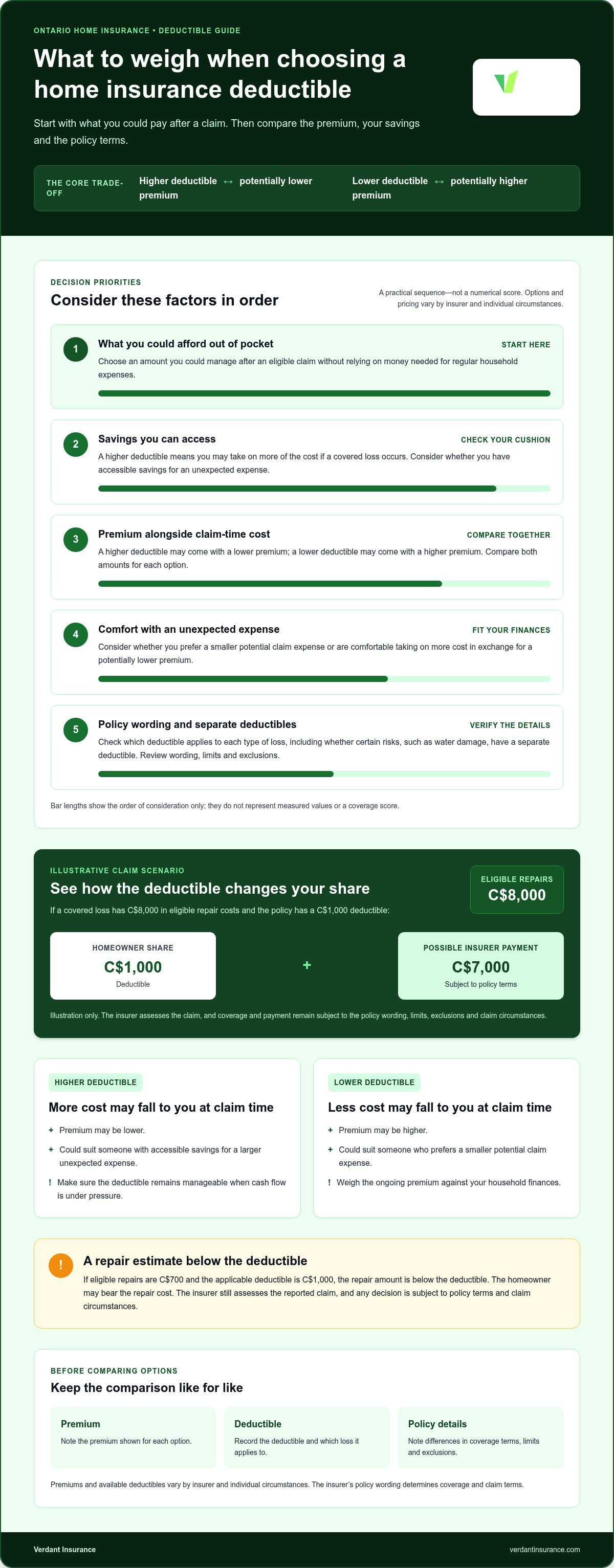
Would a lower home insurance premium still feel like a good deal if you couldn’t comfortably pay the deductible after a claim? When choosing a deductible for home insurance, start with what you could afford out of pocket, then weigh that amount against the premium. A higher deductible generally means a lower premium, but you take on more of the cost if a covered loss occurs.
It’s understandable to focus on the premium when comparing policies, especially when deductible options can be difficult to compare. The right choice depends on your budget, accessible savings and comfort with risk, not simply the lowest price. This guide explains when a deductible applies and how to compare options using illustrative claim scenarios. You’ll also learn what to look for when a policy has different deductibles for certain risks, such as water damage. Review the policy wording, limits and exclusions before deciding so you understand how each option fits your finances.
Key Takeaways
- When choosing a deductible for home insurance, consider what you could pay after a claim without relying on money needed for regular household expenses.
- Compare deductible and premium combinations together. Options and pricing vary by insurer and individual circumstances.
- Use the same illustrative loss to compare how different deductibles could affect your out-of-pocket share of an eligible claim.
- Check whether your policy has separate deductibles for certain types of damage, then review the wording, limits and exclusions.
- An Ontario insurance broker can help you compare options. The insurer’s policy wording determines coverage and claim terms.
What a home insurance deductible means when you make a claim
A home insurance deductible is the amount you’re responsible for paying toward an eligible claim. If the insurer assesses a claim as covered, the deductible is generally subtracted from the eligible claim amount. The insurer may pay the remaining amount, subject to the policy’s terms. The deductible is your share of a claim, not the cost of repairs themselves or the maximum amount your policy can pay.
This basic deductible in insurance concept is useful when comparing options, but the numbers alone don’t establish whether damage is covered. Coverage and payment depend on the policy wording, limits and exclusions, as well as the insurer’s assessment of the claim. A loss at home isn’t automatically covered simply because it causes damage.
Illustrative example: Suppose a covered loss has C$8,000 in eligible repair costs and the policy has a C$1,000 deductible. If the claim is payable and no other policy terms change the calculation, the homeowner would be responsible for C$1,000, and the insurer could pay C$7,000. This example is for illustration only, not a quote or a guarantee of payment.
When does a home insurance deductible apply?
A deductible applies after a claim is reported and assessed under the policy. It’s separate from the repair estimate: repairs describe the cost of addressing the damage, while the deductible is the portion of an eligible claim the homeowner pays. A policy limit is different. It sets a maximum amount available for a covered loss under the applicable terms, rather than the amount you pay first.
The insurer first assesses the loss against the policy wording, exclusions and limits. If the claim is eligible, the deductible is then accounted for when determining the insurer’s payment. The exact handling can depend on the policy and claim circumstances, so don’t assume every repair bill will be treated the same way.
What if the damage costs less than the deductible?
Illustrative example: If eligible repairs are estimated at C$700 and the applicable deductible is C$1,000, the repair amount is below the deductible. In that scenario, the homeowner may bear the repair cost because it doesn’t exceed their share. The insurer still assesses the reported claim, and any coverage or payment decision remains subject to the policy terms and claim circumstances.
Understanding the deductible before a loss helps you assess whether the amount would be manageable alongside other repair costs. When reviewing a quote or renewal documents, identify which deductible applies, what loss it relates to, and whether the policy sets out any separate terms. That’s a practical first step in choosing a deductible for home insurance, because it connects the figure on the policy to a possible out-of-pocket expense.
How a home insurance deductible affects your premium and claim payment
A higher deductible may be paired with a lower premium, while a lower deductible may come with a higher premium. That’s a general relationship, not a guaranteed price rule. Insurers set their own options and pricing, and both premiums and available deductibles vary by insurer and individual circumstances.
Compare the choices as a trade-off between the policy’s cost and the amount you may need to contribute after an eligible claim. The table shows the usual direction of that trade-off, not a promise about a particular quote.
| Choice | Premium direction | Claim-time payment | Budget fit to consider |
|---|---|---|---|
| Higher deductible | May be lower | You may pay more toward an eligible claim | Could suit a budget with accessible savings for a larger unexpected expense |
| Lower deductible | May be higher | You may pay less toward an eligible claim | Could suit someone who prefers a smaller potential claim expense and can manage the premium |
Higher deductible: what changes?
With a higher deductible, you take on a larger share of an eligible claim before the insurer’s payment may begin. Some homeowners consider this option when reviewing premiums, particularly if they have savings for an unexpected repair. But a higher deductible isn’t automatically cheaper or suitable. The premium difference depends on the insurer’s quote, and the amount must still be manageable when cash flow is under pressure.
Lower deductible: what changes?
A lower deductible means a smaller amount to pay toward an eligible claim, while the premium may be higher. This can feel more comfortable if a large unplanned expense would be difficult to absorb. Still, a lower deductible isn’t right for everyone. Weigh the ongoing premium against the potential claim-time payment and your household finances.
For a clearer comparison, note the premium and deductible shown for each option, along with the quote date and policy period. This helps prevent figures from different renewal periods or proposals from being compared as if they were identical. If the options also differ in coverage terms, record those differences so the deductible isn’t the only factor shaping your decision.
Choosing a deductible for home insurance means balancing a possible premium change against an amount you could realistically pay after a loss. Consider how each option fits your budget and the policy terms presented for your circumstances.
High vs. low home insurance deductibles: compare the real trade-offs
A useful comparison looks beyond the premium. Consider how each option affects your available savings, the amount you might pay after an eligible claim, and your comfort with an unexpected expense. The lowest premium may leave you with a larger bill at claim time, while a lower deductible may cost more in premiums. Neither option is automatically the right fit for every Ontario household.
Illustrative claim comparison: Imagine an eligible loss of C$6,000. With a C$500 deductible, your share would be C$500 and the potential remaining eligible amount would be C$5,500. With a C$2,000 deductible, your share would be C$2,000 and the potential remaining eligible amount would be C$4,000. These figures illustrate the deductible calculation only. Actual payment depends on the policy wording, limits, exclusions and insurer’s assessment.
Compare what you might pay over time with what you could comfortably pay at once:
- Premium: A higher deductible may be associated with a lower premium, but the price difference isn’t guaranteed. Compare the actual quoted premiums for the options available to you.
- Savings: Consider whether you could pay the deductible using accessible savings without disrupting regular household expenses or taking on debt.
- Uncertainty: Think about how a larger unexpected expense would affect your budget. Your comfort with that possibility matters as much as the premium.
- Policy terms: Compare the same coverage and relevant terms as closely as possible. If other policy details differ, the deductible alone won’t explain the full difference between options.
When might a higher deductible fit your circumstances?
A higher deductible may be worth considering if you have accessible savings and could manage a larger out-of-pocket payment without compromising essential expenses. Consider whether those funds would remain available after other urgent costs and how a substantial bill could affect your budget. This is a budgeting lens, not a recommendation about coverage or which deductible you should choose.
When might a lower deductible feel more manageable?
A lower deductible may feel more manageable if a large, unexpected payment would strain your household finances. Weigh that preference against the premium shown for the specific policy option, including whether the ongoing cost fits your budget. Don’t assume the same lower deductible is available or priced alike across insurers. Options and pricing vary by insurer and individual circumstances.
Choosing a deductible for home insurance is ultimately a balance between regular costs and your ability to absorb a claim-time expense. Before deciding, consider both the illustrative claim amount and the premium offered for each policy option. A choice that looks appealing on price alone may feel different when you picture paying the deductible from your household savings.
How to choose a home insurance deductible in four practical steps
A practical way to approach choosing a deductible for home insurance is to start with your household budget, then compare actual policy options and read the terms behind each one. These steps can help you assess the trade-off without treating any deductible as a universal recommendation.
Step 1: Set a realistic out-of-pocket limit
Decide what amount you could access on short notice without financial strain. Consider emergency savings, but separate money you could use for an unexpected expense from funds already needed for rent or mortgage payments, utilities, groceries and other regular commitments. Account for near-term costs you know are coming, too. The amount that remains available is a personal budgeting limit, not a standard deductible recommendation.
Step 2: Compare the options and premiums presented
Review each deductible alongside its corresponding premium for the policy option being considered. Don’t estimate a premium difference or assume a higher deductible will produce a particular price change. Options and pricing vary by insurer and individual circumstances. If you’re comparing policies, note whether other terms differ so you’re not judging the deductible in isolation.
Step 3: Test an illustrative claim
Use a hypothetical loss to picture the claim-time impact. For each deductible option, subtract that amount from the same assumed eligible claim total to see how the potential out-of-pocket share changes. Keep the scenario clearly illustrative: it doesn’t predict whether an actual incident would be covered or what an insurer would pay. The point is to check whether each possible payment feels manageable alongside your other financial commitments.
Step 4: Read the policy wording
Review the wording for the deductible that applies and any different terms for particular types of loss. Note relevant exclusions, limits and conditions. These details can affect how a claim is assessed, so don’t rely on the deductible amount alone to understand what a policy may pay. Coverage and payment depend on the policy wording and the insurer’s assessment.
Keep your comparison simple: record the deductible, quoted premium, savings you could use, and any wording you want clarified. This gives you a clearer basis for weighing the options. Verdant Insurance is an Ontario insurance brokerage, and a broker can help compare available deductible and premium combinations alongside policy terms. Ontario homeowners can review home insurance options and consider how each option fits their circumstances.
How an Ontario insurance broker can help you review deductible options
A broker can help you compare the deductible and premium combinations available for your home insurance and consider how each option fits your budget. This makes it easier to assess more than the premium alone. Bring your savings considerations and questions to the discussion. The insurer’s policy wording remains the authority on coverage, exclusions, limits and claim terms.
When choosing a deductible for home insurance, compare the same details across each option rather than focusing on one figure. Ask your Verdant broker to clarify what differs between the options presented, and note any terms you want to read more closely. Pricing, coverage and eligibility vary by insurer and individual circumstances, so a comparison can support an informed decision but can’t guarantee a particular price or claim outcome.
What to review before selecting an option
Gather the policy information and compare each option side by side. This checklist can help keep the discussion focused:
- The deductible that applies to the policy and any different terms described for particular losses.
- The corresponding quoted premium for each option, without assuming a fixed price difference.
- The relevant policy limits, exclusions and conditions.
- The wording that explains how a claim may be assessed and what terms apply.
Comparing like with like matters. If the options differ in more than the deductible, make a note of those differences too. A broker can help explain how the available options compare, but only the insurer’s policy wording and assessment determine coverage and payment for a claim. If a term is unclear, mark it and discuss what it says in the context of the options you’re reviewing.
Get help comparing home insurance options in Ontario
Before speaking with a broker, bring your current policy or the options you’re considering, along with a rough sense of what you could pay from accessible savings without affecting regular household expenses. It can also help to list questions about specific deductibles, policy limits or exclusions. This gives the conversation a practical starting point and keeps the comparison centred on your circumstances.
Verdant Insurance is an Ontario-based insurance brokerage located in Markham. Ontario homeowners can discuss their needs with a Verdant broker and review available home insurance options, including the deductible and premium combinations presented for their circumstances. The insurer’s policy wording guides the final understanding of coverage and claim terms.
Explore Verdant’s home insurance options or speak with a broker about comparing deductibles for your Ontario home.
Make your deductible decision with confidence
Use your personal out-of-pocket limit as a guide when comparing the options available to you. The right fit is one you can understand and plan for, not simply the one with the lowest premium. As your household budget or available savings change, revisit whether your current choice still feels manageable.
For choosing a deductible for home insurance, a clear comparison can help turn a policy detail into a decision that reflects your priorities. Verdant’s online platform, backed by dedicated support, gives Ontario homeowners a way to review their insurance needs and consider their next step.
A thoughtful choice can make your policy easier to understand and help you feel more prepared if you need to use it. Explore Verdant’s home insurance options to compare your next steps with an Ontario broker.
Frequently Asked Questions
Can I change my home insurance deductible after buying a policy?
A deductible change may be available after purchase, but the timing, premium impact and other policy details depend on the insurer and your circumstances. A Verdant broker can help review the options available to you. Don’t assume a request automatically updates your policy. Before relying on a new amount, review the updated policy documents and confirm which terms apply and from what date.
Does a higher home insurance deductible always mean a lower premium?
No. A higher deductible may be associated with a lower premium, but the relationship isn’t guaranteed. Insurers set their own pricing and available options based on the policy and individual circumstances. Compare the actual premium quoted for each deductible rather than estimating the difference or expecting a fixed discount. If other policy details change between options, include them in your comparison.
Do I pay a deductible for every home insurance claim?
Not necessarily. How a deductible applies depends on the type of loss and the wording of your policy, so there isn’t one rule that fits every claim. Check the relevant section of your policy, including any stated limits and exclusions. An Ontario insurance broker can help you review what the document says, while the insurer assesses the specific claim under the applicable policy terms.
Can different types of home damage have different deductibles?
Yes, policy terms may set different deductibles for different types of loss, depending on the insurer and policy. Don’t assume the deductible shown most prominently applies identically to every claim. Look for wording that identifies a deductible for the loss you’re considering, then read the related limits, exclusions and conditions. The insurer’s assessment determines how those terms apply to a particular claim.
Should I choose a deductible based on how often I expect to claim?
Claim frequency can be one consideration, but it can’t predict whether a future loss will be eligible or what the insurer may pay. Choosing a deductible for home insurance also means considering accessible savings, the premium options actually offered and your comfort with a larger unexpected expense. Avoid basing the decision on a prediction that you won’t claim. Instead, consider whether the out-of-pocket amount would remain manageable if a claim arose.
What information should I compare when reviewing home insurance deductible options?
Compare each deductible with its corresponding quoted premium, policy limits, exclusions and applicable wording. Make sure you’re looking at the same policy details across the options, and note any terms that differ. Available choices and pricing vary by insurer and individual circumstances. Ontario homeowners should read the full policy documents, not only a quote summary. If a term is unclear, a Verdant broker can help you review the wording and compare the options.


