

Can a home with knob-and-tube wiring still be insured in Ontario? It may be possible, but availability, eligibility, pricing and policy terms vary by insurer and by the home’s circumstances. If you’re searching for “home insurance for houses with knob and tube wiring Ontario,” keep in mind that wiring is one part of an insurer’s assessment. It does not guarantee acceptance or refusal.
It’s reasonable to wonder whether existing wiring could affect coverage or price, and what to disclose when requesting a quote. Give accurate details about what you know, and clearly identify anything uncertain. If the wiring has been inspected, repaired or upgraded, relevant records can help explain its current condition and work history.
This guide explains why insurers ask about knob-and-tube wiring, what information and documents to gather, and how to compare quotes. It also covers policy wording, limits, exclusions and insurer-specific conditions, so you can assess options without assuming every policy offers the same protection.
Key Takeaways
- Insurance may be available for a home with knob-and-tube wiring, but eligibility and terms vary by insurer and individual circumstances.
- For home insurance for houses with knob and tube wiring Ontario, prepare details about known wiring locations, its condition, inspection findings and documented work.
- Disclose what you know accurately, and identify uncertain details rather than guessing.
- Compare insurer responses beyond price, including eligibility, conditions, limits, exclusions and deductibles.
- An Ontario insurance broker can help organize the home’s information and explore options from partner insurers.
Can you insure an Ontario home with knob-and-tube wiring?
Sometimes. Home insurance for houses with knob and tube wiring Ontario is not universally available, and there is no single outcome for every property. An insurer’s decision depends on its underwriting criteria and the home’s details. The presence of this wiring does not automatically mean a home will be refused, but it does not guarantee that coverage will be offered.
A quote or initial discussion can help you understand potential options, but it is not confirmation that coverage is in force. Eligibility and terms are subject to the insurer’s assessment and the final policy wording, including its limits and exclusions. Before relying on an offer, confirm what the insurer has agreed to cover and review any conditions that apply.
What is knob-and-tube wiring, and why does it matter to insurers?
Knob-and-tube is an older electrical wiring method. It uses individual conductors supported by ceramic knobs and passed through building framing in protective tubes. For a historical and technical overview, see Knob-and-tube wiring.
The wiring’s age alone does not tell an insurer everything it needs to assess a property. The known location and condition may matter, as may inspection findings and whether wiring has been repaired, altered, replaced in part or upgraded. These details help describe what is present and what work has been completed.
If you do not know how much of the home still has this wiring, do not present an assumption as a confirmed fact. Share what you know and flag what remains uncertain. Inspection reports, invoices and other electrical-work records can help show what has been assessed or completed.
Does every Ontario insurer treat knob-and-tube wiring the same way?
No. Eligibility, conditions, pricing and coverage can vary by insurer and individual circumstances. Do not rely on a general rule that every insurer will accept or reject a home with this wiring. A decision for one property does not predict the outcome for another, even if both are in Ontario.
Insurer decisions depend on their criteria and the home’s details. Provide accurate information when requesting options. If an insurer is willing to consider the property, review the proposed terms carefully. A quote or preliminary indication is not a substitute for checking the policy wording, limits, exclusions and conditions before coverage is finalized.
How insurers assess knob-and-tube wiring and the rest of an Ontario home
Knob-and-tube wiring is one part of an insurer’s assessment, not a standalone test that determines the outcome. Insurers set their own underwriting criteria, and the information they consider or request can differ. Documentation about the wiring’s condition and work history can provide useful context, but no inspection or upgrade guarantees eligibility or a particular policy.
Which wiring details and records should homeowners gather?
Start with details you can verify. Note the areas where knob-and-tube wiring is known to remain, any inspection findings, and records of completed electrical repairs, alterations or upgrades. If an electrician’s report describes the wiring or work performed, keep it with related invoices and other supporting documents.
Arrange records by date so the sequence is easy to follow, and separate documented facts from estimates or assumptions. For example, if you know wiring was replaced in one area but do not know whether it remains elsewhere, state that clearly rather than describing the entire home as rewired. An insurer may request different supporting information, and records do not guarantee a particular underwriting decision.
What other property details may shape an insurer’s assessment?
Insurers may also consider occupancy, the home’s general condition, renovations and other risk details disclosed during the quote process. Which details matter and what supporting information is requested depend on the insurer. A question asked by one insurer should not be treated as a requirement for every Ontario home policy.
Give complete, accurate answers based on what you know. If a detail is uncertain, identify it as unknown instead of guessing. This helps keep the information consistent with your records and gives the insurer a clearer basis for its assessment. Eligibility, pricing, conditions and coverage still vary by insurer and individual circumstances.
For electrical-safety questions, consult current guidance from the Electrical Safety Authority (ESA). Keep electrical-safety guidance and insurance decisions distinct. An inspection or electrical record can describe the system or work, while the insurer determines how that information affects its assessment.
Verdant Insurance is an Ontario insurance brokerage. We help homeowners organize property details and explore options through partner insurers. The insurer assesses the home and determines eligibility and policy terms.
How to compare Ontario home insurance options for knob-and-tube wiring
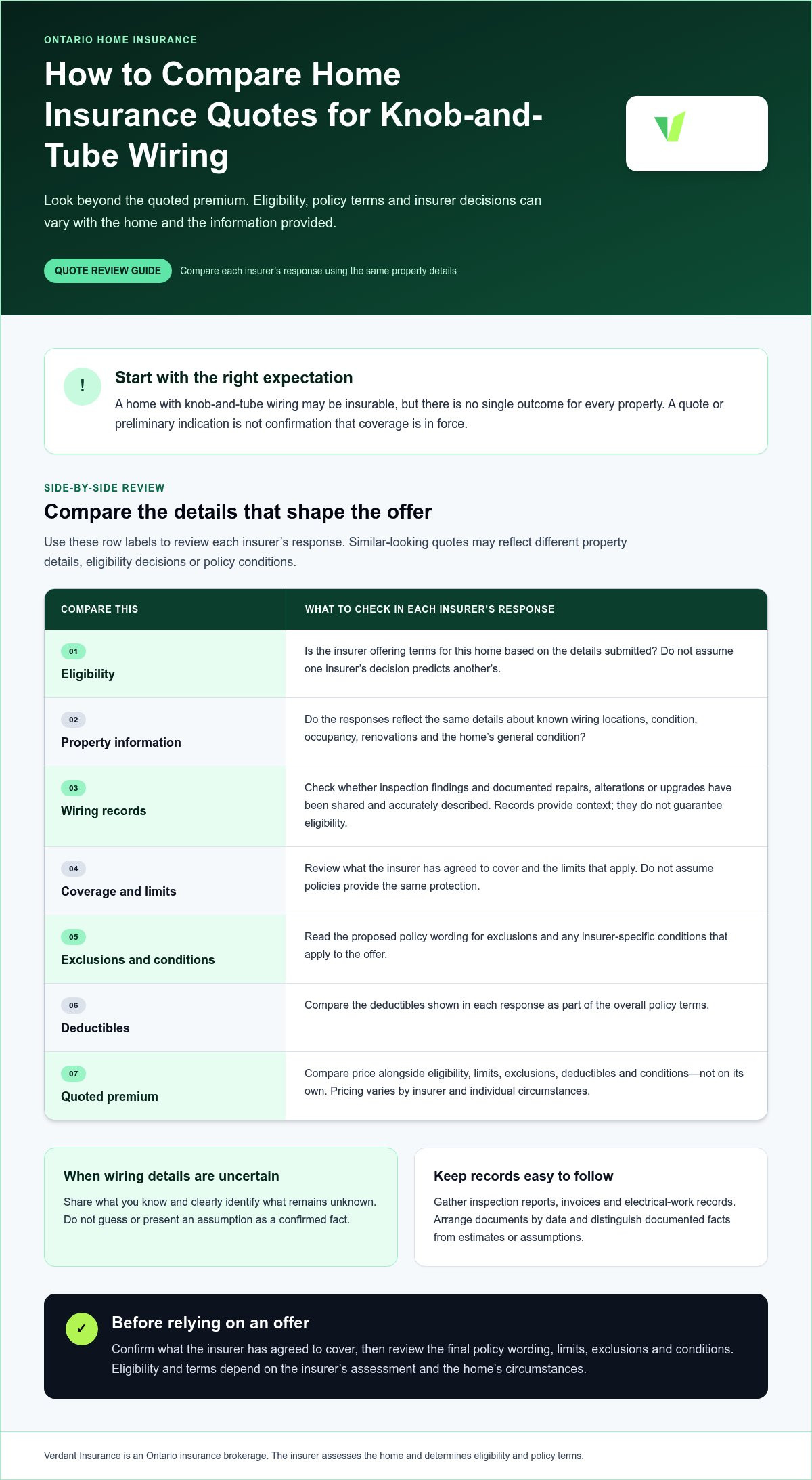
Compare the terms, not just the quoted premium. For home insurance for houses with knob and tube wiring Ontario, two quotes that look similar may reflect different property details, eligibility decisions or policy conditions. One insurer’s response also does not predict what another insurer will decide.
Use a side-by-side review to identify differences and questions to resolve before choosing an option:
| What to compare | What to check |
|---|---|
| Eligibility | Whether the insurer is offering terms for the home based on the details submitted. |
| Information provided | Whether each quote reflects the same known wiring locations, condition and documented work. |
| Conditions | Any insurer-specific requirements or conditions attached to the offer. |
| Limits | The maximum amounts shown for applicable coverages. |
| Exclusions | Situations or property details the policy wording says are not covered. |
| Deductibles | The amount you may have to pay toward an eligible claim, as described in the policy. |
Which policy details deserve a side-by-side comparison?
First, check that each quote is based on consistent property information. If one insurer received details about an electrical inspection or completed work and another did not, their responses may not be directly comparable. Then review conditions, limits, exclusions and deductibles alongside the quoted premium and coverage. A summary can help you navigate the offer, but it does not replace the policy wording.
Actual coverage is governed by the issued policy, its terms, limits and exclusions, and the insurer’s eligibility decisions. Read the documents carefully and seek clarification on wording you do not understand before relying on a quote. For broader context on home insurance pricing in Ontario, see our Ontario home insurance cost guide. It does not replace comparing the terms offered for your specific home.
How can a broker help make quote comparisons clearer?
An Ontario broker can help organize the home’s details, present them to partner insurers and compare the responses received. Verdant Insurance is a brokerage, not the insurer making underwriting decisions. Eligibility, pricing, conditions and coverage remain subject to each insurer’s assessment and the policy wording. Learn more about choosing an online insurance broker and the role a broker can play in comparing options.
For electrical-safety information specific to Ontario, consult the Electrical Safety Authority (ESA) guidance on knob-and-tube wiring. Keep safety information distinct from insurance terms, which insurers assess under their own criteria.
What to prepare before requesting a quote for an Ontario home
Preparing a few details can make quote discussions clearer and help you compare insurer responses accurately. It does not guarantee acceptance or a particular price. Eligibility, pricing and coverage depend on the insurer and your circumstances. Use this sequence to organize the information you have.
A practical quote-preparation checklist
- Identify known wiring details. Note which areas are known to have knob-and-tube wiring, whether any parts have been replaced or altered, and what you know about the wiring’s condition. If you are unsure whether it remains in certain areas, record that as unknown instead of assuming.
- Gather property and supporting records. Have the property address and occupancy details ready, along with available inspection reports and records of completed electrical work. Arrange documents by date so the history is easy to follow.
- List questions. Write down anything you want clarified about the information used for the quote, proposed conditions or policy terms. Use the same questions when reviewing each response.
- Request quotes and keep a record. Disclose known facts accurately. Keep copies of the information you submitted and each insurer’s response, including stated conditions, so you can compare them side by side.
For home insurance for houses with knob and tube wiring Ontario, clear records can show what is known and what remains uncertain. They do not replace the insurer’s assessment, and no single inspection or upgrade guarantees eligibility. For technical information about wiring or electrical work, consult an appropriately qualified professional. Insurance guidance is not a technical inspection.
Questions to clarify before choosing an option
Check that each insurer considered the property information you provided. If something appears missing or unclear, ask what details were used and whether the response includes specific conditions. Keep the answer with that insurer’s quote so you do not confuse one company’s terms with another’s.
Review the actual policy wording for limits, exclusions and deductibles. Ask for clarification about how a stated term applies to the proposed policy. Do not rely on a short summary or assume similar labels mean identical coverage. The issued policy wording, limits, exclusions and applicable conditions govern the coverage.
An Ontario brokerage can help present the home’s details to partner insurers and compare their responses. A broker can support the process, but the insurer makes its own underwriting decision.
Getting Ontario home insurance guidance from Verdant Insurance
For Ontario homeowners, a useful starting point is to document what you know about the wiring, compare insurer responses and review the policy terms before making a decision. A broker can help organize the details and explore options with partner insurers. That can make quote discussions easier to follow, but it cannot guarantee an insurer will offer coverage or particular terms.
What to expect when discussing the home with a broker
Share the wiring’s known locations and condition, along with any available inspection reports or records of electrical work. Be clear about what is documented and what remains uncertain. This gives the broker information to present to partner insurers and helps keep responses grounded in the same property details.
Verdant Insurance is an Ontario brokerage that can help communicate those details and clarify insurer responses. The insurer, not the broker, makes underwriting decisions. Eligibility, pricing, conditions and coverage depend on the insurer and individual circumstances, so an initial quote discussion is not final confirmation of coverage.
As you review options, compare more than price. Check whether each response reflects the information you supplied, then review stated conditions alongside the policy’s limits, exclusions and deductibles. Keep the relevant documents together so you can see what each insurer considered.
A clear next step for Ontario homeowners
If you’re considering home insurance for houses with knob and tube wiring Ontario, a careful comparison starts with accurate information and ends with a close review of the issued policy. The policy wording sets out coverage, limits, exclusions and applicable conditions. If a term is unclear, get clarification before relying on your understanding of the offer.
Verdant Insurance helps Ontario homeowners explore options through partner insurers. Coverage and eligibility are not guaranteed, but an organized discussion can help you understand the responses available for your circumstances.
Take the next step with clear information
Knob-and-tube wiring does not lead to the same insurance outcome for every Ontario home. Insurer decisions depend on underwriting criteria and the property’s details. Share what you know accurately, keep inspection and electrical-work records together, and compare insurer responses beyond the quoted price.
Before choosing an option, review the issued policy wording, including its limits, exclusions and conditions. Coverage, eligibility and pricing vary by insurer and individual circumstances, so a quote is not final confirmation of coverage.
For home insurance for houses with knob and tube wiring Ontario, Verdant Insurance can help homeowners explore options arranged through partner insurers. Verdant is an Ontario-based property and casualty brokerage in Markham, with online quote and policy-management options and dedicated support. The insurer makes the underwriting decision and determines the final policy terms.
With accurate details and a careful comparison, you can take the next step with greater clarity.
Frequently Asked Questions
Can you get home insurance in Ontario with knob-and-tube wiring?
It may be possible, but there is no universal answer. For homeowners seeking home insurance for houses with knob and tube wiring Ontario, insurer eligibility criteria and the property’s details both matter. Share what you know about the wiring, along with available inspection reports and records of completed work. A quote discussion can help explore options, but it does not confirm that coverage will be offered or establish final terms.
Do all Ontario insurers refuse homes with knob-and-tube wiring?
No. Do not assume every insurer makes the same decision. Underwriting criteria differ, and an insurer may assess the wiring’s known condition and documentation along with other property details. Eligibility, conditions, pricing and coverage vary by insurer and individual circumstances. Compare the responses you receive. One insurer’s decision applies to its assessment of that property, not as a rule for every Ontario home with knob-and-tube wiring.
Does knob-and-tube wiring make home insurance more expensive?
It may affect an insurer’s assessment and quoted price, but there is no universal premium or outcome for every home. Pricing depends on the insurer’s criteria and the property’s circumstances. Request options using accurate information, then compare policy terms as well as the premium. A quote reflects the insurer’s assessment of the details supplied, so it should not be treated as an estimate for another home.
What information should I provide when getting a quote for a home with knob-and-tube wiring?
Share what you know about where the wiring remains, its known condition and any inspections or completed electrical work. Provide available reports and records, and identify details you do not know instead of guessing. Insurers may request different information. Keep a copy of what you submit, including supporting documents. This can help you compare responses using consistent property details and see where insurer questions or terms differ.
Can an electrical inspection help with home insurance for knob-and-tube wiring?
An inspection report or records of electrical work may help clarify information about the wiring for an insurer’s assessment. An inspection does not guarantee that an insurer will offer coverage or particular terms. Requirements and decisions vary by insurer and property. For technical or electrical-safety questions, consult a qualified professional and current Ontario guidance. Keep that advice distinct from an insurance decision, which depends on the insurer and policy terms.
Should I replace knob-and-tube wiring before applying for home insurance?
There is no single answer that applies to every home or insurer. Consider the wiring’s known condition, professional findings and criteria relevant to your property before deciding what to do. Do not assume replacement will guarantee eligibility, a particular price or specific policy terms. Share accurate information with a broker, compare insurer responses and review any conditions carefully. Make electrical-work decisions with appropriate professional advice, not insurance guidance alone.
Does home insurance cover damage related to knob-and-tube wiring?
You cannot determine coverage from the wiring type alone. The insurer’s eligibility decision, the circumstances of a loss and the policy wording all matter, including its limits, exclusions and conditions. Review the actual issued policy rather than relying on a general statement or quote summary to interpret coverage. A broker can help clarify insurer responses, but the policy contract sets the applicable coverage. If wording is unclear, seek clarification before relying on your interpretation.


