

Does a difficult driving record automatically mean you can’t get insured in Ontario? A conviction, at-fault collision, or gap in coverage can make your options feel uncertain, but high risk auto insurance Ontario isn’t one fixed outcome. Insurers assess applications individually, so eligibility, pricing, and policy terms vary by insurer and personal circumstances.
Understanding what insurers may consider can help you prepare and compare options more confidently. A broker can organize your information and present it to partner insurers, but each insurer makes its own decision.
This guide explains what high-risk status may mean, which parts of your driving and insurance history could affect an assessment, and what details to gather when applying. You’ll also learn how to compare written policy terms and find Ontario-specific guidance.
Key Takeaways
- High-risk status is an insurer’s assessment, not a single Ontario-wide classification or a guaranteed outcome.
- Driving history and application details may affect how an insurer assesses your high risk auto insurance Ontario options.
- Compare written quotes by coverage limits, exclusions, conditions, and payment terms, not just premium.
- Gather relevant records, check details for accuracy, and provide consistent information when requesting options.
- An Ontario brokerage such as Verdant can help organize your application and explain options from partner insurers.
What does high-risk auto insurance mean in Ontario?
In Ontario, “high-risk” generally describes how an insurer assesses an applicant’s likelihood of making a claim. It isn’t a province-wide classification, a fixed score, or a guarantee that an application will be accepted or declined. Each insurer makes its own decision based on the application and its assessment practices, so eligibility, pricing, and policy terms can differ.
This distinction matters when exploring high risk auto insurance Ontario. A broker can gather and present your information to insurers, but the insurer assesses the application, decides whether to offer coverage, and sets the policy terms. A broker arranges insurance through insurers, rather than underwriting the policy or deciding the outcome.
What circumstances may lead an insurer to assess a driver as higher risk?
An insurer may consider driving convictions, at-fault collisions, interruptions in insurance coverage, or a previous policy cancellation. These are possible considerations, not automatic triggers. Their relevance and effect depend on the insurer’s approach and your circumstances, including the complete information you provide. There isn’t a universal set of points, time periods, or premium changes that applies across insurers.
Be precise about dates and circumstances when providing information. If something in your records appears incorrect, address the discrepancy rather than guessing or leaving it out.
Does high-risk status mean you cannot get Ontario auto insurance?
No single high-risk assessment determines what every insurer will decide. Insurers may assess the same applicant differently based on their full circumstances. Options can vary, but no particular decision or coverage offer is guaranteed. A label alone doesn’t tell you what terms an insurer may offer.
You may come across the term assigned risk pool when reading about insurance markets. It describes a general mechanism used in some places to arrange coverage for applicants who have difficulty obtaining it through the regular market. The term shouldn’t be taken as proof that Ontario uses the same arrangement or that a particular applicant will qualify for coverage.
For Ontario-specific information about auto insurance requirements and current guidance, consult the Financial Services Regulatory Authority of Ontario (FSRA). Its resources can help distinguish general explanations of high-risk insurance from guidance that applies in Ontario.
How Ontario insurers may assess a high-risk auto insurance application
Underwriting is an insurer’s review of an application to decide whether it can offer coverage and, if so, on what terms. It isn’t a universal score or fixed high-risk label. An insurer may consider driving history alongside information about the driver, vehicle, and intended use. The Financial Services Regulatory Authority of Ontario offers consumer guidance on high-risk drivers and auto insurance rates.
Different insurers can assess the same application differently. Each insurer applies its own underwriting approach and eligibility criteria. One company’s decision doesn’t determine what another will decide, and an offer of coverage doesn’t mean the terms will be the same. Before deciding, review the proposed policy’s limits, exclusions, conditions, and other wording.
Which details should Ontario drivers be ready to provide?
Application questions vary, but it helps to have accurate information about the vehicle, drivers, address, vehicle use, and insurance history. Insurers may also ask about relevant driving or claims information. Questions, documents, and processes can differ between insurers.
Prepare the vehicle’s make, model, and year; the names and details of the drivers; where the vehicle is kept; and whether it’s used for personal or work-related travel. Be ready to describe your insurance history and disclose relevant driving and claims information accurately. If you’re unsure about a detail, check your records rather than estimating. Complete, consistent answers help insurers assess the application using the information you provide.
Why can two insurers reach different decisions?
Insurers set their own underwriting approaches and eligibility criteria. They may weigh information differently, leading to different decisions or policy terms for similar applications. One insurer’s decision doesn’t guarantee that another will offer coverage or provide the same terms.
Compare written options carefully. Look beyond the quoted premium and check the limits, exclusions, conditions, and payment terms. A lower quote may not represent the same coverage or obligations as another option. The policy wording sets out the specific terms, subject to the insurer’s eligibility requirements.
A broker can organize your details and present them to partner insurers. Learn about Verdant’s auto insurance support in Ontario and how a broker can help you review the options received.
Comparing high-risk auto insurance options without relying on price promises
There isn’t one premium or set of policy terms for every driver considered high risk. A quote depends on the insurer’s assessment and the applicant’s circumstances, so pricing, eligibility, and available terms can vary. Compare the whole offer, not just the number at the top. A lower quoted premium alone doesn’t show whether the coverage suits your needs.
What should you compare in Ontario auto insurance quotes?
Use each written quote to check what’s being offered. Record the details side by side, and ask your broker to clarify any term you don’t understand before deciding.
| Compare | What to record |
|---|---|
| Insurer | The insurer named on the quote |
| Quoted premium | The quoted amount and how it is to be paid |
| Coverage limits | The limits stated for each coverage |
| Deductibles | The applicable amounts shown in the quote |
| Exclusions and conditions | Restrictions, requirements, or conditions described in the quote or policy documents |
| Policy period and payment terms | The dates and payment schedule presented by the insurer |
Make sure you’re comparing the same details across offers. Differences in limits, deductibles, exclusions, or conditions can affect how policies respond. The policy wording governs the coverage, subject to the insurer’s eligibility, limits, and exclusions. A side-by-side comparison helps highlight differences, but it doesn’t replace reviewing the policy documents.
What if standard-market insurers decline an application?
A decline from one insurer doesn’t determine what every other insurer will decide. Keep a record of the response and make sure information in any further application is complete and consistent. Another insurer may assess the application differently, but a different outcome or access to coverage isn’t guaranteed.
If you’re researching possible next steps after a decline, use current Ontario guidance from FSRA. Don’t assume that a particular program or market option applies to your situation. A broker can help organize your information and explain written options from partner insurers.
For high risk auto insurance Ontario, take time to compare the terms as carefully as the premium. Start by understanding what each offer says, rather than assuming similar quotes provide identical protection.
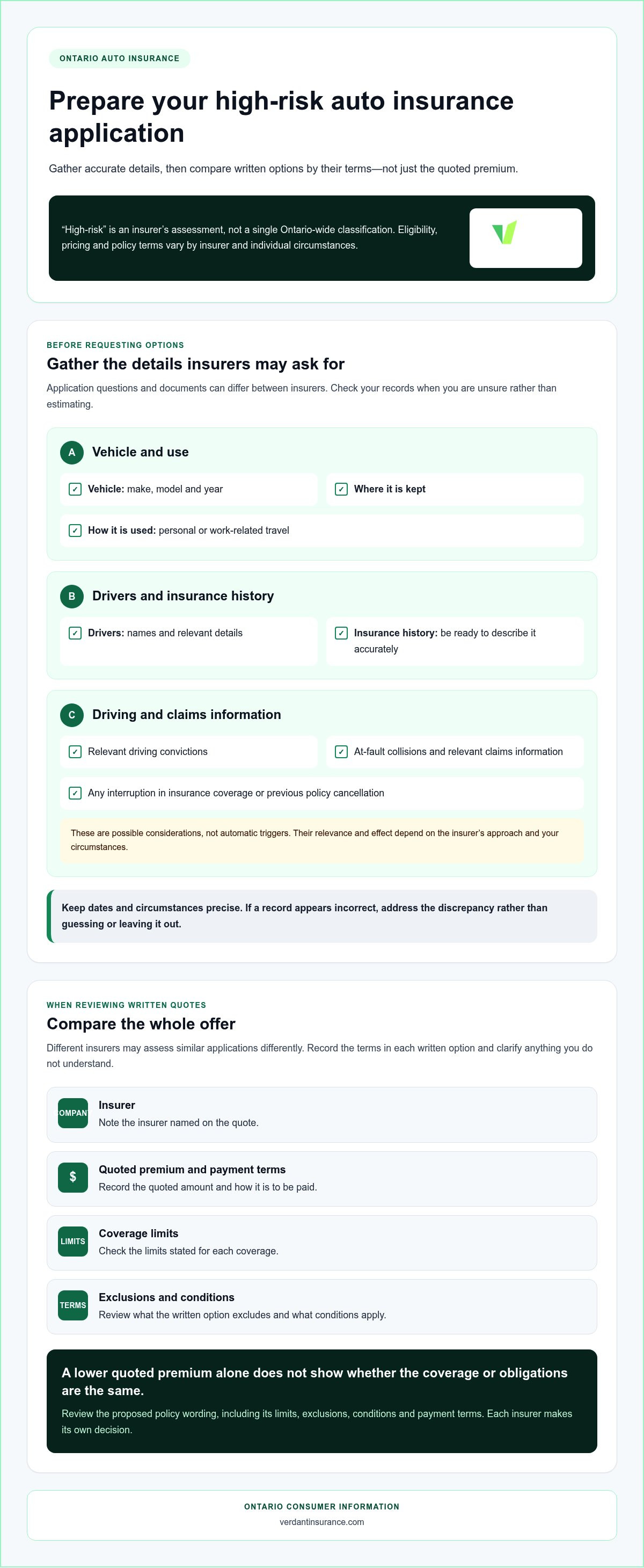
Steps to prepare for high-risk auto insurance in Ontario
Preparation can make an application clearer and help you compare the options you receive. For high risk auto insurance Ontario, focus on accurate details and written policy terms. Don’t assume every insurer will ask the same questions or reach the same decision.
Gather information before requesting an Ontario quote
Collect the details you can about the drivers, vehicle, address, how the vehicle is used, and prior insurance. Keep relevant records available in case a broker or insurer requests them. Processes can vary, and not having a particular document at hand doesn’t automatically determine an insurer’s decision.
Prepare your application in four steps
- Gather records. Pull together information about your driving, claims, and insurance history, along with vehicle and driver details.
- Confirm the facts. Check dates, addresses, vehicle information, and other details against your records. Correct errors before applying, and don’t guess when you can verify an answer.
- Request options. Provide complete, consistent answers. Disclose relevant driving and claims information accurately, and respond to questions as fully as you can.
- Compare written terms. Review each offer’s premium, coverages, limits, deductibles, exclusions, conditions, policy period, and payment terms. The policy wording sets out the specific terms.
How can drivers work toward more options over time?
Drive carefully and keep your insurance information current. If you’re considering changing or cancelling a policy, discuss the timing with a broker first. Maintaining continuous coverage where possible may be worth discussing in light of your circumstances, but it doesn’t guarantee eligibility, a particular price, or more options later. Future decisions are individual and vary by insurer.
For broader context on comparing insurance, Verdant’s Cheap Car Insurance Canada: Ultimate Buying Guide 2026 and online insurance broker guide may offer useful background. Keep Ontario-specific requirements and the terms in your own written quote at the centre of your decision.
How a Verdant broker can help with high-risk auto insurance in Ontario
High-risk auto insurance questions can be difficult to sort through, especially if you’re unsure what an insurer needs to assess your application. Verdant is an Ontario insurance brokerage based in Markham that works with partner insurers. It isn’t a direct insurer: the insurer reviews the application and determines whether it can offer coverage and on what terms.
A Verdant broker can organize the details you provide, present your enquiry to partner insurers, and explain the quote information received. This can help you understand what each option says and identify questions about limits, exclusions, conditions, or payment terms. It doesn’t guarantee that an insurer will offer coverage or a particular outcome.
What to expect when discussing your auto insurance needs
Be ready to share relevant information about your driving history, vehicle, drivers, address, vehicle use, and previous insurance. Accuracy matters. If a detail is unclear, check your records rather than estimating, and correct known errors before they’re submitted. A broker can help clarify information in a quote, while the insurer remains responsible for its decision and policy terms.
For high risk auto insurance Ontario, eligibility, premiums, and policy terms depend on the insurer and your individual circumstances. A broker can explain differences between the options received, but only the insurer can confirm its offer and applicable policy wording. Review the documents before deciding, and ask about wording you don’t understand.
Where Ontario drivers can find trustworthy insurance guidance
For Ontario-specific consumer information, consult the Financial Services Regulatory Authority of Ontario’s guidance on high-risk drivers. FSRA oversees insurance regulation in Ontario and provides auto insurance information for consumers. RIBO, the Registered Insurance Brokers of Ontario, regulates insurance brokers and brokerages in the province. These resources explain the roles of insurers, brokers, and regulators as you consider your next steps.
Verdant’s online platform lets Ontario customers obtain quotes and manage policies, with dedicated support. A broker can help you organize the information and review options from partner insurers.
Take the next step with a clear plan
High-risk status is an insurer’s assessment, not a single Ontario-wide decision. Your driving and insurance details may shape how an application is reviewed, and insurers can reach different outcomes. For high risk auto insurance Ontario, prepare accurate information and compare written quotes carefully, including limits, exclusions, conditions, and payment terms, rather than judging an option by premium alone.
Verdant Insurance is an Ontario-based brokerage in Markham. It arranges auto insurance through partner insurers, and customers can obtain quotes and manage policies online with dedicated support. A Verdant broker can help organize your information and explain the options received, while each insurer determines eligibility, pricing, and policy terms for your circumstances.
A careful application and a clear comparison are practical steps forward. Speak with a Verdant broker about Ontario auto insurance to discuss your needs and review the options available through partner insurers.
Frequently Asked Questions
What is considered high-risk auto insurance in Ontario?
In Ontario, high-risk auto insurance describes coverage considered for a driver an insurer assesses as having a higher risk profile. It isn’t one province-wide classification or a separate, uniform policy type. An insurer may consider driving convictions, at-fault collisions, interruptions in coverage, or prior cancellations, but how those details affect an application varies. For high risk auto insurance Ontario, the insurer’s individual assessment determines whether it may offer coverage and what terms apply.
Can I get auto insurance in Ontario after a DUI conviction?
It may be possible, but a DUI conviction can affect an insurer’s assessment, and no particular outcome is guaranteed. Each insurer considers applications individually, so eligibility, premiums, and policy terms can differ. Share accurate information about the conviction and your insurance history when applying. A broker can present your details to partner insurers and explain written options, but the insurer makes the underwriting decision.
How much does high-risk auto insurance cost in Ontario?
There’s no single price for high-risk auto insurance in Ontario. A premium depends on the insurer’s assessment and individual circumstances, so quotes can differ between insurers and applicants. Driving and insurance history, vehicle details, and where and how the vehicle is used may be relevant application information. Compare written quotes by premium as well as coverage limits, deductibles, exclusions, conditions, and payment terms. A lower premium alone doesn’t show whether the policy fits your needs.
Can an Ontario broker help if an insurer declines my application?
Yes. An Ontario broker can organize your information and present an enquiry to partner insurers. A decline from one insurer doesn’t determine what every other insurer will decide, but a broker can’t guarantee another insurer will offer coverage. If you receive options, review their written terms closely. Verdant is a brokerage, not a direct insurer, so partner insurers make their own decisions about eligibility, premiums, and policy terms.
What information should I prepare for a high-risk auto insurance quote?
Prepare accurate details about the drivers, vehicle, address, how the vehicle is used, and your prior insurance history. Be ready to disclose relevant driving and claims information, and have supporting records available if requested. Application questions and document requests can vary by insurer. Check dates and vehicle details against your records, and correct known errors before submitting an application.
Is high-risk auto insurance the same as basic Ontario auto insurance?
No. “High-risk” describes how an insurer assesses an applicant, while “basic” may be used informally to describe a baseline level of auto insurance coverage. The terms refer to different things: a driver’s risk assessment and the coverage in a policy. Don’t assume that a high-risk policy automatically has reduced coverage or identical terms across insurers. Review the quote and policy wording for its coverages, limits, exclusions, and conditions. FSRA provides Ontario auto insurance consumer guidance.
Can my auto insurance options change if my driving record improves?
They may change, but an improved driving record doesn’t guarantee a particular premium, eligibility, or policy terms. Insurers assess applications individually and may consider the applicant’s overall circumstances and the information provided. Keep your driving and insurance details accurate, and discuss updated information when reviewing options or applying again. Compare any new written offers carefully, since limits, exclusions, conditions, and payment terms can differ as well as the quoted premium.


