

If you’re searching for “car insurance after an at fault accident Ontario,” you may be trying to understand a fault decision that could affect your claim or future insurance options. If you disagree with your insurer’s assessment, ask it to explain how it reached the decision and what information it relied on.
A useful review request starts with the insurer’s reasons, then compares them with relevant evidence. Ontario insurers use the Fault Determination Rules to assess many common collision scenarios, so disagreement alone may not change the result. Understanding which rule was applied can help you identify whether details such as photos, witness information or a diagram need further review.
This article explains how to ask for the reasoning behind a fault decision, organize evidence and submit a clear review request. It also covers the insurer’s complaint process and possible next steps after the insurer provides its final position. Each claim is assessed on its own facts, and a review does not guarantee a different decision.
Key Takeaways
- You can ask your insurer to explain and review its fault decision, even if you are not disputing every part of the claim.
- For car insurance after an at fault accident Ontario, focus on specific facts or evidence that may have been missed, rather than dissatisfaction with the outcome alone.
- Keep your claim number, key dates and insurer communications together so you can explain clearly what you believe needs another look.
- A focused request to your claims representative should identify the disputed point, include relevant records and ask for a response.
- A fault review and future insurance pricing are separate considerations. Pricing and eligibility vary by insurer and individual circumstances.
At-fault accident in Ontario: what the insurer’s decision means
If you disagree with an at-fault decision, ask your insurer to explain how it reached the conclusion and request a review. You do not have to dispute every part of your claim to challenge the fault assessment. For example, you may accept how the insurer is handling one aspect of the claim while questioning the facts or rule it used to assign responsibility.
Understanding the decision is a practical first step if you are concerned about car insurance after an at fault accident Ontario. Ask for the reasons behind the assessment and note which details you believe need a second look. Rather than focusing only on whether the outcome feels fair, consider whether relevant facts or information were misunderstood, missing or assessed incorrectly.
What does an insurer’s at-fault decision mean?
The insurer’s fault assessment helps determine how it handles the claim under the applicable insurance rules. It is an insurance decision, not a court judgment or an informal opinion about who caused the collision. It may also be separate from other questions about your claim. Any effect on future insurance pricing or options depends on the insurer and your individual circumstances.
Who assesses fault after an Ontario collision?
The insurer handling the claim reviews the available information and applies Ontario’s rules. The collision facts and the documentation available to the insurer matter. Asking for a clear explanation can help you identify what to review and what evidence may be relevant.
Ontario’s Fault Determination Rules are regulations that insurers use to assign fault for insurance purposes in specified collision scenarios. Set out in Regulation 668 under Ontario’s Insurance Act, they provide a consistent framework for assessing fault. They are not a general guide to every legal question that might arise from a collision. A plain-language overview of Ontario’s Fault Determination Rules can help explain their role.
A police report and an insurer’s assessment serve different purposes. A report may document information gathered by police, while the insurer makes its own assessment for the claim using the applicable rules and available evidence. A police report, by itself, is not the insurer’s fault decision or a court finding.
As you read the insurer’s explanation, compare its account with what happened and the records you have. Then pinpoint the particular detail or rule you want the insurer to review.
How to understand the insurer’s fault decision before disputing it
Before asking for a review, start with the insurer’s explanation. Compare its account with your own records to identify the specific fact or detail you want the claims representative to reconsider.
Request and read the insurer’s explanation
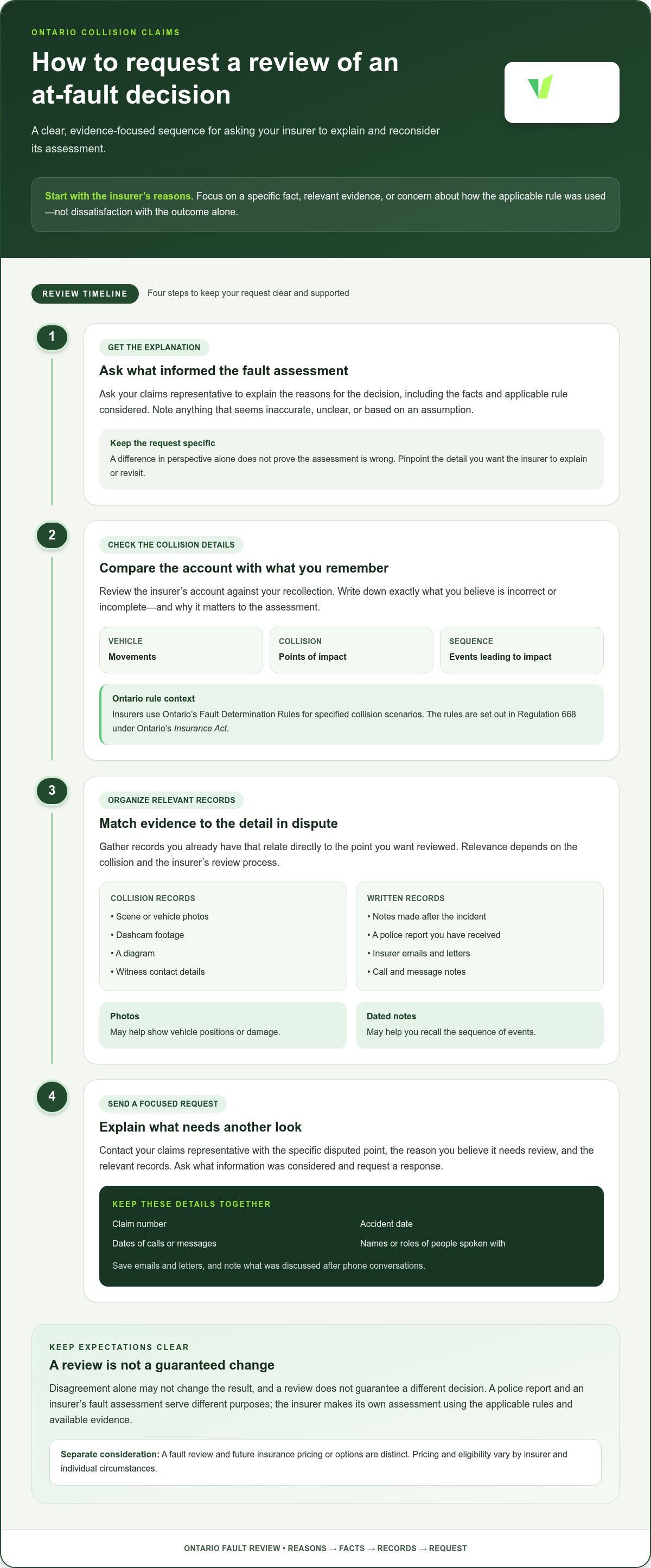
Ask the claims representative to explain the reasons for the fault assessment and the information considered. Compare that explanation with your recollection of the collision. Note any detail that seems inaccurate, unclear or based on an assumption. A difference in perspective does not, by itself, prove the assessment is wrong, but identifying a precise point gives you something concrete to follow up on.
Use this order to keep the review focused:
- Request the reasons: Ask which facts and applicable rule informed the decision. Ontario’s Fault Determination Rules are published in the e-Laws regulations, so you can compare the explanation with the relevant rule.
- Check the facts: Review the insurer’s account against what you remember, including vehicle movements, points of impact and the sequence of events.
- Identify disputed details: Write down exactly what you believe is incorrect or incomplete, and why it matters to the assessment.
- Organize records: Gather documents or other evidence that relate directly to those disputed details.
Organize evidence relevant to the collision
Gather the records you already have. Depending on the circumstances, these may include collision-scene or vehicle photos, dashcam footage, a diagram, witness contact details, notes made after the incident, a police report you have received and correspondence from the insurer. Photos may help show vehicle positions or damage, while a dated note may help you recall the sequence of events. The relevance of each item depends on the collision and the insurer’s review process.
Keep the claim number, accident date, dates of calls or messages, and the names or roles of people you spoke with in one place. Save emails and letters, and make a note of what was discussed after phone conversations. The documents available to you and the weight they carry can depend on the claim and the insurer’s process. Ask the claims representative what information was considered and whether specific records can be shared.
Consistent, dated records make a review request clearer by connecting each disputed detail to evidence that supports your account. If you are also considering future coverage, you can explore auto insurance options with Verdant. Verdant is an Ontario brokerage, while the insurer handles claims.
When can you dispute an at-fault accident decision in Ontario?
You can ask your insurer to review its fault decision if you can point to a specific fact that may be wrong, relevant evidence that may not have been considered, or a concern about how the applicable rule was applied. A focused question is more useful than simply saying the result feels unfair.
You do not need to prove the insurer made an error before raising a concern. Explain what you believe needs review and connect it to information about the collision. An unfavourable claim outcome, by itself, does not show that the fault assessment is incorrect. The insurer’s review depends on the facts and records available.
What information may support a review request?
Where possible, link each concern to specific evidence. Photos may clarify vehicle positions or damage; a diagram can help explain the sequence of events; a witness account or video may offer another view of a disputed detail. No single record guarantees a different assessment. Its relevance depends on what happened and what point you are asking the insurer to reconsider.
| Concern | Supporting record | Question for the insurer |
|---|---|---|
| The written account describes vehicle positions differently from your recollection. | Scene or vehicle photos, a diagram, or dated incident notes. | Which information supports the positions recorded in the assessment? |
| A witness or recording may clarify the sequence of events. | Witness contact details or available dashcam footage. | Was this information considered, and how does it relate to the decision? |
| You believe a relevant detail was missed or the wrong rule was applied. | The insurer’s explanation alongside records that address that detail. | Which rule and facts were used, and how did they affect the assessment? |
Which disagreements need careful wording?
Be precise about the difference between the insurer’s account and your documented recollection. Instead of writing, “The decision is unfair,” identify the disputed detail, refer to the record that may clarify it, and ask how that detail affected the fault assessment. Keep the tone factual and respectful so the claims representative can see exactly what you want reviewed.
If the insurer says its decision is final, you can still ask for the reasoning and request a review of a specific concern through its process. A review may clarify the decision, but it does not promise a change. The outcome depends on the collision facts and the insurer’s review of the available information.
How to submit a clear request to review an at-fault decision
A clear request helps the insurer see exactly what you are asking it to reconsider. Contact the claims representative handling your file, identify the disputed point, provide relevant records and ask for a written response explaining the review outcome. Keep the tone factual and respectful. Focus on what you believe was missed or recorded incorrectly, rather than making assumptions about the insurer’s motives.
What to include in a written review request
Use the claim number and collision date to identify your file. Name the decision you are questioning and briefly explain why. Connect each point to evidence where possible. For example, if you believe the vehicle positions in the insurer’s account are inaccurate, refer to a specific photo or diagram and explain what it shows.
A simple structure can keep your request organized:
- Identify the file: Include your name, claim reference and collision date.
- State the concern: Identify the specific fact, evidence or rule application you want reviewed.
- List your attachments: Name each record and say which point it relates to.
- Ask for a response: Request an explanation of the review outcome and information about any further steps available.
Keep copies of what you send and note the date and method of delivery. Before submitting, review the insurer’s instructions for complaints and any applicable timelines. These can vary, so do not assume every insurer follows the same process or deadlines.
What if the insurer maintains its decision?
If the claims representative cannot resolve the concern, ask how to escalate it through the insurer’s internal complaint process. This may involve a manager or the insurer’s complaint officer or ombudsman. Follow the insurer’s stated steps and request its final position in writing. Confirm what document you will need before pursuing an external complaint.
After the insurer’s internal process is complete, the General Insurance OmbudService (GIO) can review eligible disputes involving auto insurance companies. It is an independent service, and its recommendations are non-binding. The Financial Services Regulatory Authority of Ontario (FSRA) regulates Ontario’s financial services sector and provides consumer information. It is not a substitute for the insurer’s complaint process or the GIO’s dispute-resolution role. Check each organization’s current guidance to confirm where your concern belongs and what information to provide.
A review can clarify the decision, but it cannot guarantee that the insurer will change its assessment. If you are considering future coverage, Verdant is an Ontario insurance brokerage that can help you explore auto insurance options. Pricing, eligibility and coverage vary by insurer and individual circumstances.
After the review: insurance implications and your next steps
A fault review and a future insurance price are connected, but they are not the same decision. The review concerns how the insurer assessed responsibility for the collision. Pricing and eligibility at renewal or when applying for a policy depend on the insurer’s assessment and your individual circumstances. A review request does not guarantee a change to the fault decision or a particular premium outcome.
Could an at-fault claim affect future insurance?
An at-fault claim may affect how an insurer assesses an application or calculates pricing, but the impact varies by insurer and individual circumstances. Do not assume that every insurer will treat the claim the same way or that a particular premium change is certain.
Accident forgiveness, if it applies under your policy, is also subject to the policy’s terms and the insurer’s decisions. It should not be taken as a guarantee that a claim will not affect future pricing, eligibility or other insurance options. Review your policy wording and ask your insurer how its terms apply to your circumstances.
For a practical next step, keep the fault decision, your review request and the insurer’s response together with relevant claim records. This gives you a clear reference if you discuss the claim at renewal or seek insurance options later. Comparing options can help you understand what is available, but prices, eligibility and coverage vary by insurer and individual circumstances. Verdant’s guide to comparing affordable Ontario car insurance options can provide helpful background.
When can an Ontario broker help?
A broker can help you explore auto insurance options and discuss policy questions, including what to consider when your circumstances change. A broker is not the insurer that assessed or processed your claim and cannot promise a particular fault review result, premium or eligibility outcome. For an overview of brokerage support, see Verdant’s online insurance broker guide.
If you are considering car insurance after an at fault accident Ontario, keep your claim documents handy and be ready to describe your current needs. A Verdant broker can discuss auto insurance options with Ontario drivers and help you understand the questions to raise. Your insurer remains the point of contact for its claim decision.
Take a clear next step with confidence
If you’re dealing with car insurance after an at fault accident Ontario, start by understanding the insurer’s reasons. Compare its account with the facts and records you have, then make your review request specific: identify what you believe was missed and ask how it affected the decision. If the insurer maintains its position, follow its complaint process and keep the response with your claim documents.
A fault review and future insurance pricing are related but separate matters. Pricing, eligibility and coverage vary by insurer and individual circumstances. A broker can help you explore your auto insurance options, while the insurer remains responsible for its claim decision.
Verdant Insurance is an Ontario-based brokerage in Markham, serving drivers across the GTA with an online quote and policy platform and dedicated customer support. Speak with a Verdant broker about your Ontario auto insurance needs.
A clear record and a focused request can make the next steps easier to manage. Take them one at a time.
Frequently Asked Questions
Can I dispute an at-fault accident decision in Ontario?
Yes. You can ask your insurer to explain and review its fault decision. Focus on a specific concern, such as an incorrect collision detail, relevant evidence that may have been overlooked, or a question about how a rule was applied. Disagreeing with the outcome alone may not change the assessment. Your insurer reviews the information available, and a review does not guarantee a different decision.
How do I challenge my insurer’s fault decision after a car accident?
Start by asking the claims representative to explain the decision and the rule or facts considered. Compare that explanation with your own account, identify the exact point you dispute, and send relevant records with a concise written review request. Include your claim number and collision date, and keep copies of your request and the insurer’s response. This gives your concern a clear path through the insurer’s process.
Does a police report determine who is at fault for an insurance claim in Ontario?
No. A police report can document information gathered at the scene, but it is not the same as the insurer’s fault decision or a court finding. The insurer assesses the claim using available information and Ontario’s Fault Determination Rules where applicable. If you have a report, compare its relevant details with the insurer’s explanation and ask how any differences were considered in the assessment.
What evidence can help dispute an at-fault accident claim?
Evidence that clarifies a disputed detail may help the insurer review your concern. Depending on what happened, this could include scene or vehicle photos, dashcam footage, a diagram, witness details, dated incident notes or a police report you have received. Explain what each item shows and which point it relates to. No single document guarantees a changed assessment; the insurer considers the evidence in context.
What happens if my insurer does not change its fault decision?
Ask the claims representative how to raise the issue through the insurer’s internal complaint process. This may include contacting a manager or the insurer’s complaint officer or ombudsman. Request the insurer’s final position in writing. After completing the insurer’s process, you may be able to bring an eligible dispute to the General Insurance OmbudService. Its recommendations are non-binding, and its role differs from FSRA’s regulatory role.
Will an at-fault accident raise my car insurance premium in Ontario?
An at-fault accident may affect future insurance pricing or eligibility, but an increase is not guaranteed. How the claim is treated depends on the insurer and your individual circumstances. Accident forgiveness, if it applies to your policy, is subject to its wording and terms. If you are reviewing car insurance after an at fault accident Ontario, discuss how the claim may be considered without assuming every insurer will assess it the same way.
How long do I have to dispute an at-fault accident decision in Ontario?
Do not assume a single time limit applies to every insurer’s review or complaint process. Contact your claims representative promptly and ask what steps and deadlines apply to your file. The accident-reporting requirement is separate: Ontario drivers generally must report an accident to their insurer within seven days, or as soon as reasonably possible afterward. That reporting period should not be treated as a deadline for challenging a fault decision.