

What if a quick weekend getaway to Montreal or a cross-border shopping trip ended with a medical bill larger than your annual mortgage? Many Ontario residents assume their provincial health card provides a complete safety net wherever they go, but the reality is often more complex. The short answer is yes; you need additional coverage because OHIP has significant limits the moment you leave the province. Choosing the right travel medical insurance Canada offers is the only way to ensure a simple accident doesn't turn into a financial crisis.
It's natural to feel confused by policy jargon or worried about the hidden costs of out-of-province care. You want to focus on your vacation, not on whether a medical evacuation or a simple prescription is covered. This guide will clarify exactly what OHIP does and doesn't cover once you leave Ontario. You'll learn what to look for in a policy and how to choose coverage that fits your specific trip with confidence. We'll break down the essentials so you can travel knowing you have a reliable plan in place.
Key Takeaways
- Understand that OHIP coverage changes significantly once you cross the Ontario border, leaving you responsible for costs like ambulances and prescription drugs.
- Learn how travel medical insurance Canada policies protect you from high-cost emergency medical expenses and hospital stays that your provincial plan doesn't cover.
- Identify the essential components of a strong policy, including emergency medical evacuation and repatriation back to Ontario.
- Discover how to choose between single-trip and annual multi-trip plans based on your travel frequency and specific destination risks.
- See how working with an Ontario insurance broker provides professional guidance to find a customizable plan tailored to your unique health profile.
What is Travel Medical Insurance and Why is it Essential?
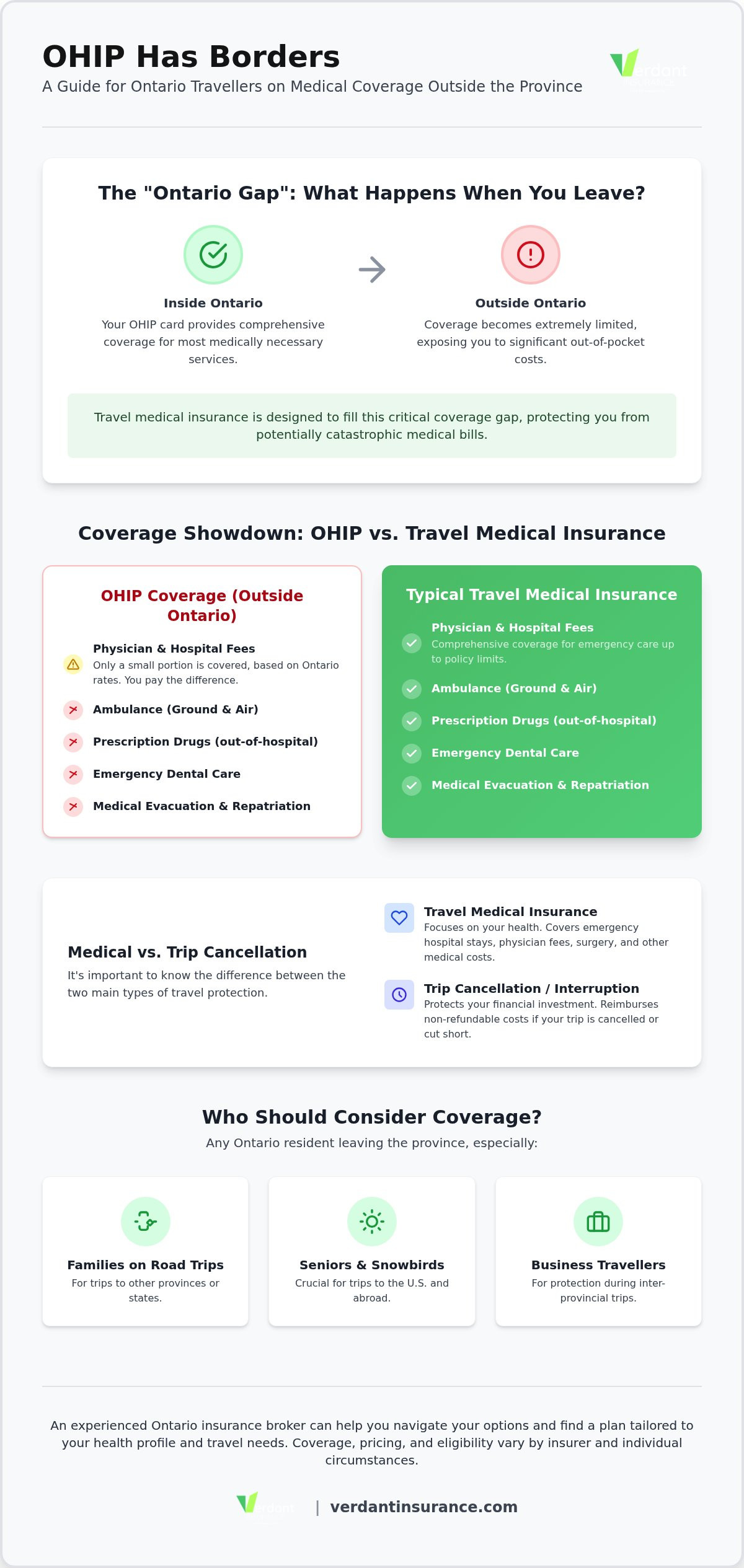
Understanding what is travel insurance? starts with recognizing it as a specialized financial shield. At its core, travel medical insurance is a policy designed to cover emergency healthcare costs when you're away from home. Whether you're crossing the border into the United States or simply driving to a neighboring province, this coverage steps in to handle unexpected hospital visits, physician fees, and diagnostic tests. It's a temporary safety net that starts exactly where your Ontario Health Insurance Plan (OHIP) stops.
The primary purpose of this coverage is to prevent financial ruin. Medical emergencies don't wait for a convenient time, and the costs associated with hospital stays or emergency transport can be staggering. Many Ontario residents believe that because we have a public healthcare system, medical care is "free" everywhere in Canada for everyone. This is a common myth. While provinces have reciprocal agreements for some services, OHIP doesn't cover everything. High-cost items like air ambulances, prescription drugs given outside a hospital, and emergency dental work often fall through the cracks. Using travel medical insurance Canada policies ensures that a simple accident doesn't lead to a mountain of debt.
The Difference Between Medical and Trip Cancellation Insurance
It's common to confuse medical coverage with trip cancellation insurance, but they serve very different roles. Travel medical insurance focuses entirely on your physical safety and health. It covers surgery, nursing care, and hospital room costs during an emergency. Trip cancellation or interruption insurance, on the other hand, protects your financial investment. If your flight is grounded or you need to return to Markham early due to an emergency at home, that policy reimburses your non-refundable expenses. Most travelers find that a comprehensive plan combining both types of protection offers the most reliable peace of mind.
Who Should Consider Travel Medical Coverage?
Everyone leaving Ontario should consider this protection, but certain groups face higher risks. Families taking road trips across Canada often overlook the costs of out-of-province ambulances or specialized care. Seniors and snowbirds heading south for the winter are particularly vulnerable, as medical costs in the U.S. are among the highest in the world. Even business travelers visiting clients in the GTA or elsewhere in the country need protection. Since coverage and eligibility vary by insurer and individual health profiles, it's vital to have a plan that reflects your specific needs.
OHIP Coverage Limits: What Happens When You Leave Ontario?
Your OHIP card is a vital asset when you're at home in Markham or Richmond Hill, but its protections change the moment you cross the provincial border. While the Ontario Health Insurance Plan provides comprehensive care within our province, it operates under strict geographic boundaries. When you travel to another part of the country, you rely on the Reciprocal Billing Agreement. This agreement ensures that other provinces will bill Ontario directly for medically necessary physician and hospital services, but it doesn't cover every aspect of your care.
The "Ontario Gap" is the space between what another province charges and what OHIP actually pays. For example, if you're visiting Quebec or Manitoba and require emergency treatment, you might find that certain services are not considered hospital services under the reciprocal deal. For those traveling abroad, the OHIP coverage outside of Canada is extremely limited, as the reimbursement rates for out-of-country emergency care are significantly lower than the actual costs of international medical treatment. This is why securing travel medical insurance Canada policies is a practical step for any trip.
Common Out-of-Province Costs Not Covered by OHIP
Many travelers are surprised to learn that some of the most expensive parts of a medical emergency are not covered by provincial plans when you leave Ontario. These costs can add up quickly, often requiring upfront payment. Common exclusions include:
- Ambulance services: Ground or air ambulance transport is not covered by reciprocal agreements and can cost thousands of dollars. An air evacuation can easily reach six figures depending on your location.
- Emergency dental work: If you need immediate dental repair due to an accident, OHIP typically won't cover the bill outside the province.
- Prescription drugs: While drugs administered inside a hospital are usually covered, any prescriptions you need to take after being discharged are your responsibility.
- Medical equipment: Costs for renting crutches, wheelchairs, or other essential recovery tools are not reimbursed by the provincial plan.
Why Your Credit Card Insurance Might Not Be Enough
It's tempting to rely on the insurance included with your premium credit card, but these policies often have hidden limitations. Many cards cap trip duration at 15 to 30 days, which doesn't help if you're planning a longer stay. Older travelers or those with dependents may also find themselves excluded due to strict age restrictions. Additionally, the claims process for credit card insurance can be significantly more complex than a standalone policy. Speaking with a Verdant Insurance broker can help you identify these gaps before you leave.
Essential Components of a Travel Medical Policy
Not all travel medical insurance Canada policies offer the same level of protection. While the primary goal is covering doctor visits, a robust plan includes several specialized components that act as a safety net when you're away from home in Markham or the GTA. Emergency hospital and medical coverage is the foundation, handling room costs, surgery, and nursing fees. This is critical because, as we've discussed, OHIP coverage outside Ontario is often insufficient for the full cost of private care or specialized out-of-province facilities.
Beyond hospital beds, your policy should include emergency medical evacuation. If you're injured in a remote area or a location without specialized cardiac or trauma care, this feature pays to transport you to the nearest adequate facility or even back to an Ontario hospital. Repatriation is another vital piece; it covers the logistical and financial burden of returning a traveler home during a tragedy. Finally, 24/7 assistance services provide a lifeline. These professionals help you find the nearest accredited clinic and can even help bridge language barriers in foreign medical systems, ensuring you aren't left to navigate a crisis alone.
Understanding Policy Limits and Deductibles
Standard policies often feature limits between $5 million and $10 million. While these numbers seem massive, they're designed to handle catastrophic events like weeks in intensive care or complex surgeries followed by air evacuation. You can often adjust your premium by choosing a higher deductible. This is the amount you pay out-of-pocket before insurance kicks in. A higher deductible can make a plan more affordable, provided you have those funds set aside. A key Verdant tip is to verify if your chosen policy pays the hospital directly. Some plans require you to pay upfront and seek reimbursement later, which can be a significant financial strain during an emergency.
The Role of Pre-Existing Conditions
Pre-existing conditions are a common source of confusion for travelers. Insurers look for a "stability" period, which is a specific timeframe before your trip where your health hasn't changed and your medications haven't been adjusted. This period varies by insurer and your age. Full disclosure is mandatory. If you don't mention a condition, your entire claim could be denied later. Working with an online insurance broker Canada residents trust can simplify this process. We help you compare different insurers to find those with stability rules that best fit your current health profile, ensuring your coverage remains valid when you need it most.
Choosing the Right Travel Medical Insurance for Your Trip
Finding the right plan doesn't have to be an overwhelming task. By using a structured approach, you can filter through the options and focus on the coverage that actually matters for your specific situation. Your first step is assessing your destination. A road trip to Quebec or Manitoba carries different medical risks and logistical challenges than a flight to a country where private healthcare costs are exceptionally high. Understanding the local environment helps you determine the level of protection you need.
Next, look at your calendar to calculate your trip duration and frequency. If you're planning more than one trip this year, an annual plan is often more efficient than buying individual policies. Review your existing work benefits and credit card insurance for specific gaps. Many workplace plans have low maximums or exclude certain types of emergency transport. Consulting an independent broker allows you to compare multiple quotes from different insurers available in Ontario. This ensures you're not overpaying for coverage you don't need or missing vital protections for travel medical insurance Canada. Finally, always read the exclusions list. It's the most important part of the fine print, detailing exactly which medical conditions or situations aren't covered.
Single-Trip vs. Multi-Trip (Annual) Plans
For most Ontario travellers, the choice between these two options depends on how often you leave the province. If you're heading south for a single two-week vacation, a single-trip policy is straightforward and simple. However, if you're a frequent traveller or enjoy spontaneous weekend trips across the border from the GTA, an annual multi-trip plan is usually more cost-effective. These plans generally pay for themselves after just two trips and offer the convenience of being covered without having to buy a new policy every time you pack. You can find more details on annual plan costs and benefits in our Travel Insurance Canada Online guide.
Special Considerations for Seniors and High-Risk Activities
Age and activity level play significant roles in your premium and eligibility requirements. Seniors may need to complete a detailed medical questionnaire to ensure their specific health history is accurately reflected in the policy wording. This transparency is vital to ensure claims are paid without delay if an emergency occurs. If your trip involves adventure sports like skiing in the Rockies or scuba diving, you'll need to verify that these aren't listed as exclusions. Not all policies cover high-risk activities by default, and some require a specific endorsement. Our brokers at Verdant can help you find specialized plans that include these activities so you don't find yourself without support in a medical crisis.
The Broker Advantage: Why Ontario Travelers Choose Verdant Insurance
When you search for travel medical insurance Canada, you'll encounter dozens of direct insurers eager to sell you their specific products. Choosing a policy through an independent brokerage like Verdant Insurance offers a distinct advantage. We don't work for the insurance companies; we work for you. As your advocate, our role is to scan the market on your behalf, ensuring you get a policy that aligns with your specific health needs and travel plans. Because we aren't tied to a single carrier, we have access to a wide range of partner insurers. This variety allows us to find a better fit for your unique risk profile, whether you're managing a pre-existing condition or planning a specialized excursion.
Our team is based right here in Markham, serving the GTA and the surrounding York Region. We understand the specific concerns Ontario residents face when traveling out-of-province. This local perspective means we provide personalized service that a faceless call center simply can't match. If you ever need to make a claim, we're here to assist. The claims process can be stressful during a medical emergency, so we act as your professional guide to ensure you're treated fairly by the insurance carrier throughout the entire procedure.
Simplifying the Complex World of Insurance Jargon
Insurance policies are often filled with dense, technical language that's hard to decipher. We take pride in breaking down complex policy wording into clear, actionable information. By explaining exactly what you're buying, we help you avoid common pitfalls like misunderstood stability periods or undisclosed health changes that often lead to denied claims. Verdant helps Markham and GTA residents find genuine peace of mind by ensuring they understand their coverage before they head to the airport or hit the highway.
Ready for Your Next Adventure?
Getting started is simple. You can reach out to our team for a personalized quote that compares various options tailored to your specific trip. Many of our clients also find value in bundling their travel protection with other essential coverages. For example, understanding the average cost of home insurance Ontario residents pay can help you see the benefit of having your home, auto, and travel policies managed by a single trusted broker. Whether you're heading to a neighboring province or across the ocean, traveling with the right protection allows you to focus on your trip instead of worrying about unexpected medical bills. Reach out to a Verdant broker today to secure your next journey.
Secure Your Journey Beyond the Ontario Border
Travelling should be about discovery and relaxation, not worrying about the potential costs of a medical emergency. You now understand that while OHIP is a great foundation, it leaves significant gaps once you cross the provincial border. Whether it's high-cost ambulance fees or out-of-province prescriptions, a dedicated policy ensures you aren't left with a heavy financial burden. Selecting the right travel medical insurance Canada offers means looking for stability, high coverage limits, and 24/7 assistance services that act as your lifeline in an unfamiliar medical system.
Our Markham-based team provides the local expertise and independent advice you need to travel with confidence. We compare multiple insurers to find a plan that fits your health profile and itinerary. You don't have to navigate these complex decisions alone.
Speak with a Verdant Insurance broker today to find the right travel coverage for your next trip.
Your next adventure is waiting. Pack your bags knowing that your health and finances are protected by a plan designed specifically for your needs. Safe travels.
Frequently Asked Questions
Is travel medical insurance mandatory for travel within Canada?
No, it's not legally mandatory for domestic travel within Canada, but it's highly recommended for every Ontario resident. While you won't be stopped at a provincial border, you remain responsible for costs like ambulances or certain prescriptions that OHIP doesn't cover. Having a policy ensures a simple accident in Quebec or Alberta doesn't turn into a financial crisis for your family back home in Markham or the GTA.
Does OHIP cover me if I have a medical emergency in another province?
OHIP provides limited coverage through reciprocal billing agreements for medically necessary physician and hospital services. However, it doesn't cover extra costs like ground or air ambulances, medical equipment rentals, or prescription drugs provided outside a hospital. You'll often have to pay these out-of-pocket unless you have additional travel medical insurance Canada coverage to bridge the gap and protect your personal savings.
Can I buy travel insurance if I have a pre-existing medical condition?
Yes, you can usually find coverage, but you must disclose your full medical history and meet specific stability requirements. Insurers require your condition to be stable for a set period, such as 90 or 180 days, before your departure. Working with an Ontario broker is helpful here because different insurers have varying definitions of stability. We can help you find the most suitable fit for your unique health profile.
How much does travel medical insurance usually cost in Ontario?
The cost varies significantly based on your age, health status, destination, and the length of your trip. While we don't provide generic pricing because every traveller is unique, factors like a higher deductible or choosing a single-trip plan will influence the price. Every insurer uses different underwriting rules, so comparing multiple travel medical insurance Canada quotes through an independent brokerage ensures you find a plan that fits your budget.
What is the difference between a single-trip and an annual multi-trip plan?
A single-trip plan covers one specific journey from start to finish. In contrast, an annual multi-trip plan provides coverage for an unlimited number of trips within a 365-day period, provided each trip stays under a specific day limit. For Ontario residents who travel more than twice a year, annual plans are often more convenient and provide better value for those spontaneous weekend getaways across the border.
Does travel insurance cover emergency dental work?
Most comprehensive policies include coverage for emergency dental repair resulting from a sudden blow to the mouth or face. There's usually a specific dollar limit for these services, and the work must be performed during your trip. It's important to check your policy wording for exclusions related to routine care or pre-existing dental issues. These are typically not covered by standard emergency medical travel plans.
What should I do if I have a medical emergency while travelling?
Your first step should be to contact your insurance provider’s 24/7 emergency assistance line immediately. They can direct you to the nearest accredited hospital and, in many cases, arrange for direct billing so you don't have to pay upfront. Keep all your receipts and medical records carefully. These documents are essential for the claims process once you return home to the GTA or York Region.
Will my work benefits cover me for travel medical emergencies?
Some employer-sponsored health plans include out-of-province emergency coverage, but they often have lower maximum limits than standalone policies. They might also exclude vital services like medical evacuation or repatriation back to Ontario. It's wise to review your benefits booklet carefully or speak with a broker to identify any coverage gaps that could leave you vulnerable during a serious medical crisis while away from home.