

Could your home insurance liability coverage respond if someone is injured on your trampoline? There isn’t a universal yes-or-no answer. Understanding trampoline insurance liability Ontario homeowners may face means looking at the policy wording, the property, how the trampoline is used and the circumstances of an incident.
A home policy may include personal liability coverage, but that does not automatically mean every trampoline-related injury is covered. Policies can contain conditions, limits or exclusions, and insurers assess coverage based on the policy and individual circumstances. Reviewing the actual wording is more useful than relying on a general description of personal liability.
This article explains which policy sections to review, what details about your trampoline and property to gather, and what to discuss with an Ontario insurance broker. For example, its location, who can use it, whether the space is shared and any changes to its use can help make the discussion more specific. These details do not guarantee a particular coverage decision, but they help you ask focused questions.
Key Takeaways
- Trampoline insurance liability Ontario depends on the policy wording and circumstances. Personal liability coverage should not be treated as a blanket guarantee.
- Be ready to describe the trampoline’s location, setup and use, including whether it is at a home, rental property or business.
- Use the comparison of owner-occupied, tenant, rental and business situations to identify which policy context applies.
- Gather your policy documents and details about the property and trampoline before discussing the situation with a broker.
- An Ontario broker can help you discuss your insurance needs and policy questions. The insurer makes coverage decisions.
Trampoline insurance liability in Ontario: what is the short answer?
There is no automatic yes-or-no answer. Trampoline insurance liability in Ontario depends on the wording of the home insurance policy and the circumstances of an incident. A policy may include personal liability coverage, but that term does not guarantee that every injury involving a trampoline will be covered.
For example, a guest injured while using a trampoline presents different circumstances from an incident involving someone who was not invited onto the property. Those details do not determine coverage on their own. The insurer’s eligibility requirements, applicable exclusions, policy limits and conditions also matter, along with the facts of a particular claim.
What does liability coverage generally refer to?
Personal liability is a type of protection described in an insurance policy. In general terms, it may relate to situations where an insured person is alleged to be legally responsible for injury to someone else or damage to their property. The policy sets out the scope and limits of that protection. Whether a specific trampoline-related injury or claim falls within it depends on the wording and circumstances, not simply on the presence of a liability section.
Seeing “personal liability” in a policy does not explain how the insurer would respond to every accident, visitor or trampoline setup. This general description does not interpret your contract or predict the outcome of a claim.
Why is there no universal yes-or-no answer?
Policies can differ in their wording and in how they address trampolines. An exclusion may affect how a particular claim is handled, and conditions or limits may also be relevant. Insurer eligibility and decisions can vary based on the property and individual circumstances. Location and use may form part of the information considered, so a backyard trampoline used by household members should not automatically be treated the same as one used by visitors or in another setting.
You may also come across the legal phrase Attractive Nuisance Doctrine, a concept concerning hazards that may attract children. It can help explain why property-related injury questions may involve more than whether someone was invited onto the property. This is general background, not an assessment of Ontario law or a determination of insurance coverage in a specific situation.
Policy-specific review matters because the same trampoline can raise different insurance questions depending on the contract, property and use. A general article can identify issues to look at, but it cannot establish whether a particular policy covers a particular incident. The complete policy wording and the individual circumstances need to be considered.
How trampoline setup and use may affect an Ontario home policy
The trampoline’s setup and use are useful details to include in a discussion about an Ontario policy. They do not, by themselves, establish whether an insurer will offer coverage or how a claim would be handled. Relevant wording and individual circumstances matter, and requirements or restrictions can vary between insurers.
Start with the property’s purpose. A trampoline in the backyard of an owner-occupied home, used by household members, presents a different insurance context from one at a rental property or a business where customers may use it. That distinction is not a coverage decision on its own. It helps identify which policy and use details to review.
Which property and use details are worth reviewing?
Before reviewing the policy, write down a clear description of the situation. Include details such as:
- Property use: Is it owner-occupied, tenant-occupied, rented to others or used for business?
- Users: Is the trampoline for household members, invited visitors, tenants, guests or customers?
- Location and access: Where is it placed? Is the space private or shared, and who can access it?
- Setup: Note visible features such as an enclosure or net, its placement, and how it is secured. Follow the manufacturer’s setup and use instructions. Do not assume a particular feature changes insurance coverage.
- Changes: Has the trampoline been added, moved or put to a different use since the policy was arranged?
- Policy documents: What do the relevant wording, exclusions, limits and conditions say?
These details make the review more specific. For instance, moving a trampoline from a private yard to a shared area at a rental property changes the context to describe. It does not automatically determine whether the policy responds, but it is important information to include.
What if the trampoline is at a rental or business property?
Household, rental-property and commercial insurance are not interchangeable. A homeowner who rents out a property should review the insurance applying to that rental rather than assuming an owner-occupied home policy answers the question. A tenant’s policy and the property owner’s policy relate to different insurance interests. Where relevant, consider the applicable documents and circumstances together.
Business use is another distinct context. A trampoline used as part of a business activity, or made available to customers, should be discussed in relation to the business insurance and the activity described by that policy. Do not assume that a personal home policy addresses commercial use, or that a business policy automatically covers every trampoline-related situation. The actual wording, limits, exclusions and conditions matter.
For a useful review of trampoline insurance liability Ontario, describe the property, who can use the trampoline and how it is used. Verdant Insurance is an Ontario insurance brokerage based in Markham. A Verdant broker can help you discuss your insurance needs and the relevant policy questions, while the insurer makes coverage decisions. Verdant’s Ontario insurance brokerage can help homeowners consider the details of their situation.
Home, tenant, or business insurance: which context applies?
Start with the policy connected to the property and how the trampoline is used. The table below is a conversation guide, not a coverage decision. It can help you identify which policy documents and details to review when considering trampoline insurance liability in Ontario.
| Setting | What to review | Useful details to discuss |
|---|---|---|
| Owner-occupied home | The home policy for your residence | Where the trampoline is located, who uses it, and relevant exclusions, limits, conditions or disclosure wording |
| Tenant-occupied home | Your tenant policy and the property owner’s insurance context | Whether the trampoline belongs to you or the landlord, where it is kept, and who has access |
| Rental property | The policy applying to the rented property | Whether the trampoline is provided for tenants or guests, and whether its use has changed |
| Business property | The business insurance relevant to the activity | Whether customers or other visitors can use the trampoline, and how it relates to the business |
When should homeowners review their home insurance?
If the trampoline is at your residence, begin with the policy covering that property. Look for relevant exclusions, limits, conditions and wording about disclosure. Do not assume a home policy either includes or excludes trampoline-related claims. If a clause is unclear, note the question and discuss it with an Ontario insurance broker. The insurer assesses the issue using the policy wording and circumstances.
Describe the setup plainly: whether the trampoline is in a private yard or shared space, who uses it, and whether visitors are invited to jump. These details give the discussion a clear starting point without treating any one feature or use as an automatic coverage rule.
How might tenants, landlords, and businesses differ?
A tenant’s policy questions may concern the tenant’s own insurance and use of the property. A landlord’s questions relate to insurance for the property they own or rent to others. These policies address different interests, so one should not be assumed to answer the other’s questions. Identify who owns the trampoline and who controls or uses the space, then review the applicable documents.
Business use calls for a separate conversation. Do not assume household liability wording addresses a business activity, especially where customers may use the trampoline. Relevant business insurance depends on the activity and policy wording, including any applicable limits, exclusions or conditions. For commercial property or customer use, Verdant’s Business Insurance Canada: The 2026 Small Business Buying Guide can help readers consider business insurance questions alongside this property-specific discussion.
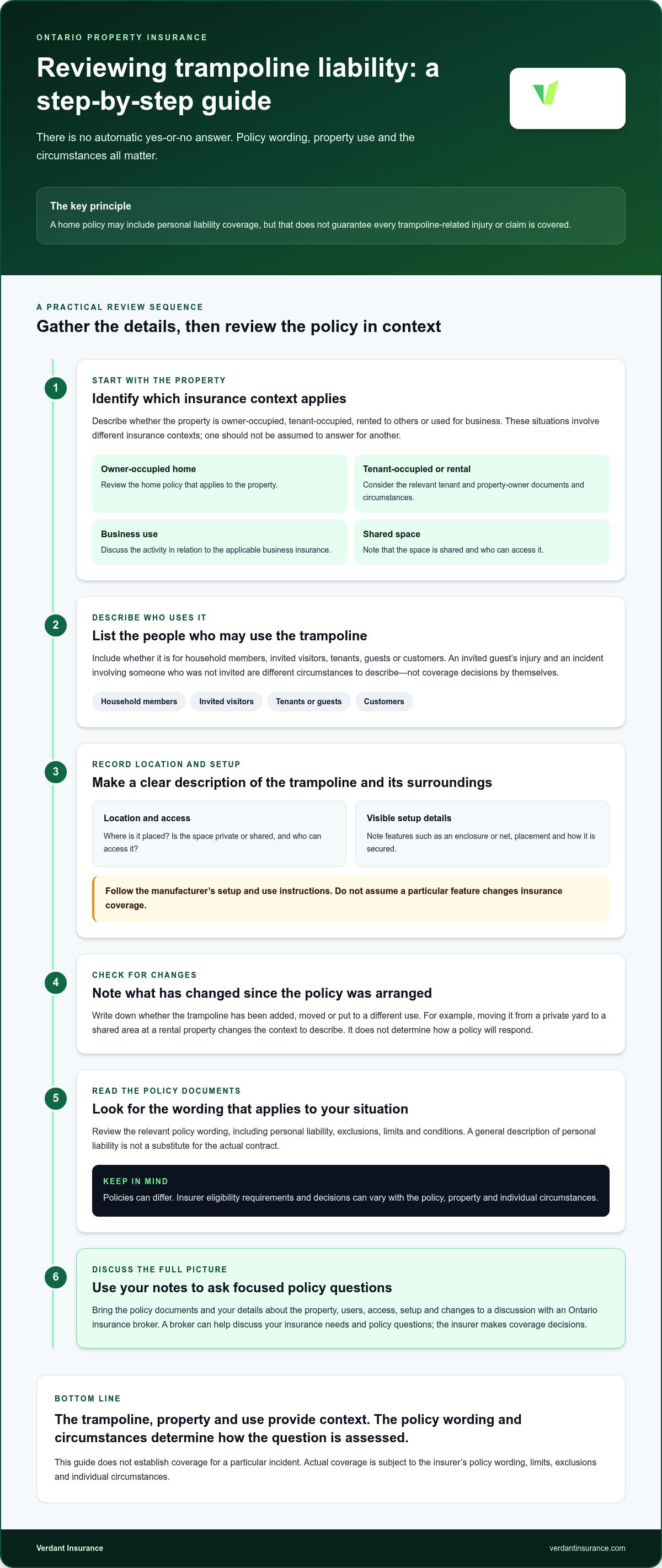
How Ontario residents can review trampoline liability step by step
A focused review helps you bring clear questions to an Ontario insurance broker. The goal is to understand which policy wording may be relevant, not to assume that a discussion guarantees coverage or predicts how a future claim will be handled. The insurer’s eligibility decisions and the policy wording, limits, exclusions and conditions govern the individual situation.
Use these steps to get organised:
- Identify the policy context. Note whether the trampoline is at your owner-occupied home, a rental property or business premises. If you are a tenant, distinguish your own policy from the property owner’s insurance.
- Gather current documents. Have the applicable policy wording, declarations, endorsements and renewal documents available. If you cannot tell which wording applies, flag that for the discussion rather than guessing.
- Write down the trampoline details. Record its location, who uses it, whether visitors or customers can use it, and how it is set up and used. Include changes since the policy began, such as moving it or making it available to a different group.
- Review the relevant language. Look for sections addressing personal liability, exclusions, conditions, limits and disclosure. Note the exact wording or page so you can ask about it. A section heading alone may not explain how the complete contract applies.
- Discuss the facts and questions with a broker. Explain the property and use plainly. Ask which policy wording is relevant and whether the details you have described affect the insurance discussion.
What should you ask an Ontario insurance broker?
Specific questions can make the conversation more useful. For example: “Which exclusions, conditions or limits should I read in my policy?” “Does the wording address a trampoline at this type of property?” “Does the way it is used change which policy details we should review?” If a sentence is unclear, ask for help locating the relevant language and identifying the question it raises.
Bring up changes to your home or property when they are relevant to your policy discussion. For general background on factors that can affect home insurance in Ontario, Verdant’s Average Cost of Home Insurance in Ontario: 2026 Price Guide may provide useful context. It does not determine how a trampoline is treated under your own policy. Pricing and eligibility vary by insurer and individual circumstances.
A broker can help you discuss your insurance needs and property details. The insurer remains responsible for eligibility and coverage decisions, and an initial conversation is not a promise that a policy will be accepted or that a future claim will be covered. Keep your notes and any explanation you receive with your policy documents so you can refer back to the discussion.
Discuss trampoline liability with a Verdant Ontario broker
The practical takeaway is to review three things together: the property the trampoline is on, how it is used, and what the relevant policy wording says. There is no reliable answer based on the word “trampoline” alone. The policy and individual circumstances guide the insurance discussion.
Verdant Insurance is an Ontario-based brokerage in Markham. A Verdant broker can help you discuss your property and insurance needs, identify relevant policy questions and review available insurance options. Verdant is a brokerage, not the insurer. Eligibility and coverage decisions rest with the insurer, and any response depends on the applicable wording, limits, exclusions, conditions and circumstances.
How can a broker help clarify the next step?
A broker can help you organise questions about which parts of your policy apply to the situation you have described and whether the property’s use is relevant. You can also ask for help locating exclusions, conditions or limits that may need closer review. This can make a complex policy discussion easier to follow, but it cannot guarantee a particular policy response or claim outcome.
For trampoline insurance liability in Ontario, keep the roles clear: a broker helps you discuss insurance needs and options, while the insurer’s policy wording and decisions determine how coverage applies. Pricing and eligibility may vary by insurer and individual circumstances. A conversation can help clarify the questions to address, but it is not a promise that coverage will be offered or that a future claim will be paid.
When should you bring the question forward?
Raise the issue when reviewing your home policy, at renewal, or when the property or the trampoline’s use changes. For example, explain if it has been moved, if visitors will use it, or if a residential property is now being rented. Describe the facts plainly instead of assuming how the policy treats them.
Have the relevant policy documents available, including any endorsements or renewal materials, and note the wording or questions you want to discuss. If the trampoline is at a rental or business property, identify that context clearly so the conversation starts with the right insurance needs.
With the property details and policy documents in hand, you can have a focused discussion rather than rely on guesswork. Ontario homeowners can speak with a Verdant broker about their home insurance needs and questions raised by a trampoline on their property.
Make your next policy review more useful
Insurance is one part of deciding how to use your outdoor space. Understanding the relevant policy wording can help you make that decision with fewer assumptions and keep your household’s needs in view.
Thinking about trampoline insurance liability Ontario in practical terms makes it easier to prepare: identify the policy, describe the setup and use, and note the wording you want to discuss. The aim is not to predict every possible outcome, but to make informed choices based on your circumstances.
With a thoughtful approach, you can make decisions about your home with a clearer understanding of the insurance questions involved.
Frequently Asked Questions
Does home insurance in Ontario cover trampoline liability?
Not automatically. Trampoline insurance liability in Ontario depends on the policy wording and the facts of an incident. Review the full contract rather than relying only on a general description of personal liability. Note whether an injury involved a household member or guest, where it happened, and how the trampoline was being used. The insurer assesses coverage under the applicable terms and circumstances.
Can an insurer exclude trampoline-related injuries from home insurance?
An insurer may use policy wording that excludes certain trampoline-related injuries or claims, but there is no universal rule that every Ontario insurer handles trampolines the same way. Check your policy for exclusions, conditions and limits, including any endorsements that may change its terms. If a clause is unclear, mark it and discuss its meaning in the context of your policy and property.
Do I need to tell my home insurer about a trampoline?
Review your policy’s wording about disclosure and changes to your property or risk, then discuss the trampoline with your insurer or broker if it is relevant. This is especially useful if you added one after arranging the policy or changed how the yard is used. Keep a note of when it was installed and the details you shared. Disclosure wording can differ between policies.
Does tenant insurance cover a trampoline at a rental home?
It depends on the tenant policy and circumstances. Tenant insurance relates to the tenant’s insurance needs, while the property owner’s policy addresses the owner’s interests in the building. If the trampoline belongs to the landlord or sits in a shared yard, identify that when reviewing your policy. Do not assume one policy answers questions about another person’s coverage or responsibilities.
What happens if a guest is injured on a trampoline at my home?
An injury does not establish by itself who is legally responsible or whether insurance will respond. The circumstances, applicable policy terms and any relevant limits or exclusions need to be considered. If an incident occurs, document the basic facts, including when and where it happened and who was present, and follow your policy’s instructions for reporting incidents or claims. In cases involving significant physical harm, legal advocacy from trial firms like Cowper Law highlights how personal injury liability is assessed beyond basic insurance claims. Do not assume an outcome before the facts are assessed.
Is trampoline liability coverage different for a business in Ontario?
Business use calls for a distinct insurance discussion because a household policy should not be assumed to address a commercial activity. Describe how the trampoline relates to the business, where it is located, and whether customers or other visitors can use it. The relevant business policy wording, exclusions, conditions and limits matter. A broker can help identify questions to raise, but the insurer determines eligibility and coverage under its terms.
What should I ask an Ontario insurance broker about trampoline liability?
Bring your policy documents and ask which wording applies, whether any exclusions or conditions are relevant, and what limits appear in the policy. Explain who owns the trampoline, where it is located and who uses it. Mention any changes to its location or use. A broker can help you discuss insurance options and questions for your situation, but the discussion is not a promise of coverage.


