

If you’re wondering how to save money on home insurance in Ontario, start by reviewing what affects your premium and whether your policy still fits your home and household. A lower price can look appealing, but changing your deductible, limits or optional coverage can also change the protection you have.
To compare options fairly, look at policies with equivalent limits, deductibles and coverage options. Premiums and available coverage vary by insurer and individual circumstances, so don’t judge a quote by price alone. First identify what has changed, what protection matters to you and which trade-offs you would be comfortable making.
This guide explains what to review, from home details and risk-prevention measures to deductibles and policy wording. You’ll also find a practical process for comparing quotes and questions to raise with an Ontario insurance broker.
Key Takeaways
- To understand how to save money on home insurance in Ontario, review your policy and compare equivalent options before making changes.
- Insurers may assess home and household details differently, so no single change guarantees a lower premium.
- Consider the trade-offs of changing your deductible, reviewing risk-prevention measures or comparing home and auto quotes together.
- Use consistent property details and coverage choices when comparing quotes, and revisit them at renewal or after a meaningful household change.
- A broker can help explain quote differences and policy options. Insurers determine eligibility, pricing and terms.
How to Save Money on Home Insurance in Ontario: Start with a Policy Review
Start with your current policy, then compare alternatives using the same key limits, deductibles and coverage options. Don’t remove protection just because doing so lowers a quote. Find out what would change and whether the revised policy would still suit your household and property.
No single adjustment guarantees a lower premium. Insurers assess information differently, and pricing depends on the insurer and your circumstances. A review is useful even if it doesn’t lower the cost: it can help you catch outdated details, understand renewal changes and make a more informed comparison.
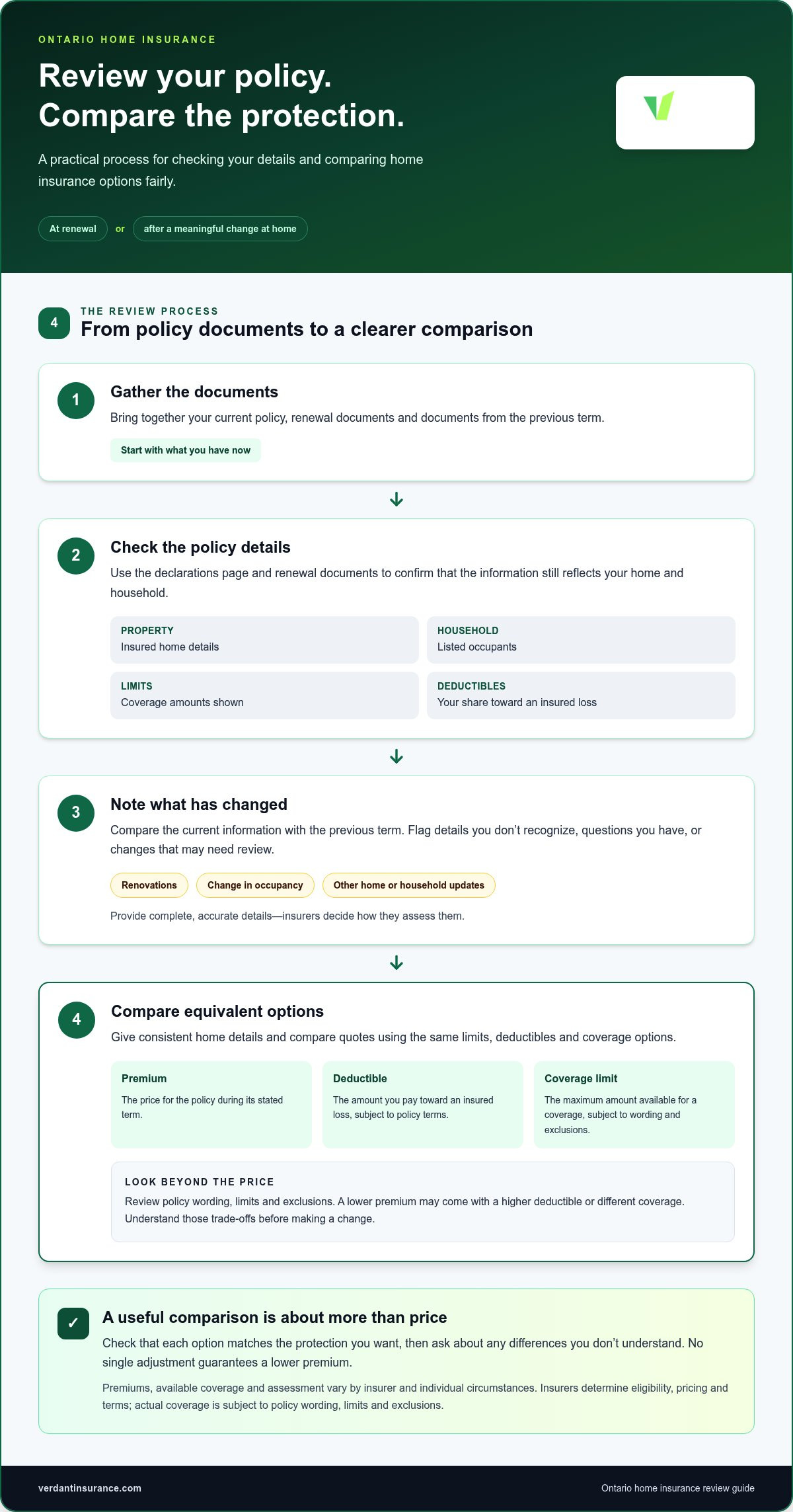
Before renewal, or after a meaningful change at home, take these steps:
- Gather your current policy and renewal documents, along with the documents from the previous term.
- Check the property details, occupants, limits and deductibles listed on the policy.
- Note changes, such as renovations or a change in who lives in the home.
- Write down your questions and compare alternatives using equivalent coverage details.
This gives you a clear starting point before considering adjustments. For a general overview of the purpose and common features of home insurance, see the linked reference. Your own policy’s terms determine the protection it provides.
Which parts of a home insurance policy should you review first?
Start with the declarations page, which summarizes important policy information. Check the insured property details, listed occupants, coverage limits and deductibles. Then compare your renewal documents with the previous term. Note changes to the premium or policy details, and flag anything you don’t recognize or understand.
Check that the information still reflects your home and household. A renovation may have changed the property details, for example, or a change in occupancy may mean the listed information needs an update. Don’t dismiss a detail just because it seems administrative. Accurate information makes comparisons more meaningful, although insurers decide how to assess it.
Keep a short list of discrepancies and questions. When comparing quotes, provide consistent details about the home and the coverage you want. If the information used to prepare each quote differs, it can be difficult to tell whether a price difference comes from the policy or the details provided.
Why the lowest premium may not be the lowest-risk choice
A lower premium may come with a higher deductible, different limits, changes to coverage or exclusions. These differences can affect what the policy may pay for and what costs you may need to handle yourself after a loss. A quote is useful only when you understand what sits behind its price.
Compare the protection as well as the premium. Check that each option reflects the limits, deductibles and coverage you want, then review any differences before deciding. Actual coverage is subject to insurer eligibility, policy wording, limits and exclusions. If a term is unclear, have it explained before making a change. The goal is to understand the trade-offs and choose coverage that aligns with your needs, not simply to pick the lowest price.
What Affects Home Insurance Premiums for Ontario Homeowners?
A home insurance premium is the amount paid for a policy during its stated term. Insurers may consider information about the property and applicant when setting a quote, but they don’t all assess the same details in the same way. A premium is the policy’s price, a deductible is the amount you pay toward an insured loss, and a coverage limit is the maximum amount available for a particular coverage, subject to the policy’s wording and exclusions.
Knowing these terms helps explain why two quotes may differ, even when they appear to protect the same home. The Ontario home insurance cost guide provides broader context on costs. Your own quote depends on the insurer, property and individual circumstances.
Property and household details that may influence a quote
Insurers may consider where a home is located, its characteristics, who lives there and what property is insured. The home’s type, age or condition may also be relevant to an insurer’s assessment. These are examples of information that could be considered, not a universal rating formula. The effect of any detail can vary between insurers and individual circumstances.
A general statement about a city or neighbourhood won’t tell you exactly how an insurer will assess your home. Instead, provide complete and accurate information when requesting or reviewing a quote. If something has changed, such as the home’s occupancy or a property detail, flag it for review rather than assuming how it affects the price. Consistent information also makes quotes easier to compare.
How deductibles, limits and policy wording affect comparisons
A deductible is the amount you’re responsible for paying toward an insured loss before the insurer pays the covered amount, subject to the policy terms. A higher or lower deductible can affect a quote, but it also changes your share of costs if you make a claim. Consider whether the amount would be manageable, not just whether it changes the premium.
Coverage limits matter too. If one quote has different limits or exclusions from another, the prices don’t represent equivalent protection. Policy wording explains how coverage applies, including relevant conditions, limits and exclusions. Don’t assume two similarly named options work the same way. Compare their actual terms and have any differences explained before choosing.
The linked Financial Services Commission of Ontario (FSCO) on insurance resource is about auto insurance, not home coverage. It doesn’t explain the terms of a home policy, so rely on the home insurer’s wording to understand what a particular quote covers.
Before considering a change, gather your policy details and decide what you want to compare. If quote differences or policy terms are unclear, a broker-led home insurance review can help you discuss the options and trade-offs.
Compare Home Insurance Savings Options in Ontario Without Creating Coverage Gaps
There are several ways to review the cost of a home policy, but each involves a different trade-off. The right option depends on your home, household priorities and the insurer’s terms. Use this comparison to prepare questions and understand what could change before adjusting your policy. Any potential benefit varies by insurer and individual circumstances.
| Option | Possible benefit | Trade-off to consider | Ask your broker |
|---|---|---|---|
| Review policy details | Correcting inaccurate information may help align the policy with your current situation. | A correction doesn’t guarantee a lower premium, and updated details may affect the insurer’s assessment. | Which details should be corrected, and how could that affect the quote or terms? |
| Change the deductible | A different deductible may affect the quoted premium. | You may have to pay more yourself after a covered loss. | How would each deductible option affect the quote and my out-of-pocket responsibility? |
| Consider risk-prevention measures | Some measures may be relevant to an insurer’s assessment of the home. | Suitability and any effect on the quote vary. Don’t assume a measure qualifies for a discount. | Could this measure affect the insurer’s assessment, and what details would be needed? |
| Compare multi-policy quotes | Reviewing home and auto together may show a different combined price or arrangement. | A combined price isn’t automatically lower or a better fit. Compare both policies in full. | How do the combined and separate options compare in total cost and terms? |
When is changing a deductible worth considering?
Consider changing your deductible only after weighing the quote against what you could comfortably pay out of pocket following a covered loss. A higher deductible can mean a larger immediate expense if you make a claim. There isn’t one level that suits every household, and no particular deductible guarantees a lower premium. Ask your broker to explain how the options affect both the quote and your share of a loss.
Think through a practical scenario: if you had to pay the deductible unexpectedly, would that amount fit your budget? If not, a lower quoted premium may not be worth the added financial pressure. Review the policy terms before deciding.
Can a home and auto insurance bundle reduce the total bill?
It can be useful to compare combined and separate quotes, but don’t assume a bundle includes a discount or will suit your needs. Compare the total premiums alongside each policy’s deductibles, limits, exclusions and renewal terms. A change to one policy can affect the overall arrangement, so assess both contracts rather than focusing on a single price.
As you compare, note any differences that need clarification and consider whether the combined arrangement still fits your priorities for both policies. This helps you weigh convenience and cost against the protection and terms offered.
A Step-by-Step Annual Home Insurance Review for Ontario
A repeatable review can help you spot outdated information and organize a fair quote comparison. Use this checklist at renewal or after a meaningful household change. It won’t guarantee a lower premium, but it can help you check that each quote reflects the same home details and the coverage you want to consider.
Prepare your home and policy information before comparing quotes
Gather your current declarations page and renewal documents, along with accurate details about the home and household. Note renovations, occupancy changes and property updates. These details may be relevant to an insurer’s assessment, but their effect on pricing varies. A useful comparison starts with the same home and coverage information for each quote.
Before requesting or reviewing quotes, work through this checklist:
- Confirm the property and household details you’ll provide are accurate.
- Keep your current declarations page and renewal documents nearby for reference.
- Record renovations, occupancy changes or property updates since your last review.
- Write down the limits, deductibles and relevant coverage details you want to compare.
- Note any questions about differences or policy terms that need clarification.
Consistent information makes comparisons more meaningful. For example, if one quote reflects a completed renovation and another doesn’t, the results may not be directly comparable. Report changes accurately, but don’t assume an update will automatically raise or lower the premium. Insurers assess details differently, and pricing depends on the insurer and individual circumstances.
Review quotes side by side before making a decision
Compare each quote’s premium alongside its limits, deductibles and relevant exclusions. Review the policy wording for details that could affect how coverage applies. If one quote differs, identify the specific difference and seek an explanation before treating it as an equivalent option.
A simple comparison sheet can help. Create a column for each quote and record its premium, limits, deductibles, exclusions and renewal terms. Mark anything missing or unclear. A lower figure may reflect different terms, so don’t decide on price alone.
A guide to average home insurance costs in Ontario can provide broader context, but treat averages as general reference points, not a promised benchmark for your home or a prediction of what an insurer will quote. Individual premiums vary.
Once you’ve gathered the documents and noted the differences, you’ll have a clearer basis for deciding what to ask about and which options merit closer review. Keep your comparison sheet with your renewal documents for your next review.
How an Ontario Insurance Broker Can Help You Review Home Insurance
A broker can help clarify quote differences and discuss policy options, making it easier to understand what you’re comparing. Verdant is an insurance brokerage, not an insurance company. Insurers determine eligibility, pricing and policy terms, and coverage is subject to the policy wording, limits and exclusions. A broker can explain the choices, but can’t promise a particular price or insurer decision.
What to expect when discussing a home insurance quote
A useful conversation can cover your home, current protection, household priorities and budget. Bring your policy and renewal documents, along with notes about renovations, occupancy changes or other updates. A broker can help clarify differences between quotes and discuss available options. What’s available and how it’s priced depends on the insurer and your individual circumstances.
Arrive with specific questions. For example, ask what explains a difference between two quotes, whether an option changes a policy term, or what information an insurer needs to assess your home. An Ontario guide to choosing an online insurance broker can offer additional context about the process.
If a policy term is unclear, ask for an explanation before making a decision. Recommendations depend on your details and insurer terms, so focus the conversation on options that fit your needs rather than assuming one solution works for every homeowner.
When to revisit your home insurance options
Renewal is a natural point to review your policy. You may also want to revisit it after a material change to your home or household, such as a renovation or change in occupancy. Check that the information on file remains accurate and clarify policy changes rather than making assumptions about how your protection applies.
Before a review, note what has changed, what you want your coverage to do and which terms you’d like explained. This preparation can make a broker conversation more focused and help you assess available options with a clearer understanding of the trade-offs.
Make Your Next Renewal a More Informed Decision
Keep a brief record of questions, policy changes and quote comparisons as you review your coverage. It gives you a reference for your next renewal and helps you notice when your home or household details have changed. Learning how to save money on home insurance in Ontario isn’t about reducing the premium at any cost. It’s about understanding what you’re paying for and what the policy says.
Even if you decide your current protection still fits, the review can help you make a more informed choice. Verdant Insurance is a Markham-based brokerage supporting Ontario homeowners with online quotes and policy support. Coverage and pricing depend on the insurer and your individual circumstances.
When you’re ready, use your policy documents and comparison notes to discuss home insurance options with Verdant.
Frequently Asked Questions
How can I lower my home insurance premium in Ontario without reducing important coverage?
Start by checking your renewal for changes and asking what options could affect the premium without removing protection you value. To explore how to save money on home insurance in Ontario, check whether policy details are outdated, whether your deductible fits your finances, or whether prevention measures could affect an insurer’s assessment. Ask what each change means, then review the revised terms before deciding. Pricing and options vary by insurer and household.
Does increasing my home insurance deductible always lower my premium?
No. Increasing the deductible doesn’t always lower a premium, and any effect depends on the insurer and your circumstances. Before changing it, consider whether you could manage the larger amount you’d pay yourself if a covered loss occurred. Ask for the premium difference and deductible amount, then weigh the possible cost change against your out-of-pocket responsibility. The policy terms determine how a deductible applies.
Can bundling home and auto insurance save money in Ontario?
It’s worth comparing, but combining home and auto policies doesn’t guarantee a discount or a lower total cost. Compare a combined quote with separate quotes, then check both policies for limits, deductibles, exclusions and renewal dates. A lower combined price may come with different terms on one policy, so assess the whole arrangement. Availability and pricing depend on insurer rules and individual details.
What home improvements could affect my insurance quote in Ontario?
Improvements to the roof, electrical or plumbing systems may be relevant to an insurer’s assessment. Water-protection features such as a sump pump, backwater valve or leak-detection system may also be considered. The effect isn’t automatic: insurers differ in the information they request and how they assess it. Keep records of completed work and equipment details, and report changes accurately when reviewing your policy or requesting a quote. Don’t assume an improvement creates a discount.
Should I compare home insurance quotes every year in Ontario?
Reviewing options at renewal can help you understand whether the price or terms have changed and whether another available policy fits your needs. You don’t have to switch simply because another quote is available. Compare offers using the same property details and desired protection, and account for policy wording and renewal dates. A quote is based on the information submitted; final terms, eligibility and price depend on the insurer.
Why did my Ontario home insurance premium increase at renewal?
A renewal increase can reflect several factors, which may differ by insurer and household. The insurer may have reassessed information about the home, claims history or the cost associated with insuring the property. Check your renewal documents for changes, then ask which factors contributed and whether any policy terms changed alongside the price. Don’t assume the increase means your coverage improved or weakened. Compare the renewal wording with your current policy.
Does making a home insurance claim affect my future premium in Ontario?
It may affect future pricing or an insurer’s decision, but the outcome depends on the insurer, claim details and your circumstances. A claim doesn’t produce the same result for every policyholder. Before deciding whether to make a claim, review your deductible and policy terms, and consider asking how the insurer handles the situation. Don’t delay urgent steps needed to protect people or prevent further damage while seeking clarification about insurance consequences.


