

Could your residence room, parents’ policy or roommate’s insurance leave you without the protection you expect? Tenant insurance for students depends on more than where you sleep. Your housing arrangement, lease terms and the people named on a policy can all affect what to review.
It’s easy to assume you’re covered through family or that one policy covers everyone in a shared rental. Those assumptions can leave important questions unanswered. Coverage depends on the insurer, your circumstances and the policy wording, including its limits and exclusions.
This guide explains what Ontario students should consider in residence and off-campus housing, how to review a parent’s or roommate’s policy, and how to estimate the value of personal belongings. It also outlines the role of contents, personal liability and additional living expenses coverage so you can compare options with a clearer picture of your needs.
Key Takeaways
- Start with your housing arrangement. Residence, an off-campus rental and living with family can raise different insurance questions.
- Review coverage for your belongings, personal liability and additional living expenses, including relevant limits and exclusions.
- Don’t assume a parent’s policy or a roommate’s insurance covers you. Eligibility and protection depend on the policy and your circumstances.
- Before comparing options, identify your housing, inventory your belongings and gather relevant rental or residence agreements and policy documents.
- A broker can help you explore tenant insurance options. The insurer’s policy wording determines what coverage applies.
Tenant insurance for students in Ontario: why housing type matters
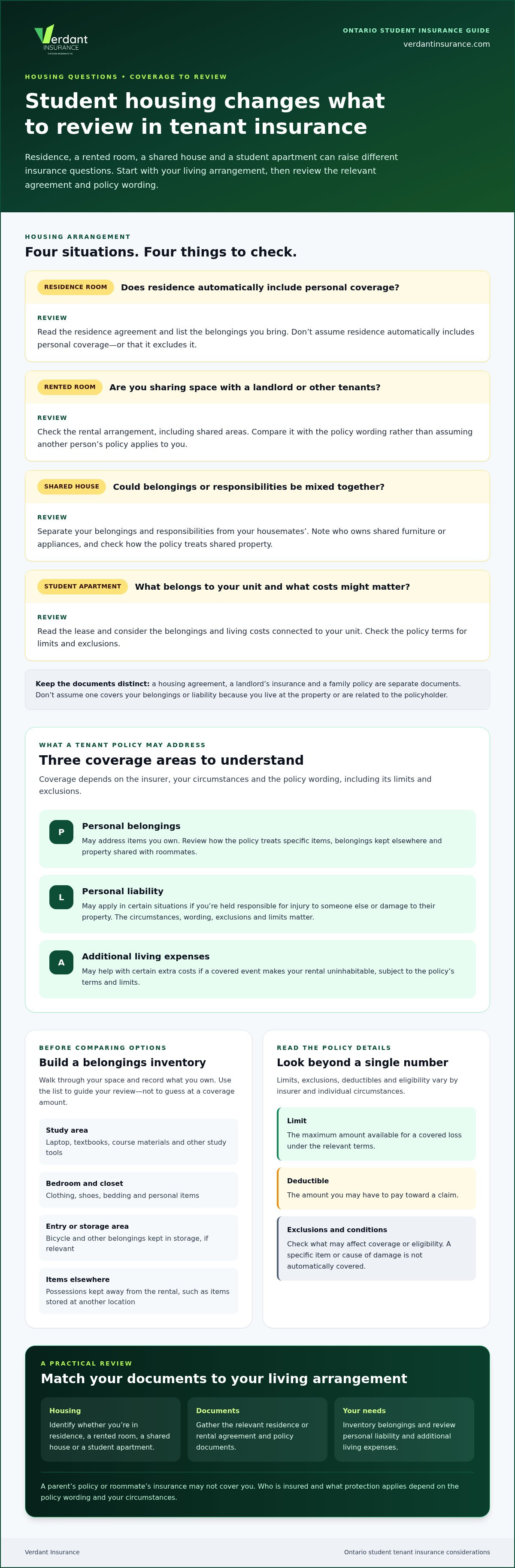
For tenant insurance for students, begin with the housing arrangement. A campus residence room, a rented room in a private home, a shared house and a student apartment can involve different agreements and living arrangements. Your insurance questions also depend on what you own and whether another policy may apply to you.
Tenant insurance is designed to address a tenant’s personal belongings, personal liability and additional living expenses after certain covered events. The policy wording, limits and exclusions determine what applies to your circumstances. For a general overview of the term, see Renters insurance.
Does student residence housing change the insurance question?
It can. Campus residence is arranged through a residence agreement, while a private apartment is usually rented under a lease. Read the document for your housing and note any insurance terms and stated responsibilities. Don’t assume that residence automatically includes personal coverage, or that it excludes it.
A requirement in an agreement and a requirement under Ontario legislation are separate questions. Review the current agreement, and use authoritative Ontario information for legal questions rather than relying on a general assumption.
What can tenant insurance be designed to address?
Consider three parts of a tenant policy. Personal belongings coverage may address items you own. Personal liability may apply if you’re held responsible for injury or property damage. Additional living expenses may help with certain extra costs if a covered event makes your home uninhabitable. Each part is subject to policy terms, limits and exclusions.
Your type of housing can help you decide what to review:
- Residence room: Read the residence agreement and list the belongings you bring with you.
- Rented room: Review the rental arrangement, especially if you share common areas with a landlord or other tenants.
- Shared house: Separate your belongings and responsibilities from those of your housemates.
- Student apartment: Review the lease and consider the belongings and living costs connected to your unit.
These examples aren’t automatic coverage rules. A policy defines insured people, property and covered situations in its own terms. A landlord’s insurance and a family policy are also separate documents. Don’t assume they cover your belongings or liability simply because you live at the property or are related to the policyholder.
Before deciding whether a separate policy fits, compare the relevant agreement with the policy wording. That helps you focus on your actual housing arrangement rather than treating all student accommodation as the same.
What student tenant insurance may address in a rental
For tenant insurance for students, distinguish coverage for your belongings from personal liability. A policy may address both, and may include additional living expenses if a covered event makes your rental uninhabitable. None applies automatically to every item, loss or incident. Review the policy wording to understand what applies to your situation.
A laptop, bicycle or set of textbooks may be important to your studies, but don’t assume a particular item or cause of damage is covered. Limits, exclusions, deductibles and eligibility vary by insurer and individual circumstances. The same applies to belongings kept outside the rental or property shared with roommates.
How to think about belongings and replacement needs
An inventory can help you consider how much belongings coverage to explore. Walk through your living space and record what you own instead of relying on memory. The purpose is to create a useful list and flag items that need closer review, not to guess at a coverage amount.
- Study area: Note electronics such as a laptop, textbooks, course materials and other study tools.
- Bedroom and closet: Include clothing, shoes, bedding and personal items.
- Entry or storage area: List a bicycle and other belongings kept in storage, if relevant to your arrangement.
- Items elsewhere: Record possessions kept away from the rental, such as belongings stored at another location.
For each item, note who owns it and where it’s usually kept. This matters in a shared household, where furniture or appliances might belong to a roommate or be jointly owned. Policy wording determines how shared property and belongings kept elsewhere are treated, so use the inventory to guide your review rather than assume they’re covered.
What liability and policy limits mean for students
Personal liability may respond in certain situations where you’re held responsible for injury to someone else or damage to their property. For example, a landlord or another person might allege that you accidentally caused damage. An allegation alone doesn’t establish that a policy will respond. The circumstances, policy wording, exclusions and limits matter.
As you review a policy, note its liability limit and deductible. A limit is the maximum amount available for a covered loss under the relevant terms. A deductible is the amount you may have to pay toward a claim. Compare these details with the exclusions and any conditions that affect eligibility. Don’t judge a policy by one number without understanding what it applies to.
Additional living expenses may help with certain extra costs if a covered event prevents you from living in the rental, subject to the policy’s terms and limits. You can explore tenant insurance with an Ontario broker and discuss how your housing and belongings fit into your insurance needs.
Parents' insurance, roommates, or a student policy: what to compare
A parent’s policy or a roommate’s arrangement may seem like a straightforward solution, but don’t assume either covers you. Sharing an address, rent or a room doesn’t establish who is insured or which belongings and situations a policy addresses. Compare the actual policy terms with your living arrangement before deciding what fits.
Use this table to organize the questions. It’s a starting point, not a coverage determination. Eligibility and protection depend on the insurer, policy wording and individual circumstances.
| Option | What to review | Key question |
|---|---|---|
| Parent’s policy | Eligibility while living away for school, the student’s residence, and how the policy treats the student’s belongings and liability. | Does the wording include this student and this living arrangement? |
| Roommate arrangement | Who is named or otherwise identified as insured, whose property is involved, and how the policy applies to shared spaces or possessions. | Does the policy address this student, not just the roommate who arranged it? |
| Individual student policy | Who the policy is for, the rental address, selected coverage, limits, deductibles and exclusions. | Does the policy wording fit the student’s own situation and needs? |
Could a parent's policy apply while a student is away?
Possibly, but don’t rely on family relationship alone. Review the policy’s eligibility terms and how they describe a student living away from home for school. Consider the student’s residence, relationship to the policyholder and how belongings kept at school are treated. A Verdant broker can help you discuss your circumstances and review the relevant policy details. The applicable wording and insurer terms determine whether coverage applies.
Does sharing rent mean sharing insurance?
No. Roommates may split rent and share common areas, but that doesn’t automatically make everyone insured under the same policy. Check who the policy identifies as insured and how it treats each person’s belongings and responsibilities. A policy arranged by one tenant may not address every roommate’s situation.
Compare the documents, not verbal shorthand like “we’re covered.” Gather the parent’s policy if you’re considering family coverage, the roommate’s policy if you plan to rely on it, and the rental or residence agreement. Review definitions of insured persons, residence or premises, property, exclusions and relevant limits. If a term is unclear, note the specific question rather than assuming the broadest interpretation.
Then compare the options with your needs. Does the policy address your housing arrangement? How does it treat property you own versus shared items? What limits, deductibles and exclusions apply? These details can help you decide whether an existing policy fits or whether to explore an individual policy. Coverage and eligibility vary, so the insurer’s terms and your circumstances determine the answer.
How Ontario students can prepare to explore tenant insurance
Prepare a few details before comparing tenant insurance options. This four-step process helps you organize the information most relevant to your housing and belongings.
- Identify your housing. Note whether you’ll live in campus residence, a rented room, a shared house or an apartment. Record the address, expected move-in timing and who you’ll live with. Insurers may ask for different information, but these details help explain your situation.
- Make a belongings inventory. List the items you own and where you usually keep them. Include belongings you take between your family home and school so you can describe what’s at the rental and what’s elsewhere.
- Review your agreements and current policies. Gather your lease or residence agreement and relevant household policy documents. Keep a parent’s or roommate’s policy available if you’re considering relying on it.
- Compare policy details. Review who is insured, the coverage categories, limits, deductibles and exclusions. Consider how the terms fit your housing and belongings.
What information should a student gather first?
Keep a short summary of your housing type, move-in timing, roommates and any existing household policy. Your inventory can identify belongings that travel between home and school, along with where they’re kept. This is a practical starting point for a discussion, though each insurer may request or assess information differently.
How to review a quote or policy summary
Start by checking the named insureds and whether the documents describe your household and rental. Compare the coverage categories and limits with the needs you identified. Review the deductible, exclusions and any wording that affects eligibility or how a loss is handled. A quote or summary helps you compare options, but it doesn’t replace the full policy wording.
Use the documents side by side. A lease or residence agreement describes the housing arrangement; a policy explains insurance terms. Neither replaces the other. Note anything you can’t interpret, such as whether a particular person is insured or how a limit applies, and raise that specific question when reviewing the policy.
Policy wording, limits, deductibles, exclusions and insurer eligibility determine how options compare. Don’t rely on a quote summary or broad label alone.
With your agreements and policy documents in hand, you can discuss your circumstances and explore options through Verdant, an Ontario insurance brokerage based in Markham.
Explore student tenant insurance with an Ontario broker
An Ontario insurance broker can help students explore tenant insurance options for their housing arrangements. Verdant Insurance is a property and casualty insurance brokerage based in Markham, not an insurer or policy underwriter. Insurers set their own eligibility requirements, premiums and policy terms, so options depend on the insurer and the student’s circumstances.
A broker discussion gives you a place to explain the details that make your situation distinct, such as living in residence, renting a room or sharing an apartment. A broker can help you explore options, while the insurer makes underwriting and claims decisions under its rules and policy terms.
What an insurance broker does in the process
A broker helps customers explore insurance options and discuss how their circumstances relate to those options. Explain your housing setup and ask questions about the terms presented. The insurer determines eligibility and coverage under its terms, and the policy wording remains the reference for what applies.
Questions to resolve before choosing a policy
Before making a decision, be clear about who needs insurance and where each person lives. Review the proposed documents with these questions in mind:
- Who is identified as insured, and does that match the student’s housing arrangement?
- Which coverage categories and limits are shown?
- What deductible applies, and which exclusions or conditions could affect coverage?
- Are any belongings or responsibilities shared with parents or roommates, and how do the policy terms address them?
A quote can help you consider an option, but it doesn’t replace reviewing the policy wording, limits, exclusions and deductibles. Identify any unclear detail and resolve the specific question before relying on an assumption. That keeps the decision grounded in your living arrangements and the insurer’s terms.
Plan ahead for your next housing change
Your student housing may change as school plans develop. Moving from residence to an off-campus rental, heading abroad for an exchange, changing roommates or returning home can all affect the details relevant to insurance. Even for students relocating internationally and organizing housing like student accommodation Lancaster, lease terms and contents protection require the same careful evaluation. When your living arrangement changes, review whether your current approach still fits instead of relying on assumptions from your previous address.
For tenant insurance for students, a useful next step is to discuss your actual plans. Bring up questions tied to a new address or a change in who lives with you. You don’t need to have every answer before you start. A clear summary of your plans can make it easier to explore options.
With thoughtful questions and a little preparation, you can approach your next housing decision with greater confidence.
Frequently Asked Questions
Is tenant insurance required for students in Ontario?
Ontario law doesn’t generally require tenants to buy tenant insurance, but a rental or residence agreement may set out an insurance condition. Read the agreement for your housing and check its wording before signing or moving in. A requirement in an agreement and a legal requirement are different things. If you’re unsure what a clause means, get advice specific to your situation instead of relying on a general assumption.
Can a student be covered by their parents' tenant insurance?
Possibly, but don’t assume a parent’s tenant policy includes a student living elsewhere for school. The insurer’s eligibility terms may depend on details such as the student’s relationship to the policyholder and where they live. Review the relevant policy wording, including how it treats the student’s belongings and liability. A parent’s home policy may have different terms, so the policy type matters too.
Do roommates need separate tenant insurance policies?
Roommates should each find out whether they’re insured under the arrangement they plan to rely on. Sharing rent or an address doesn’t establish insured status, and a policy may identify only certain people. Review the named insureds and how the terms apply to each roommate. Separate policies may be appropriate, but the answer depends on the insurer’s wording and the household’s circumstances.
What does tenant insurance cover for a student?
A policy may include coverage for personal belongings, personal liability and additional living expenses, but the details differ. Check whether a particular loss involving a laptop or other study item is included, and what deductible or limit applies. Don’t assume every cause of loss or every item is covered. The policy’s exclusions, conditions and limits determine how it may respond.
How much tenant insurance does a student need?
There’s no single coverage amount that fits every student. Consider what you own, the cost of replacing those belongings, and the liability limit and deductible shown in policy options. Think beyond your bedroom, too. Include property you rely on for school or daily life. Compare limits with your circumstances rather than choosing based on a general rule.
What happens if a student moves from residence into an apartment?
Review your insurance arrangements before moving, since a new address and rental setup can affect eligibility or policy details. Tell the relevant insurer or broker about the change and ask whether the existing policy needs updating or a different option should be considered. Read the apartment lease for any insurance terms, and understand when policy changes take effect before relying on them. For example, when moving into furnished housing arranged through a lettings agency such as Nicholson Lettings, reviewing the inventory and agreement helps clarify what belongs to the accommodation versus what requires your own personal tenant coverage.
Can a student get tenant insurance for a rented room?
A rented room may be eligible for tenant insurance, depending on the insurer’s requirements and the student’s circumstances. Describe the arrangement accurately, including whether common areas are shared and whether the landlord lives in the home. Review how the policy addresses the room, belongings and other insured people. Eligibility and coverage depend on the insurer’s terms, so room rentals aren’t all treated alike.


