

Could driving fewer kilometres make a mileage-based policy a better fit, even if your routine changes from month to month? That’s the key question behind pay as you go car insurance Ontario drivers may be considering. The idea can sound simple, but it’s natural to wonder how extra kilometres affect what you pay.
If you drive less, a plan that links part of your cost to mileage may be worth exploring. But pay-as-you-go insurance isn’t necessarily the same as telematics that assesses driving habits such as braking or speed. Some Ontario programs track distance only, while other usage-based plans consider driving behaviour too. The details depend on the insurer and program.
This guide explains how mileage-based insurance works, what to review if you drive more than expected, and which terms to compare with your current driving habits. You’ll also learn how to assess pricing, eligibility, coverage and data collection, so you can decide whether the structure makes sense for your Ontario driving, not just whether the label sounds appealing.
Key Takeaways
- Pay-as-you-go arrangements link some insurance costs to mileage, but pricing and policy terms depend on the insurer and program.
- For pay as you go car insurance Ontario options, review how mileage is recorded, when charges apply and what happens if your driving increases.
- Estimate your annual kilometres using recent driving patterns, commute changes and occasional longer trips.
- Compare complete quotes and policy documents, including payment arrangements, tracking requirements, limits and exclusions.
- Neither mileage-based nor traditional insurance guarantees a lower premium. Pricing, eligibility and coverage vary by insurer and individual circumstances.
What Pay-as-You-Go Car Insurance Means for Ontario Drivers
Pay-as-you-go car insurance is an arrangement that links at least part of an auto insurance cost to how far a vehicle is driven. Other parts of the premium and policy still depend on the insurer’s pricing and coverage terms. Mileage can affect the cost, but it isn’t necessarily the only factor. The phrase describes a broad approach, not one standard Ontario policy or calculation.
For someone researching pay as you go car insurance Ontario, that distinction matters. One program might use a base amount plus a mileage-based charge, while another could apply mileage information differently. The exact structure, eligibility and policy terms vary by insurer and product, so the label alone doesn’t explain how the final premium is calculated.
Auto insurance pricing may also account for details beyond distance, and a policy includes more than its payment method. For a general overview of the wider category, see What is Usage-Based Insurance? Then review the insurer’s product wording to understand how its specific mileage-based option works.
How mileage-based insurance differs from standard payment plans
Paying a premium monthly or on another instalment schedule doesn’t automatically make a policy pay-as-you-go. Instalments divide a premium into payments; they don’t necessarily change how the premium is calculated based on distance. A mileage-linked arrangement, by contrast, gives recorded or reported driving distance a defined role in its pricing structure. There isn’t one universal per-kilometre formula, so the insurer’s terms explain how mileage affects charges.
For example, a driver could pay an existing policy premium in regular instalments while driving either a short or long distance. The payment schedule alone wouldn’t show whether mileage changes the amount owed. With a mileage-based product, distance has a defined role in the cost calculation, though other rating information and policy details may still apply. When comparing options, separate two questions: how is the price determined, and how is that price paid?
Pay-as-you-drive and usage-based insurance: are they identical?
Not always. Insurers may use terms such as “pay-as-you-drive” and “usage-based insurance” differently, and programs can vary in what they measure. A mileage-focused option uses distance as its measurement. Other usage-based programs may also assess driving behaviour, such as braking or speed. Read the product wording to find out exactly what is measured and how, rather than relying on the program name.
This distinction helps you avoid comparing unlike options. If a program measures mileage only, its terms should explain how distance is recorded and how it affects the price. If it also monitors driving behaviour, review what data is collected and how the program says that information is used. Tracking methods and pricing rules are specific to each program, so don’t assume two products with similar names work alike.
Use the label as a starting point, not a complete description. Before deciding whether mileage-based insurance fits your Ontario driving, identify which parts of the cost are linked to distance, which other factors may apply, and what the written terms say about measurement and pricing. That gives you a clearer basis for comparing it with a conventional policy paid in instalments.
How Pay-as-You-Go Car Insurance Can Measure and Charge for Driving
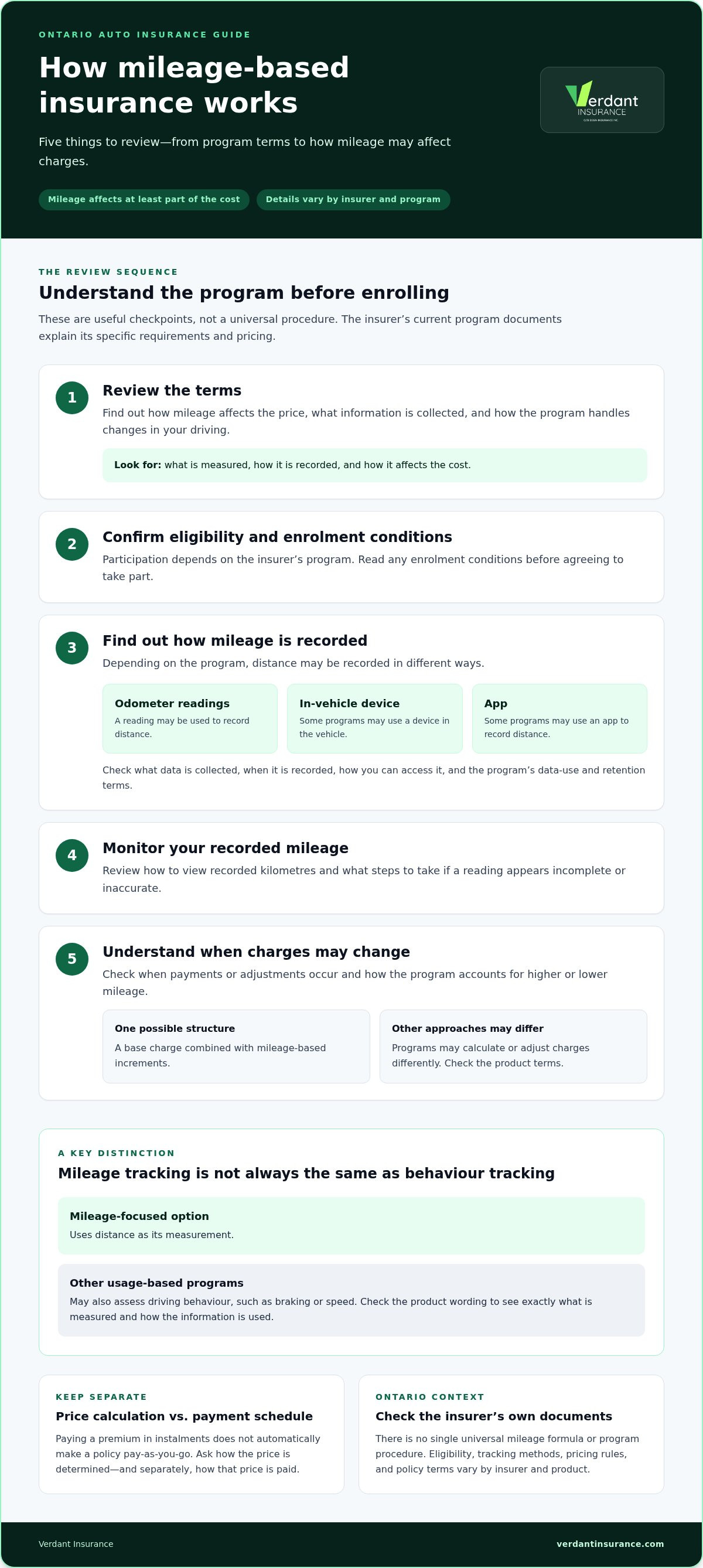
For drivers considering pay as you go car insurance Ontario, the key is to understand the program’s process before enrolling. A mileage-linked policy may involve several steps, but enrolment requirements, tracking methods and billing approaches depend on the insurer and product. Use this sequence as a guide, then compare it with the current policy documents.
- Review the terms. Find out how mileage affects the price, what information is collected and how the program handles changes in driving.
- Confirm eligibility and enrolment conditions. Participation depends on the insurer’s program. Read any enrolment conditions before agreeing to take part.
- Record mileage. Depending on the program, distance may be recorded through odometer readings, an in-vehicle device or an app.
- Monitor your use. Review how to view recorded kilometres and what steps to take if a reading appears incomplete or inaccurate.
- Review charges. Understand when payments or adjustments occur and how the program accounts for higher or lower mileage.
These are possible stages, not a universal procedure. FSRA provides Ontario context for usage-based insurance in its Ontario's Regulatory Stance on Pay-as-You-Go Insurance material. Each insurer’s current documents explain how its specific program works.
What mileage tracking may involve
Tracking could rely on odometer readings, a connected device or an app, but not every program uses the same method. The product documents should specify what data is collected, when it is recorded and how you can access it. Before enrolling, review the program’s data-use and retention terms, along with any permissions or device requirements. This helps you understand what participation means in practice.
How billing may respond to recorded kilometres
Some programs may combine a base charge with mileage-based increments; others may calculate or adjust charges differently. Don’t assume a particular kilometre band, billing interval or automatic payment rule applies to every option. Review what happens when your use changes, including whether and when additional charges may apply. The program terms should explain how a billing adjustment is calculated and where you can review the mileage used.
Picture a routine that shifts from short local trips to a longer commute. The practical question isn’t just how far you expect to drive today; it’s how the selected program responds if that pattern changes. Review the terms for the relevant billing period, payment timing and process for addressing mileage records that seem incorrect. Keep billing notices alongside your own mileage notes so you can compare the figures and follow the program’s process if something doesn’t appear to match.
Pay-as-You-Go vs. Traditional Auto Insurance: What Should You Compare?
A mileage-based policy and a traditional policy can differ in how costs are calculated and how your driving is tracked. But lower annual mileage doesn’t automatically mean a mileage-based option will cost less. Compare the complete quote and terms, not just the part of the price connected to kilometres. Neither structure guarantees a lower premium. Pricing and eligibility vary by insurer and individual circumstances.
| What to compare | Mileage-based structure | Traditional structure |
|---|---|---|
| Pricing basis | Some costs are linked to recorded or reported mileage. Other rating factors may still apply. | The premium is priced under the insurer’s regular policy structure. Paying in instalments doesn’t necessarily link cost to distance. |
| Mileage monitoring | The program may track or request distance information. The method depends on the product. | Distance may not be used as an ongoing payment measure, though the insurer’s policy terms govern what information is required. |
| Usage variability | Changes in kilometres may affect charges, depending on the program’s rules. | Driving more or less may not change instalment amounts during the policy term, but the policy and pricing terms still apply. |
| Program-specific terms | Review tracking, billing, eligibility and any mileage-related conditions. | Review the quoted premium, payment schedule and policy wording. |
This comparison is a starting point, not a recommendation for every driver. With pay as you go car insurance Ontario options, the useful question is how a specific program’s total cost and requirements compare with a traditional quote for the coverage you’re considering.
When a mileage-based structure may fit your routine
Infrequent driving, predictable annual use or access to another regular way to travel can be useful considerations when assessing a mileage-based structure. They don’t establish eligibility or guarantee a lower price. The insurer determines whether a program is available for your circumstances, and its terms determine how mileage affects the cost. Think about your actual routine, not just an unusually quiet stretch of driving.
Consider whether your estimate includes regular errands, commuting, appointments and occasional longer trips. A driver who uses a car sparingly for much of the year may still have periods of heavier use. If your routine is likely to change, factor that uncertainty into the comparison instead of assuming today’s mileage will continue.
What to weigh against convenience and price
Compare the full quoted premium and payment arrangements, including any mileage-linked charges described in the offer. Then consider the practical side: whether the tracking method suits you, whether the program’s data practices feel acceptable, and how it handles changes in use. A lower mileage estimate alone can’t show whether the overall arrangement is a better fit.
Before choosing, make sure your comparison reflects the same coverage and policy details. Review the insurer’s wording for limits, exclusions, eligibility and program conditions, since these may differ. If your commute changes or you take occasional longer trips, understand how those kilometres are treated. A useful comparison weighs price, predictability and tracking requirements together.
How Ontario Drivers Can Decide Whether Mileage-Based Insurance Fits
Whether mileage-based insurance suits you depends on more than how little you drove last month. Compare your recent habits with the kilometres you realistically expect to travel, then assess the full quote and policy documents. For pay as you go car insurance Ontario drivers should consider how their routine may change, what the program tracks and how mileage affects charges.
Start with this checklist:
- Recent driving: Review odometer records or a travel log to see how much you’ve actually driven.
- Expected annual use: Include regular errands, commuting, appointments and other recurring trips.
- Possible routine changes: Consider a new workplace, a different commute, a move or changes to household travel.
- Occasional longer trips: Account for vacations, seasonal travel and visits that may add kilometres.
- Full policy comparison: Compare the complete quote and documents, not just an advertised mileage feature.
Your Ontario location, driver profile, vehicle, insurer and selected coverage can all affect the terms and price offered. Eligibility and pricing vary by insurer and individual circumstances, so a mileage estimate alone can’t tell you whether a program is available or what your premium will be.
Estimate your likely mileage without treating it as a guarantee
Use recent odometer readings, if available, or keep a travel log to build a practical estimate. Look beyond a typical week: seasonal driving, a change in work arrangements or a longer trip can alter your yearly use. Some trips may not happen predictably, so allow for uncertainty rather than treating one quiet period as your normal pattern. An estimate helps you compare options; it doesn’t determine eligibility or guarantee a future premium.
Review program, privacy, and policy terms before deciding
Before enrolling, read how the program records and reports mileage, what information it uses, and how you can review it. Look for terms explaining payment adjustments if your driving changes and what to do if recorded mileage appears incorrect. Also review the policy wording, limits, exclusions and eligibility requirements. A mileage feature doesn’t replace understanding the coverage in the policy itself.
Price is only one part of the decision. Consider whether the tracking method works for you, whether the data practices are acceptable, and whether the payment structure feels manageable if your routine shifts. Compare quotes using the same information and coverage details so you’re weighing like against like. For a broader perspective on comparing policies and evaluating price alongside coverage, the car insurance buying guide can help frame your review.
Before moving forward, write down the parts of the arrangement that matter most to you, such as predictable payments, minimal tracking or flexibility if your travel changes. That short list can help you judge whether the trade-offs fit your priorities, rather than choosing based on mileage alone.
How to Compare Ontario Quotes and Take the Next Step
A useful quote comparison starts with accurate information and ends with a careful read of the policy documents. For pay as you go car insurance Ontario options, look beyond the initial price: compare how mileage is measured, how charges may change, and what coverage the quote describes. A quote is an estimate based on the information provided, not a promise of eligibility, coverage or savings. Final terms depend on the insurer and your circumstances.
- Gather your details. Organize accurate information about the vehicle, drivers, location and expected use requested during the quote process.
- Request relevant quotes. Compare mileage-based options with a traditional policy, where available, using consistent driver, vehicle and coverage details.
- Compare the full terms. Review total quoted premiums, mileage rules, tracking requirements and payment arrangements, not just the advertised feature.
- Read the policy wording. Check applicable limits, exclusions, eligibility conditions and how the mileage program fits with the policy.
Keep the quote details together with the documents you’re comparing. That makes it easier to spot differences between options and identify what needs clarification before making a decision.
Information to have ready for an Ontario auto insurance quote
Prepare the vehicle and driver details requested during the quote process, along with your Ontario location and an accurate description of how the vehicle is used. Have a realistic mileage estimate in mind and note any expected commute or routine changes. Recent odometer readings or a travel log can help you form that estimate, but no particular record guarantees eligibility or a specific rate.
Accuracy matters. If your expected driving includes occasional longer trips or may change because of work or household needs, include that context where relevant. A quote based on incomplete or outdated details may not give you a fair basis for comparison. Review the insurer’s written terms to understand how mileage changes may affect charges, rather than assuming the estimate fixes future costs.
How a broker can help clarify the options
An insurance broker can help review auto insurance options and explain differences in insurer-specific terms, including how payment arrangements relate to policy wording. Verdant Insurance is an Ontario brokerage, not the insurer underwriting a policy. The insurer sets eligibility, pricing and policy terms, which remain subject to the applicable wording, limits and exclusions.
Once you have comparable quotes, take time to resolve questions about tracking, billing or coverage before choosing. A conversation with a Verdant broker can help you assess those details in light of your driving needs.
Explore Verdant’s Ontario auto insurance service or speak with a Verdant broker to discuss your options.
Make Your Next Insurance Review More Useful
Your driving routine can change, so treat a mileage estimate as a snapshot rather than a permanent measure. Revisit it when your commute, work schedule or household travel shifts. That gives you a clearer starting point when considering pay as you go car insurance Ontario and comparing it with other options. Pricing, eligibility and coverage vary by insurer and individual circumstances, so base your decision on the terms that apply to you.
A broker conversation can help you consider how an insurance option fits your driving needs and clarify insurer-specific policy terms. Verdant Insurance is an Ontario-based brokerage in Markham, offering auto insurance and customer support.
Explore Verdant’s auto insurance options or speak with a Verdant broker to discuss your next steps.
Frequently Asked Questions
Is pay-as-you-go car insurance available in Ontario?
Yes, mileage-based insurance options are available in Ontario, though availability and eligibility depend on the insurer and program. Some usage-based insurance programs also consider driving behaviour, so review whether an option measures distance alone or uses other driving information. If you’re comparing pay as you go car insurance Ontario options, read the current product terms rather than relying on the program name or a general description.
Does pay-as-you-go insurance provide the same coverage as a regular auto policy?
Not automatically. A mileage-based payment structure doesn’t, by itself, tell you which coverages are included. Compare the policy documents for each option, including the coverage selected, limits, exclusions and eligibility terms. If two policies appear to offer the same coverage, confirm that in their written terms rather than assuming the only difference is how payment is calculated. The insurer’s policy wording determines the coverage that applies.
What happens if I drive more kilometres than I expected?
The effect depends on the program’s mileage rules. Additional kilometres might change charges or prompt a billing adjustment, but the exact process and timing vary. Review how the insurer handles increased use before enrolling, especially if your commute or work schedule could change. If your recorded mileage is higher than expected, follow the program’s stated process to review the reading and understand how the change affects your account.
Does mileage-based insurance track where I drive?
Not necessarily. A mileage-only program may measure distance without assessing routes, while a device or app’s data permissions can differ by program. Read the insurer’s privacy and product documents to see what information is collected, when it is recorded, and how it is used or retained. Don’t assume that “mileage tracking” means location is or isn’t collected; review the specific terms and app or device permissions.
Is pay-as-you-go insurance the same as usage-based insurance?
Pay-as-you-go is often used for arrangements that connect some costs to mileage. Usage-based insurance is a broader label that can include mileage tracking or programs that also assess driving behaviour. Insurers may use these names differently, so the wording alone may not reveal what a program measures. Review the insurer’s current description and policy documents for the data collected and how it may affect pricing.
Can I pause my car insurance when I am not driving?
Don’t assume that parking a vehicle or taking a break from driving pauses the policy or its payments. Options for changing, suspending or removing coverage depend on the insurer, policy and circumstances, and changes may affect protection while the vehicle is parked. Speak with your broker before making a change, and confirm any revised terms in writing. Keep the vehicle’s use and storage situation accurately described.


