

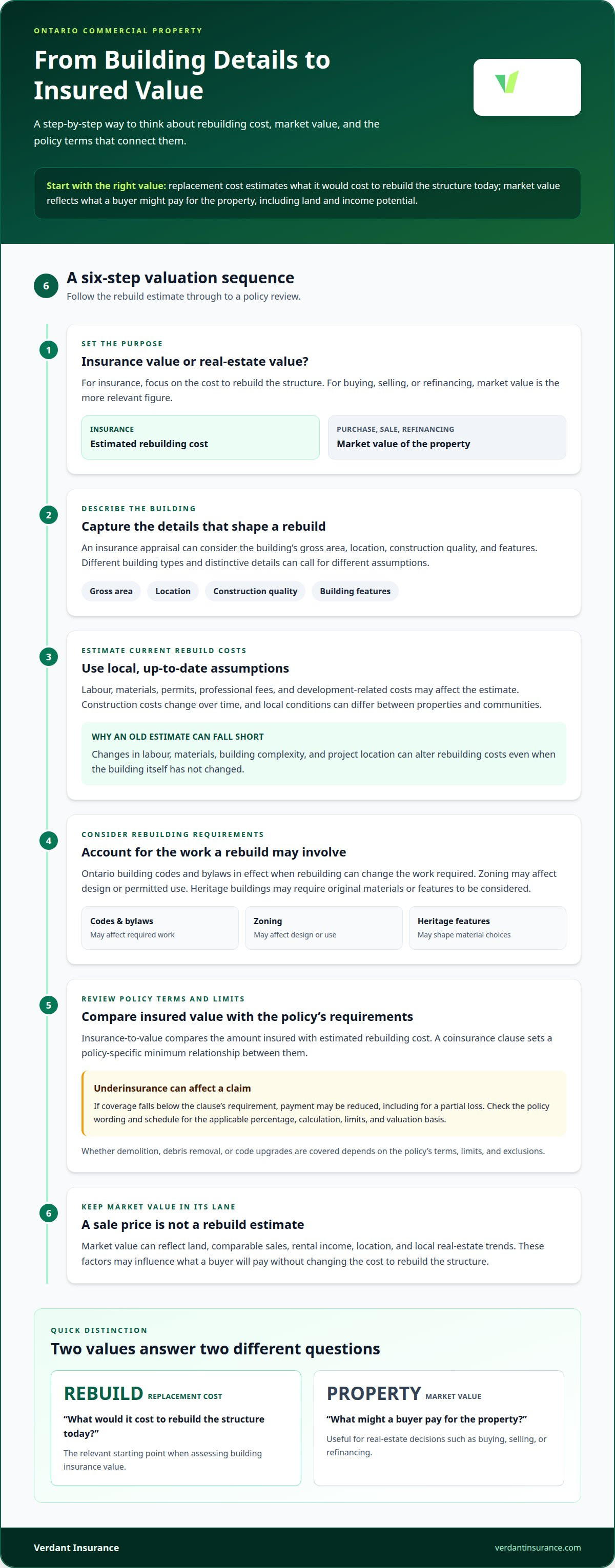
A commercial building’s purchase price can be a poor guide to its rebuilding cost. That’s the key distinction in commercial building replacement cost vs. market value in Ontario: replacement cost estimates what it would cost to rebuild the structure today, while market value reflects what a buyer might pay for the property, including its land and income potential.
It’s understandable to look at a recent sale or appraisal when deciding how much insurance a building needs. But location, rental income, and demand can affect market value without changing the cost of rebuilding the structure. For insurance, the rebuild estimate is the relevant starting point, along with the policy’s limits and terms.
This article explains how replacement cost is estimated, which building details can affect the calculation, and why the result may differ from a property’s purchase price or market value. You’ll also learn when each value is useful for insurance, refinancing, buying, or selling, and how an Ontario commercial insurance broker can help you consider the right insurance value for your building.
Key Takeaways
- Use a rebuild estimate to set the building value for insurance; market value is more relevant to buying, selling, and refinancing.
- Replacement cost estimates should reflect the building’s size, construction, location, features, and current rebuilding requirements.
- Construction costs can change over time, so an older estimate may no longer reflect what rebuilding would involve today.
- Review policy limits alongside the valuation, since coinsurance clauses can affect payment for a partial loss when a building is underinsured.
- Understand how an appraisal and policy wording work together to help choose an appropriate insured value for your commercial property.
Choosing the Relevant Value for Insurance, Refinancing, Buying, or Selling
Use replacement cost to assess a building’s insurance value, and market value for a purchase, sale, or refinancing decision. For an Ontario commercial property, each figure answers a different question about the structure or the real estate asset.
Insurance Coverage and Insurable Value
Insurable value estimates what it would cost to rebuild a commercial property, rather than its potential sale price. An insurance appraisal can help inform the amount of building coverage. A professional estimate considers gross area, location, construction quality, and features. Labour, materials, permits, professional fees, and development-related costs may also affect the estimate.
For a heritage building, matching original materials or features may shape the assessment. The appraisal’s purpose matters: an estimate for insurance should focus on rebuilding the structure, not land or rental income.
Insurance-to-Value and Coinsurance
Insurance-to-value compares the amount insured with the estimated rebuilding cost; a coinsurance clause sets a policy-specific minimum relationship between them. If coverage falls below the clause’s requirement, a claim payment may be reduced, including for a partial loss.
Review the policy wording and schedule to find the applicable percentage, calculation, limits, and valuation basis. Then compare those terms with the current building estimate. A market appraisal or purchase price may not provide the rebuild figure needed for this review.
Rebuild Costs and Code Requirements
Rebuild cost estimates the expense of restoring a property using construction of like kind and quality. Ontario building codes and bylaws in effect when rebuilding can change the work required. Zoning rules can also affect the design or permitted use, which may influence the project scope.
Depreciation affects actual cash value, while a replacement estimate focuses on current rebuilding costs. Demolition and debris removal can add expenses after a loss. Whether code upgrades or removal costs are covered depends on the policy’s terms, limits, and exclusions.
Market Value Drivers
Market value reflects what a willing buyer might pay and a willing seller might accept in an open, competitive market. An Ontario valuation may consider comparable sales, property income, and local real estate trends. Statistics Canada describes the income approach as estimating present value by capitalizing rental income.
Land value and location can affect a sale price without changing the structure’s rebuilding cost. In Toronto, zoning, transit access, tenant quality, and future potential can influence buyer interest. Rental income and usability also matter, so buildings with similar structures can have different market values.
Canadian Non-Residential Construction Cost Trends
Construction costs change, so a commercial building estimate should reflect current local conditions, not an old project budget. A warehouse in the Greater Toronto Area may require different pricing assumptions from an office elsewhere in Ontario.
Ontario Construction Cost Increases
Ontario construction cost increases reflect changes in the labour, materials, and services needed to complete a building project. They matter because an older estimate may no longer represent what it would cost to rebuild the same commercial property.
For example, a Markham owner reviewing an old construction budget should account for current pricing rather than simply reuse the original figures. Labour availability, material selection, building complexity, and project location can all affect the estimate. Changes in these inputs can alter the value used for insurance, even when the building itself has not changed.
Construction costs can also differ by building type. A warehouse with specialized loading areas and an office with complex interior finishes need different materials and trades. An estimate should reflect those features rather than apply one broad assumption to every Ontario property.
Current Local Construction Costs
Current local construction costs are the prices relevant to rebuilding in the property’s area. They matter because local labour, material supply, and site conditions shape what a comparable rebuild would involve.
Consider two similar commercial buildings, one in Toronto and one in a smaller Ontario community. Their construction specifications may match, but local contractor availability, delivery needs, and site access can affect project costs. A useful estimate reflects the building’s actual location instead of relying only on a Canada-wide benchmark.
Local conditions can also vary within the same region. A constrained urban site may require different equipment, access planning, or demolition work than an open site. These project details help explain why a general per-square-foot figure may not capture a specific building’s rebuilding needs.
Construction Cost Benchmarking
Construction cost benchmarking compares a building’s estimated rebuilding requirements with current costs for similar projects. It matters because comparable examples can help test whether an estimate reflects the property’s size, use, quality, and location.
A benchmark is a reference, not a final valuation. For example, a professional comparing an Ontario office building with similar offices would adjust for gross area, construction quality, distinctive features, and local conditions. A warehouse should be compared with industrial projects, not treated as an office simply because both are commercial properties.
For insurance planning, benchmarking can help identify assumptions that need closer review, such as specialized equipment spaces or unusual finishes. The estimate should connect each comparison to the building’s actual specifications and current construction costs. This gives owners a more relevant basis for considering coverage and potential claims.
Building Appraisals and Policy Limits
A commercial building appraisal is a valuation prepared for a stated purpose, and its scope determines how useful it is for insurance. An appraisal prepared for a sale may address different questions from an insurance valuation. Before applying a report to a policy, identify which value it estimates and what the report excludes; how the valuation relates to coverage depends on the specific policy.
The valuation and the policy limit are separate figures. The appraisal provides an estimate; the declarations page records the limit selected for the policy. Compare the appraisal’s stated value with the insured amount and confirm that both refer to the same property and valuation basis. Otherwise, a difference may reflect mismatched assumptions rather than a simple calculation error.
For example, a report may value the whole property while the policy schedule lists only the building. Land, site improvements, equipment, and other property can be treated differently, depending on the policy. Review the appraisal’s scope and the policy’s property descriptions together, so the figures being compared refer to the same insured assets.
The insurer’s policy wording and declarations page are the primary sources for the limits, deductibles, and valuation terms that apply to a particular policy. Read them together: the declarations show selected limits, while the wording explains applicable conditions and definitions. An appraisal does not amend those terms.
Appraisal reports should make their assumptions clear. The valuation date, building condition, intended use, and included components can affect how the estimate should be interpreted. If the report relies on information that has since changed, such as renovations or a change in building use, the estimate may not reflect the current property.
For a site with multiple buildings, check whether the appraisal assigns separate values to each structure or gives one combined figure. The policy schedule may list locations or buildings separately. Matching those entries can make it easier to identify an omitted structure or a limit assigned to the wrong building.
Some policies apply different valuation terms to different property items. The applicable insurer policy wording determines whether an older roof, for example, is adjusted on a replacement-cost or actual-cash-value basis. Don’t assume the building’s valuation basis automatically applies to every component.
Use the appraisal as supporting documentation, then compare its scope and date with the current policy documents. If the report and policy describe different property, limits, or valuation terms, those differences are useful points to resolve during a policy review. The policy wording explains how a covered claim is assessed, subject to its terms and conditions.
Coinsurance Clauses and Underinsurance Penalties
A coinsurance clause is a condition in some commercial property policies that relates the amount insured to the property’s value for insurance purposes. The clause in the specific policy is the relevant source for its threshold and calculation. If the insured amount does not meet that condition, the insurer may reduce a claim payment according to the policy wording. For example, the Insurance Bureau of Canada’s commercial property policy wording describes how a coinsurance condition can affect payment when the amount insured is below the required amount; other policies may use different wording and calculations.
This can matter even when damage affects only part of a building. A policy’s coinsurance calculation may compare the amount insured with the amount required by the clause, then apply that relationship to a loss. The policy wording explains how the calculation works, so owners shouldn’t assume that a partial claim is assessed only against the damaged area. The specific policy wording determines whether and how a reduction applies.
Underinsurance can arise when an owner uses a purchase price or market valuation instead of an estimate suited to building insurance. Those figures may include land, income potential, or other real estate factors. If they lead to an insured amount below what the policy requires, the difference may affect a claim settlement.
Review the current policy schedule alongside the coinsurance clause. Identify the insured amount, the value basis used by the policy, and any stated coinsurance requirement. Then compare those terms with the property’s current insurance valuation. The policy documents, rather than a general example, determine the applicable calculation and its effect.
Changes to a building can make that review more important. An addition, renovation, change in use, or altered construction specification may affect the estimate used for insurance. If the policy schedule still reflects outdated property information, the insured amount may no longer match the building’s current details.
Market value is not automatically an appropriate substitute for replacement cost when assessing a coinsurance condition. A sale price can move with land value, location, tenancy, or buyer demand, while the policy’s calculation follows its stated valuation basis. Keeping those figures distinct helps owners avoid comparing unrelated values.
For a renewal or policy review, focus on whether the policy’s stated amount and coinsurance wording correspond with the latest insurance valuation. A broker can explain how the policy terms relate to the information provided, while the insurer’s wording governs the claim calculation. The outcome also depends on applicable limits, deductibles, exclusions, and the facts of the loss.
Commercial Building Replacement Cost Versus Purchase Price
For commercial building replacement cost versus market value in Ontario, the key question is what the figure needs to measure. A purchase price reflects a real estate transaction; replacement cost estimates the expense of rebuilding the structure. They serve different purposes, so a sale price alone may not set an appropriate insurance value.
A purchase price can include land, location, rental income, and the buyer’s view of future potential. Rebuilding coverage focuses on the building itself. For example, an owner buying an industrial property in Etobicoke may pay for its land and business potential, not just its walls, roof, and systems.
Market value is the amount a willing buyer might pay and a willing seller might accept in an open, competitive market. An income approach estimates present value by capitalizing rental income, while comparable sales and local trends can also inform valuation. These methods assess the property as an asset, not simply the cost to reconstruct its building.
The cost approach combines different components: it starts with replacement cost, subtracts depreciation, and adds land value. This helps explain why market value and replacement cost can diverge. Two buildings with similar rebuilding costs may sell for different amounts because their locations and uses differ.
Depreciation also changes the comparison. Replacement cost estimates rebuilding with materials of similar kind and quality without deducting depreciation. A purchase price, meanwhile, reflects the property’s condition and appeal at the time of sale. Original construction cost is another historical figure, not a current rebuild estimate.
Reviewing a commercial building replacement estimate may be appropriate when circumstances change, such as renovations or changes to the building. The timing of a review depends on the property, insurer, and individual circumstances. An older estimate may not reflect current rebuilding costs, building features, or bylaws, which could affect insurance-to-value and a coinsurance clause.
For a purchase, sale, or refinance, market valuation helps assess the transaction and the property’s income potential. For insurance, replacement cost is the relevant starting point. Keeping those figures separate helps owners evaluate a deal using market value while setting the building’s insured value from a rebuild estimate.
How Verdant Can Help With Commercial Property Insurance
Verdant Insurance helps Ontario commercial property owners consider how a building’s value relates to its insurance needs. A purchase price, market valuation, and rebuild estimate answer different questions, so the insurance discussion should focus on the property and the purpose of coverage.
As an insurance brokerage, Verdant can help you explore commercial property insurance options and understand how a proposed policy’s limits and terms relate to your building. The commercial property insurance information explains the relevant service for Ontario business property owners.
A useful discussion starts with the details that shape the building’s risk and value. These may include its location, use, construction, age, approximate area, major features, and recent improvements. An existing appraisal or replacement cost estimate can help inform the conversation, especially if it reflects the current building rather than only its original construction cost or sale price.
It also helps to identify the decision you’re making. An owner renewing a policy may need to review the insured amount and coinsurance terms. A buyer arranging insurance before closing may be comparing the purchase price with the cost to rebuild. For a refinance, market value may matter to the lender, while replacement cost remains relevant to property insurance.
Verdant’s insurance brokers can help you consider the insurance questions raised by these situations and discuss options for your circumstances. Coverage, eligibility, limits, exclusions, and pricing vary by insurer and individual circumstances. The policy wording determines how a claim is adjusted, so the insured value alone doesn’t describe every aspect of protection.
For a commercial property quote, provide the information requested through the commercial insurance quote form. Details about the building and its use can help frame the request, while an appraisal can provide useful context for the value discussion. If your estimate or property details have changed since the last renewal, include the updated information.
Separating market value from rebuild value gives the insurance conversation a clearer starting point. Contact Verdant Insurance to discuss commercial property insurance for your Ontario building.
Frequently Asked Questions
How do you calculate the replacement cost of a building?
Estimate the cost to reconstruct the building using its current specifications and local construction costs. A professional estimate can review documents, inspect the property, measure its gross area, and assess construction quality and distinctive features. It can also account for demolition, materials, labour, permits, and professional fees. The result estimates the building’s rebuilding cost, not its land value or potential sale price.
Replacement Cost vs Market Value: Which Matters for Your CRE?
Replacement cost is the relevant starting point for insuring the building; market value is more useful for buying, selling, or refinancing commercial real estate. For example, a property’s rental income or redevelopment potential may affect what a buyer pays without changing the cost to reconstruct its existing structure. Keep the valuations separate, then consider the transaction or insurance purpose before relying on either figure.
What happens if I am underinsured on my commercial property policy in Ontario?
If your insured amount falls below a policy’s coinsurance requirement, a partial-loss payment may be reduced under the policy’s calculation. For illustration only, a building with a C$10 million replacement cost and an 80% coinsurance requirement would need C$8 million in coverage to meet that threshold. Coinsurance requirements and claim calculations vary by policy. The outcome also depends on policy limits, deductibles, wording, and the loss details, so an outdated valuation can create financial exposure.
What is the difference between replacement cost and an appraisal?
Replacement cost is an estimated amount: what it would cost to rebuild a structure. An appraisal is an assessment that produces a valuation for a stated purpose. An insurance-focused appraisal may estimate rebuilding expenses, while a real estate appraisal may examine comparable sales, land, or income. Before using an appraisal for insurance, identify what it values and whether it addresses the building’s current rebuilding requirements.
What is the difference between commercial building replacement cost and market value in Ontario?
Replacement cost estimates the expense of reconstructing the building; market value estimates what the property could sell for. In Ontario, market value can reflect land, location, tenant income, zoning, and buyer demand. Those factors may shift the sale value without changing the building’s physical rebuilding requirements. Use a rebuild estimate when considering building insurance and market valuation when assessing a purchase, sale, or refinancing.
How is commercial building replacement cost calculated in Ontario?
An estimate considers the building’s gross area, location, construction quality, and features, then applies current construction costs. A quantity surveyor may review documents, inspect and measure the building, compare similar properties, and prepare a report. For an Ontario property, the estimate should also consider current bylaws and building codes, along with demolition and removal expenses where relevant. Building use and unusual specifications can affect the assessment.
What construction cost per square foot is typical for commercial buildings in Ontario in 2026?
There isn’t one per-square-foot figure that represents every Ontario commercial building in 2026. An office, warehouse, and medical building can differ in structure, finishes, equipment, and construction requirements. Location and project conditions also affect estimates. A per-square-foot benchmark can offer a comparison point, but it shouldn’t replace a property-specific assessment based on actual gross area, specifications, and current local construction costs.
Does commercial property insurance in Ontario cover replacement cost or market value?
The policy’s valuation wording determines how insured property is valued after a loss. Commercial property coverage may use replacement cost or actual cash value, and terms can vary by insurer, policy, and property item. For example, a policy may treat certain items differently from the building. Review the valuation basis alongside limits, exclusions, and deductibles, since those terms affect how a claim is assessed and paid.


