

A subcontractor’s project file should include a certificate of insurance showing commercial general liability (CGL), along with relevant WSIB documentation. Use this contractor certificate of insurance checklist for Ontario to confirm that the insured business name and described operations match the work, the policy dates cover the project period, and any required additional insured wording is supported by the policy documents. A certificate is a useful starting point, but it does not replace reviewing the applicable policy wording.
A clear certificate helps you assess whether the paperwork aligns with the contract, but a headline limit alone does not tell the whole story. Check the names, dates and wording that connect the coverage to your project.
This checklist explains which insurance and WSIB documents to request, how to review the insured name and policy dates, and what additional insured wording means. It also covers what to clarify before work begins, so you can spot gaps in the documents and identify questions to discuss with your broker.
Key Takeaways
- Request proof of commercial general liability insurance and relevant WSIB documentation before work begins.
- Match the insured business name and described operations to the contractor and the work being done.
- Check that policy dates cover the project, and keep track of subcontractor certificate expiry dates.
- When additional insured status is required, review the endorsement wording and effective period, not just the certificate.
- Share contract insurance requirements early so a broker can help assess the contractor’s coverage needs.
What insurance does a subcontractor need?
Start by matching the subcontractor’s commercial general liability (CGL) insurance to the work and contract. The certificate should identify the insured business and describe operations that reflect the subcontractor’s actual tasks. CGL may respond to third-party bodily injury or property damage allegations connected with those operations, subject to policy wording, limits and exclusions.
There is no single CGL limit for every Ontario project. Compare the contract’s required per-occurrence and aggregate limits, along with any relevant sublimits. A project owner may set limits based on the work, contract terms and risk exposures. If the contract requires umbrella limits, include them in your review instead of relying on the main CGL figure alone.
Builders should also check that the certificate and policy documents align with the construction scope. A contract for structural work, electrical work or roofing may have different insurance requirements. The certificate provides a summary, while the policy wording sets out applicable coverage. A subcontractor’s CGL should not be treated as a promise to pay for every defect or the cost of correcting poor workmanship.
Completed operations can matter after the subcontractor finishes. A later injury or property damage allegation may arise from completed work, but coverage depends on the policy’s terms. Review how the contract allocates responsibility after completion, particularly when the work becomes part of a larger project.
For projects involving multiple subcontractors, ask whether wrap-up liability coverage applies. Clarify which parties, operations and project period it includes, and how it coordinates with each trade’s own policy. A wrap-up arrangement does not automatically remove a contractor’s own exposure.
- Compare limits: Check contract requirements against per-occurrence, aggregate and any umbrella limits.
- Match the work: Confirm that the operations described reflect the subcontractor’s assigned tasks.
- Review completed work: Consider how the contract addresses liability after the trade finishes.
- Clarify project coverage: Identify whether wrap-up insurance applies to the relevant subcontractors and operations.
Workers’ compensation is separate from CGL. According to the Workplace Safety and Insurance Board (WSIB), most people working in construction must have WSIB coverage. It addresses workplace injuries, rather than third-party liability allegations. Employer’s liability is another distinct coverage term; compare any contract requirement with the documents provided and the applicable policy wording.
What does additional insured mean?
An additional insured is another party, such as a project owner, named for certain liability protection under a contractor’s policy. The protection depends on the endorsement’s wording, covered operations, limits and exclusions. For example, a commercial property owner may request this status for liability arising from a subcontractor’s work on the property.
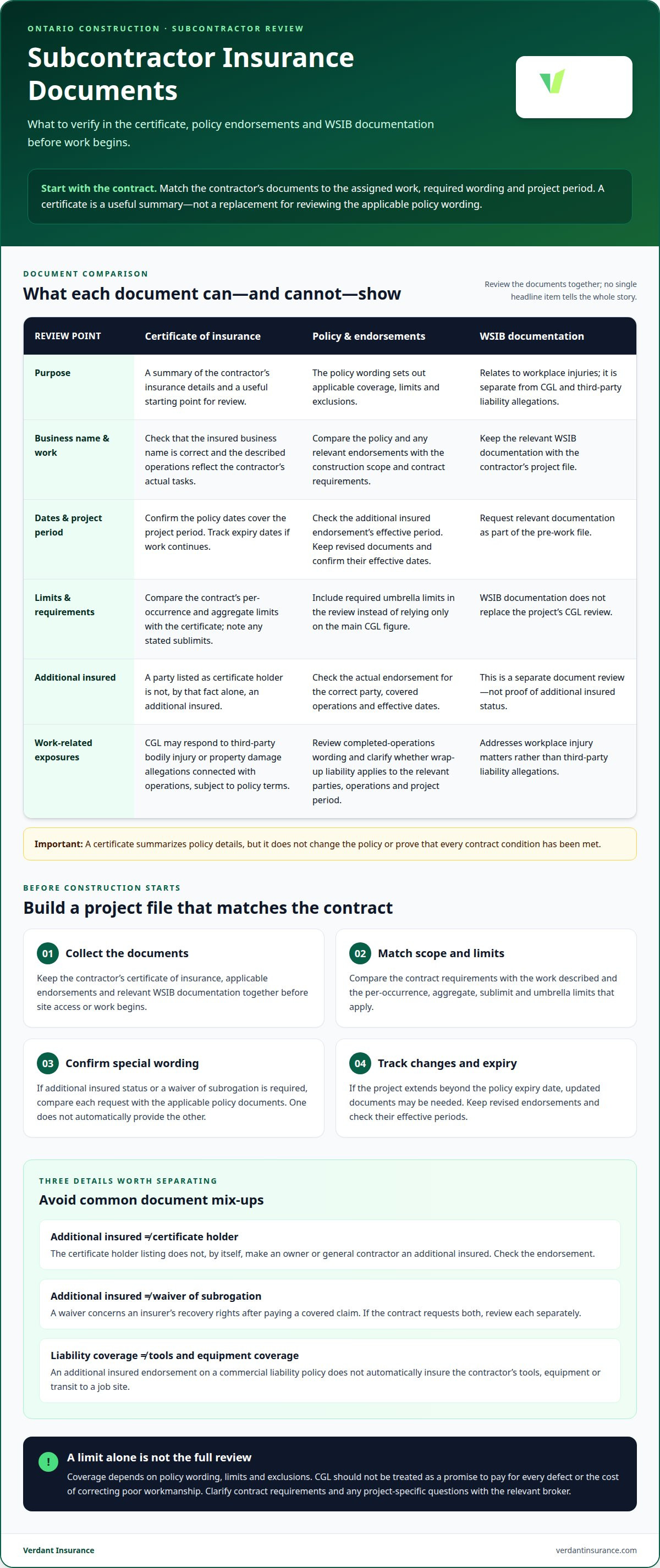
A certificate of insurance (COI) summarizes policy details, but it does not change the policy. Listing an owner as the certificate holder does not, by itself, make that owner an additional insured. Request the actual additional insured endorsement and compare its named parties, operations and effective dates with the contract.
To obtain a COI, an Ontario contractor should give their broker the certificate holder’s exact legal name and address, project details, required wording and submission deadline. Identify any requested additional insured status or waiver of subrogation so the broker can address those terms with the insurer.
- Match the party: Confirm the endorsement names the correct owner, general contractor or other contractually required entity.
- Match the work: Compare the described operations with the subcontractor’s actual scope, such as installing a commercial roof.
- Match the dates: Check that the endorsement’s effective period aligns with the project and policy dates.
- Review related wording: Identify whether the contract also requires a waiver of subrogation, then compare that request with the policy documents.
A waiver of subrogation is separate from additional insured status. It concerns an insurer’s recovery rights after paying a covered claim. A contract may request both, but one does not automatically provide the other. For example, a general contractor may require additional insured wording and a separate waiver for a particular project.
Check the timing carefully. If a project continues beyond the policy expiry date, updated insurance documents may be needed to show the renewed term. If an endorsement is revised, keep the revised copy and confirm its effective period. A certificate issued before renewal may show dates that do not cover later work.
Keep liability documents separate from property coverage questions. An additional insured endorsement on a commercial liability policy does not automatically insure a contractor’s tools and equipment or their transit to a job site. Review those property exposures separately against the relevant policy wording.
Insurance documents required before construction starts
Before construction begins, assemble the contractor’s certificate of insurance, applicable endorsements and relevant WSIB documentation. Owners, general contractors and municipalities commonly request a certificate as proof of insurance before site access. Treat it as a summary, not a replacement for policy wording or proof that every contract condition has been met.
Does an Ontario contractor need commercial general liability insurance? Ontario law does not require CGL universally for every contractor, but project owners, general contractors, municipalities or contract terms may require it. Review the project’s written requirements before work starts.
What information should an Ontario contractor COI include? Check the insured business name, described operations, policy dates, coverage types and limits, and the certificate holder’s exact name and address. Compare these details with the tender and contract, including any requested additional insured wording or waiver of subrogation.
What exclusions or risks should Ontario clients check on a contractor COI? A certificate does not show every exclusion or determine whether a claim is covered. Review the relevant policy wording for the project’s operations, completed work, faulty workmanship and contractual obligations.
Send tender requirements to the contractor’s broker early. Provide the certificate holder’s legal name and address, required wording and submission deadline. Identify requested limits, additional insured status or waiver of subrogation separately. Compare contractual indemnity terms with the insurance documents, especially where the agreement assigns responsibility for injury or property damage.
- Certificate: Match names, operations, limits, dates and holder details to project documents.
- Endorsements: Review supporting documents for requested additional insured or waiver terms.
- WSIB: Obtain applicable clearance or other status documents for the contractor and participating trades.
- Project property: Clarify who insures materials, equipment and work in progress, including items in transit.
According to the Workplace Safety and Insurance Board (WSIB), coverage is legally required for most people working in construction. WSIB coverage is separate from CGL and concerns workplace injuries. For construction financing, follow the lender’s written instructions for builder’s risk documentation, including any requested insured value, mortgagee or loss-payee details. These financing details are separate from a liability certificate.
Bonding documents are separate from insurance. A bid, performance or labour and material payment bond addresses specified contract obligations; it does not replace a liability policy. Match each document to the tender’s requirements before mobilizing, and keep the accepted documents together in the project file.
WSIB clearances for builders and trades
A WSIB clearance certificate helps a project owner assess whether a contractor’s account is in good standing. According to the Workplace Safety and Insurance Board (WSIB), clearances confirm account status for businesses contracting work. Keep the clearance with the project records, separate from liability insurance documents, because it does not describe commercial liability coverage.
Check the certificate’s validity before work begins and track its expiry date during the project. WSIB clearance certificates are valid for 90 days, according to WSIB. Their validity ends on the 20th of February, May, August and November. A clearance obtained near one of those dates may expire while work continues, so plan a fresh status review before the current clearance expires.
- Match the account: Compare the clearance details with the contractor’s legal business identity.
- Track expiry: Record the end date and schedule another review before it lapses.
- Include each trade: Identify subcontractors on site and collect applicable status documentation.
- Save dated copies: Keep clearances with the project agreement and insurance records.
WSIB status can depend on how the work is organized. WSIB guidance recognizes that some independent operators working alone on private homes may be exempt from coverage. That possibility does not establish an exemption for every sole operator or project. The work arrangement and use of employees or other help matter, so document the basis for the contractor’s status.
Review the status if a contractor changes its crew or brings in additional trades. For example, a contractor working alone may later add a helper for a larger installation. Request updated WSIB documentation that reflects the changed arrangement before that person starts work, then keep the updated record in the project file.
A clearance and liability certificate serve different purposes. The WSIB document relates to account standing, while a liability policy responds to covered third-party claims under its terms. Keep both records distinct. Check that each document relates to the business performing the work and reflects the project’s current arrangements.
For a larger construction project, maintain a simple trade register. List the general contractor, each subcontractor, their planned operations and clearance expiry dates. Update it when crews or scopes change. This gives the project team a clear record of whose status was documented and when, rather than relying on a clearance collected only during tendering.
Checking policy dates and the insured business name
How do Ontario businesses verify a contractor’s certificate of insurance? Compare the named insured, described operations and policy dates with the signed contract and actual project scope. Record the certificate’s issue date too: it shows when the document was prepared, not how long coverage lasts. A contractor certificate of insurance checklist for Ontario can make these comparisons consistent across projects.
Start with the insured name. A corporation’s legal name may differ from its operating name, while an independent contractor may work under a trade name. For example, if a contract names “Northfield Renovations Inc.” but the certificate shows only “Northfield Renovations,” ask the contractor’s broker to clarify the relationship and ensure the insured entity matches the work agreement. A similar name alone does not establish that the right business is insured.
Next, compare the operations description with the work being performed. A certificate describing interior painting may not reflect a separate roofing or excavation scope. If a contractor has added services since the document was issued, confirm that the insurance documents reflect those operations. The certificate lists details; coverage depends on the applicable policy wording.
- Match the entity: Compare the contract name, certificate name and any stated operating name.
- Check the policy period: Ensure the effective and expiry dates cover the planned work.
- Note the certificate date: Record when it was issued and request updated documentation if circumstances change.
- Review the operations: Compare the description with the contractor’s actual project tasks.
Pay close attention to dates when schedules change. If a renovation starts after the certificate’s effective date or continues beyond its expiry, the document may not show coverage for the full work period. Track subcontractor certificate expiry dates too, and set a reminder before each policy term ends. A new certificate should show the renewed dates, not simply repeat an earlier document.
Check that the listed insurance type matches the contract. A commercial general liability certificate provides evidence of liability insurance, not every project protection. For example, it does not automatically confirm coverage for tools, materials or work in progress. Use a contractor certificate of insurance checklist for Ontario to compare the contract’s insurance requirements with the certificate and supporting endorsements.
If tender terms require a licensed insurer or specific wording, compare those requirements with the certificate and supporting policy documents. A broker can help clarify mismatched names, dates or operations; keep the response with the project file. This dated record helps an owner or general contractor trace which documents applied when a trade began work.
Contractor Insurance Through Verdant Insurance
Verdant Insurance is a natural next step when an Ontario contractor needs to discuss business insurance around a project, renewal or changing scope. As an insurance brokerage, Verdant can help organize the conversation around the contractor’s operations, contract requirements and insurance documents. The goal is to connect the details of the work with an insurance review, not treat a certificate as a substitute for policy wording.
Before discussing a project, gather its practical details. A useful starting file includes the project address, work description, planned dates, construction budget, payroll, subcontractor details, prior claims and the contract’s insurance requirements. For example, a contractor taking on a new type of work can explain how it differs from existing operations. Clear information helps frame the discussion with insurers.
Certificate questions often involve more than the limit shown on one page. A project owner may request specific commercial general liability limits, additional insured wording or a waiver of subrogation. A contractor can share the exact contract language and certificate holder details, then discuss how the requested terms relate to the policy. Coverage, availability and underwriting depend on the insurer, policy wording and individual circumstances.
It also helps to describe the work performed by subcontractors and clarify who is responsible for each trade. If the project includes equipment, materials, work in progress or property in transit, include those details in the review. Builder’s risk arrangements and contractor liability insurance address different exposures, so the documents should be considered against the contract’s scope and responsibilities.
- For a new project: Gather the scope, address, dates and contract requirements before reviewing insurance needs.
- For a renewal: Note any changes in services, subcontractors, payroll or claims history.
- For a certificate request: Provide the exact certificate holder name, address and required wording.
- For a changed operation: Discuss the new work before it begins and keep written records of accepted policy changes.
This approach helps Ontario contractors identify questions to resolve before signing a contract or mobilizing to a site. It also gives a broker useful context for discussing business insurance needs, while the policy and endorsements remain the documents that set out actual terms. A contractor certificate of insurance checklist is most useful when it connects project requirements with the underlying insurance documents.
For a project-specific discussion, contact Verdant Insurance through the commercial quote form.
Frequently Asked Questions
How much CGL insurance does a contractor need?
The contract and project risk determine the required commercial general liability limit. Compare the per-occurrence limit with the aggregate and any relevant sublimits, since they measure different parts of the policy. For example, a contract may require an umbrella limit in addition to the underlying CGL. A certificate showing one headline limit does not establish that every contract requirement is met.
Is every job covered under one certificate?
Not necessarily. A certificate describes insurance details when it is issued, while a new project may have different operations, dates, certificate-holder details or contract wording. For example, a contractor starting excavation after previously doing interior work should ensure the described operations reflect the new scope. The contract may also require project-specific endorsements, so one existing certificate may not address every job’s terms.
What insurance is legally required for construction in Ontario?
Ontario requires WSIB coverage for most people working in construction, while commercial general liability is not a universal legal requirement for every contractor. Owners, general contractors and tender documents may still require CGL as a condition of the work. If the project uses business vehicles on Ontario roads, those vehicles also need applicable automobile insurance. Distinguish each legal obligation from contractual requirements.
What is a certificate of insurance?
A certificate of insurance is a document that summarizes selected details of an insurance policy, such as the insured business, coverage type and policy period. An owner may use it to document insurance received for a project file. It is not the policy itself and does not amend policy terms. For example, a certificate can summarize liability coverage, while the policy wording determines applicable exclusions and conditions.
What is a contractor certificate of insurance in Ontario?
It is a certificate showing selected insurance details for a contractor working on an Ontario project. A property owner might keep it with the construction agreement and tender records. Use it to identify the contractor’s insured business, described operations and policy period, then compare those details with the work being done. It provides evidence of listed information, not a guarantee that a future claim will be covered.
What insurance coverage limits do Ontario contractors typically need?
Ontario contractors’ limits depend on the work, contract, client requirements and insurer terms. A residential repair contract and a larger commercial construction project may set different requirements. Review each requested limit by coverage category, including per-occurrence and aggregate amounts, rather than assuming one number applies across the policy. If the contract asks for umbrella coverage or a specific sublimit, account for that separately.
When is WSIB clearance required for Ontario contractors?
A WSIB clearance is commonly requested to show that a contractor’s WSIB account is in good standing, particularly before construction work starts. WSIB coverage and a clearance document are not the same thing: one concerns workplace injury coverage, while the other documents account status. Some independent operators working alone on private homes may be exempt. Work arrangements and whether help is added affect which requirements apply.
Who should be listed as certificate holder or additional insured in Ontario?
List the certificate holder named in the contract, using its exact legal name and address. Additional insured status is different: the relevant party, such as an owner or general contractor, must be named through applicable policy wording or an endorsement. For example, listing a building owner as certificate holder does not by itself make the owner an additional insured. Match each party’s role to the contract.


