

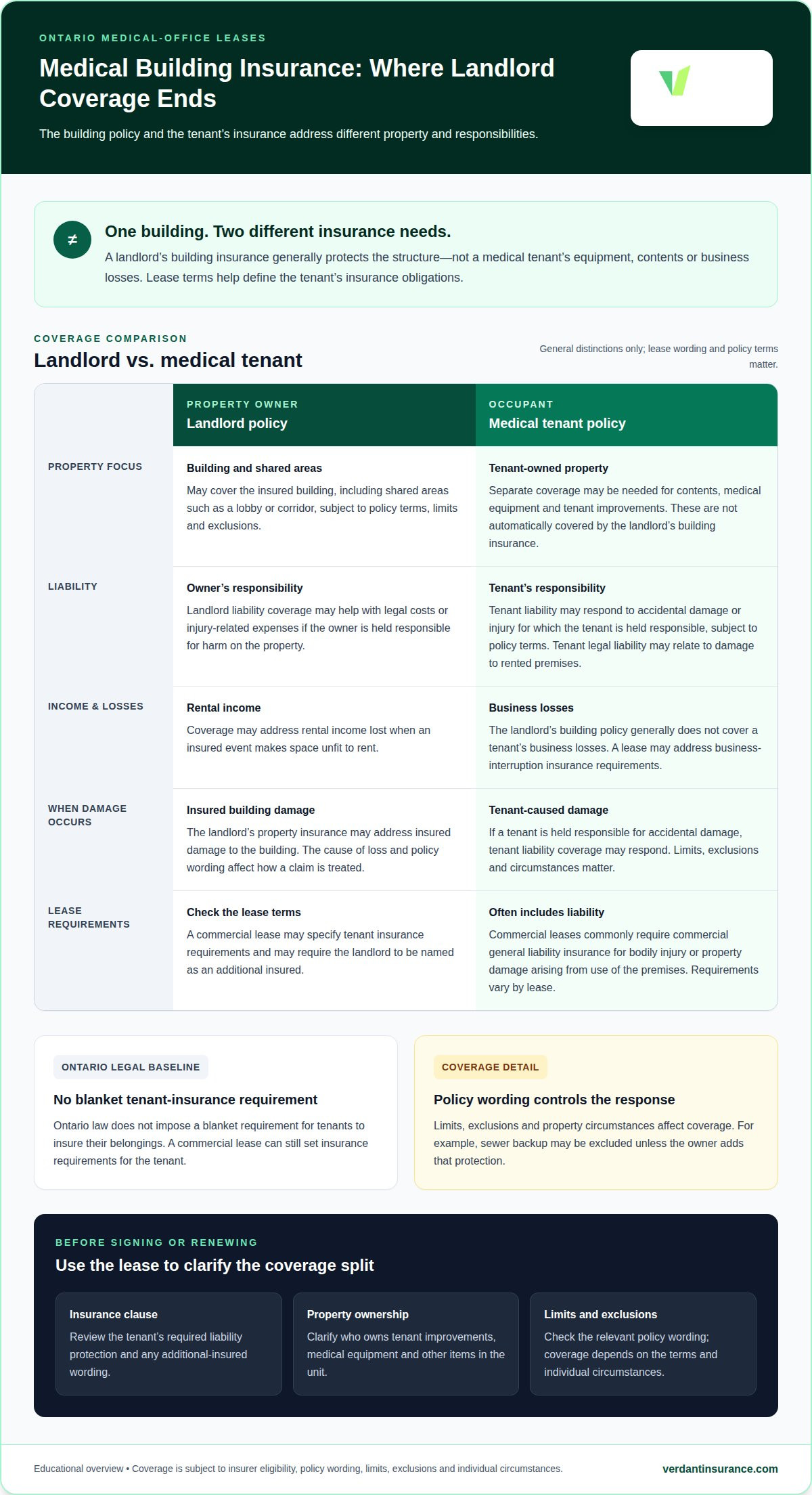
The landlord’s building insurance isn’t a substitute for a tenant’s coverage. For medical-building landlord and tenant insurance in Ontario, the lease usually sets the tenant’s insurance obligations. Commercial leases commonly require commercial general liability insurance, but requirements vary by lease. Ontario law doesn’t impose a blanket requirement for tenants to insure their belongings.
It’s understandable to expect the building policy to protect everyone on the premises. In practice, it generally covers the building, not a medical tenant’s equipment, contents or business losses. A tenant’s liability coverage may respond if the tenant is held responsible for accidental damage or injury, subject to the policy’s terms.
This article explains what a landlord’s building insurance may cover, when tenant liability could apply, and how lease requirements shape each party’s coverage needs. You’ll learn where the landlord’s protection ends and the tenant’s responsibilities begin, helping you understand the insurance picture before signing or renewing a medical-office lease.
Key Takeaways
- Ontario law doesn’t generally require tenants to carry tenant insurance, but a commercial lease may set insurance requirements.
- Review the lease’s insurance clause before signing; requirements can include liability coverage and may address tenant contents or business interruption.
- Tenant liability coverage may respond to accidental damage or injury for which the tenant is responsible, subject to policy terms and limits.
- A landlord’s building policy generally protects the structure, while tenants need separate coverage for their belongings and business property.
- Medical-building owners can explore coverage tailored to their property through Verdant Insurance’s medical building insurance service.
What does landlord insurance cover in Ontario?
For an Ontario medical building, landlord insurance generally addresses the owner’s building, liability and rental income after an insured event. It doesn’t replace a tenant’s coverage for belongings or personal liability.
Landlord Building and Rental Income Coverage
This coverage can protect the insured building, the landlord’s liability and rental income lost when an insured event makes a space unfit to rent. This matters because a fire that closes a medical office can affect both the property and the owner’s expected rent.
Coverage should reflect the building’s actual replacement cost and rental income, rather than relying only on market value. A landlord should also tell the insurer when a property is rented, since a standard homeowner policy may not cover a home after it becomes a rental.
Read the policy for exclusions and optional protections. For example, sewer backup may be excluded unless the owner adds that coverage. The policy wording, limits and property’s circumstances determine how a particular loss is treated.
Landlord and Personal Liability Coverage
Landlord liability coverage may help with legal costs or injury-related expenses if the owner is held responsible for harm on the property. Personal liability coverage is generally part of a tenant policy and may respond when the tenant is held responsible for accidental injury or damage to someone else’s property.
These protections address different parties and responsibilities. For example, a visitor injured in a shared corridor could raise questions about the owner’s responsibility, while damage caused by a tenant’s actions could involve the tenant’s liability coverage. The facts and policy terms matter in each claim.
Tenant policies may also cover personal belongings and additional living expenses when insured damage makes a unit uninhabitable. Contents coverage can apply to items such as furniture, clothing and electronics. Expensive jewellery or collectables may need separate attention under the policy.
Medical Building Coverage Questions
An Ontario medical building owner generally needs property coverage for the building, liability protection and consideration of rental-income loss. A single policy doesn’t automatically cover every item on the premises, so ownership of improvements and equipment matters.
Tenant improvements and medical equipment aren’t automatically covered by the landlord’s building insurance. Commercial landlord building insurance generally doesn’t cover tenants’ property or business losses. The lease and policy wording help distinguish the owner’s building from tenant-owned equipment and improvements.
Shared areas, such as a lobby or corridor, form part of the property the landlord insures, subject to the policy’s terms, limits and exclusions. Tenants should arrange separate coverage for their own contents and personal liability. If a unit becomes uninhabitable after insured damage, tenant additional living expenses may help with temporary accommodation and meals, as the policy allows.
How tenant liability insurance may respond to tenant-caused damage
Tenant liability coverage may respond when a tenant is held responsible for accidental damage or injury, subject to policy terms. A lease can specify the liability protection a medical-office tenant must carry, while the cause of a loss and policy wording affect how a claim is handled.
Tenant Legal Liability for Building Damage
Tenant legal liability can help cover damage a tenant accidentally causes to rented premises, such as fire damage or an overflowing tub. This matters because a claim for damage to a clinic unit can involve the tenant’s legal responsibility and the landlord’s separate property interests.
If a tenant’s actions damage the premises, the landlord may seek recovery for the loss. The tenant’s policy may respond to covered legal liability, while the landlord’s property insurance may address insured building damage. The cause, policy wording, limits and exclusions affect each policy’s response. Repairs may also involve adjacent spaces if damage spreads beyond the original unit.
Property Damage and Bodily Injury Liability
Tenant liability may apply to accidental property damage or bodily injury when the tenant is legally responsible. For example, a visitor injured after slipping on a wet floor could bring a claim involving the tenant’s actions or maintenance of the rented space.
Ontario commercial leases commonly require commercial general liability insurance for bodily injury or property damage arising from the tenant’s use of the premises. A lease may also require the landlord to be named as an additional insured. That wording doesn’t make every claim covered; the policy terms and circumstances still matter. Liability coverage also differs from protection for repairing the building.
Fire Safety and Liability Exposure
A fire in a medical office can damage the rented unit, affect neighbouring spaces and interrupt access to shared areas. If the tenant is held responsible for accidentally causing it, tenant legal liability may be relevant to building damage, while commercial general liability may address covered third-party claims.
For example, an accidental fire involving office equipment could lead to repair costs and an injury claim. The landlord’s property insurance may address insured building damage, while a tenant’s policy may respond to the tenant’s legal responsibility. Replacement cost and rental income are separate considerations under the landlord’s property policy.
Liability Limits for Medical Offices
Ontario commercial leases commonly set tenant liability requirements in the range of $1 million to $2 million. The lease identifies its required limit and may require the landlord as an additional insured.
For landlords, $2 million in liability coverage is increasingly common, while rental-property guidance recommends at least $1 million. These are general reference points, not a universal medical-office rule. For medical building landlord and tenant insurance in Ontario, the lease terms and policy wording help define the specific limit and protection arranged.
Whether tenant insurance is legally required in Ontario
Ontario law doesn’t generally require tenants to buy tenant insurance, but a lease can set insurance requirements. The Ontario Standard Lease addresses tenant insurance in section 11, while commercial medical-office leases set their own terms.
Lease Requirements and Proof of Insurance
Section 11 of Ontario’s Standard Lease allows landlords and tenants to agree that the tenant will carry insurance. This matters for new residential tenancies because the written agreement defines the agreed requirement. The Residential Tenancies Act, 2006 doesn’t require landlords to insure rental properties, though a mortgage lender may require property insurance under its mortgage agreement.
For a new medical-office tenancy, a commercial lease can specify liability coverage and require proof, such as an insurance certificate. A landlord can’t require residential tenants to insure their belongings as a condition of renting. In commercial settings, the lease can set insurance terms, including liability requirements and documentation.
A certificate records policy information, but it doesn’t change the policy itself. Landlords and tenants can use the lease wording to identify the requested limit, certificate details and whether the landlord must be named as an additional insured. Clear requirements help avoid confusion when coverage documents are exchanged.
Insurance Requirements in Commercial Leases
Commercial lease insurance clauses describe the coverage a tenant agrees to maintain for its operations on the premises. Ontario law doesn’t generally require a medical-office tenant to carry commercial general liability insurance, but a lease may require it for bodily injury or property damage arising from the tenant’s use.
Clinics, dental offices and pharmacies don’t automatically have identical insurance obligations. Their specific requirements come from lease terms, including permitted use, liability limits and certificate wording. Tenants may also need to insure their own contents, inventory and improvements they paid for. Some agreements address business interruption coverage.
An insurance broker can explain policy terms, help arrange certificates and clarify additional-insured requests. For example, a clinic moving into a unit can have its certificate requirements reviewed against the lease before occupancy. If a claim later involves accidental damage, the insurer assesses responsibility and coverage under the relevant policy wording, limits and exclusions.
Limits on adding an insurance requirement during an existing lease
For an existing Ontario tenancy, an insurance condition depends on what the original lease says. If tenant insurance wasn’t included when the tenant moved in, the landlord can’t add it later as a new requirement. The parties can discuss a proposed change, but the written agreement remains the reference for the current tenancy.
This distinction matters when a medical property changes hands or management. A new owner takes on a building with existing lease arrangements, so a request for proof of coverage doesn’t itself create a new tenant obligation. The lease may still contain other insurance terms, such as liability requirements or certificate wording. Consider those existing clauses separately from a new request to insure contents.
The owner’s policy also needs to reflect the property’s use. A standard homeowner policy may not cover an Ontario property after it is rented out. If an owner moves from personal occupancy to renting the property, the change in use can affect the insurance arrangement and how rental income is considered. Telling the insurer about the rental helps ensure the owner’s policy reflects the changed exposure.
Condominiums require another distinction. A condo corporation’s master policy doesn’t extend to the unit owner’s liability or rental exposure for a rented condo with multiple tenants. The corporation’s policy and the unit owner’s coverage serve different interests. Don’t treat the master policy as the owner’s protection for rental activity.
Occupancy changes can matter even when a unit isn’t newly rented. Many Ontario rental policies restrict or suspend some coverage after a property has been unoccupied for around 30 days, subject to the insurer’s wording. A medical-office owner dealing with a vacant unit during renovations should consider how vacancy is addressed in the building policy, rather than assuming an existing tenant clause resolves it.
In practice, keep three matters distinct: the signed lease’s current requirements, the owner’s policy for the property’s actual use, and any condo corporation coverage. A tenant-insurance condition can’t simply be added mid-tenancy, while a change in occupancy or vacancy can still affect the owner’s insurance considerations. These separate issues call for different attention during a lease transition or property-management change.
Landlord building insurance versus tenant belongings
In Ontario, the property owner generally insures the medical office building, while each tenant arranges coverage for belongings and business property. The lease helps clarify responsibility for improvements and shared areas.
Insuring the Medical Office Building
Building insurance protects the owner’s interest in the structure, rather than automatically covering everything inside it. This distinction matters if a fire damages the building and a tenant’s equipment at the same time.
Commercial landlord building insurance generally doesn’t cover tenants’ property or business losses. The owner’s policy should reflect the building’s replacement cost, not simply its market value. Market price includes factors beyond rebuilding the structure, so it may not indicate what’s needed to repair or reconstruct after insured damage.
Shared spaces, such as a lobby, hallway or common washroom, are part of the building’s operation. The landlord’s policy may address the structure and common areas, subject to its wording, limits and exclusions. A tenant shouldn’t assume that coverage for the building itself automatically extends to tenant-owned items located there.
Insuring Medical Office Contents
Tenants generally arrange coverage for their own contents, including furniture, computers and medical equipment. This matters because a building policy typically doesn’t insure a renter’s belongings or business losses.
For example, a dentist’s practice may own treatment equipment, while the property owner owns the building and shared corridor. If a water loss damages both, the building policy and the tenant’s equipment coverage have different roles. The actual response depends on ownership, policy terms and the cause of loss.
Lease wording can also clarify responsibility for tenant improvements or betterments. A reception counter installed and paid for by a clinic may not be treated like the building’s original structure. Tenants should understand which improvements they own and arrange coverage accordingly. Contents coverage may also limit expensive items, so medical equipment and other high-value property warrant careful attention to policy details.
The practical takeaway is to separate three interests: the owner’s building, the tenant’s contents and any improvements addressed by the agreement. For medical building landlord and tenant insurance in Ontario, this distinction helps owners and renters identify which policy may apply to a loss, without assuming one policy covers the premises and everything inside.
Verdant Insurance: Medical Building Insurance
Verdant Insurance is a relevant next step for Ontario owners assessing insurance for a medical or professional building. As a brokerage, Verdant compares options from multiple insurers and can help owners consider how the property’s use, tenants and insurance priorities fit into a commercial insurance discussion.
A medical building may contain different tenants, shared areas and owner-held property. A useful review starts with understanding what the owner owns and operates, which spaces are rented, and how the lease describes responsibilities. These details help frame the insurance discussion without assuming one policy covers every tenant’s equipment, contents or business losses.
Owners can explore medical building insurance in Ontario when considering coverage for their property. The building’s occupancy, its use as medical or professional space, and the arrangements with tenants are relevant context. Changes such as a new tenant or a change in how space is used can also affect the information considered for insurance.
For a discussion, useful details include the property address, the building’s general features, how the premises are occupied, and any known updates or changes. Information about rental arrangements, shared spaces and owner responsibilities can help clarify the building’s risk profile. Priorities may differ between an owner-occupied clinic and a building leased to separate healthcare practices.
It’s also helpful to distinguish the owner’s building from tenant-owned contents and improvements. Lease terms can describe who is responsible for particular improvements, while policy wording defines the coverage an insurer provides. Keeping those roles clear can help owners identify questions about building protection, liability and rental-income exposure.
Verdant Insurance is a brokerage, not the insurer that underwrites or issues a policy. Coverage, eligibility, limits and exclusions depend on the insurer, policy wording and the property’s circumstances. Accurate information about the building and its occupancy is important when discussing available insurance options.
For owners reviewing a new purchase, renewal or tenant change, a focused conversation can help connect property details with insurance priorities. Contact Verdant Insurance to discuss your Ontario medical building insurance needs.
Frequently Asked Questions
Do I have to get tenant insurance?
Ontario law doesn’t generally require tenants to buy tenant insurance, but a commercial lease can make specific insurance a contractual requirement. For a medical office, review the signed lease for liability limits, certificate requirements and any landlord additional-insured wording. If the original lease didn’t require insurance, a landlord can’t simply add that requirement after the tenancy begins. Tenant insurance can still address risks to the tenant’s own property and liability.
What Does It Not Cover?
Tenant insurance doesn’t automatically cover every item or loss. Expensive jewellery, collectables and specialized medical equipment may need additional coverage or separate arrangements. Sewer-backup protection may also require an endorsement. Coverage for roommates depends on who the policy names and how it’s arranged. For a clinic, check how the policy treats equipment, tenant improvements and business-related losses, then compare those terms with the lease and the tenant’s actual property.
How much does insurance cost?
There isn’t one standard cost for medical-building or tenant insurance in Ontario. A building’s construction, replacement value, location, occupancy, rental income and selected coverage can affect the owner’s premium. Tenant costs depend on factors such as contents, liability limits, business use and insurer pricing. For instance, a building owner and a clinic renting one unit need different coverage arrangements, so their premiums aren’t directly comparable.
What is the deductible?
A deductible is the amount the insured pays toward a covered claim before the insurer pays the remaining eligible amount, subject to the policy. The policy documents state which deductible applies to each type of loss. For example, a building policy and a tenant’s contents policy can have different deductibles. Check the wording for any separate deductibles that may apply to particular causes of damage, such as water-related losses.
What insurance should tenants in an Ontario medical building carry?
Tenants should review the lease for required commercial general liability coverage, liability limits and certificate wording. They generally need to consider coverage for their own contents, inventory and improvements they paid for. A clinic with costly equipment should account for those assets rather than treating the landlord’s building policy as contents insurance. Some commercial leases also require business interruption coverage, which may help address revenue loss after an insured closure.
Does Ontario require medical office tenants to carry commercial general liability insurance?
Ontario law doesn’t impose a general requirement for medical-office tenants to carry commercial general liability insurance. However, commercial leases commonly require it for bodily injury or property damage arising from the tenant’s use of the premises. The lease may also require the landlord to be named as an additional insured. A clinic should follow its specific lease terms, since required limits and documentation vary between agreements.
How much does commercial property and liability insurance cost for a medical building in Ontario?
Premiums vary with the building, its use and occupancy, construction, replacement cost, rental income, liability exposure and selected limits. Tenant mix and property features can also affect how an insurer assesses the risk. A medical building owner’s property and liability insurance isn’t priced like a tenant’s policy. The actual premium depends on the insurer’s assessment and the coverage selected for that specific building.
What insurance clauses should an Ontario medical office lease include, and what should landlords and tenants consider?
A lease can set out liability insurance requirements, limits, proof of coverage and whether the landlord must be named as an additional insured. It should also clarify responsibility for tenant contents and improvements, and state whether business interruption coverage is required. Landlords and tenants can compare the insurance clause with their respective policies before signing. A broker can help explain insurance wording and certificate details, while legal advice can address lease interpretation.


