

Will the condo corporation’s policy pay to restore the kitchen you renovated? Usually, its insurance covers the building, common areas and a unit’s basic features, while owner-made upgrades and personal belongings may need separate protection. Understanding what condo corporation insurance covers can help you spot where your own coverage may matter.
It’s reasonable to expect the building’s policy to protect the property, but that doesn’t mean every part of your unit is included. The corporation’s policy may also cover liability related to common areas, while its deductible or a loss assessment could affect owners financially. The details depend on the policy and the condominium’s governing documents.
This article explains what the corporation’s insurance generally covers, how renovations can create gaps, and how your own condo policy may help protect your belongings, upgrades, liability and additional living expenses. It also explains when loss assessment coverage may help if the corporation charges owners for a covered loss or shared costs.
Key Takeaways
- The condo corporation’s policy generally protects the building and shared areas, but it may not cover everything inside your unit.
- Renovations and upgrades can create a coverage gap, so understand how the corporation defines the unit’s basic features.
- Your own condo policy can help protect personal belongings, improvements, personal liability and extra living costs after a covered loss.
- Loss assessment coverage may help if you’re charged a share of the corporation’s deductible or certain covered costs.
- Review the corporation’s insurance information alongside your own policy to understand where their coverage meets and where yours may need to start.
Unit coverage when corporation insurance is insufficient
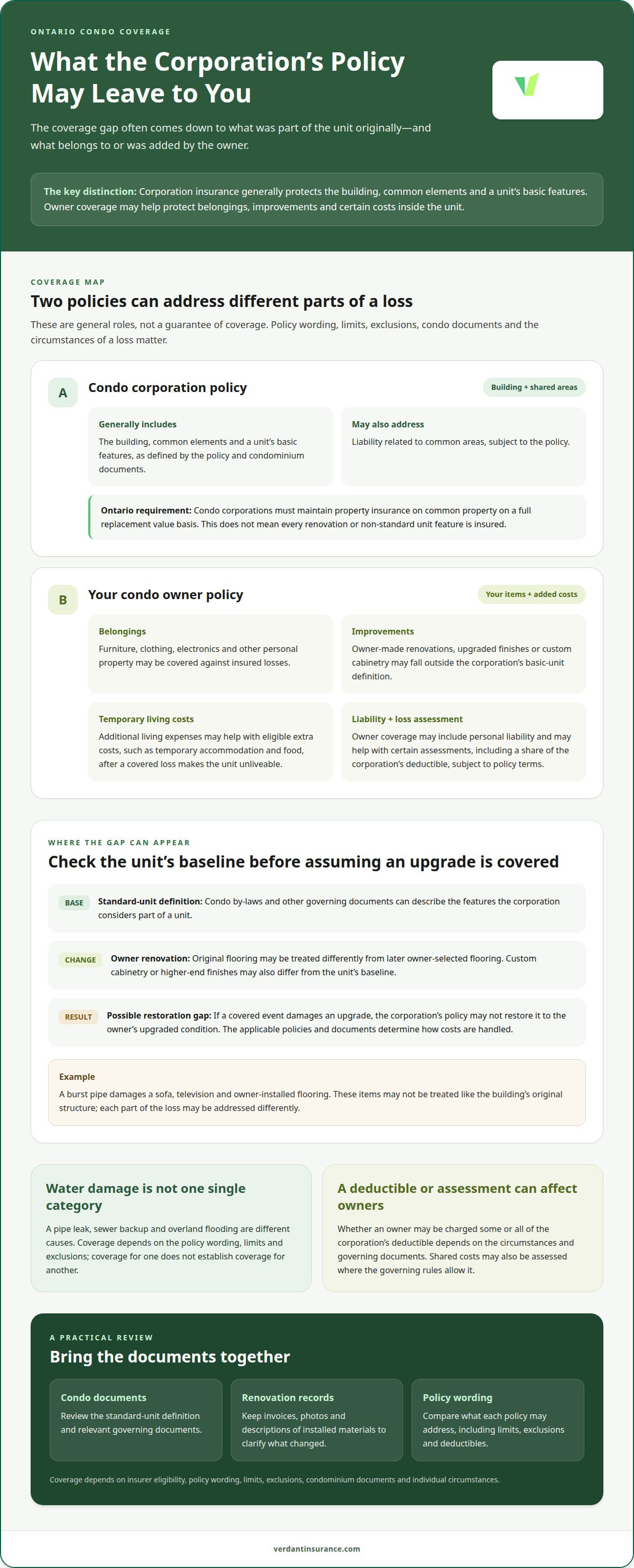
An Ontario condo corporation’s policy generally covers the building and common elements, but may not restore every part of an owner’s unit. The standard-unit definition, renovations, belongings and displacement expenses can all affect the remaining coverage gap.
By-Laws and the Base-Unit Condition
The standard-unit definition describes the features the corporation considers part of a unit when deciding what it will repair or replace. Condo by-laws and other governing documents can help establish this baseline. It matters after damage: original flooring may be treated differently from a later, owner-selected upgrade. That distinction can affect which policy responds and who pays for repairs.
Consider a unit with original kitchen cabinets and a later renovation that added custom cabinetry. The corporation’s policy may cover basic features as originally built, while upgraded cabinets fall outside that definition. The master policy can define covered parts differently, so assumptions about floors, fixtures or finishes may not match the building’s documents. That difference can leave an owner responsible for some restoration costs.
Personal Belongings and Unit Improvements
Personal belongings are items owned by the unit owner, while improvements are changes or upgrades made to the unit. A corporation’s insurance generally doesn’t cover an owner’s furniture, clothing, electronics or upgraded finishes. Separate condo coverage can help protect these items against covered losses. The policy wording, limits and exclusions determine how a particular claim is handled.
A burst pipe could damage a sofa, television and owner-installed flooring in the same room. Those items may not be treated like the building’s original structure. Belongings stored in a personal locker elsewhere in the building may also be covered by an owner’s policy, subject to its terms. Keep an inventory and renovation records to help clarify what you owned or changed.
A covered loss can also make a unit temporarily unliveable. Additional living expenses coverage may help with necessary, reasonable extra costs, such as temporary accommodation and food, while the unit is repaired. For example, an owner displaced by a covered fire may need a hotel and meals away from home. This coverage applies to eligible expenses resulting from an insured loss, not every inconvenience or repair delay.
Deductibles create another possible gap. If the corporation’s policy responds to damage, its deductible may still affect what owners ultimately pay, depending on the circumstances and governing documents. Owners should understand how the standard-unit definition, improvements, belongings and temporary expenses fit together. These are separate parts of a loss, and one policy may not address them all.
Will my condo corporation policy cover any renovations I’ve done?
Usually, the corporation’s master policy protects the building and common property, not owner-made upgrades. Whether renovation damage is covered depends on what the policy defines as insured property, the cause of damage and any exclusions. Original building features and later improvements may be treated differently, even within the same unit.
A condo corporation’s insurance generally applies to common elements and damage to units, subject to the policy. Shared spaces can include the lobby, parking areas, gym, building systems and common-area contents. For example, damage to a shared hallway may fall under the corporation’s policy, while upgraded flooring inside a unit may be considered an owner improvement. The master policy’s definition of the building determines the distinction.
Ontario condominium corporations must maintain property insurance on common property on a full replacement value basis. That doesn’t mean every renovation or non-standard feature inside a unit is insured. A kitchen renovated with custom cabinetry or higher-end finishes could exceed the policy’s baseline for the unit. If a covered event damages those upgrades, the owner’s policy may help address the repair gap.
Does condo corporation insurance cover water damage, sewer backup, and flooding? Water damage may be covered when the cause is an insured peril, but sewer backup and flooding depend on the corporation’s policy wording, limits and exclusions. A pipe leak, sewer backup and overland flooding are different causes, so coverage for one water-related claim doesn’t establish coverage for another.
What is the condo corporation insurance deductible, and who pays it after a claim? The corporation’s governing documents and the circumstances of the damage determine whether an owner may be charged some or all of the deductible.
A claim involving a shared roof shows how costs can extend beyond one suite. If damage exceeds the corporation’s insurance limit, or repairs aren’t covered by available funds, owners may face a shared assessment where the governing rules allow it. A building-wide water loss can also involve the corporation’s deductible, common-property repairs and damage inside individual units. These costs may be handled separately rather than as one combined claim.
Renovation records can clarify what changed from the unit’s original condition. Keep invoices, photos and descriptions of installed materials together, then compare them with the corporation’s unit definition and your own policy. This can help identify whether the master policy’s building coverage or your own policy may apply to particular improvements after a loss.
Condo owner coverage versus condo association insurance
Ontario condo ownership usually involves two insurance policies: the corporation’s master policy and an individual unit owner’s policy. The corporation insures the building and shared property; the owner’s policy can address personal risks inside the unit. For example, a hallway loss and damage to an owner’s laptop involve different property and may be handled under different policies.
A unit owner’s policy typically covers personal belongings and contents, such as furniture, clothing and electronics. It may also provide personal liability coverage if someone is unintentionally injured at the owner’s residence, or if the owner damages someone else’s property and faces a claim. Depending on the policy, liability coverage may help with medical expenses, repairs, legal fees or settlement costs.
That distinction matters when buying a condo. A buyer may bring valuable belongings, while the corporation’s policy focuses on insured building property and common elements. An insurance broker can explain how an owner’s coverage fits alongside the corporation’s insurance, including relevant limits, exclusions and deductible-related protection for the unit.
Landlords face different risks from owners who live in their units. Landlord condo insurance may cover the unit’s physical structure and interior, landlord liability, and lost rental income if tenants must leave after an insured loss. For example, if a covered fire makes a rented unit unliveable, lost rent may be a concern. The tenant’s belongings are a separate consideration.
Tenants generally need their own protection for possessions such as a bicycle, computer or furniture. A renter’s policy can cover a tenant’s belongings, which aren’t covered by the landlord’s condo insurance. In Ontario, tenant insurance isn’t legally required, although a tenancy agreement or condominium governing documents may require it. Review the lease before moving in to understand the requirement.
Co-op owners shouldn’t assume that a condominium corporation’s insurance arrangement automatically applies to their housing. A co-op’s ownership structure, governing documents and insurance policy determine how the building, personal property and liability are addressed. For instance, a resident’s interest in a co-op may differ from a condo unit owner’s title, so the relevant documents shape insurance responsibilities.
Think of the policies as covering different interests, not as interchangeable layers. The corporation’s policy addresses insured building and shared-property losses; an individual policy focuses on the owner’s or tenant’s own risks. For condo owners, landlords and co-op residents, the practical question is who owns the damaged property and which policy responds to the loss.
Loss assessment coverage
Yes, an Ontario condo corporation can charge an owner its insurance deductible in some circumstances. Section 105 of Ontario’s Condominium Act, 1998 addresses an owner’s responsibility for the corporation’s deductible. Whether a charge applies depends on the circumstances and the corporation’s governing documents.
Loss assessment coverage is part of an owner’s condo policy that may help pay certain amounts assessed by the corporation after an insured loss. For example, damage to shared property could lead to a deductible charge or an assessment for eligible repair costs. The owner’s policy wording, limits and exclusions determine whether a particular assessment qualifies.
The cause of damage can affect responsibility. If damage starts in an owner’s unit or exclusive-use area, the corporation may seek to recover its deductible from that owner in some circumstances. Governing documents may also extend responsibility to situations where nobody is directly at fault. A claim traced to one suite may therefore be treated differently from a loss affecting shared areas.
Not every contribution requested by the corporation is an insurance loss assessment. If a roof needs replacement and the reserve fund can’t cover the work, owners may be asked to contribute to the shortfall. That differs from a deductible charge or an assessment connected to an insured claim. Distinguishing a maintenance expense from a claim-related assessment helps clarify what your policy might address.
The applicable amount depends on the type of loss and the corporation’s policy. When a covered event affects a unit or common property, the corporation’s insurance may respond first, and the owner’s policy may provide excess coverage, depending on the policies and circumstances. How the policies apply is subject to their wording, limits and exclusions.
One incident can create different costs. For example, a shared-property claim might involve a corporation deductible, while damaged belongings or owner-installed flooring create separate personal-property or improvement losses. Loss assessment coverage addresses eligible charges from the corporation. It doesn’t replace coverage for belongings or upgrades, which fall under other parts of an owner’s policy.
To understand an assessment, identify its cause: a deductible after an insured claim, an uncovered repair or a reserve-fund shortfall. The corporation’s notice and governing documents can help explain the charge. That distinction makes it easier to understand whether loss assessment coverage may apply.
Condo corporation insurance coverage
Ontario condominium corporations must maintain insurance for specified property and liability risks. Requirements differ across Canada, so Ontario’s rules shouldn’t be treated as a national standard.
Under Ontario’s Condominium Act, 1998, sections 99, 102 and 39 address insurance for property damage, liability involving common areas or machinery, and directors’ and officers’ liability. The corporation’s policy wording sets out its limits, conditions and exclusions. Those details determine how coverage applies to a particular building or claim.
Property insurance generally protects insured building property and common elements against covered damage. For example, a fire in a shared lobby could damage walls, building systems and contents in that common area. The policy may also respond to covered damage within units, but that doesn’t mean every finish, upgrade or personal item is included. The corporation’s definition of insured property matters.
Liability insurance addresses a different risk. If a visitor is injured in a shared hallway or by machinery used by the corporation, liability coverage may respond to a claim, subject to the policy. Directors’ and officers’ coverage relates to personal liability connected with carrying out board duties. The Act’s protection for directors and officers has conditions, including acting in good faith.
How can condo owners find their corporation’s insurance coverage, limits, and deductible? Ask the condominium corporation or property manager for its current insurance certificate and a policy summary. Review the stated coverage, limits and deductibles alongside the governing documents. A certificate can summarize key details, while the policy wording describes conditions and exclusions.
Review the deductible by type of loss, rather than treating it as one universal amount. A corporation may have separate deductibles for different insured events, and the amount can affect owners if the governing rules allow a charge after a claim. For example, a water-damage deductible may differ from the deductible for another covered peril. The certificate or policy summary can help identify the applicable figure.
Condo corporation insurance also differs from home insurance. A detached-home policy typically addresses the whole home structure and other insured property, while a condominium master policy centres on the building and shared property. A condo unit owner’s policy addresses personal risks the corporation’s policy may not cover, such as belongings, improvements or liability inside the unit.
When reviewing a coverage summary, focus on three details: insured property, liability coverage and deductibles. Then consider whether a loss could affect a condo unit, shared property or both. That distinction helps clarify which policy may respond and whether costs could exceed the corporation’s coverage or available funds.
Verdant Insurance
Verdant Insurance helps Ontario residents consider personal property insurance alongside their condominium corporation’s coverage. If you’re reviewing belongings, renovations or liability concerns, a broker can explain the insurance questions relevant to your situation. Verdant offers Home Insurance for eligible Ontario residents. Coverage availability depends on insurer rules and the details of your situation.
Before discussing your needs, gather the corporation’s insurance certificate and any notice about a deductible or assessment. Details such as the unit’s improvements and the type of loss can help frame the conversation. Actual coverage depends on the insurer, policy wording, limits, exclusions and your circumstances.
Contact Verdant Insurance to discuss your insurance needs.
Make your next coverage conversation clearer
Understanding what condo corporation insurance covers helps connect the building’s insurance details with your living situation. Keep the current insurance certificate, renovation records and any assessment notice together. These documents can help frame questions about your unit’s specific risks.
Those details can also clarify which personal coverage questions matter to you. Verdant Insurance is an Ontario brokerage that offers Home Insurance for eligible clients. Coverage, limits and exclusions vary by insurer and individual circumstances.
A focused conversation can help you take your next step with greater clarity about your home and belongings.
Frequently Asked Questions
Do I Need Home or Condo Insurance for my Townhouse?
The right policy depends on how the townhouse is legally owned and insured. A townhouse within an Ontario condominium corporation may have a master policy for the building and shared property, while its owner may need separate coverage for belongings, liability and other personal risks. A freehold townhouse may need home insurance for the dwelling and contents. The property documents and corporation’s insurance certificate help clarify which arrangement applies.
What Doesn’t Condo Insurance Cover?
Condo insurance doesn’t automatically cover every loss or item. An owner’s policy may exclude or limit particular causes of damage, belongings, improvements or liability, depending on its wording. For example, sewer backup and flooding may be treated differently from other water damage. Review the exclusions, limits and deductibles in both the owner’s policy and the corporation’s insurance information to understand how a specific loss could be handled.
What is Loss Assessment coverage and why is it important?
Loss assessment coverage may help with certain charges the condominium corporation passes to an owner after an insured loss. For example, a covered event affecting shared property could lead to an owner being charged an eligible portion of the corporation’s deductible. This protection matters because the corporation’s claim and an owner’s financial responsibility aren’t always the same. The owner’s policy wording determines which assessments qualify and what limits apply.
What does an Ontario condo corporation insurance policy typically cover?
Coverage depends on provincial law and the corporation’s policy. In Ontario, condominium corporations must maintain insurance for damage to units and common elements, as well as liability coverage involving common areas or machinery and directors’ and officers’ liability. A corporation’s insurance certificate offers a useful overview, while the policy and governing documents explain details that affect a particular building.
Does condo corporation insurance cover the building structure, common areas, and shared equipment?
Generally, the corporation’s property policy covers insured building property and common elements, including shared spaces and equipment. For example, a loss involving a lobby, parking area or shared building system may fall within the corporation’s coverage, subject to the policy. The certificate and policy wording describe insured property and applicable limits. An owner’s private belongings remain separate from shared building property.
What is the standard unit definition in Ontario condo insurance?
A standard-unit definition establishes the baseline features of a unit that the corporation treats as its responsibility to repair or replace after an insured loss. It may distinguish original finishes from owner-installed upgrades. For example, the definition could affect whether original flooring or a later renovation falls within the corporation’s coverage. Definitions and governing documents differ between condominium corporations, so don’t assume there’s one standard across Ontario.
Does condo corporation insurance cover damage to individual condo units and owner upgrades?
A corporation’s policy may cover insured damage to units, but that doesn’t mean every owner upgrade is included. The policy’s definition of the unit and the corporation’s standard-unit description help determine what building property is insured. For example, damage to an original fixture may be treated differently from damage to a custom replacement. Consider the cause of loss, unit definition and policy terms together.
What are common exclusions in Ontario condo corporation insurance policies?
Exclusions vary by policy, so there isn’t one universal list for every Ontario condominium. The wording may limit or exclude certain causes of damage, property types or circumstances. Water-related losses, such as sewer backup or flooding, can be treated differently from other water damage. The certificate may summarize coverage, but the policy wording identifies exclusions and conditions. Compare those details with the corporation’s governing documents when assessing a specific situation.


