

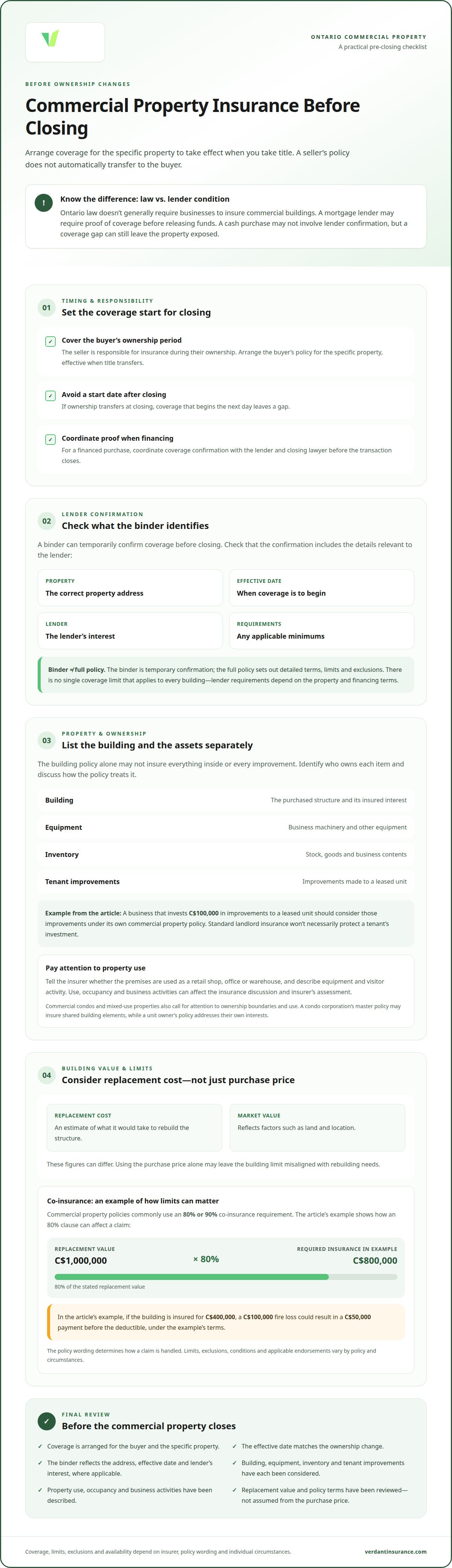
Ontario doesn’t require every business to carry commercial property insurance by law. But if you’re financing a purchase, your lender will generally require proof of coverage before releasing funds, with protection effective from the moment you take ownership. Arranging insurance before closing a commercial property in Ontario is an important part of preparing for the handover.
The purchase itself and the seller’s existing policy don’t automatically protect the building after closing. Insurance is arranged for a specific property and ownership interest, so the buyer needs coverage in place for the closing date. A cash purchase may not involve a lender asking for proof, but a gap in coverage can still leave the property exposed.
This article explains when insurance is required by law versus by a lender, what a binder confirms before closing, and how coverage may apply to a building, equipment, inventory, and tenant improvements. It also outlines practical considerations for arranging protection so you can prepare for closing with a clearer picture of what needs to be covered.
Key Takeaways
- Ontario law doesn’t generally require businesses to insure commercial buildings, but a mortgage lender will typically require proof of coverage before releasing closing funds.
- Arrange coverage for the property to take effect on the closing date, so there’s no gap when ownership changes.
- A binder can provide the lender with confirmation of coverage before closing; the full policy sets out the detailed terms, limits, and exclusions.
- Consider more than the building: equipment, inventory, and tenant improvements may also need to be addressed, depending on the policy and who owns them.
- Property use, occupancy, and business activities can affect insurance needs, so make them part of the coverage discussion before closing.
Is Commercial Property Insurance Legally Mandatory in Ontario?
Ontario law doesn’t require businesses to insure commercial property. However, a mortgage lender may make coverage a condition of releasing funds, so legal requirements differ from loan conditions.
Lender Coverage at Closing
Lender-required coverage is insurance arranged for the purchased building, with proof provided before the transaction closes. Financing may depend on showing that adequate coverage will take effect when the buyer takes title.
For a financed commercial property purchase in Ontario, lenders and closing lawyers typically require a binder or other confirmation of coverage. It should identify the property address, effective date, lender’s interest, and any applicable minimum requirements. A binder confirms coverage temporarily; the full policy sets out its terms, limits, and exclusions.
There’s no single coverage limit that applies to every building. A lender’s requirements depend on the property and financing terms. Commercial property coverage may address the building, equipment, or inventory, while endorsements can change the protection. The policy wording determines which claims are covered or excluded.
Pre-Closing Insurance Responsibility
The seller is responsible for arranging insurance during their ownership period, while the buyer needs coverage from the time they take title. The buyer’s policy must be arranged for the specific property. The seller’s policy doesn’t automatically transfer to the new owner.
For a financed purchase, the buyer coordinates proof of coverage with the lender and closing lawyer. A cash purchase may not require lender confirmation, but the buyer still needs protection effective on the closing date. If ownership transfers at closing, coverage that starts the next day leaves a gap.
Commercial condos and mixed-use properties call for careful attention to ownership boundaries and use. A condo corporation’s master policy may insure shared building elements, while the unit owner’s policy addresses their own interests. A storefront with apartments above combines commercial and residential uses, which can affect how the property is insured.
Premiums depend on factors such as building use, equipment, visitors, and the property’s risk profile. Maintaining the building and managing access can inform an insurer’s assessment, but don’t guarantee a lower premium. Endorsements may add or change coverage, with availability and cost varying by insurer and circumstances.
The key distinction for Ontario rules and taxes is that provincial law doesn’t mandate commercial property insurance, while a lender may impose a contractual coverage requirement. Any applicable premium tax is a separate issue. A lender’s closing condition doesn’t establish a tax rate.
Buildings, equipment, inventory, and tenant improvements
Commercial property coverage may protect more than the building. When arranging insurance before closing a commercial property in Ontario, identify the building, business assets, and improvements that need consideration.
Insured Property and Improvements
Insured property may include a building, business equipment, inventory, and improvements made to a leased unit. Identify each interest because the building owner and tenant may own different assets. A policy may cover business contents and stock, but its limits, exclusions, and conditions determine how claims are handled.
For example, a business that invests C$100,000 in leased-unit improvements should consider those improvements under its own commercial property policy. Standard landlord insurance won’t necessarily protect a tenant’s investment. Equipment and inventory also need attention: the building policy alone may not insure a tenant’s machinery, shelving, or goods.
Building Characteristics and Underwriting
Underwriting is the insurer’s assessment of a property and its risks before offering terms. For a commercial building in Ontario, business use, equipment, and visitor activity can affect that assessment. Explain whether the premises operate as a retail shop, office, or warehouse so the insurer can understand the exposure. Insurers may also ask about property losses during the last five years.
Building coverage limits are typically based on estimated replacement cost, not the purchase price or market value. Replacement cost estimates what it would take to rebuild the structure, while market value reflects factors such as land and location. Since the figures can differ, using the purchase price alone may leave the building limit misaligned with rebuilding needs.
Co-insurance clauses can affect a claim if the insured limit falls below the policy’s required share of replacement value. Commercial property policies commonly use an 80% or 90% requirement. For example, an 80% clause on a building with a C$1,000,000 replacement value calls for C$800,000 in insurance. If insured for C$400,000, a C$100,000 fire loss could result in a C$50,000 payment before the deductible, under the example’s terms.
Inventory may be insured differently from the building. Stock coverage is generally based on actual cash value, calculated as replacement cost minus depreciation. When arranging insurance before closing a commercial property in Ontario, consider equipment, inventory, and tenant improvements separately because ownership, value, and policy treatment may differ. Liability for injury or damage to others is separate from damage to insured property.
Commercial property insurance brokers and insurer market access
A commercial insurance broker helps buyers present a property’s use and risk details to insurers. Clear information helps insurers assess the building and prepare terms for review before closing.
Arranging Coverage Before Closing
Arranging coverage before closing means giving a broker the purchase and property details needed to seek insurance for the buyer’s ownership period. Start when the purchase is firm to allow time to discuss the building’s use, occupancy, equipment, and closing date.
For a financed purchase in Ontario, the broker can coordinate confirmation of coverage for the lender and closing lawyer. Share the lender’s requirements early, since they may affect which insurance documents are needed to complete the transaction.
Vacancy, Renovations, and Occupancy Changes
Vacancy, renovations, and tenant changes can alter the risk being insured. Tell the broker if the building will be empty, undergoing repairs, or changing tenants or business use.
A vacant retail unit undergoing renovations presents a different risk from an occupied shop. Policy terms may treat these situations differently, so disclose the timing and planned work before arranging coverage or when circumstances change.
Property use matters because a warehouse, office, and retail shop present different exposures. Give the broker accurate details about operations, equipment, customer visits, and tenants so the risk can be presented to insurers. If the building has several uses, such as storefronts with apartments above, describe each one rather than only the main tenant.
Insurers assess the information submitted and decide whether to offer terms. A broker’s access to insurers can help buyers seek options suited to the property, but not every insurer will offer coverage. The insurer’s assessment, eligibility criteria, policy wording, limits, and exclusions shape the result.
When reviewing an insurance proposal, ask the broker to explain the policy’s coverage, limits, exclusions, and claims process. Read the documents carefully and raise questions about how the proposed terms relate to the property and its planned use.
Accurate property details help connect the requested coverage with the transaction. If occupancy changes after the initial application or renovations begin before closing, update the broker so the revised circumstances can be presented to the insurer. Changes can affect terms, so communicate them promptly.
Ontario businesses that need commercial property insurance
Commercial property insurance is relevant when an Ontario property earns income, hosts clients, or holds business assets. A retail shop, warehouse, office, or rental building may have different property exposures because its operations and occupants differ.
Ownership isn’t the only consideration. A business leasing a unit may need protection for its equipment, inventory, and improvements, while a building owner focuses on the structure and rental exposure. For example, a shop tenant’s stock and display equipment are separate from the landlord’s building.
Small-business insurance can reflect the business’s location and operations. A professional office may need to account for computers and client visits, while a warehouse may hold goods and machinery. Describing the property’s use, contents, and activities helps clarify which exposures the insurance arrangement should address.
Business contents insurance concerns items used in daily operations, such as computers, tools, furniture, and inventory. Distinguish business-owned property from assets belonging to a landlord or customer. For example, a retailer’s stock is separate from shelving owned by the property owner.
Business interruption coverage relates to income losses when an insured property loss disrupts operations. A fire that closes a restaurant, for example, may interrupt sales while repairs are underway. The policy wording determines covered events, applicable limits, and how an interruption claim is assessed.
Home-based businesses also have property and liability exposures. Ontario home insurance policies often exclude or limit business activity. A consultant working from a spare room may have business equipment or client visits that change the risk. A business endorsement or dedicated commercial policy may be appropriate, so don’t assume standard home coverage addresses every business-related loss.
For mixed-use premises, consider each activity separately. A building with a ground-floor clinic and rental units above combines professional operations and residential occupancy. The property’s uses, visitors, equipment, and income sources help define the coverage discussion before a purchase or tenant change.
Whether commercial property insurance is legally mandatory in Ontario
Ontario law doesn’t generally require businesses to insure commercial buildings. The next step is to distinguish property insurance from protections that may arise from legislation, contracts, or ownership arrangements.
For example, commercial property insurance and title insurance address different risks. Property insurance relates to insured physical property losses under the policy, while title insurance addresses certain losses involving ownership or title. Title insurance doesn’t insure a building against fire damage, and property coverage doesn’t resolve every title issue.
Commercial vehicles are a separate matter. That distinction applies to vehicles used for business, not the building where the business operates. A company buying a retail property and operating delivery vehicles therefore faces separate insurance questions for its premises and vehicles.
Contracts can also determine what parties agree to insure. A commercial lease may assign responsibilities between landlord and tenant, while a purchase agreement can contain conditions specific to the transaction. These contractual terms aren’t the same as a province-wide statutory requirement. Review the documents to clarify who is expected to arrange coverage for particular interests.
Ownership structure can matter, too. A corporation may hold title to a building while a separate operating company uses the premises. The named insured and relationship between the entities should reflect the actual arrangement. Otherwise, the policy documents may not clearly match the ownership and business structure.
For a buyer, the practical question is not only whether insurance is legally required, but what obligations apply to this transaction and ownership arrangement. The purchase documents, lease terms, business structure, and any vehicle use each raise different considerations. A commercial property insurance discussion can focus on the building and the interests that need to be considered, while keeping those separate obligations distinct.
How Verdant Can Help With Commercial Property Insurance in Ontario
Verdant Insurance is an Ontario brokerage that helps buyers arrange commercial property insurance before closing. A discussion can cover the building’s use, occupancy, business contents, and the information an insurer needs to assess the request.
For example, a buyer acquiring an office with multiple tenants can describe each occupancy and any planned changes. Verdant can use those details to discuss the request with insurers. The insurer’s quote, declarations, and policy wording are the primary sources for the proposed terms and any issued coverage. Those documents specify the applicable limits, exclusions, and conditions.
If the purchase is financed, include the lender’s requested documentation and transaction details in the discussion. This keeps the insurance request connected to the buyer’s closing needs. The closing lawyer can clarify which documents the transaction requires, while the insurer’s documents set out the coverage terms.
It’s also useful to distinguish the building from property owned by tenants or operating businesses. A landlord, tenant, and property-owning corporation may have different interests. Tell the insurer who owns the building, equipment, inventory, or improvements so it has the relevant information for its assessment.
Ontario buyers can review commercial property insurance options and prepare details about the property address, occupancy, business activities, and closing timeline. For a mixed-use property, describe each use so the request reflects the actual building.
Each insurer’s quote and policy wording sets out terms for that particular risk. Review the documents for coverage, limits, exclusions, and conditions. A brokerage can explain the documents and discuss questions about the request, while the insurer determines the terms it offers.
If you’re purchasing a commercial property in Ontario, contact Verdant Insurance about your property insurance request.
Make insurance part of your purchase plan
Planning insurance before closing a commercial property in Ontario is easier when it’s part of the purchase timeline, not a last-minute task. Build time for an insurance discussion into your transaction planning alongside financing and legal arrangements. This gives you room to consider how the property’s intended use and ownership plans affect the request.
Verdant Insurance is a brokerage that can help Ontario buyers discuss commercial property coverage. The next step is to share your purchase details and explore the commercial property insurance options relevant to the building. Coverage, terms, and pricing vary by insurer and individual circumstances.
With a clear plan and the right conversation, you can approach closing with greater confidence.
Contact Verdant Insurance about your commercial property insurance
Frequently Asked Questions
Is commercial property insurance required before closing on a property in Ontario?
Ontario law generally doesn’t require a business to insure its commercial building. A lender may require coverage under its agreement with the buyer as a financing condition. For a property purchase, review the financing and ownership documents for obligations specific to the transaction rather than treating them as province-wide insurance rules.
When must commercial property insurance take effect before closing in Ontario?
Set the effective date to match the date ownership transfers. If the closing date changes, promptly tell the broker and lender so the insurance documents reflect the revised date. For example, if a transaction moves to a later business day, the original effective date may no longer align with the transfer. Keep the closing lawyer informed about updated insurance confirmation, rather than relying on documents prepared for the former date.
What types of coverage should commercial property insurance include in Ontario?
Consider coverage for the building and property connected with its operations, such as equipment or inventory, based on ownership and business needs. As a practical step, separate landlord-owned assets from tenant-owned assets and identify any business interruption exposure. Liability for visitor injuries is separate from physical damage to property. The policy wording, limits, exclusions, and insurer’s terms determine what protection applies.
How much does commercial property insurance cost in Ontario?
There’s no standard price for commercial property insurance in Ontario. Premiums depend on the insurer’s assessment and the property’s circumstances. Business type, equipment, and visitor activity may affect underwriting, while selected limits and insured property also shape the quote. To compare quotes meaningfully, provide consistent information about the building and its use. A price for one property or business isn’t a reliable estimate for another.
What documents or proof of insurance must be provided to the lender or lawyer at closing?
A lender or closing lawyer typically needs a binder letter or other written confirmation of coverage. For a transaction involving multiple properties, make sure the confirmation identifies each building’s address. The buyer’s business name and lender details should also match the transaction documents. Ask for the lender’s requirements to be reflected in the confirmation instead of assuming a general certificate will satisfy the closing condition.
What happens if commercial property insurance is not in place by closing?
If the purchase is financed, missing proof may prevent the lender from releasing funds on schedule. If the closing date changes, promptly coordinate the revised date with the lender, closing lawyer, and broker. Don’t assume a delayed closing automatically changes the insurance effective date or the lender’s requirements. For a cash purchase, no lender condition doesn’t remove the buyer’s exposure to property losses after ownership transfers.


