

A new tenant can change what your commercial property policy needs to account for. Commercial property insurance when a tenant changes in Ontario generally protects the building and landlord-owned property, and may also cover rental income after an insured loss and the landlord’s liability. A tenant’s contents, inventory and business losses are typically separate from the landlord’s building coverage.
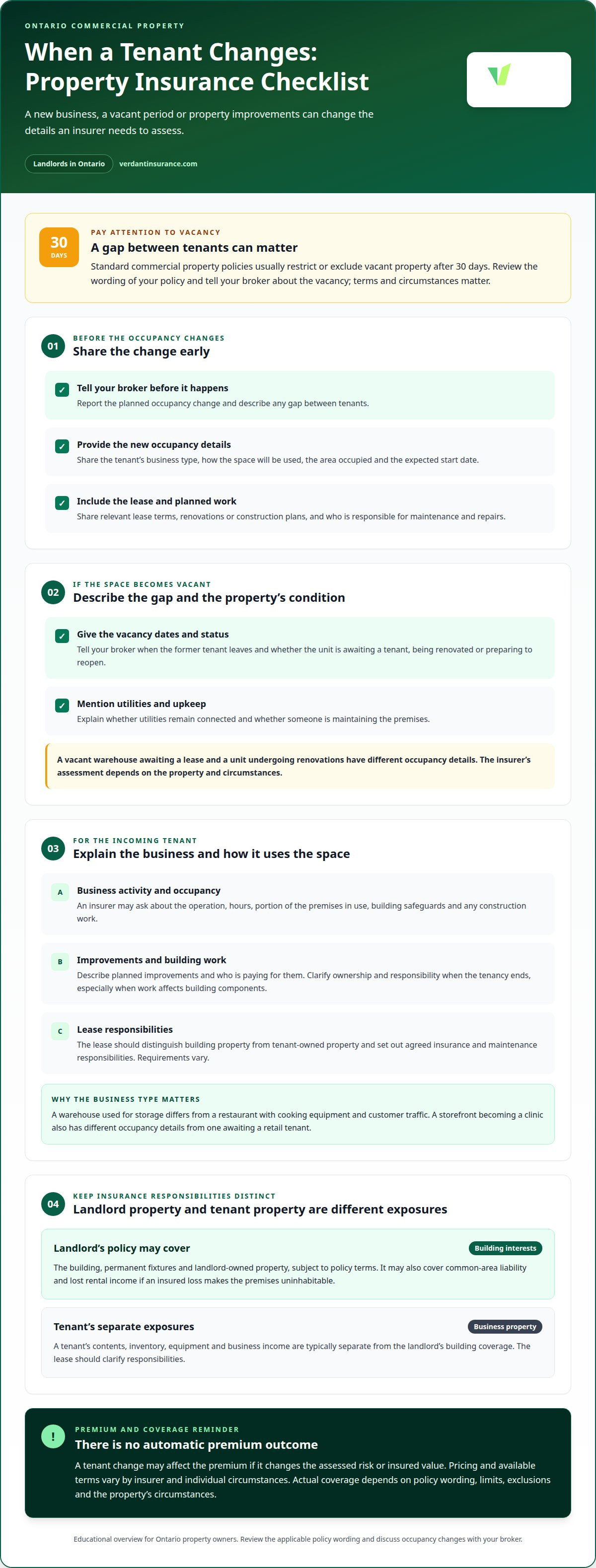
It’s understandable to focus on finding the next tenant, but tell your broker about a change in occupancy before it happens. A vacancy can matter too: standard commercial property policies usually restrict or exclude vacant property after 30 days. This article explains what commercial property insurance may cover, what to discuss with your broker when tenants change, and which vacancy details can affect your policy. Actual coverage depends on the policy wording, limits, exclusions and circumstances of the property.
Key Takeaways
- A new tenant’s business activity, lease terms and property improvements can affect how the building’s insurance needs are assessed.
- Tell your broker about a planned occupancy change before it takes place, and describe any gap between tenants.
- Vacancy can affect coverage: review your policy wording for any vacancy restrictions, including any stated time limits such as 30 days.
- Insurers may ask about the tenant’s operations, lease responsibilities and the condition or use of the premises; requirements vary.
- A tenant change may affect the premium, but the impact depends on the property, occupancy and insurer’s assessment.
What does commercial property insurance cover in Ontario?
In Ontario, commercial property insurance generally covers the building, permanent fixtures and landlord-owned property, subject to the policy terms. It may also cover liability for common areas and lost rental income if an insured loss makes the premises uninhabitable. A tenant’s inventory, equipment and business income are separate exposures to consider.
That distinction matters when a tenant changes. A clothing shop and a food business have different contents and activities. The landlord’s policy covers the landlord’s insured property interests, while the tenant’s insurance addresses its own contents and business exposures. The lease should specify who insures each item and how related costs are handled.
Commercial leases in Ontario commonly require tenants to carry commercial general liability insurance for bodily injury or property damage arising from their use of the premises. A lease may also require the landlord to be named as an additional insured. The contract should clearly state the insurance requirements, while the lease sets out the parties’ agreed responsibilities.
Lease terms also allocate maintenance duties. For example, a tenant might handle routine interior upkeep while the landlord takes responsibility for structural repairs. These duties can affect property risks and costs, especially if a tenant’s construction work touches plumbing, electrical systems or other building components. An insurance broker can consider the lease terms alongside the property details.
Tenant improvements adapt a space for a business, for example, by adding counters, partitions or specialized lighting. The landlord or tenant may pay for leasehold improvements, and the lease should clarify ownership and responsibility when the tenancy ends. Commercial property insurance may treat improvements as optional coverage, so their value and ownership matter when considering protection.
Improvement costs and lease obligations can affect the amount of property protection to consider. For example, a clinic tenant may install built-in rooms and equipment while the landlord remains responsible for the building’s structure. The lease should distinguish the building from tenant-funded improvements and address repair or reinstatement obligations after damage.
Could a tenant change invalidate coverage or lead to a claim denial in Ontario? A change does not automatically mean a claim will be denied. However, a new business use, an undisclosed occupancy change or a lease condition that conflicts with policy terms can affect coverage or a claim outcome. The policy wording and circumstances matter.
Vacancy periods and underwriting questions
A tenant’s departure can create a coverage-sensitive gap before the next business opens. The vacancy period and the building’s condition both matter to an insurer’s assessment.
Insurer Notification of Tenant Changes
Notifying the insurer means reporting a change in occupancy or a period when the premises have no tenant. Ontario landlords should tell their broker about occupancy changes before they happen. Standard commercial property policies usually restrict or exclude vacant property after 30 days. If a landlord doesn’t report a change, the insurer may assess a claim using outdated occupancy details, and the policy response may be affected by its wording and the circumstances.
Information About New Commercial Tenants
Insurers may ask who will occupy the premises and how the space will be used. Useful details include the tenant’s business type, the area occupied, the expected start date, and whether renovations or construction are planned. For example, a vacant storefront becoming a clinic is different from an empty unit awaiting a retail tenant. Share the updated lease and relevant occupancy details with the broker.
Tenant Changes and Insurance Premiums
A tenant change can affect the premium if it changes the building’s assessed risk or insured value. Renovations under a new lease may affect rebuilding costs, while changes in occupancy can affect the insurer’s assessment. Replacement cost, the deductible and options such as sewer backup coverage are also relevant policy details. Pricing varies by insurer and individual circumstances, so there is no automatic premium outcome.
Business Type and Occupancy Factors
A tenant’s business activity and use of the premises help insurers assess risk and rates. For example, a warehouse used for storage differs from a restaurant with cooking equipment and customer traffic. A broker may ask about the operation, hours, construction work, building safeguards and portion of the space in use. These details help explain the exposure, but the insurer’s assessment and available terms vary by business and property.
Vacancy details matter as much as the incoming tenant’s business. If a unit remains empty beyond 30 days, standard commercial property policies usually restrict or exclude vacant property. Tell the broker when the former tenant leaves, whether utilities remain connected, and whether someone is maintaining the premises. A vacant warehouse awaiting a new lease, for instance, has different occupancy information from a unit undergoing renovation before reopening.
For an update, give the broker the tenant’s business activity, occupancy start date, lease information, planned improvements and any vacancy period. Include renovation details and maintenance responsibilities. This gives the broker a clearer basis for discussing how the change may affect property coverage, liability and rental income protection.
Does changing tenants require notifying a commercial property insurer in Ontario?
Ontario landlords should report an occupancy change to their broker before the new tenancy begins. Commercial property insurance when a tenant changes in Ontario depends on accurate information about the insured premises. Treat the update as a policy-administration step, not just a change to rental records. The insurer can assess the revised circumstances and explain whether policy details need updating.
Start the conversation once the tenancy arrangement is settled enough to share reliable information. Identify the unit, the expected effective date and what is changing. If the agreement is still being finalized, distinguish provisional details from confirmed ones. This helps avoid presenting a draft arrangement as final.
Keep the notification focused and organized. A concise written message can identify the property and policy, describe the occupancy update and attach relevant lease pages. Ask the broker to confirm receipt and explain whether the insurer needs more information or revised documents. This creates a clear record of what was reported and when.
Use the effective date carefully. If possession, lease commencement and business opening fall on different dates, list each one separately. For example, a tenant may get access before opening to install furnishings. Clear dates help the broker communicate the timeline accurately to the insurer.
After the insurer reviews the change, keep its response with the property’s insurance records. File any revised policy documents with the current lease and earlier correspondence. If the proposed arrangement changes before the effective date, send the updated details through the same channel. This keeps the lease, broker correspondence and policy documents consistent.
Do not assume that notifying the broker changes the policy. Ask what the insurer has decided, when any revised terms take effect, and whether written confirmation or updated documents will follow. A tenant change does not automatically cancel coverage, but the insurer’s response depends on the policy wording and circumstances.
For a commercial property insurance tenant change in Ontario, dated written notice and a clear record of the insurer’s response make the handover easier to track. Keep the message, attachments and updated documents together. This record can help clarify what information was provided if questions later arise about the policy update.
What information do Ontario insurers require about a new commercial tenant?
There is no universal tenant-information checklist for every Ontario commercial property policy. An insurer may ask about the incoming business, its use of the premises, lease terms and planned work. The broker uses these details to describe the changed occupancy accurately and identify what the insurer needs for its assessment.
Start with the tenant’s legal business name, business activity, unit or area occupied, and planned possession date. Describe the operation specifically. “Medical clinic with examination rooms” gives a clearer picture than “office.” If the tenant sells products, prepares food or stores materials, explain those activities rather than relying only on a broad industry label.
- Tenant name and the premises or unit number.
- Business activity, operating hours and areas used.
- Lease start date and relevant insurance clauses.
- Renovations, construction plans or tenant-funded improvements.
- Any vacancy between the outgoing and incoming occupants.
The lease connects the tenant’s obligations with the building’s insurance information. For example, it may state who handles interior maintenance, repairs or damage to improvements. The broker may need the lease or relevant excerpts to understand those responsibilities. A draft lease can describe proposed terms, while the signed agreement records the final arrangement.
Insurers may also ask about the premises and planned changes. A restaurant tenant proposing kitchen alterations presents different information from a professional office occupying an unchanged suite. Note whether work affects plumbing, electrical systems or structural elements, and provide construction dates when available. These facts help the insurer assess occupancy and property exposure together.
Lease insurance requirements can also be relevant. A commercial lease may require the tenant to carry commercial general liability insurance and name the landlord as an additional insured. The insurer or broker may ask for evidence showing the tenant, rental address, policy dates, liability limit, insurer or brokerage, and policy number where applicable. Requirements depend on the lease and the insurer’s process.
Share updates as details become firm. If the tenant’s opening date moves, the business activity changes or planned improvements expand, send the new information rather than leaving the original description in place. For instance, a unit first described as a retail shop may later include product preparation. Accurate details help the insurer assess actual use, not an outdated plan.
Insurer requests vary by company, property and tenant. A broker can identify what is needed for the specific submission and explain how the lease, occupancy details and proposed work fit together. Complete, consistent information can reduce avoidable back-and-forth as the insurer reviews a new commercial tenant.
Can a landlord's insurance premium change when a commercial tenant changes?
Yes. A tenant change can lead an insurer to reassess the property and its premium, but an increase is not automatic. Commercial property insurance after a tenant change in Ontario is priced according to the insurer’s assessment of the individual risk. The outcome may be no premium change, an adjustment or a discussion about different policy terms.
The tenant is one part of the assessment, not the only one. An insurer may also consider the building’s insured value, construction and location. For example, a tenant change at a building with no physical alterations may still prompt a review of its overall risk information. The insurer determines how these details affect its assessment.
Separate the cost of insurance from the scope of coverage. A premium change does not, by itself, show that protection has expanded or narrowed. The policy’s limits, exclusions and wording describe the coverage, while the premium reflects the insurer’s pricing assessment. Owners should review both if the insurer proposes revised terms.
There is no standard pricing result for every tenant change. Two buildings with similar tenants can receive different assessments because their construction, location, insured values and insurer circumstances differ. Likewise, a new occupant does not necessarily change the premium if the insurer’s assessment leads to no adjustment. Pricing varies by insurer and individual circumstances.
Factors that may shape the property-level assessment include:
- The building’s insured value and construction details.
- The property’s location and overall characteristics.
- The insurer’s assessment of the changed occupancy.
- The policy terms and coverage selected for the property.
These factors work together rather than following a fixed formula. A building’s location or insured value may matter alongside updated occupancy information. The insurer weighs the details under its own underwriting approach. A tenant change alone cannot establish the direction or size of a premium adjustment.
When reviewing a proposed change, focus on what the insurer has assessed and which policy terms apply. The broker can explain the insurer’s response and clarify whether the premium, limits or other terms differ. Compare the proposed terms with the current policy as a whole, rather than treating the premium as the only measure of change.
If a commercial tenancy is continuing or changing, the appropriate next steps depend on the lease terms and the circumstances. Landlords and tenants may wish to review the lease and seek legal advice about whether an amendment or renewal is appropriate.
Verdant Insurance: Commercial Property Insurance
Verdant Insurance is a next step for Ontario commercial property owners reviewing insurance after a tenant change. As a brokerage, Verdant can help owners consider the building, occupancy and insurance needs together. This may be useful before a new lease begins, during a vacancy, or when a tenant plans renovations that change the premises.
The commercial property insurance information is relevant to owners of commercial buildings, including plazas, warehouses and professional properties. The appropriate insurance depends on the property and its use. Policy wording, limits, exclusions, insurer eligibility and individual circumstances all shape what protection may apply.
A tenant change is a practical time to review the information used to describe the property. An owner can share the new tenant’s business activity, expected occupancy date, lease responsibilities and planned construction. If a unit will remain empty between leases, include that timing too. These details help frame the discussion around the property’s current situation.
Property owners can also organize relevant records for a broker’s review, such as the current policy, building details, lease documents and information about landlord-owned property. If tenant-funded improvements are involved, note what was installed and who is responsible under the lease. Insurer questions and available terms vary, so a clear picture of the property supports a more focused assessment.
- The building’s use and current tenant schedule.
- Any vacancy, renovation or occupancy changes.
- Lease terms related to maintenance and insurance.
- Property, rental income and liability considerations.
These details help keep the insurance conversation grounded in the actual building rather than a generic description. For example, a warehouse with a vacant unit and planned electrical work differs from a fully occupied professional building without renovations. The broker can use the owner’s information to discuss the submission with insurers, each of which applies its own underwriting approach.
Verdant helps Ontario property owners explore commercial property insurance in light of their building and tenancy details. Coverage and pricing vary by insurer and individual circumstances. The policy wording, limits, exclusions and insurer’s assessment determine the terms available for a particular property.
Start a commercial quote request with Verdant Insurance to discuss your Ontario property’s insurance needs.
Frequently Asked Questions
Who Needs This Coverage?
Owners renting commercial buildings or units to businesses should consider dedicated commercial landlord property insurance. Whether a homeowner or small business policy responds to a claim involving a commercially rented building depends on the policy, insurer and circumstances. For example, an owner leasing a storefront to a retailer needs to consider protection for the building separately from the retailer’s stock and equipment. The property’s occupancy and the owner’s interests help shape the insurance arrangement.
How does a tenant change affect commercial property insurance coverage in Ontario?
A tenant change can affect how the insurer assesses the property, particularly if the new business uses the space differently. For example, converting a quiet office suite to a food-service operation changes the activity taking place there. The change does not automatically cancel coverage, but accurate occupancy information matters if a claim occurs. The lease, policy wording and circumstances help determine how the insurer responds.
What insurance should an Ontario commercial tenant carry, and who is responsible for it?
The tenant generally arranges insurance for its own contents, inventory and improvements it paid for. A commercial lease commonly requires the tenant to carry commercial general liability insurance for bodily injury or property damage arising from its use of the premises. Some leases also require business interruption coverage. The landlord typically insures the building. The lease sets out the parties’ responsibilities, so requirements differ between agreements.
Does a commercial lease in Ontario require tenants to provide proof of insurance?
A commercial lease may require a tenant to provide proof of insurance, but the specific requirement comes from the agreement. For example, a lease may require evidence of commercial general liability coverage and name the landlord as an additional insured. Proof may show the tenant, rental address, policy dates and liability limit. The lease may also request the insurer or brokerage and policy number, where applicable.


