

A 12-month indemnity period may not match the time needed to repair and reopen a commercial rental property. Most standard commercial business interruption policies offer a 12-month indemnity period, so understanding how the commercial rental income insurance indemnity period works in Ontario is important when assessing protection.
It’s reasonable to expect rental-income coverage to help when a covered loss leaves a unit unfit to rent. This protection may replace lost rental income after covered physical damage, but the policy wording, insured amount and time limit determine what it can pay.
This article explains how fair rental income is assessed, why repairs and permits can extend a shutdown, and what happens when restoration outlasts the indemnity period. It also covers how the indemnity period differs from a waiting period and why the right timeframe depends on the property and its potential recovery timeline.
Key Takeaways
- Most standard commercial business interruption policies offer a 12-month indemnity period, but that may not match the time needed to restore a rental property.
- Understand how the policy defines fair rental income and what financial records may help support a loss-of-rent claim.
- Repair timelines can stretch due to permitting, contractor availability, supply delays and work needed to meet building requirements.
- Consider the property’s potential recovery timeline when assessing an indemnity period, and distinguish it from any waiting period.
- Review how commercial property insurance may address building damage and rental-income exposure, since policy wording, limits and exclusions vary.
What does rental property insurance cover in Ontario?
For an Ontario commercial landlord, the applicable property policy wording sets out what building damage is insured, while its business interruption wording explains whether income losses may qualify. The policy’s definitions, conditions and limits are the primary references for understanding how those protections work together.
Rental Income and Business Interruption
Commercial rental income insurance is business interruption protection applied to a landlord’s lost rent, as defined in the policy wording. It matters because a landlord’s leases and income exposure differ from a tenant business’s sales. The policy identifies the interruption covered, the basis for calculating income and the applicable limits. Those terms determine how coverage applies to a specific loss.
Restoration and Indemnity Periods
The policy wording defines how the restoration period and indemnity period apply. It may define the restoration period as the time needed to repair damage and resume operations. Under the policy terms, the indemnity period ends when normal operations resume or the maximum time limit is reached. The contract’s exact definitions govern.
Business interruption or business income coverage may address lost income and eligible expenses when insured physical damage disrupts normal operations. For a landlord, the relevant income may be rent affected by damage to commercial premises. Whether a loss qualifies depends on the policy’s trigger, income provisions, exclusions and limits, not just the coverage label.
The policy also explains how to report a claim and what information the insurer requires. Start by following its reporting instructions, documenting the damage and interruption, and gathering records that support rental income, such as leases and rent statements. Keep repair updates and related expenses together. The insurer assesses the claim under the contract’s terms.
Business interruption coverage may be included in a business policy or added as an endorsement to a property policy or package. The wording may also address operating expenses, payroll, loan payments or temporary relocation, but provisions and limits vary. Read each applicable coverage section separately: building damage, rental income and additional expenses may have different triggers and conditions.
For a rental property, distinguish between physical damage to the building and the resulting financial interruption. The property policy wording explains the first; any business interruption or rental-income wording explains the second. Reviewing both sections helps clarify which losses may be considered and what requirements apply to a claim.
Fair rental income and loss-of-rent coverage
For an Ontario commercial landlord, fair rental income helps establish the amount of rent lost after covered damage. Mortgage payments, property taxes and other fixed expenses can continue during repairs, even when rent stops.
Covered Income and Operating Expenses
Loss-of-rent coverage may address rental income interrupted by covered physical damage, along with eligible operating expenses. It matters because a landlord’s financial obligations can continue while a damaged unit sits empty. The policy may use rental income and financial records to assess the loss, while its wording defines which income and expenses qualify.
How is the limit calculated? The insurer assesses rental-income exposure using information such as leases and financial records, then applies the policy’s stated limit and terms.
Distinguish rent lost because of covered damage from income lost for another reason, such as a tenant’s departure. Tenant-caused damage or vandalism does not automatically mean a rental-income claim will be paid. The physical damage must meet the policy’s coverage terms, and the cause, exclusions and resulting interruption all matter.
Exclusions and Waiting Periods
Exclusions identify losses the policy does not cover, while a waiting period delays when interruption-loss payments begin after physical damage. Both can affect the claim amount. For example, a waiting period measured in days can leave the landlord responsible for early lost rent. The policy wording determines which causes of damage are excluded.
Vacancy can also affect protection: an extended vacancy, often 30 days or more depending on the policy, may bring restrictions or exclusions. Short turnover gaps between tenants differ from a prolonged empty unit, so occupancy details and policy terms matter. A commercial landlord should account for vacancy when assessing potential coverage gaps.
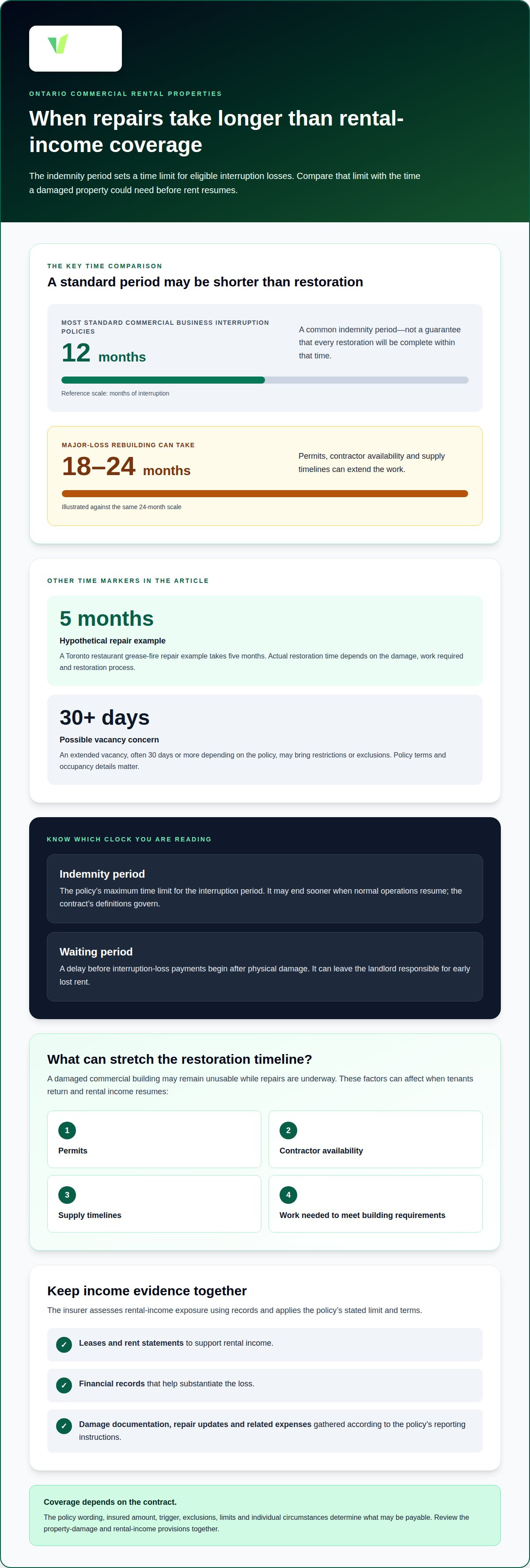
Rebuilding after a major loss can take 18 to 24 months when permits, contractor availability and supply timelines extend the work. Landlords may still carry mortgage obligations, taxes and other fixed costs while rental income is interrupted for 12 months or more. If restoration outlasts the policy’s indemnity period, lost rent after that limit may fall outside the covered period. Keep lease and rent records current to support the declared income and claim assessment.
Construction, permitting and repair delays
A damaged commercial building may remain unusable even after repairs begin. In Ontario, permits, contractor availability, supply timelines and work required to meet building requirements can all affect when tenants return and rental income resumes. The repair schedule therefore matters when assessing whether the indemnity period could cover the full interruption.
As a hypothetical example, repairs after a grease fire at a Toronto restaurant take five months. For a commercial landlord, a similar delay can leave a unit empty while repairs proceed. The actual timeline depends on the damage, the work required and how restoration progresses. A projected reopening date can change when contractors uncover additional work.
Permits can delay construction or specific repairs. Contractor schedules and material availability can also affect the sequence of work. These delays may be outside the landlord’s control, but they still affect how long the space earns no rent. A clear timeline can help explain the interruption, from the damage date through repair milestones and the return to use.
Building-code work may extend restoration beyond repairs to visible damage. Some policy wordings may address business-interruption losses related to additional time needed for code-compliance work. Check the insurer’s policy wording for the applicable terms, limits and exclusions; availability and application depend on that wording. When reviewing a claim, distinguish ordinary repair time from additional work required for code compliance.
During restoration, keep a clear record of the interruption and progress. Useful items include:
- Damage reports and dated photographs showing the affected commercial property.
- Permit applications, approvals and correspondence related to repair work.
- Contractor schedules, work updates and records of material delays.
- Lease and revenue records showing the rent affected by the interruption.
These records can connect repair events to lost rental income. A broker can explain how the indemnity period, declared revenue and policy wording relate to the building’s restoration timeline. Review these details before renewal, especially if the property may need complex repairs or code-related work. The key question is whether the chosen period allows enough time to restore the property and resume normal rental operations.
For strata properties, insurance arrangements should account for common property, common assets and fixtures installed as part of the original construction. This requirement can matter when defining restoration work and documenting which insured elements are being repaired, alongside permits, contractor schedules and records of construction progress.
Indemnity period length
The indemnity period sets the time window for assessing eligible interruption losses after a covered event. For a commercial landlord, its length should reflect how long the property may need before it can generate rental income again. An estimate based only on visible repairs may overlook other work needed before tenants can return.
For commercial rental income insurance in Ontario, choose a period by comparing the building’s likely recovery needs with the policy’s stated limit. The wording explains how the period is measured and how the maximum applies. A longer period may suit complex restoration work, but duration alone does not determine whether a loss qualifies.
Consider the property’s recovery as a sequence: address the damage, complete repairs, prepare affected spaces for use and resume leasing. The time required can differ between a single unit and a building with several types of commercial space. Tenant needs and the extent of the damage can also affect when rental activity resumes.
Use these considerations to assess whether the period fits the property:
- Building complexity: Consider whether the layout or use could make restoration more involved.
- Tenant mix: Different uses may require different work before occupants can return.
- Income exposure: Review how much rental activity could be affected if shared areas or systems are unusable.
- Policy limit: Understand the maximum time available for assessing eligible interruption losses.
A useful review also accounts for changes since the policy was arranged. Renovations, a new tenant mix or a change in how the premises are used can affect the recovery process. Lease information and current rental records show how the building earns income, while repair plans help outline expected restoration needs. These details support a property-specific discussion about the appropriate period.
Remember that the indemnity period is a time limit, not a promise that every loss during that time will be paid. The covered event, policy wording, applicable limits and exclusions still shape the claim assessment. Evaluate the period against the building’s likely path back to normal rental use, rather than relying on a general timeframe that may not suit its circumstances.
Standard indemnity periods for commercial policies
Commercial policies set a maximum time for assessing eligible interruption losses, and the specific period appears in the policy. For an Ontario landlord, “standard” is only a starting point for review. The key question is whether the stated limit fits the property’s potential recovery timeline and rental-income exposure.
A policy may include interruption protection or add it through an endorsement to a property policy or package. The document explains the period, how it applies and whether an extension is available. For commercial rental income insurance in Ontario, compare these terms with the expected time to restore the premises and resume normal leasing, rather than relying on a general label.
A building with several rented units shows why the details matter. Damage may affect shared areas, individual units or both, and restoration may happen in stages. Some spaces may be ready for tenants before others. The policy’s definition and maximum period set the time window for eligible lost income, while its wording determines how the loss is assessed.
When reviewing a policy, consider these details together:
- Start point: Identify the event or date that begins the period under the wording.
- End point: Note whether the period ends at a stated maximum or when normal rental operations resume.
- Income basis: Check how declared rental income relates to interruption-loss calculations.
- Extension wording: Review whether an endorsement changes the period, limit or conditions.
Renewal is a practical time to revisit these terms, especially after changes to the building, occupancy or rental arrangements. Renovations, a different tenant mix or changes in how spaces are used may alter the likely restoration process. Current lease and income information can help frame the discussion around the property’s earnings and how an interruption could affect them.
Read the policy’s stated period and conditions together. A familiar label does not establish how a specific claim will be assessed, and an extension does not necessarily change every other policy term. Judge the period against the building’s needs rather than assuming a common commercial-policy format suits every rental property. Coverage remains subject to the policy wording, limits and exclusions.
Verdant Insurance: Commercial Property Insurance
Verdant Insurance helps Ontario commercial property owners explore insurance options for buildings rented to tenants. As a brokerage, Verdant compares options from multiple insurers and can help you consider building use, rental-income exposure and the indemnity period alongside broader commercial property needs. This can be useful when buying a property, preparing for renewal or reassessing coverage after a change in occupancy or building use.
For a productive discussion, bring together details about how the property operates. These may include its use, tenant mix, lease arrangements, expected rental income, construction details and recent changes. This context helps identify issues to consider, such as whether the policy’s interruption period reflects the property’s potential restoration timeline and the income at risk during repairs.
Rental-income protection is only one part of the review. Building coverage, limits, exclusions and interruption terms all affect how a policy responds to a loss. Verdant’s brokers can help you consider these elements together and explain coverage trade-offs. Eligibility requirements and policy terms apply, and coverage decisions depend on the specific property and circumstances.
Before discussing your property, organize details such as:
- The building’s location, use and occupancy.
- Current tenant and lease information.
- Rental-income records and relevant financial details.
- Known renovations, repairs or changes to the premises.
- Questions about the indemnity period, waiting period and declared income.
These details give the discussion a clear focus. For example, a landlord planning renovations can ask how the work may affect occupancy and rental income. An owner approaching renewal can discuss whether the policy still reflects current tenants, income and property use. A broker can explain how insurer options and policy wording vary, rather than assuming one standard period fits every building.
Commercial property insurance involves interconnected decisions. Reviewing building information alongside rental income and recovery timelines helps clarify what needs attention. To take the next step, request a commercial insurance quote from Verdant for your Ontario property. This starts a discussion about your insurance needs without assuming a particular coverage outcome or price.
Submit a commercial quote request with Verdant Insurance.
Frequently Asked Questions
What is business interruption insurance?
Business interruption insurance helps address lost income and eligible continuing expenses when covered physical damage disrupts normal operations. For a commercial landlord, affected income may be rent that cannot be collected while damaged premises are unusable. For example, damage to shared building systems could interrupt several leases at once. The policy’s trigger, income calculation, limits and exclusions determine how a claim is assessed.
How long of an indemnity period does my business need?
Choose a period that reflects how long the property could take to restore and return to normal rental use, not just the initial repair estimate. Complex operations may need an 18-to-24-month period; 24 to 36 months may suit businesses with complex operations, high capital investment or specialized supply-chain dependencies. For a landlord, building complexity, tenant use and expected restoration work help inform the assessment.
How does rental income insurance cover lost rent after insured property damage?
Depending on the policy, coverage may include eligible rental income lost when covered damage makes the insured premises unusable. If only one unit is affected, the loss assessment may differ from damage that prevents multiple tenants from operating. Lease schedules, rent records and dates showing when each space became unusable or reopened can help explain the interruption and support the income calculation.
How long are typical indemnity periods for commercial property insurance in Ontario?
Most standard commercial business interruption policies offer a 12-month indemnity period. That is a common starting point, not a guarantee that every rental property has the same period or needs no extension. Some policies may offer an extended period, with terms depending on the insurer and policy. A landlord can compare the stated limit with the building’s likely restoration timeline and tenant return plans.
What expenses and lost rental income are covered during the indemnity period?
Depending on the policy, eligible losses may include interrupted rent and certain continuing expenses tied to the covered interruption. A landlord may still face loan payments or property taxes while a damaged unit produces no rent. The wording sets out which expenses qualify, how income is calculated and which limits apply. Building repair costs are separate from the calculation of lost rental income.
How do business interruption and rental income insurance differ for commercial landlords?
Business interruption insurance is the broader coverage concept; rental-income insurance describes how it applies to a landlord’s lost rent after covered property damage. A retailer’s claim might focus on interrupted sales, while a landlord’s income exposure comes from affected leases. The policy wording defines covered income, eligible expenses and the time limit. The label alone does not establish what a specific policy will pay.


