
Would your current policy actually cover the full cost of rebuilding your home if a major loss happened tomorrow? With residential construction prices in Canada jumping nearly 70% between late 2019 and 2025, many homeowners in Markham and across the GTA are finding that their old limits no longer match today's reality. It's frustrating to face rising premiums while feeling uncertain about whether a "Comprehensive" or "Broad" policy is the right choice for your family.
You aren't alone if you feel confused by the fine print or worried about being underinsured during a severe Ontario storm. This guide simplifies your homeowner insurance coverage options by breaking down the standard protections and the specific add-ons that actually matter for our local climate. We'll walk you through the core pillars of a policy, explain essential endorsements like overland water, and show you how to tailor a plan that fits your property's unique needs. By the end, you'll have the clarity and confidence to discuss your policy with a broker and ensure your home is truly protected.
Key Takeaways
- Learn how standard policies combine property protection with personal liability to create a foundational safety net for your home.
- Compare the differences between Comprehensive, Broad, and Basic forms to choose the best homeowner insurance coverage options for your property.
- Identify essential Ontario endorsements, including water damage protections, that fill the gaps left by standard policy wordings.
- Understand the relationship between deductibles and premiums to ensure your coverage limits reflect today's high rebuilding costs in the GTA.
- Discover why partnering with a local Markham broker helps you compare multiple partner insurers to find a policy tailored to your unique needs.
Standard Homeowner Insurance Coverage: The Core Pillars
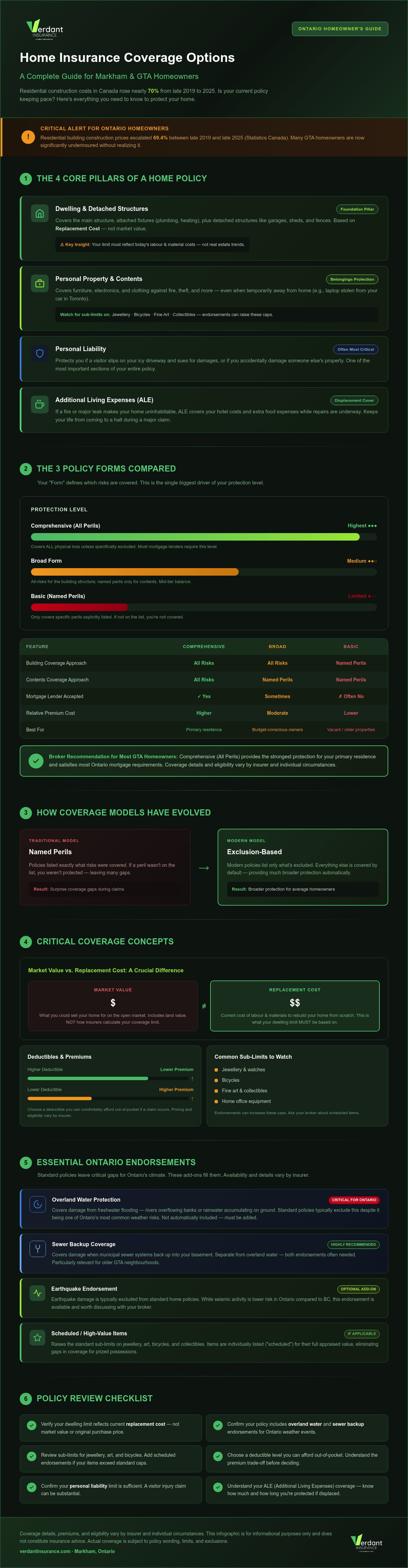
A standard policy doesn't just protect your roof; it's a carefully bundled package of protections designed to keep you financially secure. In Ontario, understanding your homeowner insurance coverage options starts with recognizing that your policy is divided into distinct sections. These pillars work together to safeguard your assets, whether you're dealing with a burst pipe or a legal claim. While the specific details vary by insurer, the structure of standard home insurance coverage remains consistent for most properties in Markham and the GTA.
Many homeowners in Richmond Hill or Vaughan confuse their home's market value with its insurance value. Your insurance isn't based on what you could sell your house for on the open market. Instead, it's based on the "Replacement Cost." This reflects the current price of labour and materials required to rebuild your home from scratch on your existing land. According to Statistics Canada, residential building construction prices escalated by 69.4% between late 2019 and late 2025. This surge makes it vital to ensure your dwelling limit keeps pace with actual rebuilding costs rather than just following local real estate trends.
Dwelling and Detached Structures
This pillar covers the main physical structure where you live, including attached fixtures like plumbing and heating systems. It also extends to "detached structures" on your property. This includes your garden shed, fences, or a detached garage. Insurers use specialized tools to estimate the cost of rebuilding your specific home, considering details like the quality of your finishes and the age of your roof. It's a foundational part of any Homeowner Insurance policy that ensures you can restore your property after a major loss.
Personal Property and Contents
Your belongings deserve protection too. This section covers your furniture, electronics, and clothing against risks like fire or theft. Most policies protect your items even when they're temporarily away from home; for example, if your laptop is stolen from your car while you're visiting Toronto. You should be aware that insurers often set "sub-limits" for high-value items. Standard caps often apply to jewellery, bicycles, or fine art. If your collection exceeds these basic limits, you can often add a specific endorsement to ensure they're fully covered.
Liability and Additional Living Expenses
Personal liability is often the most critical part of your policy. It protects you if a visitor slips on your icy driveway and decides to sue for damages. It also covers accidental damage you might cause to someone else's property. Alongside this, Additional Living Expenses (ALE) provides a vital safety net. If a fire or major leak makes your home uninhabitable, ALE helps cover the cost of a hotel and extra food expenses while you're displaced. This ensures your life doesn't come to a halt while your home is being repaired.
Comprehensive, Broad, and Basic: Choosing Your Policy Form
When you look at homeowner insurance coverage options, you'll encounter the term "Form." This simply refers to the scope of risks, or perils, your policy covers. It's the difference between a policy that lists exactly what's protected and one that protects everything except a few specific exclusions. For most people in York Region, this choice defines the balance between their annual premium and their level of financial security.
The Financial Consumer Agency of Canada guide to home insurance highlights that understanding these forms helps you avoid surprises during a claim. Traditionally, policies were built on "Named Perils." This meant if a risk wasn't on the list, you weren't covered. Modern policies have shifted toward an "Exclusion" model. Instead of listing what's included, they list what's left out. This shift provides much broader protection for the average homeowner in Markham and the GTA.
Comprehensive (All Perils) Coverage
The Comprehensive Form is the most popular choice for a reason. It offers "All Risks" protection for both your building and your contents. This means you're covered for any physical loss or damage unless the policy specifically says otherwise. Common exclusions usually involve predictable events like general wear and tear, rust, or intentional damage. Because it's so robust, most mortgage lenders in Ontario require you to have this level of coverage in place before they'll fund your loan. It provides the highest level of peace of mind for your primary residence.
Broad and Basic (Named Perils) Forms
Not every property requires the highest level of protection. A Basic Form only covers specific risks explicitly named in the document, such as fire, lightning, or explosions. If a tree falls on your roof but "falling objects" isn't on that list, you're on your own. The Broad Form sits in the middle. It usually provides comprehensive "All Risks" coverage for the main house structure but limits the contents inside to "Named Perils." This creates a tiered level of protection that can be more complex to navigate during a claim.
These more restrictive forms are often chosen for seasonal cottages or by homeowners looking for a lower-cost alternative. However, the savings in premium can quickly be outweighed by the out-of-pocket costs of an uncovered loss. If you're unsure which form fits your property, you can speak with an Ontario insurance broker to review the fine print. Your choice eventually comes down to your personal comfort with risk and your budget requirements.
Essential Endorsements for Ontario Homeowners
An endorsement is an add-on that modifies your basic policy, allowing you to fill gaps that standard forms might leave behind. While a comprehensive policy covers many risks, it often excludes specific events like certain types of water damage or earth movement. By using these riders, you can customize your homeowner insurance coverage options to match the specific risks of your property and neighbourhood. These additions act as custom upgrades that provide peace of mind where standard wording falls short.
In Ontario, the regulatory framework ensures you have access to clear information about these additions. You can refer to FSRA's property insurance guidance to better understand your rights and the importance of choosing endorsements that reflect your local environment. Evaluating the cost versus the benefit is a personal decision. However, adding protection for a few extra dollars a month often prevents a massive financial burden later. This proactive approach ensures your policy remains as unique as your home.
Water Damage: Sewer Backup and Overland Water
Water damage is the leading cause of home insurance claims in Canada. Sewer backup protection covers you if water or sewage flows back through your drains or sump pump. In contrast, overland water coverage protects against surface water entering your home from heavy rain or overflowing bodies of water. According to the Insurance Bureau of Canada, severe weather claims paid by Canadian insurers hit a record $9.4 billion in 2024. GTA residents frequently face sudden torrential rain, making these endorsements vital for anyone with a finished basement or a home in a low-lying area. If you're unsure which add-ons are necessary for your property, you can consult with an Ontario broker to review your specific needs.
Service Line and Equipment Breakdown
Modern homes in Markham and York Region rely on complex systems that standard policies might not fully protect. Service line coverage pays for repairs to underground pipes, like water or sewer lines, that run from the street to your house. These are often the homeowner's responsibility, and repairs can be expensive if a line bursts or freezes. Equipment breakdown coverage acts as an extension for your HVAC, water heaters, and major appliances. It covers mechanical or electrical failures that aren't typically included in a standard fire or theft policy. These modern tools provide a high degree of care for the systems that keep your home running comfortably and efficiently.
Evaluating Your Coverage Limits and Deductibles
Choosing the right homeowner insurance coverage options involves a careful balancing act between your deductible and your premium. Your deductible is the amount you agree to pay out-of-pocket before your insurance coverage kicks in. While opting for a higher deductible, such as $2,000 or $2,500, can help lower your annual costs, you need to be certain that you have those funds readily available in an emergency. It's a simple way to manage your budget, but it requires a clear understanding of your personal financial cushion.
Beyond the deductible, you must evaluate whether your personal property limits truly reflect the value of everything you own. Many people underestimate the total cost of replacing their furniture, clothing, and electronics all at once. Reviewing these figures annually with your broker is essential. It ensures your policy keeps pace with inflation and the rising costs of goods in Ontario, especially given the recent surges in rebuilding and material expenses mentioned earlier in this guide.
Actual Cash Value vs. Replacement Cost
This distinction is one of the most important factors in how much you'll receive after a claim. Actual Cash Value (ACV) pays you the depreciated value of your items. If a three-year-old television is destroyed, ACV only pays what that used TV would sell for today. Replacement Cost, however, pays for a brand-new version of the same item. Most homeowners in Markham and the GTA prefer Replacement Cost because it allows them to restore their lives to normal without dipping into their savings to cover the gap caused by depreciation.
Conducting a Home Inventory
The best way to ensure your limits are accurate is to create a detailed home inventory. This doesn't have to be a tedious task. You can use your smartphone to take a video tour of each room, opening drawers and closets as you go. Storing digital receipts for major purchases like appliances or high-end electronics in a cloud-based folder is also a smart move. This documentation serves two purposes:
- It helps you identify if you've exceeded "special limits" for items like jewellery, fine art, or high-end bicycles.
- It provides clear evidence for your insurer, which can significantly speed up the claims process.
Get a personalized home insurance review
Navigating Coverage Options with an Ontario Insurance Broker
Choosing the right homeowner insurance coverage options doesn't have to be a solo mission. While a direct insurer is limited to their own proprietary products, an independent brokerage like Verdant Insurance works for you. If your needs don't fit one specific insurer's box, a broker has the flexibility to look elsewhere. We connect you with a variety of partner carriers, comparing different wordings and rates to find the protection that aligns with your property and your budget. This model ensures you aren't forced into a one size fits all policy that might leave you vulnerable.
Professional advice is particularly valuable when you're deciding between complex forms like Comprehensive and Broad coverage. A RIBO licensed broker understands the fine print of Ontario insurance contracts and can explain how specific exclusions might impact a future claim. Localized knowledge of the Ontario market matters because risks in Markham or the GTA aren't the same as those in other provinces. We help you navigate these nuances with a focus on transparency and simplicity, ensuring you feel secure and well cared for throughout the process.
Customising Your Policy in Markham and the GTA
Living in York Region or Toronto comes with specific considerations, from urban basement flood risks to the high cost of local contractors. We take the time to understand your unique property, whether it's a new build in Vaughan or a mature home in Richmond Hill. For clients who have maintained a clean record, there are often significant benefits. Claim-free and conviction-free homeowners might see up to a 30% discount when they bundle their home and auto policies. This tailored strategy doesn't just save money; it creates a cohesive safety net for your entire household.
Getting Started with a Verdant Broker
Getting the protection you need is a straightforward process. You can start by requesting a home insurance quote online Canada to get a sense of the current market landscape. To provide an accurate assessment, it helps to have details about your home's age, the type of heating and plumbing systems you use, and the age of your roof. Once we have this information, we can compare options from our partner insurers to find the right fit for your circumstances. If you're ready to move forward with confidence, speak with a Verdant expert today to review your options and customise a policy that truly protects your home.
Securing Peace of Mind for Your Ontario Home
Protecting your property starts with clarity. By identifying the right policy form and adding essential endorsements for local risks like overland water, you can build a safety net that stands up to Ontario's changing weather. It's about more than just checking a box; it's about ensuring your home's replacement cost is accurately reflected so you aren't left with out-of-pocket gaps after a loss.
Navigating homeowner insurance coverage options feels much simpler when you have a proactive guide on your side. Our Markham-based team connects you with multiple leading Canadian insurance partners to find a tailored fit for your unique needs. If you've been claim-free, you might even qualify for savings of up to 30%. We're here to help you move forward with confidence and transparency.
Your home is likely your biggest investment. We look forward to helping you protect it with the care and attention to detail you deserve.
Frequently Asked Questions
What is the most common homeowner insurance coverage option?
The Comprehensive form is the most popular choice among Ontario residents because it offers the widest protection. It covers your dwelling and contents against all risks except for specific exclusions listed in your policy. Most mortgage lenders in the GTA require this form before approving a loan. It provides peace of mind by ensuring that almost any sudden or accidental damage is covered, making it a foundational homeowner insurance coverage options choice.
Is flooding covered by standard home insurance in Ontario?
Standard policies in Ontario usually exclude damage from surface water or sewer backups. You need specific endorsements, like Overland Water or Sewer Backup, to protect your home from heavy rain or failed sump pumps. Given that severe weather claims in Canada hit a record $9.4 billion in 2024, these add-ons are vital for properties in York Region. Always check your policy wording to confirm which water risks are included.
What is the difference between dwelling coverage and market value?
Dwelling coverage pays for the actual cost to rebuild your home, while market value is the price you'd receive if you sold the property. Market value includes the land and local real estate demand, which don't affect reconstruction costs. Between late 2019 and 2025, residential construction prices in Canada rose by 69.4%. Your insurance limit should reflect these rising material and labour costs to ensure you can fully rebuild after a loss.
Do I need extra coverage for my home office or small business?
Yes, most standard policies have very low limits for business equipment and don't cover business-related liability. If you run a small business or have clients visiting your home in Markham, you may need a specific home office endorsement or a separate business insurance policy. This ensures your professional equipment and legal risks are fully protected. A broker can help you determine if your current homeowner insurance coverage options are sufficient.
How can I lower my homeowner insurance premium without sacrificing coverage?
You can lower your costs by bundling your home and auto policies or by choosing a higher deductible. Many insurers also offer significant discounts for homes with modern security systems or water leak sensors. At Verdant Insurance, we highlight that claim-free and conviction-free clients may see discounts of up to 30%. Maintaining your property's roof and plumbing also helps you qualify for more competitive rates from our partner carriers.
Are my belongings covered if they are stolen from my car?
Your home insurance policy, not your auto insurance, typically covers personal items stolen from your vehicle. This includes things like laptops, gym gear, or holiday gifts. However, these claims are still subject to your policy deductible and specific sub-limits for high-value items. If you frequently carry expensive equipment in your car, it's a good idea to discuss your contents limits with your broker to ensure you have enough protection.
What happens if my home is uninhabitable after a claim?
If your home is damaged by a covered peril and you can't stay there, your policy's Additional Living Expenses (ALE) coverage will help. This section pays for necessary costs like hotel bills, moving expenses, and even the extra cost of meals while you're displaced. It's designed to help you maintain your normal standard of living during a stressful time. ALE limits are usually a percentage of your total dwelling coverage.
Why should I use an insurance broker instead of buying directly online?
A broker works for you rather than a single insurance company, giving you access to multiple leading Canadian insurers. We compare different quotes and policy wordings on your behalf to find a tailored fit for your budget. This professional advice is especially helpful when navigating complex Ontario regulations. Since we are based in Markham, we provide localized expertise that direct online insurers often lack, ensuring your policy matches your specific neighbourhood risks.