

If you're paying an average of $1,500 for home insurance in Ontario, you might be leaving up to $300 on the table every year simply by missing a specific certificate from your security provider. It's a common frustration for homeowners in Markham and across the GTA who see their premiums climb and wonder if their smart home gadgets are actually helping their bottom line. You want to feel safe, but you also want to know that your investment in technology is working as hard for your wallet as it is for your peace of mind.
We understand that the choice between DIY setups and professionally monitored systems is often confusing. This 2026 guide will show you how to qualify for the home security system insurance discount Canada providers offer, ensuring you get the most value from your safety features. We'll walk you through the specific ULC standards insurers look for, the difference between burglar and fire monitoring, and how to stack multiple smart home discounts to lower your annual costs. By the end, you'll have a clear checklist to hand to your broker to help maximize your savings.
Key Takeaways
- Discover how working with an Ontario broker allows you to compare different insurer rules to find the highest potential credit for your specific security setup.
- Learn why professionally monitored systems are the gold standard for securing a home security system insurance discount Canada providers offer in the Ontario market.
- Find out how adding environmental sensors like water leak detectors can stack with your burglar alarm to increase your total premium savings.
- Get a clear checklist of the evidence you'll need, including the essential Alarm Monitoring Certificate, to ensure your discount is applied correctly.
- Understand that while these discounts vary by insurer, they are available for both homeowners and those looking for tenant insurance in Markham and the GTA.
Does a Home Security System Lower Insurance Premiums in Ontario?
Yes, a security system absolutely helps lower your insurance costs in Ontario. Insurers recognize that homes with active monitoring are statistically less likely to experience successful theft or vandalism. When you reduce the likelihood of a claim, you lower the risk for the provider. They reward this proactive behavior by offering a credit on your homeowners insurance policy. It's a win for your safety and your budget.
The specific savings you'll see depend heavily on your provider and the hardware you choose. While a discount is common, the exact amount varies by insurer and the specific type of system installed. For some high-value homes in the GTA, particularly in areas like Toronto or Vaughan, a monitored system might even be a mandatory underwriting requirement. In these cases, coverage isn't just cheaper with an alarm; it's only available if you have one.
When you're deciding on a system, it's helpful to look at the total return on investment. You'll want to balance the monthly monitoring fee against your annual insurance savings. Even if the discount doesn't cover the entire cost of the service, the added layers of protection and peace of mind often make it a worthwhile investment for Ontario families.
How Ontario Insurers View Home Risk
Insurers use detailed data to determine rates in specific postal codes. If you live in a high-traffic area of Markham or a busy Toronto neighborhood, your premium reflects the local frequency of theft claims. By installing a security system, you're telling the insurer that your home is a lower risk than the statistical average for your street. The security discount is a direct reduction in the base premium of the property portion of your insurance policy.
Tenant vs. Homeowner Discounts
Many renters assume these savings are only for property owners, but that isn't the case. If you're looking for a home security system insurance discount Canada residents can use, tenant insurance policies are a great place to start. Renters in Richmond Hill or Toronto can benefit from the same risk-mitigation logic that applies to homeowners.
While a homeowner might save more in total dollars on a $1,500 policy, the percentage-based discount is still valuable for a tenant paying $300 annually. It's a simple way to make your monthly budget more efficient while protecting your belongings in a rental unit. Every insurer has different rules, so it's always best to ask your broker which systems they recognize for your specific policy type.
Types of Security Systems and ULC Standards Explained
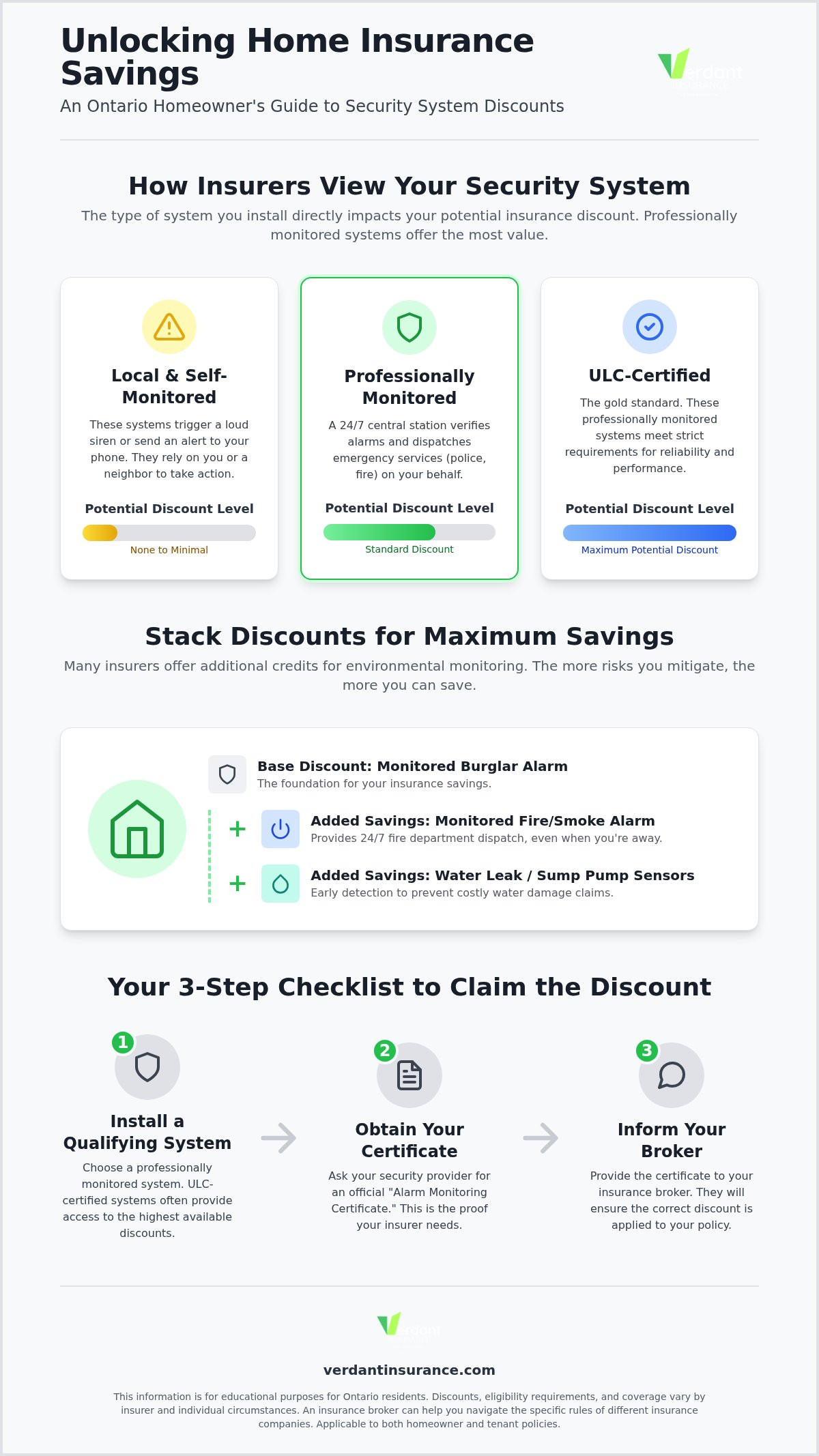
Not all security setups are viewed the same way by your insurance provider. You might have a high tech camera at your front door, but if it doesn't alert a professional response team, it may not impact your premium. In Ontario, insurers generally categorize systems into two groups: local alarms and professionally monitored systems. Local alarms use a siren to scare off intruders, but they don't notify anyone outside the home. Because these rely on a neighbor hearing the noise and taking action, they rarely trigger a significant discount.
Most insurers require central station monitoring to offer a meaningful reduction in your costs. This means your system is connected to a dedicated facility that operates 24/7. When an alarm is triggered, the station verifies the signal and dispatches emergency responders if necessary. While DIY brands like Ring, Nest, or Arlo have become popular in Markham and the GTA, their acceptance varies. Most companies will only apply a home security system insurance discount Canada residents can use if you pay for the brand's professional monitoring tier rather than just using the free smartphone alerts.
Monitored vs. Self-Monitored Systems
The distinction between professional monitoring and self-monitoring is a major factor in your eligibility. Professional monitoring involves a third party dispatch service that stays on the line until help arrives. Self-monitoring, on the other hand, sends a push notification to your phone. If you're in a meeting, sleeping, or out of cell range, that alert goes unanswered. Because self-monitoring still leaves a gap in protection, many Ontario insurers provide the full discount only for setups that include 24/7 professional oversight.
ULC Certification: The Gold Standard for Savings
If you want to ensure your system meets the strictest industry requirements, look for ULC certification. This stands for Underwriters Laboratories of Canada, an organization that sets the benchmarks for safety and reliability. A ULC-certified installation ensures that the equipment and the monitoring station meet specific standards for signal speed and hardware durability. Common standards include ULC S301 for burglar alarms and ULC S304 for fire systems. To claim your credit, you'll need to ask your security provider for a formal Alarm Monitoring Certificate. This document proves to your broker that your home meets the necessary technical requirements for a premium reduction.
Stacking Smart Home Discounts for Maximum Savings
Many homeowners start their search for a home security system insurance discount Canada providers offer because they're worried about theft. While that's a great starting point, the most effective way to lower your premium is by "stacking" different types of protection. Think of your security hub as more than just a burglar alarm. Modern technology allows for comprehensive environmental monitoring that covers a variety of risks. By adding sensors for water, temperature, and smoke, you're creating a proactive safety net that insurers find very appealing.
When you combine these features, you're doing more than just scaring off intruders; you're mitigating the most expensive risks a home faces. Insurers like to see this multi-layered approach because it shows you're committed to preventing damage before it happens. Bundling these features under a single smart home policy makes it much easier for your broker to verify your setup and apply all the relevant credits you've earned.
Water Damage Prevention: The Underused Discount
Water damage is currently the leading source of property claims across Ontario. From frozen pipes in Vaughan to overflowing appliances in Richmond Hill, the cleanup costs are often much higher than those associated with a typical break-in. Because of this, underwriters are increasingly rewarding homeowners who install smart water leak detectors. These small sensors are placed near high-risk areas like water heaters and washing machines.
The highest value comes from systems that include an automatic water shut-off valve. These devices can detect a burst pipe and shut down the main water line in seconds, even if you aren't home. When you speak with your broker, mention these specific devices. They demonstrate a level of care that goes beyond basic security, often leading to better rates on your homeowner or tenant policy.
Fire and Smoke Monitoring
It's important to distinguish between a standard battery-operated smoke detector and a professionally monitored fire system. A standard alarm alerts the people inside the house, but a monitored system alerts a central station that can dispatch emergency services immediately. This is crucial if a fire starts while you're at work or away for the weekend. Rapid response times significantly reduce the risk of a total property loss.
Because the potential for a massive claim is lower, insurers are often willing to provide better terms. This proactive approach is a key factor that influences the Average Cost of Home Insurance in Ontario for safety-conscious residents. Making sure your fire protection is linked to your central monitoring station is one of the most reliable ways to maximize your overall policy savings.
The Broker's Advantage: Comparing Insurer Rules in Ontario
Every insurance company in Ontario operates with its own internal "discount matrix." This is a complex set of rules that determines exactly how much credit you receive for specific safety features. For example, Company A might offer a 5% credit for a basic monitored alarm, while Company B offers a 15% credit for the exact same hardware. These differences happen because every insurer has a different appetite for risk and a different history with claims data.
This variation is why finding a home security system insurance discount Canada homeowners can actually rely on requires a broader view of the market. As an insurance brokerage, we aren't tied to the rules of just one company. We know which insurers in our network reward specific brands of hardware or certain levels of ULC certification. Instead of you having to guess which system will save you the most, we do the comparison for you by looking across our multiple partners to find those hidden credits.
Why Direct Insurers Can't Always Give You the Best Deal
Direct writers typically offer one-size-fits-all pricing. Their systems are built for efficiency, which often means they lack the flexibility to recognize unique or high-end security setups. If your home in Markham or Vaughan has a specialized environmental monitoring system, a direct insurer might not have a category for it in their software. This leads to missed savings for proactive homeowners who have invested in better protection.
A broker provides a personalized alternative. We understand the specific risks facing neighborhoods in the GTA and can pivot your coverage if you decide to upgrade your technology. If you move from a self-monitored DIY camera to a professionally monitored setup, we can re-evaluate your policy across our entire panel of insurers to ensure your new investment is fully recognized. It's about making sure your insurance evolves as your home does.
Customizing Your Policy for 2026
Your security system is a powerful tool for lowering your premium, but it's only one part of a modern, customizable policy. To get the best value, we look at your entire profile. Many Ontario homeowners qualify for additional credits that they might not even know exist. These can include claims-free status for long-term proactive homeowners, new home discounts for recently constructed properties, or mortgage-free credits for those who have reached that financial milestone. By reviewing these factors together, we ensure your policy is as efficient as possible for your specific circumstances.
How to Claim Your Discount: A Practical Checklist
Securing a home security system insurance discount Canada residents can actually see on their monthly bill requires a few simple administrative steps. Once your system is installed and the technician has left, the final step is ensuring your insurance policy reflects your new, lower risk profile. This isn't an automatic process; you need to proactively provide proof of monitoring to your broker. The best time to do this is immediately after installation or at least 30 days before your policy renewal date. This gives your broker enough time to shop your updated profile across different Ontario insurers to find the most competitive credit for your setup.
Keep in mind that this discount is contingent on your system remaining active. If you cancel your monitoring service or let the contract lapse, you're technically required to notify your broker. A lapse in monitoring can void the discount and, in some cases where the alarm was a mandatory underwriting requirement for a high-value home, it could even impact your coverage eligibility. Staying proactive with your contract ensures your savings remain intact year after year.
What to Look for on Your Monitoring Certificate
Your security provider will issue an Alarm Monitoring Certificate. This document is the primary piece of evidence used by underwriters to verify that you qualify for the home security system insurance discount Canada insurers provide. Before you send it over, double check that it contains these specific details:
- The exact property address of the insured home in Ontario.
- The specific types of monitoring provided, such as burglary, fire, or environmental sensors.
- The name and contact information of the ULC-certified central monitoring station.
- An active "effective date" that shows the service is currently in force.
The certificate must be current and reflect the actual level of service you're paying for. Once you've verified these details, simply email a PDF copy of this certificate directly to your broker to start the update process.
Next Steps with Verdant Insurance
Gathering your current policy details and your new security contract is the first move toward a more efficient premium. At Verdant, we've designed our process to be as transparent and effortless as possible. You can easily share your documents through our online platform, allowing our team to quickly review your coverage and apply any new credits. Our goal is to make the path to savings feel simple and supportive.
Whether you're protecting a new home in Markham or updating a long-term policy in Toronto, we're here to help you navigate the different rules of Ontario's top insurers. Taking these small steps today ensures you're not just safer, but also paying a fair price for your protection. We'll handle the comparisons so you can focus on enjoying your peace of mind.
We look forward to helping you protect what matters most while keeping your premiums manageable and fair.
Frequently Asked Questions
Does a Ring or Nest doorbell camera count for an insurance discount in Ontario?
Doorbell cameras like Ring or Nest usually don't qualify for the full home security system insurance discount Canada residents expect if they are only self-monitored. Most insurers in Ontario require a system linked to a 24/7 central station to trigger a meaningful premium reduction. While these devices offer great visibility, they rely on you seeing the alert. Professional monitoring ensures help is dispatched even if you aren't looking at your phone.
What is an Alarm Monitoring Certificate and how do I get one?
An Alarm Monitoring Certificate is a formal document issued by your security provider that confirms your system is active and professionally monitored. It includes details like your address, the type of sensors installed, and the monitoring station's ULC status. To get one, simply contact your security company's customer service department. You then email this PDF directly to your broker to have the discount applied to your homeowners or tenant insurance policy.
Is the home security discount worth the monthly monitoring fee?
While the insurance discount might not always cover the entire monthly monitoring fee, it's often a smart financial move. The premium savings help offset the cost of the system, while the equipment significantly reduces the risk of expensive claims. For homeowners in Markham or Toronto, the added layers of protection against theft and water damage provide a level of security that usually outweighs the net monthly expense.
Do I need a professionally monitored system to get a discount?
Most insurance companies in Ontario require professional monitoring to grant a significant discount. Self-monitored systems that only send alerts to your smartphone are often ineligible for the standard security credit. Insurers prioritize professional dispatch services because they ensure emergency responders are notified immediately. This reliable 24/7 oversight is what reduces the risk for the insurer and leads to a home security system insurance discount Canada providers recognize.
Can I get a discount for a DIY security system I installed myself?
You can often get a discount for a DIY system as long as it includes a professional monitoring plan. The key factor for Ontario insurers isn't who mounted the sensors, but who monitors the signals. If your DIY setup is backed by a 24/7 central station that can provide a monitoring certificate, you'll likely be eligible for a credit. Always check with your broker to see if your specific DIY brand is accepted.
Does my security system discount apply to my auto insurance too?
No, your security system discount only applies to your property insurance, such as a homeowner or tenant policy. It won't directly lower your auto insurance rates. However, many residents in the GTA find that bundling their home and auto insurance with the same broker leads to a multi-policy discount. This bundle can be combined with your security system credit for even greater total annual savings on your insurance costs.
What happens to my insurance discount if I cancel my security monitoring service?
If you cancel your monitoring service, you're required to notify your insurance broker immediately. The security discount will be removed from your policy, which will lead to an increase in your premium. If your policy was issued with a monitored alarm as a mandatory requirement for a high-value home, canceling the service could potentially void your coverage. It's always best to speak with your broker before making changes to your security contract.
Are there specific security brands that Ontario insurance companies prefer?
Ontario insurance companies generally don't have a list of preferred hardware brands. Instead, they focus on the standards of the central monitoring station. As long as your provider is ULC-certified and can issue a valid monitoring certificate, the brand name on the keypad usually doesn't matter. Whether you use a traditional security company or a modern smart home provider, the level of professional oversight is the most important factor.