

A client’s financial-loss claim can follow an overlooked requirement, an implementation error or advice that fails to deliver the expected result. Errors and omissions insurance for IT consultants in Ontario is designed to respond to claims alleging that a professional mistake caused a client financial harm. Depending on the policy, it may cover defence costs and a settlement or judgment.
It’s understandable to focus on whether a policy covers a claim, but the limit and premium matter too. The right fit depends on your work, client contracts and the potential financial impact of an alleged error.
This article explains how E&O coverage works, what kinds of IT consulting claims it may address, and how premiums and policy limits are determined. It also explains how E&O differs from commercial general liability insurance and what to consider when assessing coverage for your business.
Key Takeaways
- E&O insurance can respond to client claims alleging that professional advice or IT services caused financial loss, including defence costs and covered settlements or judgments.
- Think about how implementation errors, incomplete work or inaccurate guidance could affect a client’s business when assessing your professional liability exposure.
- E&O and commercial general liability address different risks: professional service claims differ from claims involving bodily injury or property damage.
- Premiums and suitable policy limits depend on factors such as your services, revenue, claims history and the requirements in client contracts.
- Review how a policy’s claims-made structure, exclusions and limits fit your work before choosing coverage.
What is professional liability insurance in Ontario?
Professional liability insurance, also called errors and omissions (E&O) insurance, addresses claims alleging that professional services caused financial harm. For Ontario IT consultants, the key question is whether the alleged mistake relates to work performed for a client.
Businesses That May Benefit
Businesses that provide expert advice, technical knowledge or other professional services can face liability claims when clients allege those services caused financial loss. Examples include IT consulting, software development and website design. Recommendations, configuration work and project deliverables can all become part of a complaint if a client believes an error affected its operations or revenue.
Consider the service itself: a business advising on system integration faces a different professional exposure from one that only sells equipment. Client contracts matter, too. Some Ontario service agreements require proof of professional liability insurance or specify a minimum limit. Review the scope of work and contract requirements together to identify the exposures a policy should address.
Coverage for Ontario IT Consultants
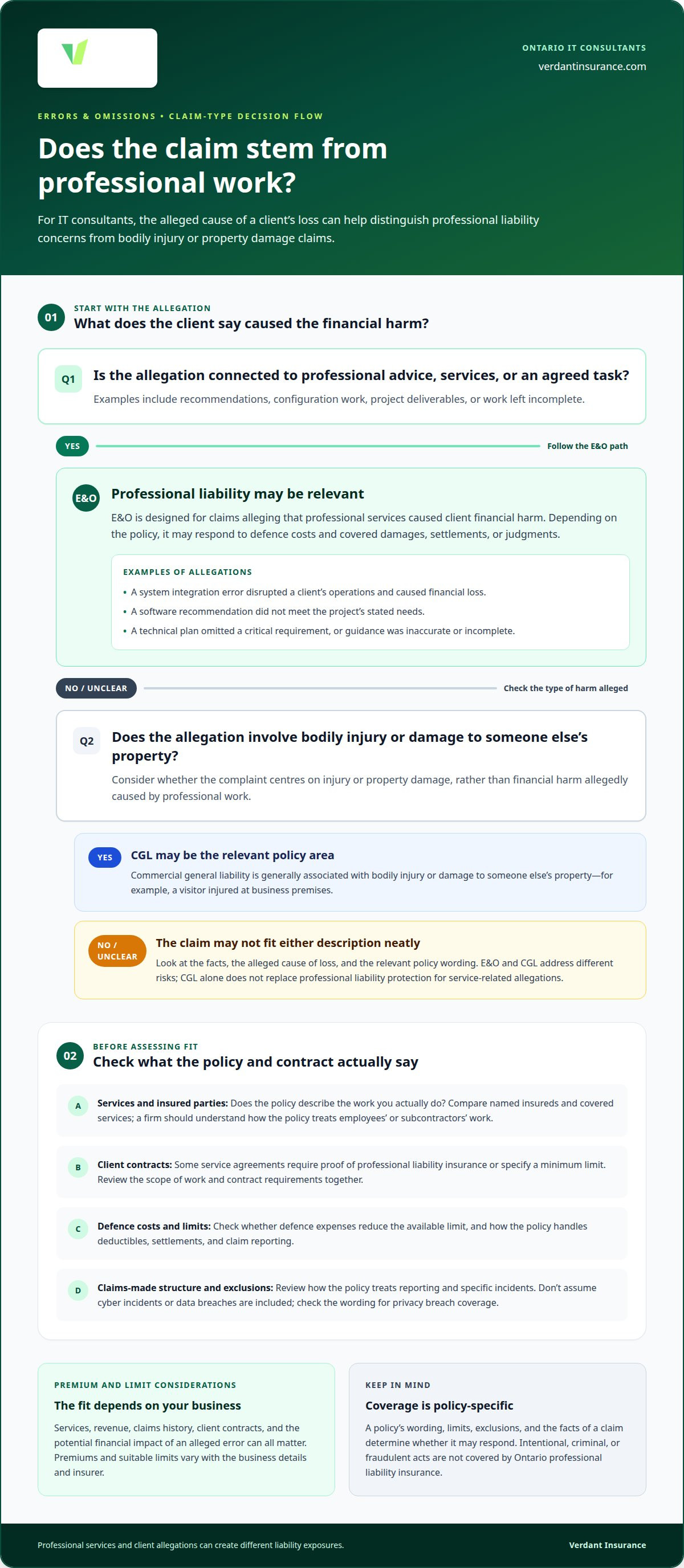
For IT consultants, E&O is designed for claims alleging negligence, an error or an omission while providing professional services. For example, a client might allege that a system integration error disrupted operations and caused financial loss. The policy may respond to covered defence costs and damages or settlement amounts, subject to its wording, limits and exclusions.
Professional liability differs from commercial general liability (CGL). CGL is generally associated with claims involving bodily injury or damage to someone else’s property, such as a visitor injured at business premises. E&O addresses alleged financial harm arising from professional advice or services. These policies address distinct liabilities, so CGL alone does not replace professional liability protection for service-related allegations.
Freelance and Incorporated Firm Policies
A freelance consultant and an incorporated firm both need to describe the professional services they provide, but their business structures differ. A freelancer should consider the services performed under their own name and the contracts they sign. An incorporated firm should consider the entity’s work and the roles of people providing services on its behalf.
For either structure, compare the named insureds, covered services, policy limit and contract requirements. For example, a firm using employees or subcontractors should understand how its policy treats their work. Legal structure alone doesn’t determine the right protection; the work performed and the potential for claims are central considerations.
Insurers and Policy Exclusions
Insurers offering E&O to Ontario IT consultants are those underwriting professional liability for the relevant services; availability depends on insurer appetite and business details. The insurer is identified in the quote and policy documents, and coverage is subject to its underwriting and policy wording.
Cyber incidents and data breaches require careful attention to policy wording. Privacy breach coverage may provide resources for prevention, required reporting and notifications, and recovery from damages, but don’t assume every E&O policy includes it. Ontario professional liability insurance does not cover intentional, criminal or fraudulent acts. Review the policy’s exclusions and definitions to understand how it treats a specific incident.
What is Errors & Omissions (E&O) Insurance?
E&O insurance addresses allegations that professional advice or services caused a client financial harm. For technology businesses, the key question is whether a claim stems from the work performed, the recommendation made or an agreed task left incomplete.
Legal Expense Coverage
A professional liability policy can help cover legal expenses to defend an insured against a covered claim. Defence costs can arise even when allegations are unfounded, so the policy’s treatment of these expenses matters alongside its limit for damages or settlements. Check whether defence costs reduce the available limit, and how the policy handles settlement decisions and claim reporting.
For example, a client could allege that a consultant’s project advice caused financial loss and start legal proceedings. The policy may provide a defence and address covered settlement or judgment costs, subject to its terms. An insurance broker can explain how the wording treats defence expenses, deductibles and the limit available to resolve a claim.
Service and Advice Claims
E&O focuses on claims connected to professional services, advice or administrative work. A client might allege that a software recommendation failed to meet the project’s stated needs, or that a consultant omitted a critical requirement from a technical plan. The dispute centres on the advice or service and its alleged financial effect.
A written contract helps define the promised work, but it doesn’t prevent a claim if a client alleges delivery fell short. Claims can involve alleged negligence, inaccurate or incomplete guidance, misrepresentation or failure to perform. Coverage depends on the policy wording and the facts behind the allegation.
Coverage for Technology Professionals
IT consultants, programmers and web designers provide different professional services, so the policy description should reflect the work actually performed. For instance, a consultant advising on software selection has a different service profile from a programmer building custom applications. Clear descriptions help connect the insured’s work to the intended coverage.
Software development companies can seek professional liability solutions designed for their sector. For a development contract, consider how the policy treats coding, configuration, implementation and project advice. A software recommendation can also lead to a claim if a client alleges it caused financial harm. Describe both advisory and delivery work accurately when arranging coverage.
Professional liability is also used in fields such as real estate, where agents provide services and advice to clients. The shared point is the professional relationship, not identical work or policy terms. For an IT business, focus on the services promised in each contract and the potential financial consequences if a client alleges an error.
Before choosing a policy, map each service line to the work described in client contracts. Then review defence-cost treatment, covered professional services and relevant exclusions. This gives you a clearer basis for discussing coverage with an insurance broker, especially if a software firm combines consulting, development and implementation.
Coverage for professional errors, omissions, negligence, and misrepresentation
E&O insurance addresses claims alleging that a professional service caused a client financial loss. An IT consulting contract in Ontario can require proof of coverage and specify limits, but there is no single limit that fits every consulting agreement.
Errors and Omissions Coverage
Coverage is intended for allegations that professional negligence, an error or an omission caused financial harm. For an IT consultant, a client might allege that a technical recommendation overlooked a requirement or an implementation left a key task incomplete. Policy wording sets the covered services, exclusions and limits, so the work described in the policy matters.
Misrepresentation claims can also arise if a client alleges that information about a service was inaccurate or misleading. The policy may address defence costs and covered damages or settlements. Intentional, criminal or fraudulent acts are not covered. Treat the allegation and the policy terms as separate questions: an allegation is not proof of liability, and coverage depends on the claim’s facts and wording.
Errors Causing Client Financial Loss
Technical work can affect a client’s operations and finances. A code defect could interrupt a business system; a system integration error could disrupt connected services; or a missed technical safeguard could expose a client to operational problems. These situations become potential E&O claims when a client alleges that professional services caused financial losses.
Keep the project scope, recommendations and delivery records together. For example, a contract may describe a specific implementation task, while project correspondence records an additional requirement. These details help show what the consultant agreed to deliver and what the client says went wrong. Defence costs for professional liability allegations can reach thousands of dollars, even when allegations are untrue.
Misleading Advice and Misrepresentation
A client might claim that advice was incomplete, inaccurate or misleading, then allege resulting financial losses. For example, an IT consultant’s software recommendation might fail to account for a stated business need. The client could argue that choosing or implementing the software caused extra work or disrupted operations. E&O is designed to address claims about professional advice, not to guarantee project results.
Review how the policy describes advisory services and compare that wording with the services in client contracts. A specialized consultant who recommends software and also handles implementation should describe both activities. Clear records of the client’s requirements, the recommendation and its limitations can help establish what advice was given and what work was agreed.
Negligence and Service Delivery
Service-delivery claims can arise when a client alleges that a provider failed to complete expected tasks or delivered inaccurate, incomplete or misleading guidance. For an IT consultant, an omitted configuration step or unfinished integration could trigger a dispute if the client connects it to financial harm. The policy’s definition of professional services determines how the work relates to coverage.
E&O is not legally mandatory for every Ontario IT consultant, but a contract can require insurance and set a limit. Requirements also apply to some regulated professions: the Real Estate Council of Ontario mandates specific professional liability coverage for real estate agents and brokerages, and lawyers in Canada are required to carry professional liability insurance. Distinguish these obligations from the terms of an IT services contract.
Protection against client claims for financial loss
E&O insurance is designed to address client claims alleging professional mistakes caused financial loss, including covered defence costs. For errors and omissions insurance for IT consultants in Ontario, insurers assess details such as services, contracts, revenue, claims history and business structure. An insurance broker can help arrange coverage suited to the consultant’s work.
Examples of Client Claims
Imagine a consultant’s system integration error interrupts a client’s sales platform. The client might claim the disruption caused lost revenue and seek compensation. In another example, a software recommendation omits a stated technical requirement, leading to additional project costs. Whether either allegation is covered depends on the policy wording, limits, exclusions and circumstances surrounding the claim.
These examples show why the client’s alleged financial loss matters. A professional liability claim concerns loss attributed to a consultant’s services, rather than every commercial dispute or disappointing outcome. Project scopes, written recommendations and delivery records can help clarify what was agreed and what the client says went wrong.
Claims-Made and Reported Policies
Professional liability policies are typically written on a claims-made basis. The policy generally responds to claims first made against the insured during the policy period, subject to its terms. Understand the policy’s reporting requirements and notify the insurer about a claim or circumstance as the wording requires.
For example, a client may allege an implementation mistake after the project ends. The relevant policy period and reporting conditions can affect how the claim is considered. When changing insurers or renewing coverage, review continuity, prior acts provisions and any applicable retroactive date. These details can matter when a claim relates to earlier work.
An insurance brokerage can help organize application details and explain policy options from insurers. Useful information includes the IT services delivered, client contract terms, revenue, staff or subcontractor involvement, and claims history. These details give insurers context for underwriting; they don’t establish that a claim will be covered. Ontario IT consultants arranging errors and omissions coverage should describe their actual work and contractual obligations.
Social inflation describes how legal and social conditions can contribute to rising claim costs. For an IT consultant, the practical concern is the possible severity of a client’s alleged loss, including defence expenses and claimed business interruption. A claim involving a system used across a client’s operations could have a different financial impact from one involving a limited project delay.
To assess that exposure, map each service to its contract obligations and the client’s reliance on the work. Then consider the policy limit, defence-cost treatment and reporting terms together. A commercial agreement may set its own insurance requirements, while the policy sets the coverage available under its wording. The documents serve different purposes and should align as closely as possible.
Errors and omissions insurance cost and policy limits
For Ontario IT consultants, E&O premiums and limits reflect the work, business finances and potential client losses. The premium is the policy’s price; the limit is the maximum available for covered claims under its terms.
What affects the premium?
Insurers consider factors such as profession, revenue, employee count and claims history when pricing professional liability insurance. The services delivered matter too: software development, system integration and technical advice can present different exposures. A business with several service lines should describe each clearly so the insurer can assess the work being insured.
Client concentration can affect the assessment. An Ontario business where one client represents more than 40 percent of revenue has concentrated exposure. If a claim disrupts that client relationship, the financial impact on the consultant’s business could be substantial. Insurers may also consider contract requirements and the scale of client engagements.
Choosing a policy limit
A C$1 million professional liability limit is common in Ontario, but a larger project may expose a consultant to losses beyond that amount. Some Ontario client contracts require at least C$1 million per occurrence and C$2 million aggregate. “Per occurrence” applies to a claim or related event; “aggregate” is the most the policy pays across covered claims during its policy period.
Higher-value engagements, government contracts and financial services work may require limits of C$2 million or C$5 million. Compare each contract’s requirement with the policy’s per-occurrence and aggregate limits. Also determine whether defence costs reduce the amount remaining for damages or settlements. Legal expenses can draw down available protection before a claim is resolved.
How to assess the fit
Start with the largest client contract and the work it describes. Estimate the financial consequences of a serious implementation failure, then consider the contract’s required limit and the policy’s available aggregate. For example, a consultant supporting a client’s core systems may face a different potential loss from one advising on a limited project.
Commercial general liability insurance addresses a different set of risks. It generally responds to claims involving bodily injury or property damage, while E&O addresses alleged financial harm from professional services. In Canada, general liability insurance typically does not cover service errors and omissions, so a CGL limit isn’t a substitute for an E&O limit.
Choose a tailored limit by weighing contract terms, revenue exposure, client concentration and defence costs together. A low premium may come with a limit that doesn’t fit a high-value engagement, while a higher limit should reflect a real contractual or business exposure. Revisit the fit when your services or contract obligations change, so the limit stays aligned with the work you undertake.
Verdant Insurance: Auto Insurance
Verdant Insurance can help Ontario business owners consider how business insurance fits alongside professional liability coverage. E&O addresses allegations tied to professional services, while other business coverage can address different risks; one policy shouldn’t be treated as a substitute for the other.
If you’re an IT consultant reviewing your wider insurance needs, consider which risks arise from your business operations, property or vehicles. Verdant offers Business Insurance and Auto Insurance, along with Home Insurance and Tenant Insurance. An insurance broker can help explain which options are relevant to the risks you’re looking to address.
For an E&O policy, focus on the professional services, contract requirements, limits and exclusions discussed in this guide. For other business coverage questions, contact Verdant Insurance to discuss your needs.
Make your next coverage review count
Use your next contract renewal or change in IT services as a prompt to revisit your insurance needs. For errors and omissions insurance for IT consultants in Ontario, consider how your work and client obligations have changed since the policy was arranged. A new service, larger project or different client requirement can make a fresh review useful.
For broader business insurance needs, Verdant Insurance can help you understand options relevant to your Ontario business. Coverage and terms depend on the insurer, policy wording and your circumstances.
A clear next step can help you make more confident insurance decisions.
Frequently Asked Questions
How much does E&O insurance cost?
There isn’t one fixed premium for every Ontario business. For a useful estimate, provide consistent details about your services, contracts and requested coverage when seeking quotes. Compare options using the same limit and deductible, then review how each policy treats defence costs and prior work. A lower premium alone doesn’t show whether the wording suits your business or a client’s contract requirements.
What types of claims are made against professional service firms?
Professional service firms can face claims alleging that their work failed to meet an agreed obligation or that their advice caused a client harm. A client may send a demand letter, start arbitration or begin litigation. Keep the relevant contract, project correspondence and work records together, and follow the policy’s claim-notification process. The form of the dispute and the allegation can affect how it is handled.
What types of situations does E&O insurance cover?
Potential situations include allegations that a professional service or recommendation caused a client financial harm. Coverage isn’t determined by the label attached to a complaint alone. For example, distinguish a client’s demand for compensation from a disagreement about an invoice or scope change. Review how the policy defines a claim, what notice it requires and which professional activities it describes.
Who is legally required to carry E&O insurance in Ontario?
Ontario requirements depend on the profession and its regulatory framework; they don’t apply uniformly to every business. For an IT consultant, a contract may require coverage even when the profession has no general statutory requirement. Separate legal or regulatory obligations from a client’s procurement conditions. This distinction helps identify whether insurance is required to practise, for a particular engagement or to address business exposure.
Will my professional liability policy cover a claim from a US client?
A claim from a US client depends on the policy’s territory and jurisdiction wording, along with the contract and circumstances. Before signing, identify where disputes may be brought and whether the agreement includes insurance or legal-proceeding requirements. Provide those details when arranging coverage. A policy’s permission to serve a client abroad doesn’t by itself establish that every resulting claim or proceeding falls within its terms.
What does errors and omissions insurance cover for IT consultants in Ontario?
E&O is intended to address claims tied to alleged financial harm from professional IT work. If a client raises a concern, preserve the signed scope, relevant project versions and communications showing decisions or approvals. Avoid making admissions or agreeing to a settlement before following the policy’s claim-handling instructions. These steps help keep the record organized while the insurer considers the claim under the policy wording.
Is professional liability insurance legally required for IT consultants in Ontario?
There isn’t a general legal requirement for every Ontario IT consultant to carry this insurance. A specific client, tender or service agreement can still make proof of coverage a condition of doing the work. Read the insurance clause before accepting the engagement, noting required documents and any stated limits. This separates a client’s contractual requirement from a legal obligation attached to a regulated profession.
How much does E&O insurance cost for IT consultants in Ontario?
The premium depends on the consultant’s business and the policy selected, so an individual cost requires a quote. For an accurate assessment, describe each service line, the types of client engagements and any insurance clauses in contracts. Include whether the work involves subcontractors, advice or implementation. Clear application details help insurers assess the risk and provide terms suited to the operations described.


