
The lowest auto insurance quote may be the least useful one to compare if it includes different coverage. If you’re looking to compare auto insurance rates Canada-wide, remember that policy choices and rules depend on where you live. For Ontario drivers, comparing the same coverage on each quote is the clearest way to understand why prices differ.
Different totals don’t necessarily mean one insurer simply costs less. Driver and vehicle details, coverage limits, deductibles, and optional benefits can all affect a quote. Since July 1, 2026, several accident benefits that were previously standard in Ontario are optional, making it especially important to check what each quote includes.
This guide explains how to compare Ontario auto insurance quotes on equal terms, which details can influence rates, and how to weigh coverage against price. You’ll also learn what common insurance terms mean and when an Ontario broker can help clarify your options. Start with consistent information and coverage choices, then check the terms behind each price.
Key Takeaways
- To compare auto insurance rates Canada drivers see for Ontario coverage, keep the vehicle, drivers, intended use, and policy choices consistent across quotes.
- Treat each quote as an insurer-specific offer based on the information provided and the assumptions used to calculate it.
- Compare premiums alongside coverage choices, limits, deductibles, exclusions, and quote assumptions.
- Ask for clarification if quote details are missing, inconsistent, or difficult to interpret before deciding which option fits your needs.
- An Ontario broker can help explain options from partner insurers, but the insurer’s policy wording and terms determine coverage.
Why Ontario auto insurance rates differ, and what a comparison can tell you
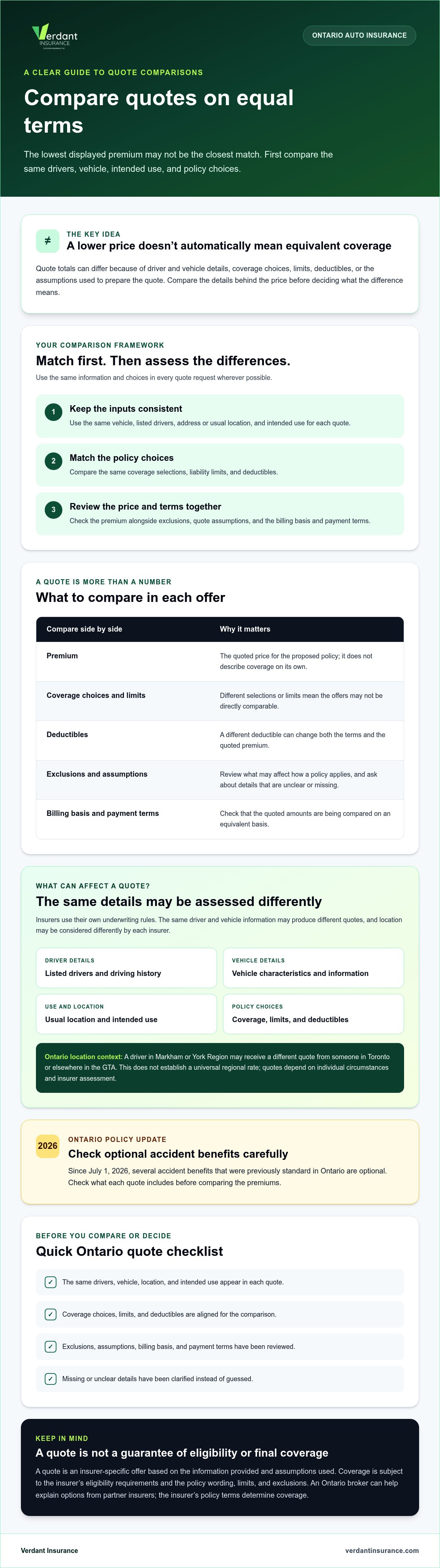
For a fair Ontario comparison, use the same driver details, vehicle, intended use, coverage choices, limits, and deductibles for each quote. Otherwise, a difference in premium may reflect different policy choices rather than a different price for equivalent coverage.
An insurance quote is an insurer-specific offer based on the information you provide and the assumptions used to prepare it. Insurers assess details under their own underwriting rules, so the same driver and vehicle may receive different quotes. Quote differences can reflect both risk details and coverage selections.
A search for “compare auto insurance rates Canada” may bring up broad information, but insurance requirements and coverage options are shaped by provincial systems. For background on vehicle insurance in Canada, including how provincial approaches differ, consult this overview. For a useful Ontario comparison, check what each quote actually includes.
What does an auto insurance rate comparison actually show?
The premium is the price quoted for the proposed policy. It doesn’t describe the coverage, limits, deductibles, exclusions, or conditions on its own. Review those details alongside the price to understand what each option offers. Also check whether the quotes use the same billing basis, so you’re comparing equivalent amounts and payment terms.
A quote isn’t proof of guaranteed eligibility or final coverage. The information may need to be confirmed, and coverage is subject to the insurer’s eligibility requirements and policy wording, limits, and exclusions. If an assumption is unclear, ask the insurer or broker to explain it before relying on the comparison.
Why the lowest displayed rate may not be the closest match
Two quotes may differ because one uses a different liability limit, deductible, or selection of optional coverage. For example, a quote with a higher deductible or fewer optional benefits may have a lower premium, but it isn’t directly comparable with a quote that has different terms. To compare prices fairly, first match the choices you want to assess.
Before ranking quotes by price, check that they reflect the same vehicle, drivers, use, coverage choices, limits, and deductibles. Then review exclusions and assumptions that could affect how a policy applies. If a quote leaves out a detail or uses information you didn’t provide, request clarification. This helps you understand what may be driving the price difference without treating the lowest figure as the closest fit.
How Ontario auto insurance quotes are calculated from your details
Insurers assess the information you submit using their own underwriting rules. As a result, the same driver and vehicle details may produce different quotes. To compare auto insurance rates Canada searchers find for Ontario coverage, start with accurate information and enter it consistently in each quote request.
Prepare details about the vehicle, its usual location, the drivers, and how it’s used. Depending on the quote process, you may be asked for the vehicle’s year, make, and model; information about listed drivers and their driving history; and whether the vehicle is used for personal, commuting, or other purposes. What each insurer requests and how it assesses the information can vary.
Which driver and vehicle details should you check?
Review every field before submitting a quote. Check that the same drivers, vehicle, address, and intended use appear in each application. Missing or inaccurate information can make quotes harder to compare and may affect how an insurer assesses your application. If you’re unsure why a question is being asked or how to answer it, ask the insurer or broker rather than guessing.
Accurate, consistent information makes quote comparisons more useful. It helps you distinguish differences in insurer assessment from differences caused by entering different details.
How Ontario location and insurer assessment can affect quotes
Insurers may consider location alongside driving history and vehicle characteristics. For example, a driver in Markham or elsewhere in York Region may receive a different quote from someone in Toronto or another part of the GTA. This doesn’t establish a universal regional rate. Insurers may assess location differently, and each quote depends on individual circumstances and the insurer’s approach.
The Financial Services Regulatory Authority of Ontario (FSRA) provides consumer information about Ontario auto insurance rates. Its guidance can help explain the provincial context. For questions about a specific quote, contact the insurer or broker. Location alone can’t tell you what a particular quote will be, since pricing and eligibility vary.
How to compare Ontario auto insurance quotes on equal terms
Use the same vehicle, drivers, intended use, coverage choices, limits, and deductibles for every quote. Then compare each premium alongside the terms it applies to. This makes it easier to assess auto insurance rates Canada search results may show while keeping the comparison focused on Ontario policy details.
A coverage label alone doesn’t tell you exactly what an option includes. Read the insurer’s description and policy documents, including the details of any optional coverage selections. The Insurance Bureau of Canada outlines standard and optional insurance coverages, but confirm what’s included in the specific quote you’re reviewing.
What should an Ontario auto insurance comparison table include?
Use the same rows for each insurer. Record the information shown on the quote, and mark anything missing as “confirm” rather than assuming the protection is included.
| Comparison item | Quote A | Quote B | Question to confirm |
|---|---|---|---|
| Quoted premium | Record amount and billing basis | Record amount and billing basis | Do both reflect the same period and details? |
| Coverage choices | List selected coverage | List selected coverage | Are the selections equivalent? |
| Limits | Record each stated limit | Record each stated limit | Are any limits different or unclear? |
| Deductibles | Record each applicable amount | Record each applicable amount | Do the amounts and terms match? |
| Exclusions and conditions | Note stated terms | Note stated terms | What restrictions should you understand? |
| Quote assumptions | Note drivers, vehicle, and use | Note drivers, vehicle, and use | Are the submitted details consistent? |
How to interpret differences in coverage and deductibles
A deductible is generally the amount you may have to pay toward an applicable claim, but the policy wording determines how it applies. Check the relevant section of each insurer’s documents rather than assuming similar labels mean identical terms.
Next, compare limits, exclusions, conditions, and optional selections. If one quote has a lower premium, check whether a coverage choice or deductible differs before treating it as a like-for-like price comparison. Actual protection depends on insurer eligibility, policy wording, limits, and exclusions. Ask the insurer or a licensed broker to clarify any terms you can’t match or interpret confidently.
A practical Ontario checklist for comparing auto insurance rates
A lower premium doesn’t automatically mean a quote offers equivalent coverage or suits your needs. Use this checklist to focus on the details behind the displayed price. It can help you compare auto insurance rates Canada search results bring up while assessing quotes for your Ontario situation.
Before requesting quotes: prepare consistent information
- Gather the details requested. Prepare accurate information about the drivers, vehicle, address, and how the vehicle is used. Use the same details for each quote request.
- Decide what you want to compare. Note the coverage choices, limits, and deductibles you want each quote to reflect. Keeping these consistent makes the results easier to assess.
- Answer questions accurately. Don’t omit or change information to try to influence a quote. If you’re unsure how to answer a question, ask the insurer or broker for guidance.
For general context, the guide Cheap Car Insurance Canada: Ultimate Buying Guide 2026 may also be useful. Treat any comparisons as a starting point, and check the details against the specific Ontario quotes and policy documents you’re reviewing.
After receiving quotes: verify the details that matter
- Check the information on every quote. Confirm that the listed drivers, vehicle, address, intended use, and selected coverage match what you submitted elsewhere.
- Compare terms, not just premiums. Review coverage choices, limits, deductibles, exclusions, conditions, and assumptions. A price difference may reflect different policy terms.
- Ask who underwrites the policy. Confirm which insurer is offering the quote and whom to contact with questions about eligibility, policy wording, or unclear details.
- Follow up on gaps. If information is missing, inconsistent, or difficult to interpret, request clarification before deciding. Don’t assume an unlisted benefit or term is included.
The related article Understanding Car Insurance Premiums: What Drives Costs? can offer more background when available. For a specific quote, the insurer’s assessment and policy wording, limits, and exclusions determine the terms of coverage.
When an Ontario insurance broker can help compare auto insurance rates
A broker can help you explore options from partner insurers and clarify how quotes differ. The broker isn’t the insurer. Each insurance company assesses the information, determines its offer, and sets the policy terms. A broker may be useful if a search for compare auto insurance rates Canada has led you to quotes you need help understanding for your Ontario circumstances.
Broker support can help you identify differences in coverage choices, limits, deductibles, or quote assumptions and decide what to ask next. Availability, pricing, and eligibility depend on the insurer and your circumstances. Final coverage is subject to the insurer’s assessment and the policy wording, limits, and exclusions.
What to ask a broker when quote details do not match
Bring the quotes or your comparison notes and ask which coverage choices, limits, deductibles, or assumptions differ. Confirm which insurer would provide each policy and where to review its wording. If a detail remains unclear, ask the broker to explain it or confirm the answer with the insurer before deciding whether the option suits your needs.
A broker can help you frame questions, but don’t rely on a label or summary alone to determine what a policy covers. Review the insurer’s documents and seek clarification on unanswered points before making a decision.
How Verdant supports Ontario auto insurance shoppers
Verdant Insurance is an Ontario insurance brokerage, not an insurance company or direct underwriter. Its online platform provides auto insurance quotes through partner insurers, and dedicated support is available to help customers understand their options. A Verdant broker can help explain quote differences and identify questions to raise with the insurer. Pricing, eligibility, availability, and final policy terms remain subject to the insurer’s assessment and documents.
Make your next Ontario quote comparison with confidence
To compare auto insurance rates Canada search results may offer, compare Ontario quotes on equal terms. Use consistent driver, vehicle, and usage details, then assess premiums alongside coverage choices, limits, deductibles, and policy conditions. A lower displayed price isn’t a reliable guide on its own if the quote reflects different selections.
Rates can also differ because insurers assess information under their own rules. Check each quote’s assumptions, and ask for clarification when details are missing or hard to understand. The insurer’s assessment and policy wording determine eligibility and final terms.
Verdant Insurance is an Ontario insurance brokerage, not an insurer. Its online platform helps customers obtain and manage policies through partner insurers, with dedicated support available to explain options. To explore auto insurance options in Ontario, start here:
A careful comparison can make your choices clearer. Take it one quote at a time, and ask questions until you understand the differences.
Frequently Asked Questions
How do I compare auto insurance rates in Ontario?
Compare quotes using the same drivers, vehicle, address, intended use, coverage choices, limits, and deductibles. Then review premiums alongside exclusions, conditions, and quote assumptions. For Ontario readers searching “compare auto insurance rates Canada,” check that each quote reflects equivalent choices before deciding what a price difference means. If a detail is missing or unclear, ask the insurer or broker to explain it.
Why are auto insurance quotes different for the same driver?
Quotes can differ because insurers assess submitted information under their own underwriting rules and may quote different policy terms. Driver history, location, vehicle characteristics, coverage selections, limits, and deductibles may all affect a quote, but their effect varies by insurer and individual circumstances. First check that the details and coverage match. If they do, ask what assumptions or terms may explain the remaining difference.
Does the lowest auto insurance quote provide the same coverage?
Not necessarily. A lower premium may reflect different coverage choices, limits, deductibles, exclusions, or quote assumptions. Compare the insurer’s documents rather than relying on a coverage label or price alone. Actual protection is subject to the insurer’s eligibility assessment and the policy wording, limits, and exclusions. If you can’t tell whether two options match, ask the insurer or broker to clarify before choosing.
What information do I need to compare auto insurance quotes?
Have accurate details about the vehicle, its usual location and intended use, and each driver you want included. You may also need information about driving history and the coverage choices you want quoted. Insurers can ask for different details, so answer each request accurately and consistently. If you’re unsure what a question means or how a detail is used, ask the insurer or broker instead of guessing.
Can an insurance broker compare auto insurance rates from different insurers?
Yes. An Ontario insurance broker can help you explore options from partner insurers and identify differences between quotes, such as coverage selections, limits, deductibles, or assumptions. A broker isn’t the insurer and doesn’t set the insurer’s final price or policy terms. Pricing, availability, and eligibility depend on the insurer’s assessment and your circumstances. Ask which insurer is offering each policy and where to review its wording.
How often should I compare auto insurance rates in Ontario?
Consider reviewing your options when your policy comes up for renewal and when a change in your circumstances may affect the information used for a quote. You can also compare when you want to check whether your current coverage choices still suit your needs. There’s no single comparison schedule for every driver. Keep details consistent, and confirm any change in price or terms with the insurer or broker.
Will comparing auto insurance quotes affect my credit score?
Don’t assume every quote process handles credit information the same way. Before submitting personal information, ask the insurer or broker whether requesting a quote involves a credit check and, if so, what type. This helps you understand the process before proceeding. If you’re comparing through more than one source, ask each one. For questions about how a check may affect your credit file, contact the credit reporting agency.


